Solution:
Concept: Lead sulphate and barium sulphate are insoluble white precipitates that do not dissolve on heating or in mineral acids. The concentrated acid can be picked out by its oxidising action on copper.
Step 1 — (a) Use lead nitrate solution.
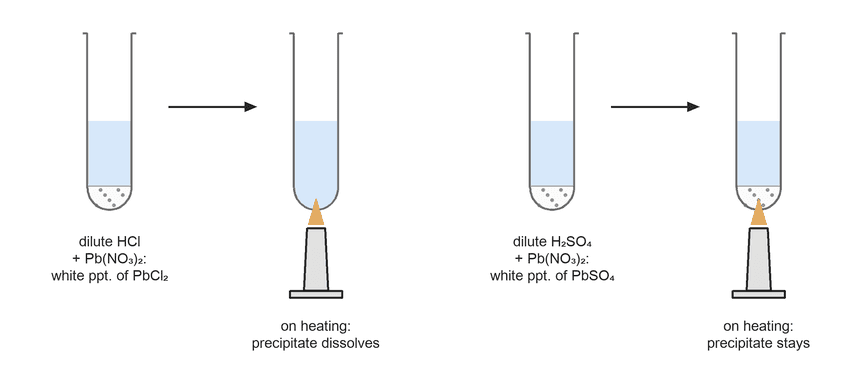
Add lead nitrate solution to each acid and warm. Dilute sulphuric acid gives a white precipitate of lead sulphate, which does not dissolve on heating:
Pb(NO3)2+H2SO4→PbSO4↓+2HNO3
Dilute hydrochloric acid gives a white precipitate of lead chloride, which dissolves on heating:
Pb(NO3)2+2HCl→PbCl2↓+2HNO3
Step 2 — (b) Use copper turnings.
Add copper turnings to each acid and heat. The conc. acid gives sulphur dioxide (it turns acidified potassium dichromate paper from orange to green) and the solution turns blue; the dilute acid shows no reaction:
Cu+2H2SO4→CuSO4+SO2↑+2H2O
Step 3 — (c) Use barium chloride solution.
Add barium chloride solution to each acid. Dilute sulphuric acid gives a white precipitate of barium sulphate, insoluble in dilute HCl or HNO3; dilute hydrochloric acid gives no precipitate:
BaCl2+H2SO4→BaSO4↓+2HCl

Watch out: In (a) both acids give a white precipitate at first; only heating tells them apart.
Therefore, (a) the precipitate with H₂SO₄ stays on heating, while that with HCl dissolves; (b) only the conc. acid gives SO₂ with copper; (c) only H₂SO₄ gives a white precipitate with BaCl₂.
