Solution:
Concept: Look at what happens to the other reactant in each reaction: water removed (B), oxygen given to it with SO2 formed (D), a volatile acid driven out (C), or an ordinary acid–base reaction (A).
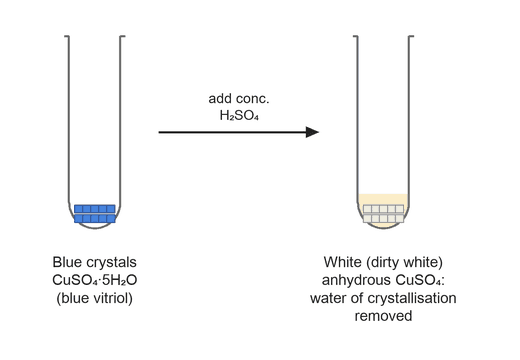
Step 1 — (a) Blue vitriol.
Conc. H2SO4 removes the water of crystallisation, and the blue crystals turn dirty white. This is B, dehydrating agent.
Step 2 — (b) Sulphur.
Sulphur gains oxygen and becomes SO2, while the acid is reduced to SO2. This is D, oxidising agent.
Step 3 — (c) Sodium nitrate.
The volatile acid HNO3 is driven out of sodium nitrate below 200 °C. This is C, non-volatile acid.
Step 4 — (d) Magnesium oxide.
Magnesium oxide is a basic oxide: acid + base → salt + water. This is A, dilute acid (typical acid).
Step 5 — (e) Zinc with the concentrated acid.
Zinc with the conc. acid gives SO2, not hydrogen. The acid is reduced, which shows its oxidising action. This is D, oxidising agent. With the dilute acid, zinc would give hydrogen instead:
Zn+H2SO4→ZnSO4+H2↑
Watch out: The same metal can show two different properties: zinc with the dilute acid shows A, but with the hot concentrated acid it shows D.
Note: the stem says “(i) to (v)”, but the reactions are labelled (a) to (e).
Therefore, (a) B; (b) D; (c) C; (d) A; (e) D.
