
Opening your dashboard
Class 10 Biology Chapter 5: Transpiration Solutions
45 textbook questions with step-by-step answers, free to read, for ICSE 2026-27.
Get talked through Ch 5, not just shown the answer
Reading a finished solution is not the same as being able to do it. The AI tutor takes one question at a time and works it with you, in your own words, until you can.
- Ask it out loud, in your own words
- It gives you the next step, not the answer
- Stuck on part (ii)? Start there
45 questions with solutions
1–12 marks · Mixed difficulty
- 11 mark
Question 1
Transpiration is best defined as (tick-mark the correct option).
Solve with AIAnswer
(A) loss of water from the plant.
- Correct
(B) loss of water as vapour from the plants.
(C) evaporation of water from the surface of leaves.
Answer: (B) loss of water as vapour from the plants.
Concept: transpiration is the loss of water in the form of water vapour from the leaves and other aerial parts of the plant.
Step 1 — List what a good definition needs.
Two points must appear: the water leaves as vapour, and it leaves from the aerial parts of the plant (leaves, and also stems).
Step 2 — Test the options.
Only option (B) says "as vapour" and speaks of the plant as a whole, so it is the best definition.
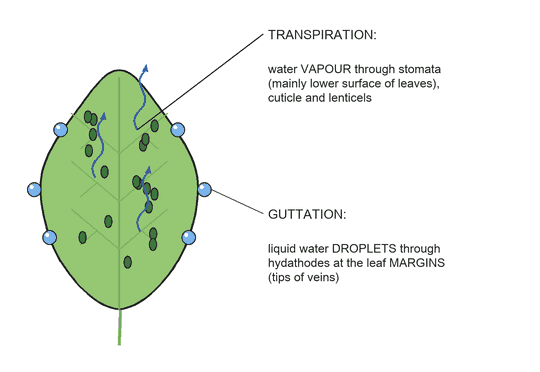
Watch out: Loss of water as liquid drops (guttation, bleeding) is not transpiration.
Why the other options are wrong:
- (A) loss of water from the plant: it is too broad: a plant also loses liquid water in guttation and bleeding, and that is not transpiration.
- (C) evaporation of water from the surface of leaves: it is too narrow: most vapour leaves through the stomata, and some leaves from stems through the cuticle and lenticels, not only from the surface of leaves.
Therefore, transpiration is best defined as the loss of water as vapour from the plants, option (B).
- 22 marks
Question 2
In one of the experiments to demonstrate transpiration, we used cobalt chloride paper. What are the characteristics of this paper that suit the experiment?
Solve with AIWritten solution
Solution:
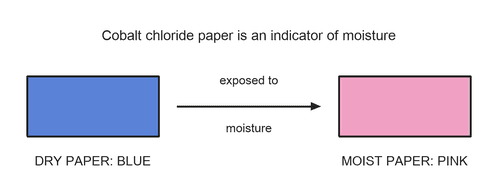
Concept: Cobalt chloride paper is an indicator of moisture: its colour shows whether water is present.
Step 1 — Colour change.
The paper is blue when dry and turns pink when exposed to moisture. So a change from blue to pink shows that the plant has given out water.
Step 2 — It must start dry.
We begin with a dry (blue) piece, so any pink colour that appears later can come only from the water vapour given out by the leaves.
Step 3 — How it is used.
The paper in the bell jar with the plant turns pink, while the paper in the control jar (no plant) stays blue. This proves that the plant gives out water vapour.
Watch out: The paper must be fully dry (blue) at the start, or the test means nothing.
Therefore, cobalt chloride paper suits the experiment because it is blue when dry and turns pink with moisture, so it shows the water vapour given out by the plant.
- 32 marks
Question 3
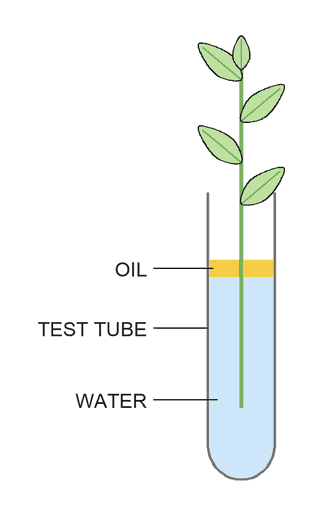
Look at the experiment shown in Fig. 5.4. Suppose you took a single flower with a long stalk dipping in water, instead of a leafy twig. Will it serve the purpose?
Yes/No. Give reason.
 Solve with AI
Written solution
Solution:
Concept: Most transpiration takes place through the stomata of the leaves. The set-up shows transpiration by a loss in weight, so the shoot must lose a measurable amount of water.
Step 1 — Compare the two shoots.
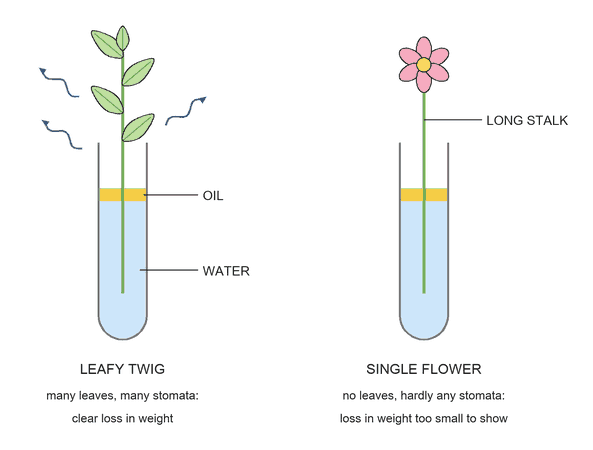
A single flower on a long stalk has no leaves, so it has hardly any stomata. A leafy twig has a large leaf surface with numerous stomata.
Step 2 — Predict the result.
The flower loses very little water, so the loss in weight of the test tube would be too small to notice. The leafy twig gives a clear loss in weight in a few hours.
Step 3 — Note the oil.
In both cases the oil layer stops evaporation from the water surface, so any loss in weight is due to the shoot alone.
Therefore, no: a single flower will not serve the purpose, because without leaves (and their stomata) it transpires too little to show a clear loss in weight.
- 41 mark
Question 4
Mention any two limitations in the use of potometers.
Solve with AIWritten solution
Solution:
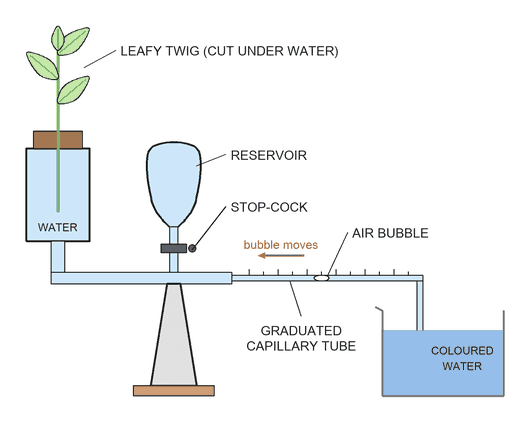
Concept: A potometer measures the rate of water uptake by a cut twig using a small air bubble moving in a capillary tube; both bring limitations.
Step 1 — List the limitations.
Any two of these:
- Introducing the air bubble into the capillary tube is not very easy.
- The twig may not remain fully alive for a long time.
- Any change in the outside air temperature may affect the position of the air bubble.
Step 2 — Remember what it really measures.
A potometer measures the water taken up by the cut shoot, not exactly the water lost in transpiration; some of the water taken up is used by the cells, for example in photosynthesis.
Therefore, two limitations are that the air bubble is not easy to introduce and that the cut twig may not stay fully alive for long (also, temperature changes shift the bubble).
- 52 marks
Question 5
From the following list, pick out the parts through which the water vapour of transpiration leaves the leaf and rearrange them in proper sequence.
Xylem vessels, mesophyll cells, stoma, intercellular space and substomatal space.
Solve with AIWritten solution
Solution:
Concept: Water reaches the leaf through the xylem, evaporates from the mesophyll cells, and then diffuses out, space by space, until it leaves through the stoma.
Step 1 — Xylem vessels.
The xylem vessels of the veins bring water into the tissues of the leaf.
Step 2 — Mesophyll cells.
The mesophyll cells give out some of this water as a thin film on their surfaces, and the film evaporates.
Step 3 — Intercellular space.
The vapour saturates the air in the intercellular spaces.
Step 4 — Substomatal space.
It collects in the substomatal space just inside the stoma.
Step 5 — Stoma.
Finally it escapes through the stoma into the outside air.
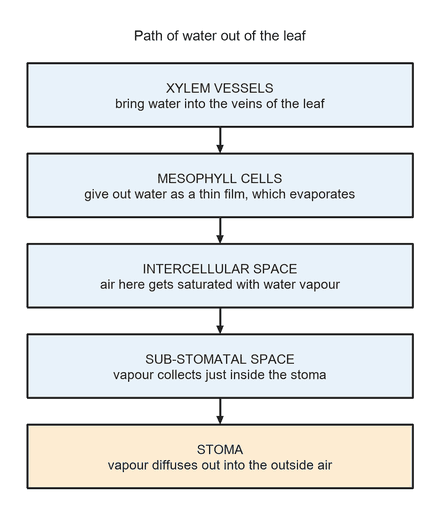
Watch out: All five parts in the list are used; only their order has to be corrected.
Therefore, the sequence is xylem vessels → mesophyll cells → intercellular space → substomatal space → stoma.
- 62 marks
Question 6
Does diffusion play a role in the passage of water vapour from the leaf during transpiration? If so, how ?
Solve with AIWritten solution
Solution:
Concept: diffusion is the movement of molecules from the region of their higher concentration to the region of their lower concentration. Water vapour behaves like any other gas.
Step 1 — Vapour builds up inside the leaf.
Water evaporates from the wet surfaces of the mesophyll cells. The vapour saturates the air in the intercellular spaces, so its concentration inside the leaf is high.
Step 2 — Vapour moves to the sub-stomatal space.
The vapour diffuses through the connecting intercellular spaces and reaches the sub-stomatal space.
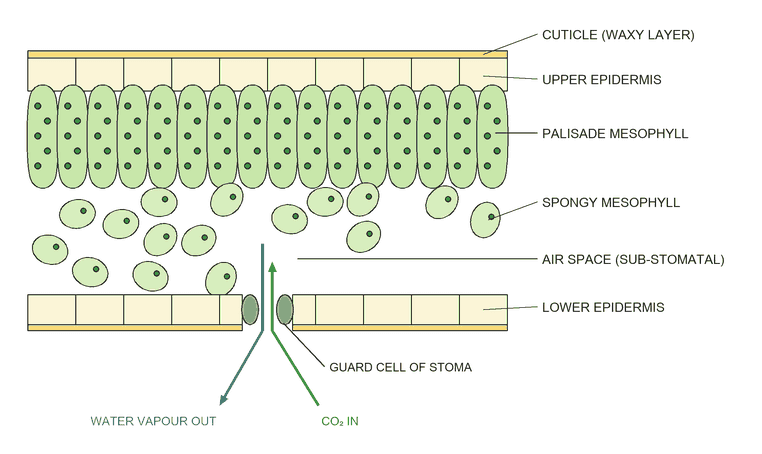
Step 3 — Vapour leaves through the stomata.
The outside air has less water vapour, so the vapour diffuses out through the stomata.
Therefore, yes: the whole passage of water vapour from the cell surfaces to the outside air is by diffusion, from its higher concentration inside the leaf to its lower concentration outside.
- 72 marks
Question 7
In any experiment to demonstrate transpiration, the leaf must remain attached to its parent plant. Why is this so?
Solve with AIWritten solution
Solution:
Concept: A leaf transpires normally only while it keeps receiving water, because only then do its guard cells stay turgid and its stomata open.
Step 1 — An attached leaf.
It keeps getting water from the plant through the xylem. Its guard cells stay turgid, the stomata remain open, and transpiration goes on at its normal rate, so the result is reliable.
Step 2 — A plucked leaf.
It gets no more water. Its water content falls, the guard cells turn flaccid and the stomata close. Transpiration soon stops, and the experiment would give a wrong result.
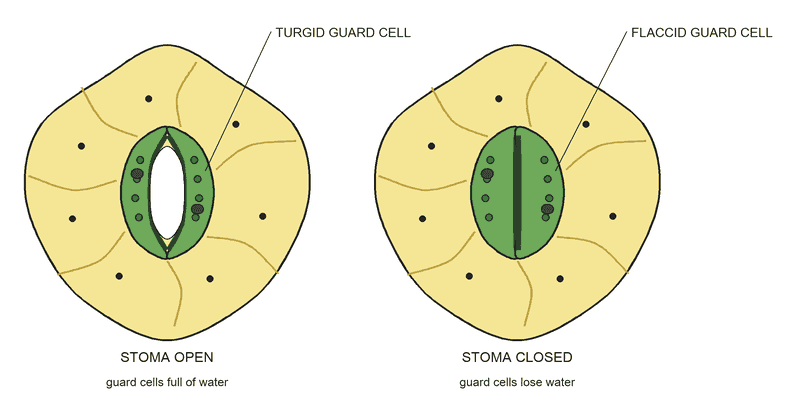
Therefore, the leaf must stay attached so that it keeps getting water, its stomata stay open and it transpires normally.
- 82 marks
Question 8
Out of the three kinds of transpiration, which one is maximum and which one is minimum?
(i) Maximum ..........
(ii) Minimum ..........
Solve with AIWritten solution
Solution:
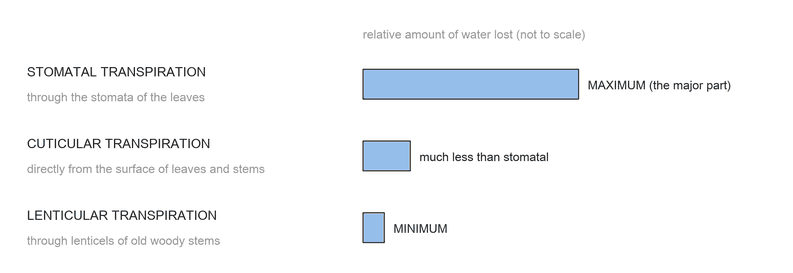
Concept: The three kinds of transpiration are stomatal, cuticular and lenticular. Most of the water is lost through the stomata; the other two lose very little.
Step 1 — Find the maximum.
Stomata are present in very large numbers on the leaves and are open during the day, so most water vapour escapes through them: stomatal transpiration is the maximum.
Step 2 — Find the minimum.
Lenticels are found only on the bark of older woody stems, and very little water evaporates through them: lenticular transpiration is the minimum.
Step 3 — Put them in order.
Cuticular transpiration is much less than stomatal but more than lenticular, so the order is stomatal > cuticular > lenticular.
Therefore, (i) maximum: stomatal transpiration; (ii) minimum: lenticular transpiration.
- 95 marks
Question 9
How will the following conditions affect transpiration ?
(i) Still air
(ii) Midday high temperature
(iii) Dry air
(iv) Dim sunlight
(v) Insufficient absorption of water by the roots
Solve with AIWritten solution
Solution:
Concept: Transpiration increases with anything that speeds up evaporation or keeps the stomata open, and decreases with anything that slows the outward diffusion of vapour or closes the stomata.
Step 1 — (i) Still air: decreases.
The vapour given out is not carried away, so the air just outside the leaf becomes saturated and the vapour diffuses out more slowly.
Step 2 — (ii) Midday high temperature: increases.
A higher temperature makes more water evaporate from the leaves, and warm air can hold more water vapour.
Step 3 — (iii) Dry air: increases.
Dry air has very little water vapour, so the vapour inside the leaf diffuses out quickly.
Step 4 — (iv) Dim sunlight: decreases.
In dim light, as on a cloudy day, the stomata are partly closed, so less vapour escapes.
Step 5 — (v) Too little water absorbed: decreases.
The water content of the leaves falls, the leaves wilt and the stomata close, which conserves water in the plant.

Watch out: Humid or still air lowers transpiration; dry or moving air raises it.
Therefore, transpiration decreases in (i) still air, (iv) dim sunlight and (v) poor water absorption, and increases at (ii) high midday temperature and in (iii) dry air.
- 101 mark
Question 10
List any three adaptations in plants to reduce transpiration.
Solve with AIWritten solution
Solution:
Concept: Plants of dry places have permanent adaptations that cut down the loss of water, mostly by protecting or reducing the stomata and the leaf surface.
Step 1 — Adaptations of the stomata.
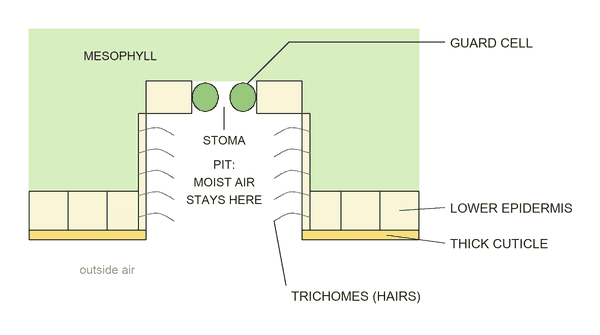
Sunken stomata, often covered by hairs (as in Nerium), keep moist air around the pore; and the number of stomata is reduced.
Step 2 — Adaptations of the leaf surface.
Thick cuticle (banyan, most evergreens); narrow leaves (Nerium); leaves that are rolled, folded or wavy.
Step 3 — Loss of leaves.
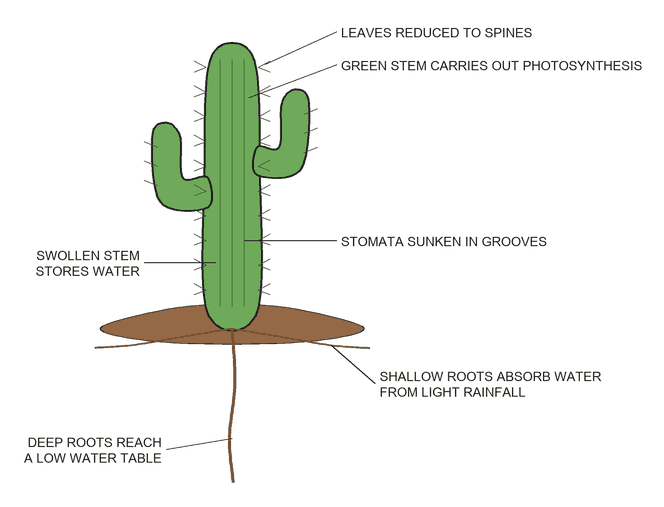
Leaves are dropped, absent or changed into spines, as in most cacti, where the green stem carries out photosynthesis.
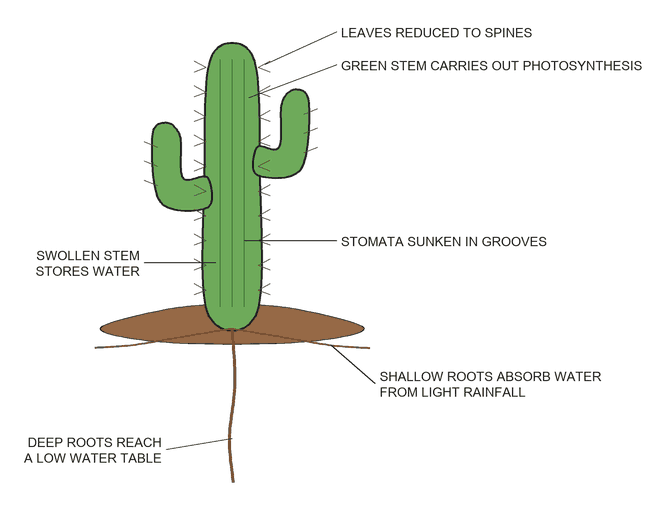
Therefore, any three of: sunken stomata, fewer stomata, thick cuticle, narrow or rolled leaves, and leaves reduced to spines.
- 111 mark
Question 11
List any four advantages of transpiration to the plant.
Solve with AIWritten solution
Solution:
Concept: Transpiration seems wasteful, but it gives the plant cooling, a suction force, and a way to distribute water and minerals.
Step 1 — Cooling effect.
Evaporation takes heat from the leaf, so it lowers the temperature of the leaf surface on hot sunny days.
Step 2 — Suction force.
Evaporation from the leaves produces a suction force acting from the top of the plant, which helps the ascent of sap.
Step 3 — More absorption by the roots.
This pull makes the roots absorb more water and mineral nutrients from the soil.
Step 4 — Distribution of water and minerals.
Leaves at the tips of all branches draw water towards them, so water and dissolved salts reach every part of the plant.

Therefore, four advantages are the cooling effect, the suction force for the ascent of sap, greater absorption by the roots, and distribution of water and mineral salts.
- 122 marks
Question 12
How would you justify the statement that transpiration contributes in bringing rain?
Solve with AIWritten solution
Solution:
Concept: Plants give out huge quantities of water vapour in transpiration, and this adds moisture to the atmosphere.
Step 1 — How much one plant loses.
A full-grown sunflower plant loses about half a litre of water a day, a single maize plant about 2 litres, and a large apple tree about 30 litres.
Step 2 — Many plants together.
Vast fields, and particularly forests, therefore release enormous amounts of water vapour into the air.
Step 3 — From vapour to rain.
This increases the moisture in the atmosphere. The vapour rises, cools and condenses into clouds, which bring rain.

Therefore, transpiration contributes to rain because the large amounts of water vapour given out by plants, especially forests, increase the moisture of the air, which condenses into rain clouds.
- 132 marks
Question 13
Differentiate between guttation and transpiration.
Solve with AIWritten solution
Solution:
Concept: Both processes remove water from the leaves, but in a different form, through different openings and at different times.
Step 1 — Compare point by point.
We place each point of difference on one row:
Guttation Transpiration Water is lost as liquid droplets. Water is lost as vapour. The water lost contains mineral salts in solution. Pure water changes into vapour. Through pores (hydathodes) at the ends of veins. Through stomata, lenticels and cuticle. Opening of hydathodes cannot be regulated. Stomatal transpiration is regulated by guard cells. Occurs at night or early morning, in humid conditions. Occurs mainly in sunlight, in dry conditions. Has no cooling effect. Cools the plant. 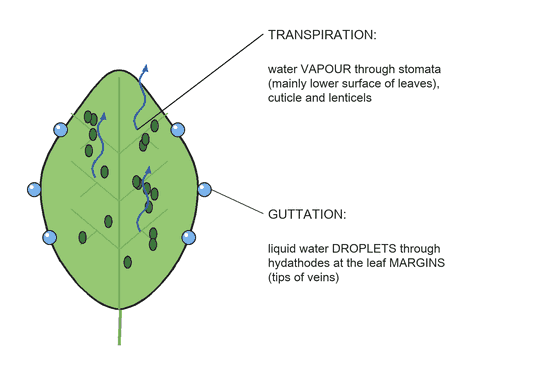
Therefore, guttation is loss of liquid water with salts through hydathodes, mostly at night, while transpiration is loss of water vapour through stomata, cuticle and lenticels, mostly by day, which cools the plant.
- 142 marks
Question 14
Plants have no blood, yet we sometimes say that a plant is "bleeding". How do you justify this ?
Solve with AIWritten solution
Solution:
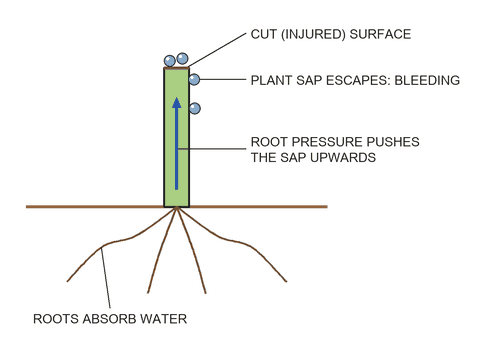
Concept: bleeding in plants means the escape of plant sap from a cut or injured surface.
Step 1 — Compare with an animal.
When an animal is wounded, blood flows out of the cut. In the same way, when a plant is cut or injured, its sap escapes ("bleeds") from the cut surface. The word is borrowed from animals, although the fluid is sap and not blood.
Step 2 — What pushes the sap out.
The root pressure of the plant pushes the sap up and out of the cut.
Step 3 — What kind of water loss it is.
Bleeding happens only because of injury. It is a form of exudation, because the fluid is lost as a liquid, not as vapour.
Therefore, we say a plant 'bleeds' because sap, pushed by root pressure, flows out of a cut or injured surface just as blood flows from a wound.
- 151 mark
Question 15
The process of evaporative loss of water from the aerial parts of plant is :
Solve with AIAnswer
(A) Ascent of sap
(B) Translocation
- Correct
(C) Transpiration
(D) Exudation
Answer: (C) Transpiration
Concept: transpiration is the loss of water in the form of water vapour from the leaves and other aerial parts of the plant.
Step 1 — Read the key words.
"Evaporative loss" means the water leaves as vapour, and "aerial parts" means the leaves and stems above the ground.
Step 2 — Match the definition.
Both points together are exactly the definition of transpiration.
Why the other options are wrong:
- (A) Ascent of sap: it is the upward movement of water through the stem; transpiration helps it, but it is not a loss of water.
- (B) Translocation: it is the movement of prepared food within the plant.
- (D) Exudation: it is the loss of water or other fluids directly in liquid form (guttation and bleeding), not by evaporation.
Therefore, evaporative loss of water from the aerial parts is transpiration, option (C).
- 161 mark
Question 16
The process of oozing out of the fluids from a plant part is :
Solve with AIAnswer
(A) Transpiration
(B) Excretion
(C) Transportation
- Correct
(D) Exudation
Answer: (D) Exudation
Concept: To exude means to ooze out. The loss of water or other fluids, with dissolved substances, directly in liquid form is exudation.
Step 1 — Read the key word.
The fluid "oozes out", so it leaves as a liquid, not as vapour.
Step 2 — Name the process.
Loss of fluid in liquid form is exudation; it happens as guttation (droplets at the leaf margins) and bleeding (sap from a cut part).
Why the other options are wrong:
- (A) Transpiration: it is the loss of water as vapour, not as an oozing fluid.
- (B) Excretion: it is the removal of unwanted metabolic wastes by an organism.
- (C) Transportation: it is the movement of substances within the plant, not out of it.
Therefore, oozing out of fluids from a plant part is exudation, option (D).
- 171 mark
Question 17
Transpiration occurs :
Solve with AIAnswer
(A) More from adaxial surface of a monocot leaf
(B) More from adaxial surface of a dicot leaf
(C) Equal from both the surfaces of a dicot leaf
- Correct
(D) More from abaxial surface of a dicot leaf
Answer: (D) More from abaxial surface of a dicot leaf
Concept: Most transpiration is through stomata, and a dicot leaf has more stomata on its lower (abaxial) surface than on its upper (adaxial) surface.
Step 1 — Recall the terms.
Abaxial means the lower surface; adaxial means the upper surface.
Step 2 — Link stomata to water loss.
More stomata on the lower surface means more water vapour escapes from it.
Step 3 — Check with cobalt chloride paper.
Dry paper held against the lower surface turns pink much faster than paper on the upper surface.

Watch out: Do not mix up adaxial (upper) and abaxial (lower).
Why the other options are wrong:
- (A) More from adaxial surface of a monocot leaf: a monocot leaf has its stomata spread almost equally on both surfaces, so its upper surface does not lose more.
- (B) More from adaxial surface of a dicot leaf: the upper surface of a dicot leaf has fewer stomata, so it loses less water, not more.
- (C) Equal from both the surfaces of a dicot leaf: the two surfaces of a dicot leaf have unequal numbers of stomata, so they do not transpire equally.
Therefore, transpiration occurs more from the abaxial surface of a dicot leaf, option (D).
- 181 mark
Question 18
Guttation takes place through :
Solve with AIAnswer
(A) Stomata
(B) Lenticels
- Correct
(C) Hydathodes
(D) Cuticle
Answer: (C) Hydathodes
Concept: hydathodes are special pores on the leaf margins, at the tips of the veins. In guttation water is forced out through them as droplets.
Step 1 — Why water is pushed out.
In warm, humid conditions transpiration is hampered, but the roots keep absorbing water.
Step 2 — Where it comes out.
The pressure that builds up forces the extra water out through the hydathodes as droplets.

Why the other options are wrong:
- (A) Stomata: stomata let out water vapour (stomatal transpiration), not droplets.
- (B) Lenticels: lenticels are openings on the bark of older stems for gases and a little transpiration.
- (D) Cuticle: the cuticle is a waxy layer from which a little water evaporates (cuticular transpiration).
Therefore, guttation takes place through hydathodes, option (C).
- 191 mark
Question 19
The apparatus used to measure the rate of transpiration is :
Solve with AIAnswer
(A) Barometer
(B) Clinostat
(C) Manometer
- Correct
(D) Potometer
Answer: (D) Potometer
Concept: A potometer measures the rate of water uptake by a plant, which is almost equal to the water lost in transpiration.
Step 1 — Set it up.
A cut twig is fixed in the water-filled apparatus, and an air bubble is introduced into the graduated capillary tube.
Step 2 — Read the rate.
As the twig transpires it draws water in, and the bubble moves along the scale. The distance moved in a given time gives the rate.
Why the other options are wrong:
- (A) Barometer: it measures atmospheric pressure.
- (B) Clinostat: it is used in experiments on the growth movements (tropisms) of plants.
- (C) Manometer: it measures the pressure of a liquid or gas, such as root pressure.
Therefore, the apparatus to measure the rate of transpiration is the potometer, option (D).
- 201 mark
Question 20
Which of the following is an external factor affecting the rate of transpiration ?
Solve with AIAnswer
(A) Number of stomata
(B) Exposed surface
- Correct
(C) Humidity
(D) Sunken stomata
Answer: (C) Humidity
Concept: external factors belong to the plant's surroundings: sunlight, temperature, wind, humidity, carbon dioxide and atmospheric pressure. Internal factors belong to the plant itself.
Step 1 — Classify humidity.
Humidity is the amount of water vapour in the outside air, so it is a condition of the surroundings.
Step 2 — See its effect.
High humidity slows the outward diffusion of water vapour through the stomata, so transpiration decreases.

Why the other options are wrong:
- (A) Number of stomata: the number of stomata is a feature of the plant itself (internal).
- (B) Exposed surface: the exposed leaf surface is also a feature of the plant.
- (D) Sunken stomata: sunken stomata are a structural adaptation of the plant.
Therefore, humidity is the external factor, option (C).
- 211 mark
Question 21
The upper layer of mesophyll in a leaf consists of elongated ground tissue called :
Solve with AIAnswer
(A) Spongy parenchyma
- Correct
(B) Palisade cells
(C) Xylem cells
(D) Phloem cells
Answer: (B) Palisade cells
Concept: The mesophyll of a leaf has two layers: the upper palisade mesophyll of elongated cells and the lower spongy mesophyll of loosely arranged cells.
Step 1 — Look at the upper layer.
In a vertical section the cells just below the upper epidermis are long and stand side by side like pillars.
Step 2 — Name them.
These elongated cells of the upper mesophyll are the palisade cells.
Why the other options are wrong:
- (A) Spongy parenchyma: it forms the lower part of the mesophyll, with loosely arranged cells and air spaces.
- (C) Xylem cells: they are conducting cells in the veins, not mesophyll.
- (D) Phloem cells: they are also conducting cells of the veins, not mesophyll.
Therefore, the elongated upper mesophyll is made of palisade cells, option (B).
- 221 mark
Question 22
Transpiration is significant for all except :
Solve with AIAnswer
(A) Cooling effect
(B) Suction pull
(C) Ascent of sap
- Correct
(D) Translocation of food
Answer: (D) Translocation of food
Concept: The main uses of transpiration are cooling, a suction force and distributing water. Movement of food is not one of them.
Step 1 — List what transpiration does.
Evaporation from the leaves cools the leaf surface and produces a suction force from the top of the plant, which draws water up the stem (ascent of sap).
Step 2 — Find the odd one out.
Prepared food moves through the phloem by a separate process (translocation), so transpiration is not significant for it.

Watch out: The question asks for the exception, the one transpiration does not help.
Why the other options are wrong:
- (A) Cooling effect: it is a use of transpiration: evaporation lowers the leaf temperature.
- (B) Suction pull: it is produced by transpiration.
- (C) Ascent of sap: it is helped by the suction pull of transpiration.
Therefore, transpiration is significant for all except translocation of food, option (D).
- 231 mark
Question 23
Hydathodes are located on :
Solve with AIAnswer
(A) At the petiole
(B) Upper surface of leaves
(C) Lower surface of leaves
- Correct
(D) Margins of leaves
Answer: (D) Margins of leaves
Concept: hydathodes are pores on the margins of the leaf, at the tips of the veins.
Step 1 — Use guttation as the clue.
In guttation, droplets of water appear along the margins of the leaves in the early morning.
Step 2 — Locate the pores.
The droplets appear there because that is where the hydathodes are.
Why the other options are wrong:
- (A) At the petiole: the petiole is the leaf stalk; it has no hydathodes.
- (B) Upper surface of leaves: the upper surface is covered by cuticle and has a few stomata, not hydathodes.
- (C) Lower surface of leaves: the lower surface has numerous stomata, not hydathodes.
Therefore, hydathodes are located on the margins of leaves, option (D).
- 241 mark
Question 24
When guard cells are flaccid, the stoma must be:
Solve with AIAnswer
(A) Open
(B) Neither open nor closed
- Correct
(C) Closed
(D) None of these
Answer: (C) Closed
Concept: A stoma is open when its two guard cells are turgid and closed when they are flaccid.
Step 1 — When guard cells turn flaccid.
If the water content of the leaf falls, the guard cells lose turgidity and become flaccid.
Step 2 — What happens to the pore.
Flaccid guard cells straighten and come together, so the pore closes and stomatal transpiration stops.

Why the other options are wrong:
- (A) Open: the stoma is open only when the guard cells are turgid.
- (B) Neither open nor closed: a stoma is either open or closed; flaccid guard cells close it.
- (D) None of these: option (C) is correct, so 'none of these' is wrong.
Therefore, when guard cells are flaccid the stoma is closed, option (C).
- 251 mark
Question 25
The following questions are Assertion-Reason based questions. Choose the answer based on the codes given below.
Assertion (A): Lenticels allow diffusion of gases for respiration.
Reason (R): Lenticels are located on the surface of older woody stems. They close during night time and open during the day for the process of transpiration.
Solve with AIAnswer
- Correct
(A) (1) A is True and R is False
(B) (2) A is False and R is True
(C) (3) Both A and R are True
(D) (4) Both A and R are False
Answer: (A) (1) A is True and R is False
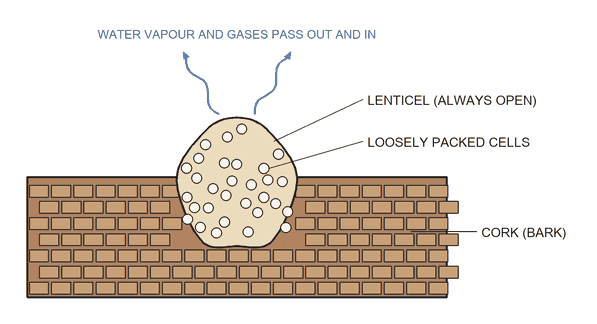
Concept: lenticels are openings on the bark of older woody stems. They are never closed; only stomata open and close (by their guard cells).
Step 1 — Judge A.
Lenticels allow diffusion of gases for respiration. A is true.
Step 2 — Judge R.
Its first part is right: lenticels are on older woody stems. But lenticels do not close at night and open by day; they stay open all the time. R is false.
Watch out: A Reason that is partly true is still a false Reason.
Why the other options are wrong:
- (B) (2) A is False and R is True: it says A is false, but A is true.
- (C) (3) Both A and R are True: it says R is true, but R is false.
- (D) (4) Both A and R are False: it says A is false, but A is true.
Therefore, A is true and R is false, option (A).
- 261 mark
Question 26
The following questions are Assertion-Reason based questions. Choose the answer based on the codes given below.
Assertion (A): Transpiration decreases the amount of moisture in the atmosphere.
Reason (R): Forests contribute in bringing rain because of transpiration.
Solve with AIAnswer
(A) (1) A is True and R is False
- Correct
(B) (2) A is False and R is True
(C) (3) Both A and R are True
(D) (4) Both A and R are False
Answer: (B) (2) A is False and R is True
Concept: Transpiration adds water vapour to the air, so it increases atmospheric moisture and helps bring rain.
Step 1 — Judge A.
A says transpiration decreases the moisture in the atmosphere, the opposite of what happens. A is false.
Step 2 — Judge R.
Forests give out huge amounts of water vapour by transpiration (a large apple tree alone may lose about 30 litres a day), so they help bring rain. R is true.

Why the other options are wrong:
- (A) (1) A is True and R is False: it says A is true, but A is false.
- (C) (3) Both A and R are True: it says A is true, but A is false.
- (D) (4) Both A and R are False: it says R is false, but R is true.
Therefore, A is false and R is true, option (B).
- 271 mark
Question 27
The following questions are Assertion-Reason based questions. Choose the answer based on the codes given below.
Assertion (A): Nerium leaves have sunken stomata covered by trichomes.
Reason (R): Nerium is a hydrophytic plant which gets rid of excessive water through the process of transpiration.
Solve with AIAnswer
- Correct
(A) (1) A is True and R is False
(B) (2) A is False and R is True
(C) (3) Both A and R are True
(D) (4) Both A and R are False
Answer: (A) (1) A is True and R is False
Concept: Sunken stomata covered by hairs are an adaptation to reduce transpiration, as in Nerium (oleander), a plant of dry places.
Step 1 — Judge A.
Nerium leaves have sunken stomata covered by hairs (trichomes). A is true.
Step 2 — Judge R.
Nerium is not a hydrophytic (water) plant and does not try to get rid of water; its sunken stomata, hairs and narrow leaves cut down water loss. R is false.
Why the other options are wrong:
- (B) (2) A is False and R is True: it says A is false, but A is true.
- (C) (3) Both A and R are True: it says R is true, but R is false.
- (D) (4) Both A and R are False: it says A is false, but A is true.
Therefore, A is true and R is false, option (A).
- 281 mark
Question 28
The following questions are Assertion-Reason based questions. Choose the answer based on the codes given below.
Assertion (A): Transpiration helps in the descent of sap by producing a suction force acting from the top of a plant.
Reason (R): Transpiration is the evaporative loss of water through the aerial parts (leaves, stems) of a plant. However, this loss holds much significance for the plant.
Solve with AIAnswer
(A) (1) A is True and R is False
- Correct
(B) (2) A is False and R is True
(C) (3) Both A and R are True
(D) (4) Both A and R are False
Answer: (B) (2) A is False and R is True
Concept: The suction force of transpiration acts from the top of the plant and helps the ascent (upward movement) of sap.
Step 1 — Judge A.
A speaks of the "descent" of sap. Transpiration pulls water up the stem, not down. A is false.
Step 2 — Judge R.
Transpiration is the evaporative loss of water from the aerial parts, and it matters a great deal to the plant (cooling, suction force, distribution of water). R is true.
Watch out: Ascent means upward; descent means downward.
Why the other options are wrong:
- (A) (1) A is True and R is False: it says A is true, but A is false.
- (C) (3) Both A and R are True: it says A is true, but A is false.
- (D) (4) Both A and R are False: it says R is false, but R is true.
Therefore, A is false and R is true, option (B).
- 298 marks
Question 29
Name the following :
(a) Openings on the stem through which transpiration occurs.
(b) The process by which the intact plant loses water in the form of droplets.
(c) An instrument used to find the rate of transpiration.
(d) A plant in which the stomata are sunken.
(e) The apparatus to record the rate of transpiration in a cut shoot.
(f) Any two parts of a leaf which allow transpiration.
(g) The structure in a leaf that allows guttation.
(h) Loss of water as droplets from the margins of certain leaves.
Solve with AIWritten solution
Solution:
Concept: Each part asks for one technical term of the chapter. The clue words are "stem", "droplets", "rate", "sunken" and "margins".
Step 1 — (a) Openings on the stem.
Minute openings on old woody stems, always open, through which lenticular transpiration occurs: lenticels.
Step 2 — (b) An intact plant losing droplets.
Loss of liquid water as droplets from an uninjured plant, through the hydathodes: guttation.
Step 3 — (c) Instrument for the rate of transpiration.
It measures the rate of water uptake, which is almost equal to the water lost: the potometer.
Step 4 — (d) A plant with sunken stomata.
Nerium (oleander); its sunken, hairy stomata reduce transpiration.
Step 5 — (e) Apparatus for a cut shoot.
A cut twig is fixed in it and an air bubble moves along a graduated capillary: a potometer (for example, Ganong's potometer).
Step 6 — (f) Two parts of a leaf that allow transpiration.
The stomata (stomatal transpiration) and the cuticle (cuticular transpiration).
Step 7 — (g) Structure that allows guttation.
Pores on the leaf margins at the tips of the veins: hydathodes.
Step 8 — (h) Droplets from the margins of certain leaves.
Guttation, common in banana, nasturtium and strawberry growing in warm, humid conditions.
Watch out: (c) and (e) have the same answer; (e) asks for the apparatus used with a cut shoot, which is Ganong's potometer.
Therefore, (a) lenticels, (b) guttation, (c) potometer, (d) Nerium, (e) Ganong's potometer, (f) stomata and cuticle, (g) hydathodes, (h) guttation.
- 303 marks
Question 30
Fill in the blanks :
(a) Transpiration is the loss of water as water .......... from the .......... parts of the plant.
(b) Closing of .......... and shedding of leaves reduce ..........
(c) Transpiration helps in creating .......... force and in removing excess ..........
Solve with AIWritten solution
Solution:
Concept: The blanks test the definition of transpiration, how a plant reduces it, and what it is used for.
Step 1 — (a) The definition.
Transpiration is the loss of water as water vapour from the aerial parts of the plant.
Step 2 — (b) Reducing water loss.
Closing of stomata and shedding of leaves reduce transpiration, so water is conserved.
Step 3 — (c) Its uses.
Transpiration helps in creating suction force and in removing excess water.
Therefore, (a) vapour, aerial; (b) stomata, transpiration; (c) suction, water.
- 314 marks
Question 31
Given below is an example of a certain structure and its special functional activity :
chloroplasts and photosynthesis.
In a similar way, write the functional activity against each of the following :
(a) Hydathodes and ..........
(b) Leaf spines and ..........
(c) Lenticels and ..........
(d) Xylem and ..........
Solve with AIWritten solution
Solution:
Concept: Just as chloroplasts carry out photosynthesis, each structure here has one special activity linked to water or gases.
Step 1 — (a) Hydathodes.
They are pores on the leaf margins through which water is forced out as droplets, so their activity is guttation.
Step 2 — (b) Leaf spines.
When leaves are changed into spines, as in most cacti, the surface that can lose water becomes very small: reduction of transpiration.

Step 3 — (c) Lenticels.
These always-open pores on the bark of older stems carry out diffusion of gases for respiration (and a little lenticular transpiration).
Step 4 — (d) Xylem.
Xylem vessels carry water and dissolved minerals from the roots to the leaves: conduction of water upwards.
Therefore, (a) guttation, (b) reduction of transpiration, (c) exchange of gases for respiration, (d) conduction of water.
- 327 marks
Question 32
(a) State whether the following statements are True (T) or False (F).
(i) Most transpiration occurs at midnight. (T/F)
(ii) Transpiration creates a pull for upward movement of the sap. (T/F)
(iii) Wind velocity has an effect on transpiration. (T/F)
(iv) Atmospheric humidity promotes transpiration from a green plant. (T/F)
(v) Transpiration helps to cool the body of the plant. (T/F)
(b) Rewrite the false statements, in (a) above, in the correct form.
Solve with AIWritten solution
Solution:
Concept: Transpiration is highest by day, in warm, dry, moving air. It cools the plant and creates a pull that draws sap upwards.
Step 1 — (a)(i) Most transpiration at midnight: False.
At midnight the stomata are closed and it is cool, so transpiration is very low.
Step 2 — (a)(ii) Transpiration pulls sap up: True.
Evaporation from the leaves produces a suction force at the top of the plant, which helps the ascent of sap.
Step 3 — (a)(iii) Wind affects transpiration: True.
Faster wind removes the vapour around the leaf more quickly, so transpiration increases.
Step 4 — (a)(iv) Humidity promotes transpiration: False.
Humid air slows the outward diffusion of water vapour, so it reduces transpiration.

Step 5 — (a)(v) Transpiration cools the plant: True.
Evaporation takes heat from the leaf and lowers its temperature.
Step 6 — (b) Rewrite the false statements.
(i) Most transpiration occurs during the day (around midday).
(iv) Atmospheric humidity reduces transpiration from a green plant.
Therefore, (a) (i) F, (ii) T, (iii) T, (iv) F, (v) T; (b) most transpiration occurs during the day, and humidity reduces transpiration.
- 335 marks
Question 33
Match the terms given in column A with column B:
Column A Column B (a) Hydathodes (i) Photosynthesis (c) Stomata (ii) Respiration (c) Cuticle (iii) Regulates opening and closing of stomata (d) Lenticels (iv) Reduces loss of water (e) Guard cells (v) Guttation Solve with AIWritten solution
Solution:
Concept: Match each structure with its main function. Start with the pairs you are sure of, then use what is left. (The second item is printed as "(c)" by a slip; it is item (b).)
Step 1 — Pairs that are certain.
Hydathodes are the pores through which water is exuded in guttation, so (a) goes with (v). Guard cells open and close the stoma, so (e) goes with (iii).
Step 2 — The remaining pairs.
The waxy cuticle prevents evaporation from the leaf surface, so (c) goes with (iv). Lenticels allow diffusion of gases for respiration, so (d) goes with (ii). That leaves stomata with (i): they open by day to let in the carbon dioxide needed for photosynthesis.
Step 3 — Write the matched table.
Putting the pairs together:
Column A Column B (a) Hydathodes (v) Guttation (b) Stomata (i) Photosynthesis (c) Cuticle (iv) Reduces loss of water (d) Lenticels (ii) Respiration (e) Guard cells (iii) Regulates opening and closing of stomata Watch out: Stomata also help in respiration, but (ii) is needed for lenticels, so stomata take (i).
Therefore, (a)–(v), (b)–(i), (c)–(iv), (d)–(ii), (e)–(iii).
- 345 marks
Question 34
Name these :
(a) Three kinds of transpiration.
(b) Three external factors which increase the rate of transpiration.
(c) Three intrinsic features which reduce the rate of transpiration.
(d) Three extrinsic factors which decrease the rate of transpiration.
(e) Four kinds of potometers on the basis of the name of scientists who discovered them.
Solve with AIWritten solution
Solution:
Concept: External (extrinsic) factors are conditions of the surroundings; intrinsic features belong to the plant itself.
Step 1 — (a) Three kinds of transpiration.
Stomatal, cuticular and lenticular transpiration.

Step 2 — (b) External factors that increase it.
High intensity of sunlight, high temperature and high velocity of wind. (Dry air and low atmospheric pressure also increase it.)
Step 3 — (c) Intrinsic features that reduce it.
Sunken stomata, fewer stomata and thick cuticle. (Narrow, rolled or folded leaves and leaves changed into spines also reduce it.)
Step 4 — (d) Extrinsic factors that decrease it.
High humidity, low temperature and still air. (Dim light or darkness also decreases it.)
Step 5 — (e) Four potometers named after scientists.
Ganong's, Farmer's, Darwin's and Garreau's potometers.
Watch out: In (b) and (d) give conditions of the surroundings, not features of the plant.
Therefore, (a) stomatal, cuticular, lenticular; (b) bright light, high temperature, strong wind; (c) sunken stomata, fewer stomata, thick cuticle; (d) high humidity, low temperature, still air; (e) Ganong's, Farmer's, Darwin's and Garreau's potometers.
- 3512 marks
Question 35
Define the following terms :
(a) Transpiration
(b) Exudation
(c) Potometer
(d) Wilting
(e) Hydathodes
(f) Cuticle
Solve with AIWritten solution
Solution:
Concept: A definition says what the thing is and what it does (or where it is found), in one precise sentence.
Step 1 — (a) Transpiration.
The loss of water in the form of water vapour from the leaves and other aerial parts of the plant, mainly through the stomata, and a little through the cuticle and lenticels.
Step 2 — (b) Exudation.
The loss of water or other fluids, with dissolved substances, directly in liquid form and not as vapour; it occurs as guttation and bleeding.
Step 3 — (c) Potometer.
A device that measures the rate of water uptake by a plant, which is almost equal to the water lost in transpiration.
Step 4 — (d) Wilting.
The drooping of leaves due to loss of turgidity of their cells, when transpiration is faster than the absorption of water by the roots (for example, balsam leaves at midday).
Step 5 — (e) Hydathodes.
Special pores on the margins of the leaf, at the tips of veins, through which water is exuded as droplets in guttation.
Step 6 — (f) Cuticle.
A waxy layer secreted by the epidermis on both surfaces of the leaf, which reduces evaporation from the leaf surface; the thicker the cuticle, the less the transpiration.
Therefore, the six terms are defined above, each by what it is and what it does.
- 366 marks
Question 36
Distinguish between the following pairs :
(a) Stomata and Lenticels
(b) Guttation and Bleeding
(c) Transpiration and Evaporation
Solve with AIWritten solution
Solution:
Concept: Compare each pair point by point: structure, location, and what is lost or exchanged.
Step 1 — (a) Stomata and lenticels.
We compare them on three points:
Stomata Lenticels Small pores surrounded by two bean-shaped guard cells; they open and close. Openings not surrounded by guard cells; they stay open all the time. Found mostly on the lower surface of leaves. Found on the bark of older woody stems. Exchange gases for photosynthesis and respiration; most transpiration. Exchange gases mainly for respiration; a little transpiration. 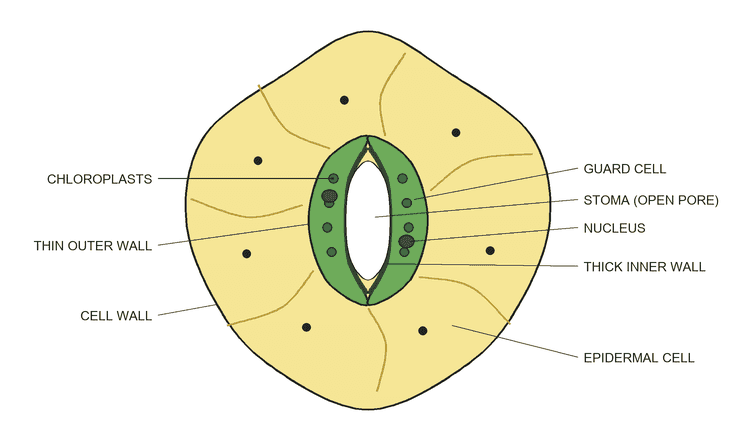
Step 2 — (b) Guttation and bleeding.
We compare where, what and when:
Guttation Bleeding From the leaf margins through hydathodes of uninjured plants. From any cut or injured part. Exudate is mainly water with some mineral salts. Exudate is mainly plant sap with sugars. Occurs in the early morning or late night. Occurs whenever the plant is injured. Step 3 — (c) Transpiration and evaporation.
We compare the source and the control:
Transpiration Evaporation Loss of water vapour from the aerial parts of a living plant. Loss of water vapour from any free water surface. A vital process, partly physical, controlled by the plant (stomata) and by the surroundings. A purely physical process, controlled only by the surroundings (temperature, humidity, wind). Comparatively slow. Comparatively fast. Therefore, the three pairs differ as shown in the tables: guard cells and location for (a), injury and exudate for (b), and living control for (c).
- 3712 marks
Question 37
Give reason/suitable explanation for each :
(a) Nerium loses less amount of water during transpiration.
(b) More transpiration occurs from the under surface of a dicot leaf.
(c) Transpiration increases with the velocity of wind.
(d) Leaves of some plants wilt during midday and recover in the evening.
(e) Guttation normally occurs during early mornings or late nights.
(f) Forests tend to bring more rains.
Solve with AIWritten solution
Solution:
Concept: Each reason comes from one of three things: the number and position of stomata, the difference in moisture between the leaf and the air, or the balance between water absorbed and water lost.
Step 1 — (a) Nerium loses less water.
Cause: Nerium has sunken stomata covered by hairs and narrow leaves.
Effect: the stomata are not directly exposed to the dry outside air and the leaf surface is small, so less vapour diffuses out.
Step 2 — (b) More transpiration from the under surface of a dicot leaf.
Cause: a dicot leaf has more stomata on its under surface.
Effect: most transpiration is stomatal, so more vapour escapes from that surface.
Step 3 — (c) Transpiration increases with wind velocity.
Cause: faster wind removes the vapour around the leaf quickly, so the air there does not get saturated.
Effect: the vapour keeps diffusing out fast, and transpiration increases.
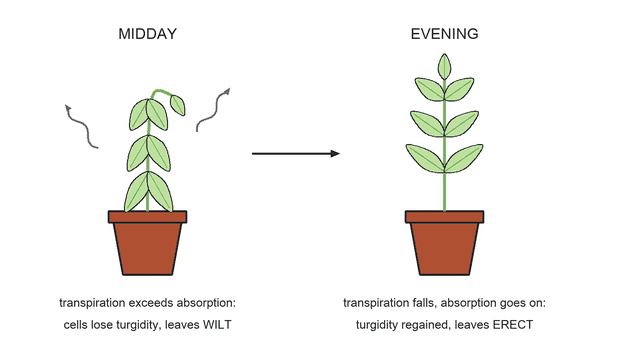
Step 4 — (d) Leaves wilt at midday and recover in the evening.
Cause: at midday transpiration is faster than absorption, even in moist soil.
Effect: the cells lose turgidity and the leaves wilt (e.g. balsam). In the evening the stomata close partly and it is cooler, so little water is lost; the cells regain turgidity and the leaves stand erect again.
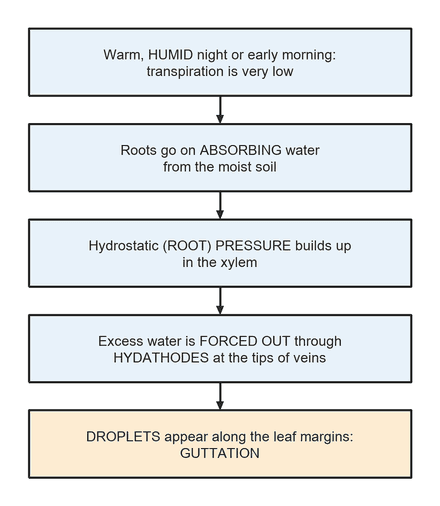
Step 5 — (e) Guttation in the early morning or late night.
Cause: the air is then humid, so transpiration is low, while the roots keep absorbing water.
Effect: pressure builds up in the plant and forces the extra water out through the hydathodes as droplets.
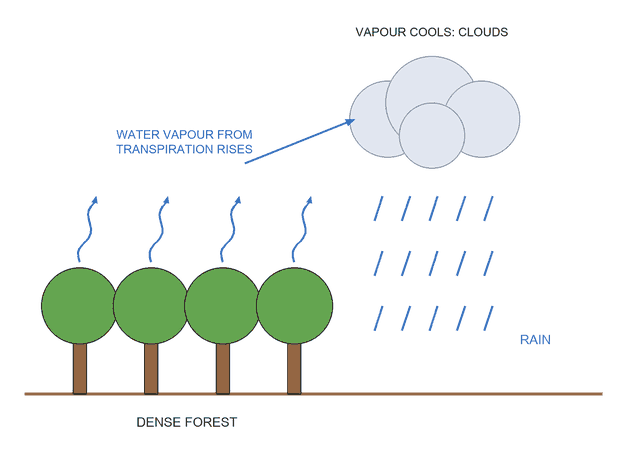
Step 6 — (f) Forests bring more rain.
Cause: forest trees give out huge quantities of water vapour by transpiration.
Effect: the air becomes moist, the vapour condenses into clouds, and more rain falls.
Watch out: In (d) wilting at midday happens even when the soil is wet; it is the rate of loss, not the lack of soil water.
Therefore, (a) sunken hairy stomata, (b) more stomata below, (c) vapour removed by wind, (d) loss exceeds absorption at midday but not in the evening, (e) low transpiration in humid air with continued absorption, (f) water vapour from transpiration brings rain.
- 384 marks
Question 38
The given figure represents an experiment :
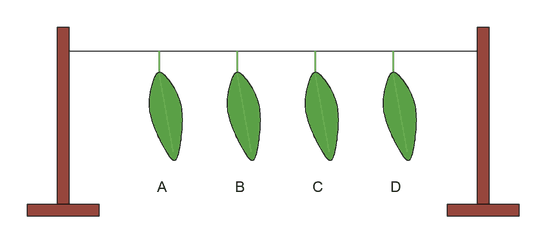
(a) Leaf A was coated with grease on both the surfaces.
(b) Leaf B was coated with grease on the lower surface.
(c) Leaf C was coated with grease on the upper surface.
(d) Leaf D was left without any application of grease.
All the four leaves A, B, C and D were left in a room for about 24 hours.
(i) Which leaf dries first ? Give reason.
(ii) Which leaf dries last ? Give reason
Solve with AIWritten solution
Solution:
Concept: Grease blocks the stomata, so a greased surface cannot transpire. A dicot leaf has more stomata on its lower surface, so the lower surface loses more water.
Step 1 — Work out how much each leaf can lose.
Leaf D (no grease) loses from both surfaces; leaf C (upper greased) loses from the lower surface, which has many stomata; leaf B (lower greased) loses from the upper surface, which has few; leaf A (both greased) can hardly lose water.
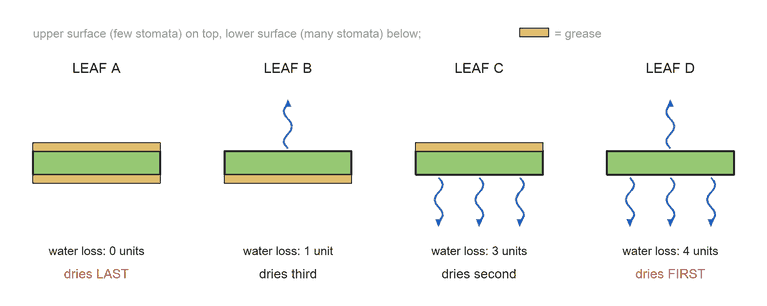
Step 2 — (i) The leaf that dries first.
Leaf D, because all its stomata on both surfaces are open, so it loses the most water.
Step 3 — (ii) The leaf that dries last.
Leaf A, because grease on both surfaces blocks all its stomata, so it loses hardly any water.
Watch out: Do not take B and C as equal: the lower surface has more stomata, so C dries before B.
Therefore, (i) leaf D dries first (no stomata blocked) and (ii) leaf A dries last (all stomata blocked); the full order is D, C, B, A.
- 3912 marks
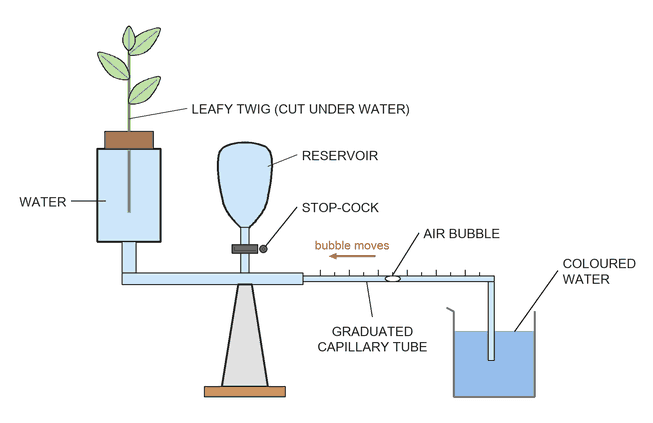
Question 39
Given below is the diagram of an apparatus used to study a particular phenomenon in plants :
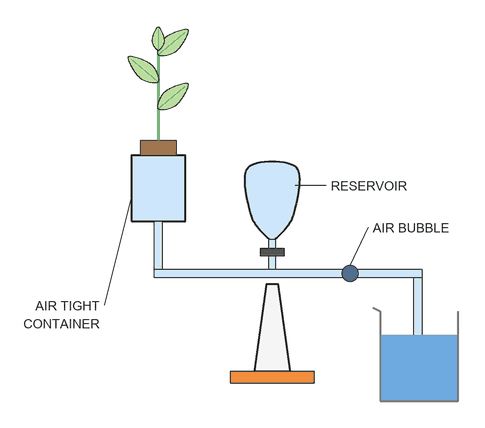
(a) Name the apparatus.
(b) What is it used for ?
(c) What is the role played by the air-bubble in this experiment ?
(d) What is the use of the reservoir ?
(e) What happens to the movement of the air-bubble if the apparatus is kept :
(i) in the dark; (ii) in sunlight; (iii) in front of a fan?
Give a reason in each case.
Solve with AIWritten solution
Solution:
Concept: As the twig transpires, it draws water through the capillary tube. The air bubble moves with this water and shows how fast the water is taken up.
Step 1 — (a) Name the apparatus.
It is Ganong's potometer.
Step 2 — (b) Its use.
It measures the rate of water uptake by a cut twig. This is almost equal to the water lost in transpiration, so it gives the rate of transpiration.
Step 3 — (c) Role of the air bubble.
The bubble is a marker (index). As the twig loses water, suction pulls water from the beaker and the bubble moves along the graduated tube, giving the volume of water taken up in a given time.
Step 4 — (d) Use of the reservoir.
Opening the stop-cock lets water from the reservoir into the tube, which pushes the bubble back to its starting point, so the experiment can be repeated.
Step 5 — (e) The bubble in three conditions.
We link each condition to the rate of transpiration:
(i) In the dark: the bubble moves very slowly or almost stops, because the stomata are closed and transpiration is very low.
(ii) In sunlight: the bubble moves faster, because the stomata are open and the warmth increases evaporation.
(iii) In front of a fan: the bubble moves faster, because moving air removes the vapour around the leaves, so they do not get saturated and transpiration increases.
Watch out: The bubble shows water taken up, which is only nearly equal to the water transpired.
Therefore, (a) Ganong's potometer; (b) rate of transpiration; (c) marker of water uptake; (d) resets the bubble; (e) slow in the dark, faster in sunlight and in front of a fan.
- 407 marks
Question 40
Given ahead is the diagram of an experimental set up to study the process of transpiration in plants. Study the same and then answer the questions that follow :

(a) Name the colour of dry cobalt chloride paper?
(b) Is the experimental leaf a monocot or a dicot? Give a reason to support your answer.
(c) Why are glass slides placed over the dry cobalt chloride papers?
(d) After about half an hour what change, if any, would you expect to find in the cobalt chloride paper placed on the dorsal and ventral sides of the leaf? Give a reason to support your answer.
Solve with AIWritten solution
Solution:
Concept: Cobalt chloride paper is blue when dry and pink when moist. A dicot leaf has more stomata on its lower surface, so that surface gives out more water vapour.
Step 1 — (a) Colour of dry paper.
Dry cobalt chloride paper is blue.
Step 2 — (b) Monocot or dicot.
The leaf is dicot: it is broad with reticulate (net-like) venation and is dorsiventral, with more stomata on its lower surface.
Step 3 — (c) Why glass slides are used.
The slides hold the papers against the leaf and keep out the moisture of the surrounding air, so any colour change is due only to vapour from the leaf.
Step 4 — (d) Change after half an hour.
The paper on the ventral (lower) side turns pink quickly; the paper on the dorsal (upper) side stays blue or turns pink much later. The reason is that the lower surface has many more stomata, so more transpiration takes place from it.

Watch out: Dorsal is the upper surface and ventral the lower surface of the leaf.
Therefore, (a) blue; (b) dicot, because of net venation; (c) to hold the paper and keep out air moisture; (d) the lower-side paper turns pink faster because the lower surface has more stomata.
- 418 marks
Question 41
An outline sketch of a tree is shown in a diagram below. Study the same and answer the questions that follow :
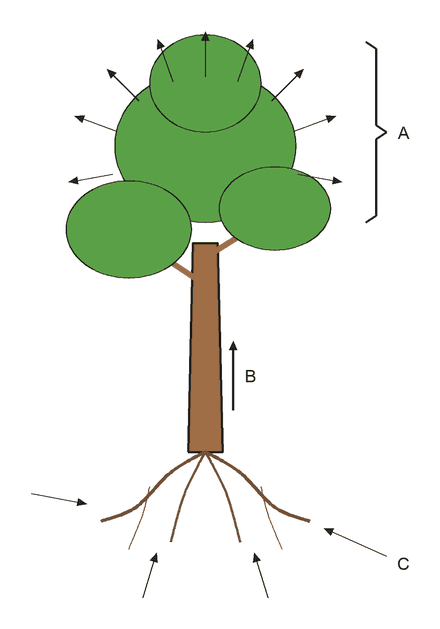
(a) Name and define the phenomenon labelled A in the diagram.
(b) Write the significance of the process mentioned in A for the plants.
(c) What do the direction of arrows in B and C indicate ? Name the phenomena.
(d) Draw a neat and labelled diagram of an opened stomata.
Solve with AIWritten solution
Solution:
Concept: The diagram shows the transpiration stream: water enters at the roots (C), passes up the trunk (B) and is lost from the leaves (A).
Step 1 — (a) Name and define A.
A is transpiration: the loss of water in the form of water vapour from the leaves and other aerial parts of the plant.
Step 2 — (b) Significance of A.
- Cooling effect: evaporation lowers the leaf temperature on hot days.
- Suction force: it pulls water up (ascent of sap) and helps the roots absorb water.
- Distribution of water and mineral salts to all parts of the plant.
Step 3 — (c) What B and C show.
B: the arrow points up the trunk, showing water rising through the xylem: ascent of sap.
C: the arrows point into the roots, showing water absorbed from the soil by osmosis: absorption of water.

Step 4 — (d) Draw an open stoma.
Draw two bean-shaped guard cells bulging outwards with a clear pore between their thick inner walls. Labels: guard cell, stoma (open pore), thick inner wall, thin outer wall, nucleus, chloroplasts, epidermal cell, cell wall.
Therefore, (a) A is transpiration; (b) cooling, suction and distribution of water; (c) B ascent of sap, C absorption of water by the roots; (d) the open stoma as drawn.
- 429 marks
Question 42
The figure given below represents an experimental set up with a weighing machine to demonstrate a particular process in plants. The experimental set up was placed in bright sunlight. Study the diagram and answer the following questions: (2014)
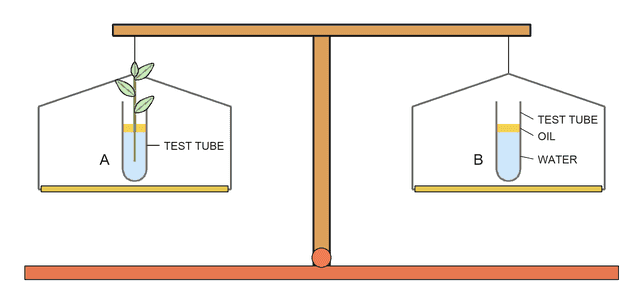
(a) Name the process intended for study.
(b) Define the above mentioned process.
(c) When the weight of the test tubes A and B is taken before and after the experiment, what change is observed ? Justify.
(d) What is the purpose of keeping the test tube B in the experimental set up?
(e) What is the purpose of putting oil in the test tube ?
Solve with AIWritten solution
Solution:
Concept: Only test tube A has a leafy shoot, so only A can lose water by transpiration. The oil stops evaporation in both tubes, and B is there for comparison.
Step 1 — (a) Name the process.
Transpiration.
Step 2 — (b) Define it.
Transpiration is the loss of water in the form of water vapour from the leaves and other aerial parts of the plant.
Step 3 — (c) Change in weight.
Test tube A loses weight; test tube B shows no change, so the pan with A rises. The shoot in A takes up water and gives it out as vapour through its leaves in the bright sunlight, while B has no shoot and its oil layer stops evaporation.
Step 4 — (d) Purpose of test tube B.
B is the control. It shows that the loss in weight of A is due to transpiration by the shoot and not to evaporation from the tube.
Step 5 — (e) Purpose of the oil.
The oil forms a layer over the water and prevents evaporation from the water surface, so any loss in weight is due to transpiration alone.
Therefore, (a) transpiration; (c) A becomes lighter, B does not change; (d) B is the control; (e) oil prevents evaporation from the water.
- 4311 marks
Question 43
An apparatus as shown below was set up to investigate a physiological process in plants. The setup was kept in sunlight for two hours. Droplets of water were then seen inside the bell jar. Answer the questions that follow : (2015)
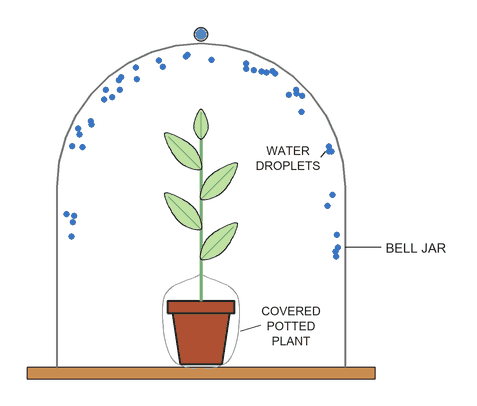
(a) Name the process being studied.
(b) Explain the process named above in (a).
(c) Why was the pot covered with a plastic sheet ?
(d) Suggest a suitable control for this experiment.
(e) Mention two ways in which this process is beneficial to plants.
(f) List three adaptations in plants to reduce the above mentioned process.
Solve with AIWritten solution
Solution:
Concept: The leaves give out water vapour, which condenses into droplets on the inner wall of the bell jar.
Step 1 — (a) Name the process.
Transpiration.
Step 2 — (b) Explain it.
Water absorbed by the roots rises through the stem to the leaves. It evaporates from the wet surfaces of the mesophyll cells into the intercellular spaces, and the water vapour diffuses out through the stomata. Inside the closed jar the air becomes saturated, and the vapour condenses into droplets on the cool glass.
Step 3 — (c) Why the pot is covered.
The plastic sheet stops water vapour escaping from the pot and soil, so the droplets can come only from the plant.
Step 4 — (d) A control.
A similar bell jar in the same sunlight without a plant (only a covered pot of soil). No droplets appear, which shows the water came from the plant.
Step 5 — (e) Two benefits.
Any two: the cooling effect on hot days; the suction force for the ascent of sap and absorption of water; the distribution of water and mineral salts.
Step 6 — (f) Three adaptations to reduce it.
Any three: sunken stomata covered by hairs (Nerium); fewer stomata; thick cuticle (banyan); narrow, rolled or folded leaves; leaves changed into spines (cactus).
Therefore, (a) transpiration; (c) to keep out vapour from the soil; (d) a jar without a plant; (e) cooling and suction force; (f) sunken stomata, thick cuticle, leaves reduced to spines.
- 448 marks
Question 44
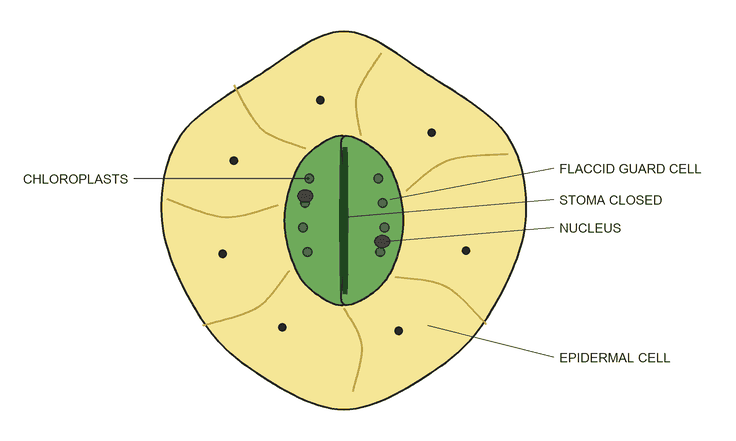
Given below is the figure of a stoma. Study the same and answer the following questions :

(a) Label the guidelines A and B.
(b) Write the exact location of the above mentioned structures.
(c) Mention one important role of structure A.
(d) Write three important roles of structure B.
(c) Redraw the same figure when structures A are in flaccid condition. When does flaccid condition occur ?
Solve with AIWritten solution
Solution:
Concept: A stoma is a minute opening (B) in the leaf epidermis, surrounded by two bean-shaped guard cells (A).
Step 1 — (a) Label A and B.
A: guard cells. B: stoma (the stomatal pore).
Step 2 — (b) Exact location.
They occur in the epidermis of leaves, in large numbers on the lower epidermis of a dicot leaf.
Step 3 — (c) One role of A.
The guard cells regulate the opening and closing of the stoma: turgid guard cells open it, flaccid ones close it.
Step 4 — (d) Three roles of B.
- Transpiration: water vapour escapes through it.
- Photosynthesis: carbon dioxide diffuses in (and oxygen out).
- Respiration: it allows exchange of gases for respiration.
Step 5 — (e) Redraw with flaccid guard cells (printed as a second "(c)").
When the guard cells are flaccid, their thick inner walls straighten and come together, so the stoma closes. This happens when the water content of the leaf falls (for example, during heavy water loss on a hot afternoon) and at night. Labels: flaccid guard cell, stoma closed, nucleus, chloroplasts, epidermal cell.
Therefore, (a) A guard cells, B stoma; (b) in the leaf epidermis, mostly the lower one; (c) A open and close the stoma; (d) transpiration, photosynthesis, respiration; (e) flaccid guard cells close the stoma, as drawn.
- 454 marks
Question 45
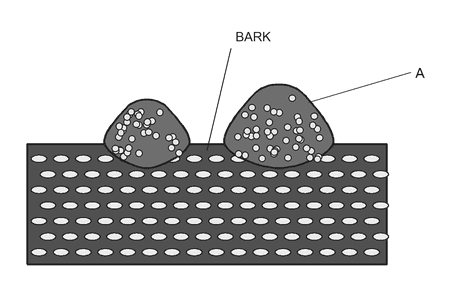
The figure given below is a transverse section of an old woody stem. It shows very minute openings labelled-A on its surface.
(a) What are these tiny openings called ?
(b) Mention two significant functions of these openings.
(c) Name two other tiny openings which can be found on the surface or margins of leaves.
Solve with AIWritten solution
Solution:
Concept: The minute openings on the bark of an old woody stem are lenticels. They are never closed.
Step 1 — (a) Name the openings.
They are lenticels.
Step 2 — (b) Two functions.
- Exchange of gases for respiration between the air and the living tissues inside the stem.
- Lenticular transpiration: a little water evaporates through them.
Step 3 — (c) Two other openings on leaves.
Stomata (on the surface of the leaf) and hydathodes (on the margins of the leaf).
Therefore, (a) lenticels; (b) gaseous exchange for respiration and lenticular transpiration; (c) stomata and hydathodes.
What Class 10 Biology Ch 5 covers
The sections of the chapter, in the order the book takes them. Every question above comes from one of these.
- 01Transpiration
- 02Demonstration of Transpiration
- 03Measurement of Transpiration
- 04Kinds of Transpiration
- 05Factors That Affect Transpiration
- 06Adaptations in Plants to Reduce Excessive Transpiration
More ways to study this chapter
The same chapter asked three other ways. Practise it, revise it, and see what the board has set on Ch 5 before.
- Competency-Based Questions (CBQ)Case study questions: a situation, and the part of the chapter that answers it.40questionsOpen
- Previous Year QuestionsQuestions that have actually appeared in board papers, each tagged with its year.36questionsOpen
- Practice QuestionsExtra questions per chapter, for when one attempt at a method is not enough.44questionsOpen
Ch 5 in past ICSE papers
The same chapter as the board has actually asked it. These are worded differently from the textbook exercise, which is the point of reading them.
- 11 mark
Board paper question 1
State the main function of the following:
Guard cells
Solve with AIWritten solution
Solution:
Concept: A stoma is a tiny pore in the epidermis of a leaf. It is bordered by two bean-shaped guard cells, whose change of shape opens and closes the pore.
Step 1 — Recall where the guard cells are.
Every stoma in the leaf epidermis is surrounded by two bean-shaped guard cells. Unlike the ordinary epidermal cells around them, they contain chloroplasts, and their inner walls (next to the pore) are thicker than their outer walls.
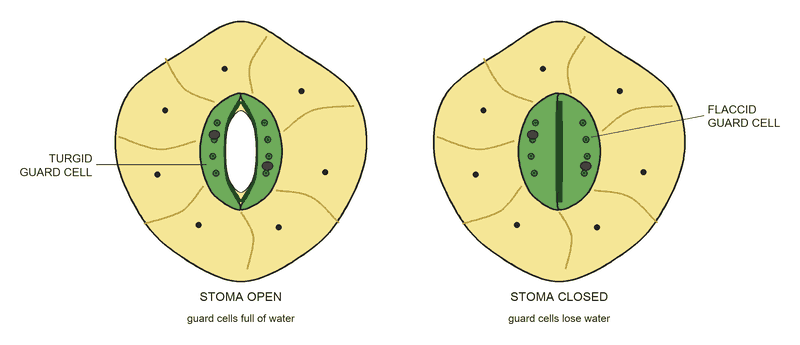
Step 2 — See how they work.
When the guard cells take in water and become turgid, their thin outer walls stretch more than the thick inner walls, so the cells bow outwards and the pore opens. When they lose water and become flaccid, they straighten and the pore closes.
Step 3 — State the main function.
By opening and closing the stomata, the guard cells control the exchange of gases (carbon dioxide in, oxygen out during photosynthesis) and the loss of water vapour by transpiration.
Watch out: The guard cells do not 'make' the gases or the water vapour; they only open and close the pore through which these pass.
Therefore, the main function of guard cells is to regulate the opening and closing of the stomata, and so control gaseous exchange and the loss of water by transpiration.
- 25 marks
Board paper question 2
The diagram of an apparatus given below demonstrates a particular process in plants. Study the same and answer the questions that follow:

(i) Name the apparatus.
(ii) Which phenomenon is demonstrated by this apparatus?
(iii) Explain the phenomenon mentioned in (ii) above.
(iv) State two limitations of using this apparatus.
(v) What is the importance of the air bubble in the experiment?
(vi) Name the structures in a plant through which the above process takes place.
Solve with AIWritten solution
Solution:
Concept: A potometer (Ganong's potometer) measures the rate at which a cut leafy shoot takes up water. Because nearly all the water taken up is lost by transpiration, this rate is almost equal to the rate of transpiration. Transpiration is the loss of water in the form of water vapour from the aerial parts of a plant, mainly through the stomata of the leaves.
Step 1 — (i) Name the apparatus.
The figure shows a leafy shoot fixed in a water-filled vessel, joined to a reservoir with a stop-cock and to a graduated capillary tube that dips into coloured water, with an air bubble in the tube. This is the set-up of Ganong's potometer.
Step 2 — (ii) Name the phenomenon.
The apparatus shows transpiration. Strictly, it measures the rate of water uptake by the shoot; this is almost equal to the water lost by transpiration, because only a very small part of the water taken up is kept by the plant.
Step 3 — (iii) Explain the phenomenon.
Water reaches the leaf through the xylem of the veins. The mesophyll cells give out water as a thin film on their surfaces, and this water evaporates into the intercellular air spaces, which become saturated with water vapour.
The vapour then diffuses out through the open stomata into the drier outside air, because water vapour moves from where it is more concentrated to where it is less concentrated.
As the leaves lose water, a suction force (transpiration pull) is set up in the shoot. It pulls water from the apparatus into the cut end of the shoot, so the water column, and the air bubble in it, moves along the capillary tube towards the shoot.
Step 4 — (iv) State two limitations.
The readings of a potometer can go wrong for several reasons:
- Introducing the air bubble is not easy (and the bubble must not enter the shoot).
- The cut twig may not remain fully alive and healthy for long, so its rate of water uptake changes.
- Changes in the air temperature around the capillary tube may shift the air bubble on their own.
Step 5 — (v) Give the importance of the air bubble.
The air bubble is a marker. The distance it moves along the graduated capillary tube in a measured time gives the volume of water taken up by the shoot, from which the rate of transpiration is worked out. Opening the stop-cock lets water from the reservoir push the bubble back to the start for the next reading.
Step 6 — (vi) Name the structures.
Most transpiration takes place through the stomata of the leaves. A small amount also takes place through the cuticle and through the lenticels of woody stems.
Watch out: The bubble moves TOWARDS the shoot, because the shoot is drawing water out of the tube.
Therefore, (i) Ganong's potometer; (ii) transpiration (the rate of water uptake by the shoot); (iii) water evaporates from the mesophyll and diffuses out through the stomata, setting up a suction that draws water from the apparatus; (iv) the air bubble is hard to introduce, and the twig may not stay alive (temperature changes also move the bubble); (v) the bubble is a marker whose movement measures the water taken up; (vi) mainly the stomata, also the cuticle and lenticels.
- 31 mark
Board paper question 3
Give biological reasons for the following statements:
In some xerophytes leaves are modified into spines.
Solve with AIWritten solution
Solution:
Concept: Plants of dry places cut down the loss of water vapour by reducing the surface that loses water and by slowing the escape of vapour from the stomata.
Step 1 — Note where most water is lost.
Most transpiration takes place through the stomata of the leaves, so the larger the leaf surface, the more water vapour a plant loses.
Step 2 — See what spines do.
In xerophytes such as cacti the leaves are reduced to spines. A spine has a tiny surface and no open stomata, so very little water is lost through it.

Step 3 — Link it to the habitat.
Xerophytes grow where water is scarce, so cutting down transpiration conserves water. The green, swollen stem takes over photosynthesis and stores water, and the spines also protect the plant from grazing animals.
Watch out: The spines are modified LEAVES, not hairs; the photosynthesis is then done by the green stem.
Therefore, in some xerophytes the leaves are modified into spines to reduce the surface area exposed for transpiration and so conserve water in a dry habitat.
- 41 mark
Board paper question 4
Give appropriate biological / technical terms for the following:
An apparatus that measures the rate of water uptake in a cut shoot due to transpiration.
Solve with AIWritten solution
Solution:
Concept: A potometer (Ganong's potometer) measures the rate at which a cut leafy shoot takes up water. Because nearly all the water taken up is lost by transpiration, this rate is almost equal to the rate of transpiration.
Step 1 — Read what the apparatus must do.
The apparatus measures how fast a cut leafy shoot takes up water, which is almost the same as the rate at which it loses water by transpiration.
Step 2 — Name it.
This apparatus is the potometer (for example, Ganong's potometer). The movement of an air bubble along its graduated capillary tube gives the volume of water taken up in a given time.
Watch out: A potometer measures water UPTAKE, which only approximately equals the water lost.
Therefore, the apparatus is the potometer.
- 51 mark
Board paper question 5
(a) Name the following:
The wax like layer on the epidermis of leaves which reduces transpiration.
Solve with AIWritten solution
Solution:
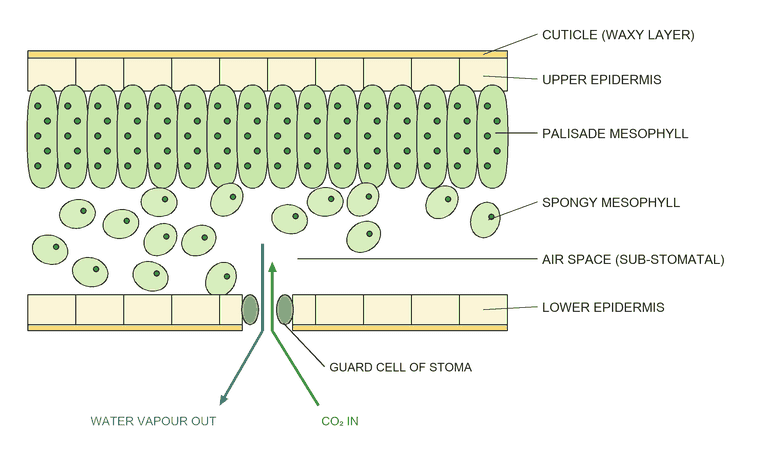
Concept: The cuticle is a waxy layer secreted by the epidermis over the surface of the leaf. Water cannot pass through wax easily, so the cuticle cuts down the evaporation of water from the leaf surface.
Step 1 — Find the layer.
The epidermis of the leaf secretes a wax-like layer over its outer surface. This layer is the cuticle.
Step 2 — Say how it reduces transpiration.
Wax does not let water through easily, so the cuticle cuts down the evaporation of water from the leaf surface (cuticular transpiration). The thicker the cuticle, the less water is lost, which is why many plants of dry places have a thick cuticle.
Watch out: The cuticle is a non-living waxy layer ON the epidermis, not a layer of cells.
Therefore, the wax-like layer is the cuticle.
- 61 mark
Board paper question 6
Choose between the two options to answer the question specified in the brackets for the following:
An example is illustrated below.
Example: Corolla or Calyx (Which is the outer whorl?) Answer: Calyx
Lenticels or stomata (Which one remains open always?)
Solve with AIWritten solution
Solution:
Concept: Lenticels are small openings in the bark (cork) of older woody stems, filled with loosely packed cells. They have no guard cells, so they stay open all the time. A stoma is a tiny pore in the epidermis of a leaf. It is bordered by two bean-shaped guard cells, whose change of shape opens and closes the pore.
Step 1 — Compare how each opening is controlled.
A stoma has two guard cells that open it (when turgid) and close it (when flaccid), so stomata are usually open by day and closed at night.
Step 2 — Pick the one with no control.
A lenticel has no guard cells: it is just a gap in the cork filled with loosely packed cells, so it remains open all the time.
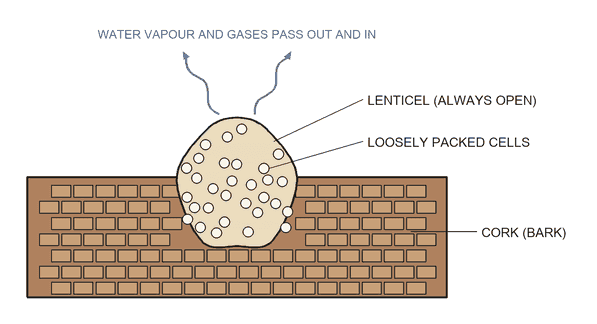
Therefore, lenticels remain open always.
All 36 board paper questions for this chapter, solved the same way.
Class 10 Biology Ch 5 questions students ask
How many questions are there in Class 10 Biology Ch 5?
45 questions. Every one is solved step by step on this page.
Are these Class 10 Biology solutions free?
Yes. Every question and its full working is free to read, with no account needed.
Can I download the Class 10 Biology Ch 5 solutions as a PDF?
There is no PDF to download. Every solution is on this page instead, which means it is searchable, always the current syllabus, and readable on a phone. Use your browser's print option if you want it on paper.