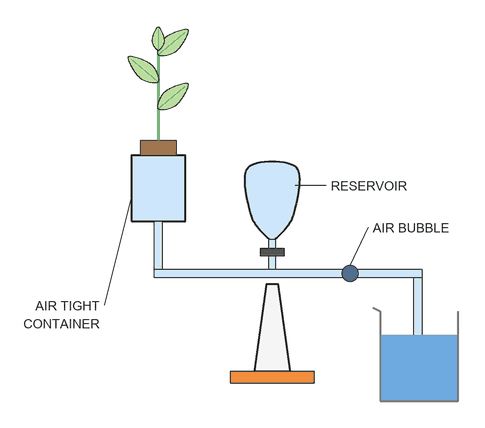
Solution:
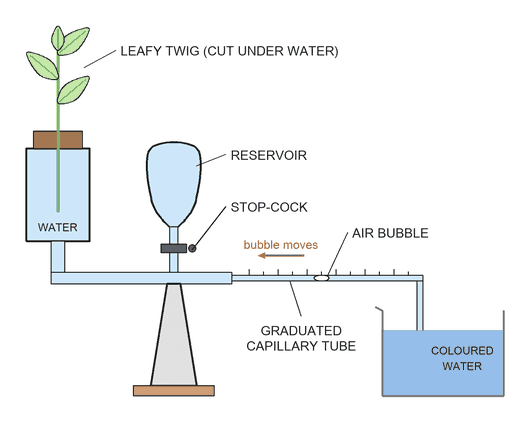
Concept: As the twig transpires, it draws water through the capillary tube. The air bubble moves with this water and shows how fast the water is taken up.
Step 1 — (a) Name the apparatus.
It is Ganong's potometer.
Step 2 — (b) Its use.
It measures the rate of water uptake by a cut twig. This is almost equal to the water lost in transpiration, so it gives the rate of transpiration.
Step 3 — (c) Role of the air bubble.
The bubble is a marker (index). As the twig loses water, suction pulls water from the beaker and the bubble moves along the graduated tube, giving the volume of water taken up in a given time.
Step 4 — (d) Use of the reservoir.
Opening the stop-cock lets water from the reservoir into the tube, which pushes the bubble back to its starting point, so the experiment can be repeated.
Step 5 — (e) The bubble in three conditions.
We link each condition to the rate of transpiration:
(i) In the dark: the bubble moves very slowly or almost stops, because the stomata are closed and transpiration is very low.
(ii) In sunlight: the bubble moves faster, because the stomata are open and the warmth increases evaporation.
(iii) In front of a fan: the bubble moves faster, because moving air removes the vapour around the leaves, so they do not get saturated and transpiration increases.
Watch out: The bubble shows water taken up, which is only nearly equal to the water transpired.
Therefore, (a) Ganong's potometer; (b) rate of transpiration; (c) marker of water uptake; (d) resets the bubble; (e) slow in the dark, faster in sunlight and in front of a fan.