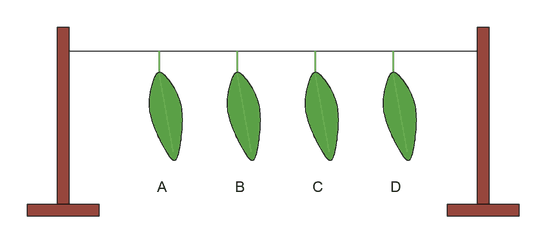
Solution:
Concept: Grease blocks the stomata, so a greased surface cannot transpire. A dicot leaf has more stomata on its lower surface, so the lower surface loses more water.
Step 1 — Work out how much each leaf can lose.
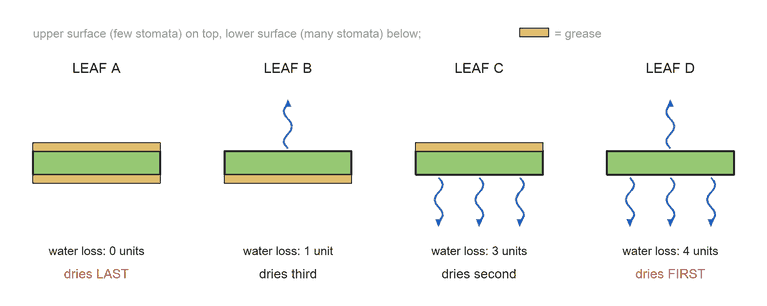
Leaf D (no grease) loses from both surfaces; leaf C (upper greased) loses from the lower surface, which has many stomata; leaf B (lower greased) loses from the upper surface, which has few; leaf A (both greased) can hardly lose water.
Step 2 — (i) The leaf that dries first.
Leaf D, because all its stomata on both surfaces are open, so it loses the most water.
Step 3 — (ii) The leaf that dries last.
Leaf A, because grease on both surfaces blocks all its stomata, so it loses hardly any water.
Watch out: Do not take B and C as equal: the lower surface has more stomata, so C dries before B.
Therefore, (i) leaf D dries first (no stomata blocked) and (ii) leaf A dries last (all stomata blocked); the full order is D, C, B, A.