Solution:
Concept: Each reason comes from one of three things: the number and position of stomata, the difference in moisture between the leaf and the air, or the balance between water absorbed and water lost.
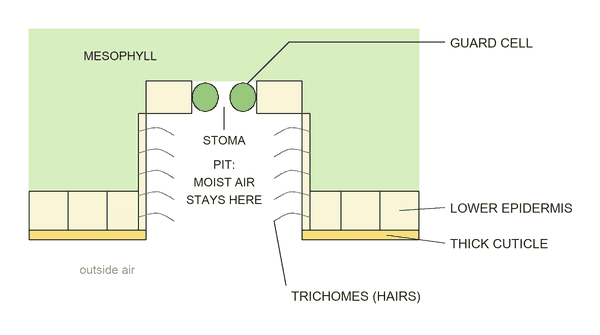
Step 1 — (a) Nerium loses less water.
Cause: Nerium has sunken stomata covered by hairs and narrow leaves.
Effect: the stomata are not directly exposed to the dry outside air and the leaf surface is small, so less vapour diffuses out.
Step 2 — (b) More transpiration from the under surface of a dicot leaf.
Cause: a dicot leaf has more stomata on its under surface.
Effect: most transpiration is stomatal, so more vapour escapes from that surface.
Step 3 — (c) Transpiration increases with wind velocity.
Cause: faster wind removes the vapour around the leaf quickly, so the air there does not get saturated.
Effect: the vapour keeps diffusing out fast, and transpiration increases.
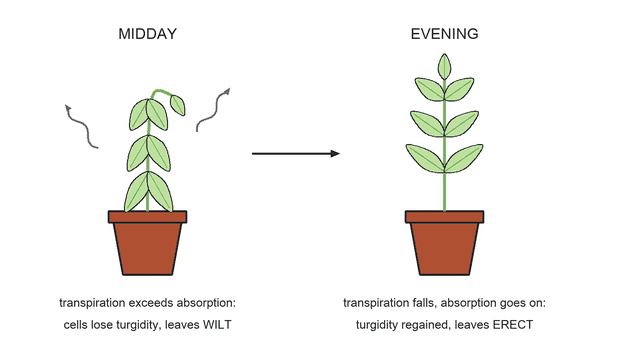
Step 4 — (d) Leaves wilt at midday and recover in the evening.
Cause: at midday transpiration is faster than absorption, even in moist soil.
Effect: the cells lose turgidity and the leaves wilt (e.g. balsam). In the evening the stomata close partly and it is cooler, so little water is lost; the cells regain turgidity and the leaves stand erect again.
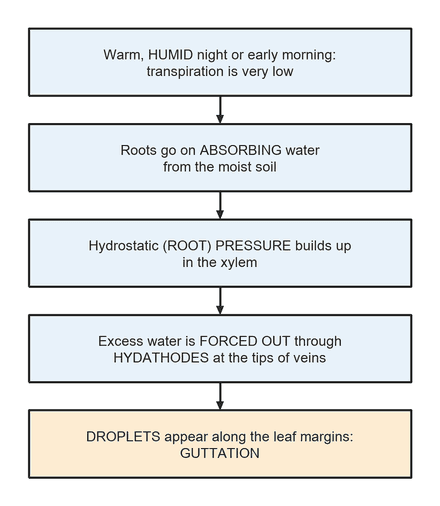
Step 5 — (e) Guttation in the early morning or late night.
Cause: the air is then humid, so transpiration is low, while the roots keep absorbing water.
Effect: pressure builds up in the plant and forces the extra water out through the hydathodes as droplets.
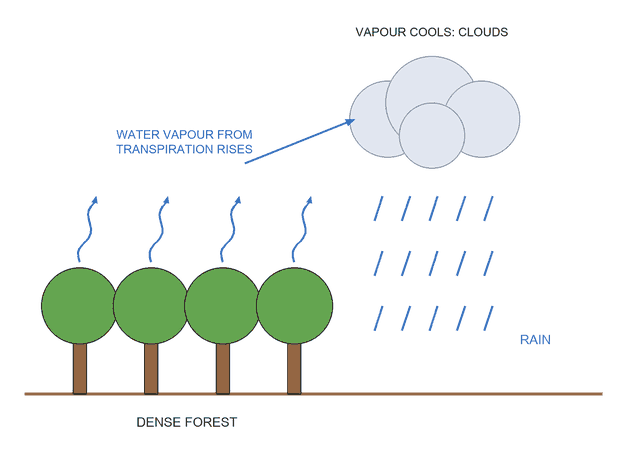
Step 6 — (f) Forests bring more rain.
Cause: forest trees give out huge quantities of water vapour by transpiration.
Effect: the air becomes moist, the vapour condenses into clouds, and more rain falls.
Watch out: In (d) wilting at midday happens even when the soil is wet; it is the rate of loss, not the lack of soil water.
Therefore, (a) sunken hairy stomata, (b) more stomata below, (c) vapour removed by wind, (d) loss exceeds absorption at midday but not in the evening, (e) low transpiration in humid air with continued absorption, (f) water vapour from transpiration brings rain.
