
Question 366 marksEasy
Distinguish between the following pairs :
(a) Stomata and Lenticels
(b) Guttation and Bleeding
(c) Transpiration and Evaporation
Confirming your payment
Sign up now and get 250 free tokens.
Transpiration · Question 36 of 45
Distinguish between the following pairs :
(a) Stomata and Lenticels
(b) Guttation and Bleeding
(c) Transpiration and Evaporation
Solution:
Concept: Compare each pair point by point: structure, location, and what is lost or exchanged.
Step 1 — (a) Stomata and lenticels.
We compare them on three points:
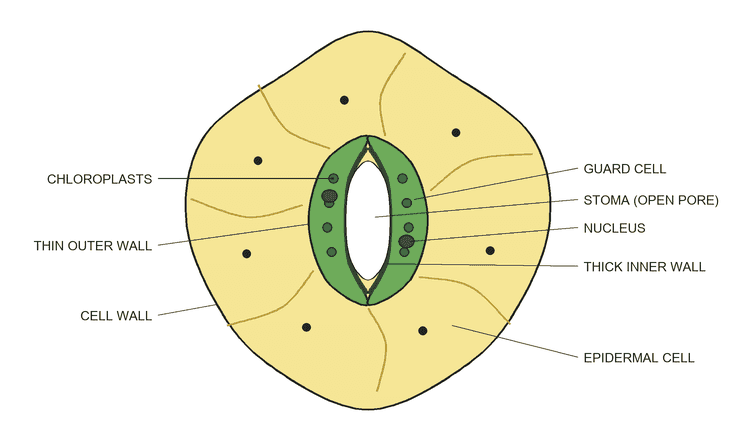
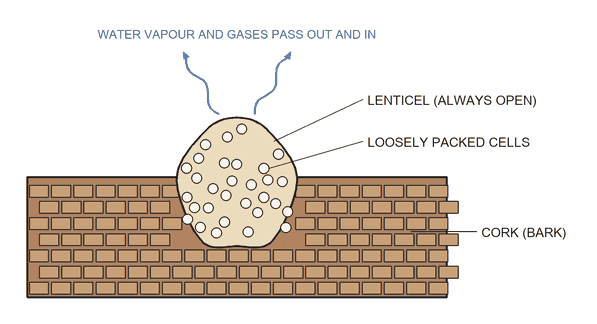
| Stomata | Lenticels |
|---|---|
| Small pores surrounded by two bean-shaped guard cells; they open and close. | Openings not surrounded by guard cells; they stay open all the time. |
| Found mostly on the lower surface of leaves. | Found on the bark of older woody stems. |
| Exchange gases for photosynthesis and respiration; most transpiration. | Exchange gases mainly for respiration; a little transpiration. |
Step 2 — (b) Guttation and bleeding.
We compare where, what and when:
| Guttation | Bleeding |
|---|---|
| From the leaf margins through hydathodes of uninjured plants. | From any cut or injured part. |
| Exudate is mainly water with some mineral salts. | Exudate is mainly plant sap with sugars. |
| Occurs in the early morning or late night. | Occurs whenever the plant is injured. |
Step 3 — (c) Transpiration and evaporation.
We compare the source and the control:
| Transpiration | Evaporation |
|---|---|
| Loss of water vapour from the aerial parts of a living plant. | Loss of water vapour from any free water surface. |
| A vital process, partly physical, controlled by the plant (stomata) and by the surroundings. | A purely physical process, controlled only by the surroundings (temperature, humidity, wind). |
| Comparatively slow. | Comparatively fast. |
Therefore, the three pairs differ as shown in the tables: guard cells and location for (a), injury and exudate for (b), and living control for (c).