Solution:
Concept: A potometer (Ganong's potometer) measures the rate at which a cut leafy shoot takes up water. Because nearly all the water taken up is lost by transpiration, this rate is almost equal to the rate of transpiration. Transpiration is the loss of water in the form of water vapour from the aerial parts of a plant, mainly through the stomata of the leaves.
Step 1 — (i) Name the apparatus.
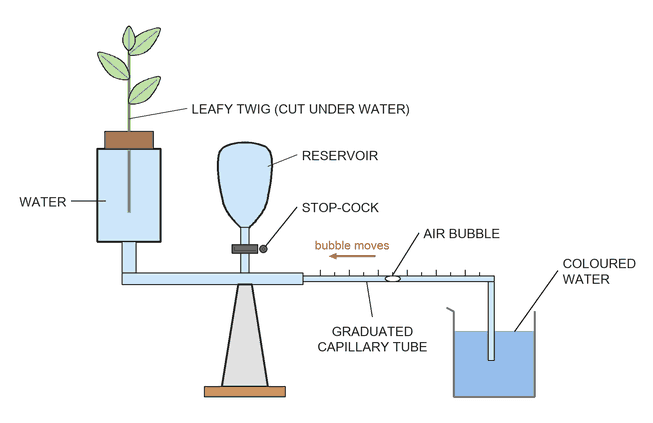
The figure shows a leafy shoot fixed in a water-filled vessel, joined to a reservoir with a stop-cock and to a graduated capillary tube that dips into coloured water, with an air bubble in the tube. This is the set-up of Ganong's potometer.
Step 2 — (ii) Name the phenomenon.
The apparatus shows transpiration. Strictly, it measures the rate of water uptake by the shoot; this is almost equal to the water lost by transpiration, because only a very small part of the water taken up is kept by the plant.
Step 3 — (iii) Explain the phenomenon.
Water reaches the leaf through the xylem of the veins. The mesophyll cells give out water as a thin film on their surfaces, and this water evaporates into the intercellular air spaces, which become saturated with water vapour.
The vapour then diffuses out through the open stomata into the drier outside air, because water vapour moves from where it is more concentrated to where it is less concentrated.
As the leaves lose water, a suction force (transpiration pull) is set up in the shoot. It pulls water from the apparatus into the cut end of the shoot, so the water column, and the air bubble in it, moves along the capillary tube towards the shoot.
Step 4 — (iv) State two limitations.
The readings of a potometer can go wrong for several reasons:
- Introducing the air bubble is not easy (and the bubble must not enter the shoot).
- The cut twig may not remain fully alive and healthy for long, so its rate of water uptake changes.
- Changes in the air temperature around the capillary tube may shift the air bubble on their own.
Step 5 — (v) Give the importance of the air bubble.
The air bubble is a marker. The distance it moves along the graduated capillary tube in a measured time gives the volume of water taken up by the shoot, from which the rate of transpiration is worked out. Opening the stop-cock lets water from the reservoir push the bubble back to the start for the next reading.
Step 6 — (vi) Name the structures.
Most transpiration takes place through the stomata of the leaves. A small amount also takes place through the cuticle and through the lenticels of woody stems.
Watch out: The bubble moves TOWARDS the shoot, because the shoot is drawing water out of the tube.
Therefore, (i) Ganong's potometer; (ii) transpiration (the rate of water uptake by the shoot); (iii) water evaporates from the mesophyll and diffuses out through the stomata, setting up a suction that draws water from the apparatus; (iv) the air bubble is hard to introduce, and the twig may not stay alive (temperature changes also move the bubble); (v) the bubble is a marker whose movement measures the water taken up; (vi) mainly the stomata, also the cuticle and lenticels.

