
Opening your dashboard
Class 10 Biology Chapter 5 Transpiration: Previous Year Questions
36 questions on Chapter 5, each solved step by step. Class 10 Biology, ICSE 2026-27.
36 questions with solutions
1–5 marks · Mixed difficulty
- 11 mark
Question 1
State the main function of the following:
Guard cells
Solve with AIWritten solution
Solution:
Concept: A stoma is a tiny pore in the epidermis of a leaf. It is bordered by two bean-shaped guard cells, whose change of shape opens and closes the pore.
Step 1 — Recall where the guard cells are.
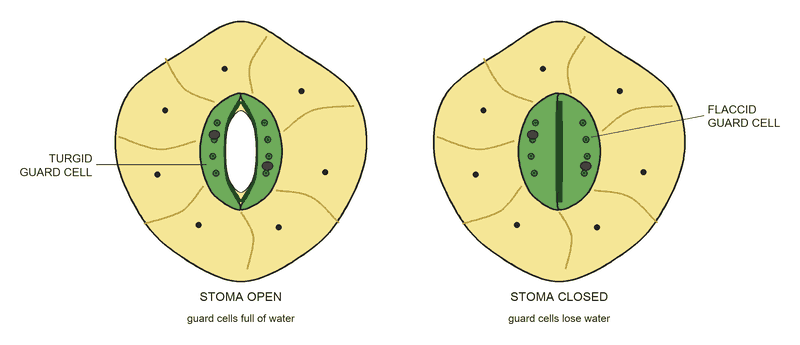
Every stoma in the leaf epidermis is surrounded by two bean-shaped guard cells. Unlike the ordinary epidermal cells around them, they contain chloroplasts, and their inner walls (next to the pore) are thicker than their outer walls.
Step 2 — See how they work.
When the guard cells take in water and become turgid, their thin outer walls stretch more than the thick inner walls, so the cells bow outwards and the pore opens. When they lose water and become flaccid, they straighten and the pore closes.
Step 3 — State the main function.
By opening and closing the stomata, the guard cells control the exchange of gases (carbon dioxide in, oxygen out during photosynthesis) and the loss of water vapour by transpiration.
Watch out: The guard cells do not 'make' the gases or the water vapour; they only open and close the pore through which these pass.
Therefore, the main function of guard cells is to regulate the opening and closing of the stomata, and so control gaseous exchange and the loss of water by transpiration.
- 25 marks
Question 2
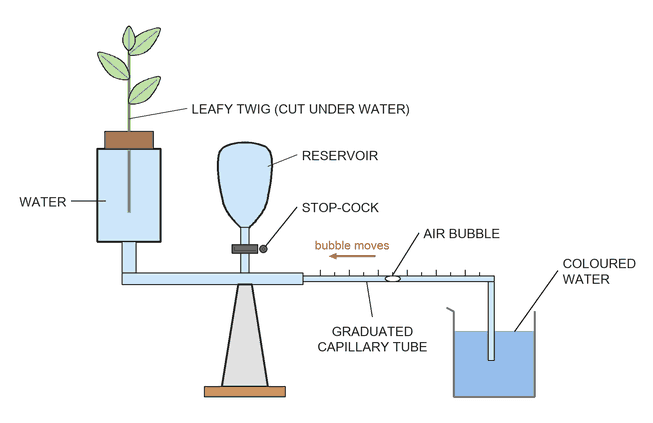
The diagram of an apparatus given below demonstrates a particular process in plants. Study the same and answer the questions that follow:

(i) Name the apparatus.
(ii) Which phenomenon is demonstrated by this apparatus?
(iii) Explain the phenomenon mentioned in (ii) above.
(iv) State two limitations of using this apparatus.
(v) What is the importance of the air bubble in the experiment?
(vi) Name the structures in a plant through which the above process takes place.
Solve with AIWritten solution
Solution:
Concept: A potometer (Ganong's potometer) measures the rate at which a cut leafy shoot takes up water. Because nearly all the water taken up is lost by transpiration, this rate is almost equal to the rate of transpiration. Transpiration is the loss of water in the form of water vapour from the aerial parts of a plant, mainly through the stomata of the leaves.
Step 1 — (i) Name the apparatus.
The figure shows a leafy shoot fixed in a water-filled vessel, joined to a reservoir with a stop-cock and to a graduated capillary tube that dips into coloured water, with an air bubble in the tube. This is the set-up of Ganong's potometer.
Step 2 — (ii) Name the phenomenon.
The apparatus shows transpiration. Strictly, it measures the rate of water uptake by the shoot; this is almost equal to the water lost by transpiration, because only a very small part of the water taken up is kept by the plant.
Step 3 — (iii) Explain the phenomenon.
Water reaches the leaf through the xylem of the veins. The mesophyll cells give out water as a thin film on their surfaces, and this water evaporates into the intercellular air spaces, which become saturated with water vapour.
The vapour then diffuses out through the open stomata into the drier outside air, because water vapour moves from where it is more concentrated to where it is less concentrated.
As the leaves lose water, a suction force (transpiration pull) is set up in the shoot. It pulls water from the apparatus into the cut end of the shoot, so the water column, and the air bubble in it, moves along the capillary tube towards the shoot.
Step 4 — (iv) State two limitations.
The readings of a potometer can go wrong for several reasons:
- Introducing the air bubble is not easy (and the bubble must not enter the shoot).
- The cut twig may not remain fully alive and healthy for long, so its rate of water uptake changes.
- Changes in the air temperature around the capillary tube may shift the air bubble on their own.
Step 5 — (v) Give the importance of the air bubble.
The air bubble is a marker. The distance it moves along the graduated capillary tube in a measured time gives the volume of water taken up by the shoot, from which the rate of transpiration is worked out. Opening the stop-cock lets water from the reservoir push the bubble back to the start for the next reading.
Step 6 — (vi) Name the structures.
Most transpiration takes place through the stomata of the leaves. A small amount also takes place through the cuticle and through the lenticels of woody stems.
Watch out: The bubble moves TOWARDS the shoot, because the shoot is drawing water out of the tube.
Therefore, (i) Ganong's potometer; (ii) transpiration (the rate of water uptake by the shoot); (iii) water evaporates from the mesophyll and diffuses out through the stomata, setting up a suction that draws water from the apparatus; (iv) the air bubble is hard to introduce, and the twig may not stay alive (temperature changes also move the bubble); (v) the bubble is a marker whose movement measures the water taken up; (vi) mainly the stomata, also the cuticle and lenticels.
- 31 mark
Question 3
Give biological reasons for the following statements:
In some xerophytes leaves are modified into spines.
Solve with AIWritten solution
Solution:
Concept: Plants of dry places cut down the loss of water vapour by reducing the surface that loses water and by slowing the escape of vapour from the stomata.
Step 1 — Note where most water is lost.
Most transpiration takes place through the stomata of the leaves, so the larger the leaf surface, the more water vapour a plant loses.
Step 2 — See what spines do.
In xerophytes such as cacti the leaves are reduced to spines. A spine has a tiny surface and no open stomata, so very little water is lost through it.

Step 3 — Link it to the habitat.
Xerophytes grow where water is scarce, so cutting down transpiration conserves water. The green, swollen stem takes over photosynthesis and stores water, and the spines also protect the plant from grazing animals.
Watch out: The spines are modified LEAVES, not hairs; the photosynthesis is then done by the green stem.
Therefore, in some xerophytes the leaves are modified into spines to reduce the surface area exposed for transpiration and so conserve water in a dry habitat.
- 41 mark
Question 4
Give appropriate biological / technical terms for the following:
An apparatus that measures the rate of water uptake in a cut shoot due to transpiration.
Solve with AIWritten solution
Solution:
Concept: A potometer (Ganong's potometer) measures the rate at which a cut leafy shoot takes up water. Because nearly all the water taken up is lost by transpiration, this rate is almost equal to the rate of transpiration.
Step 1 — Read what the apparatus must do.
The apparatus measures how fast a cut leafy shoot takes up water, which is almost the same as the rate at which it loses water by transpiration.
Step 2 — Name it.
This apparatus is the potometer (for example, Ganong's potometer). The movement of an air bubble along its graduated capillary tube gives the volume of water taken up in a given time.
Watch out: A potometer measures water UPTAKE, which only approximately equals the water lost.
Therefore, the apparatus is the potometer.
- 51 mark
Question 5
(a) Name the following:
The wax like layer on the epidermis of leaves which reduces transpiration.
Solve with AIWritten solution
Solution:
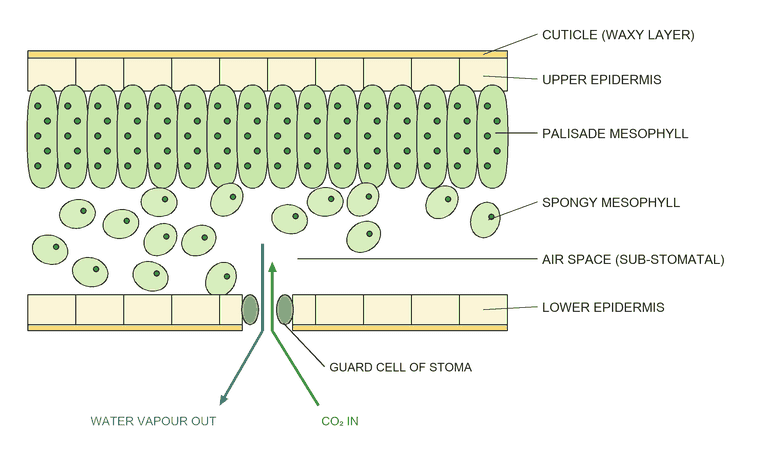
Concept: The cuticle is a waxy layer secreted by the epidermis over the surface of the leaf. Water cannot pass through wax easily, so the cuticle cuts down the evaporation of water from the leaf surface.
Step 1 — Find the layer.
The epidermis of the leaf secretes a wax-like layer over its outer surface. This layer is the cuticle.
Step 2 — Say how it reduces transpiration.
Wax does not let water through easily, so the cuticle cuts down the evaporation of water from the leaf surface (cuticular transpiration). The thicker the cuticle, the less water is lost, which is why many plants of dry places have a thick cuticle.
Watch out: The cuticle is a non-living waxy layer ON the epidermis, not a layer of cells.
Therefore, the wax-like layer is the cuticle.
- 61 mark
Question 6
Choose between the two options to answer the question specified in the brackets for the following:
An example is illustrated below.
Example: Corolla or Calyx (Which is the outer whorl?) Answer: Calyx
Lenticels or stomata (Which one remains open always?)
Solve with AIWritten solution
Solution:
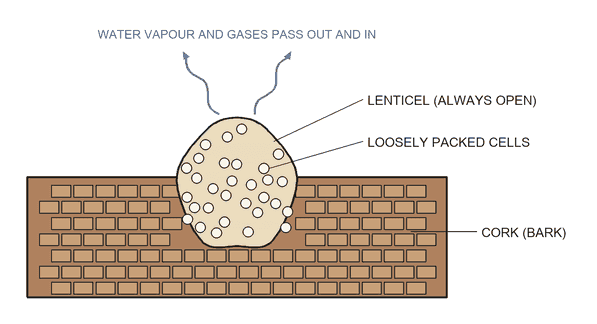
Concept: Lenticels are small openings in the bark (cork) of older woody stems, filled with loosely packed cells. They have no guard cells, so they stay open all the time. A stoma is a tiny pore in the epidermis of a leaf. It is bordered by two bean-shaped guard cells, whose change of shape opens and closes the pore.
Step 1 — Compare how each opening is controlled.
A stoma has two guard cells that open it (when turgid) and close it (when flaccid), so stomata are usually open by day and closed at night.
Step 2 — Pick the one with no control.
A lenticel has no guard cells: it is just a gap in the cork filled with loosely packed cells, so it remains open all the time.
Therefore, lenticels remain open always.
- 71 mark
Question 7
Mention the exact location of the following:
Hydathodes
Solve with AIWritten solution
Solution:
Concept: Guttation is the loss of water as liquid droplets from the margins (edges) of leaves, through special pores called hydathodes at the ends of the veins.
Step 1 — Recall what hydathodes do.
Hydathodes are special water pores through which guttation takes place: excess water is pushed out of the leaf as droplets.
Step 2 — Give the exact location.
They lie on the margins (edges) of the leaves, at the tips of the veins (vein endings), for example in the leaves of banana, nasturtium and strawberry and at the tips of grass blades.
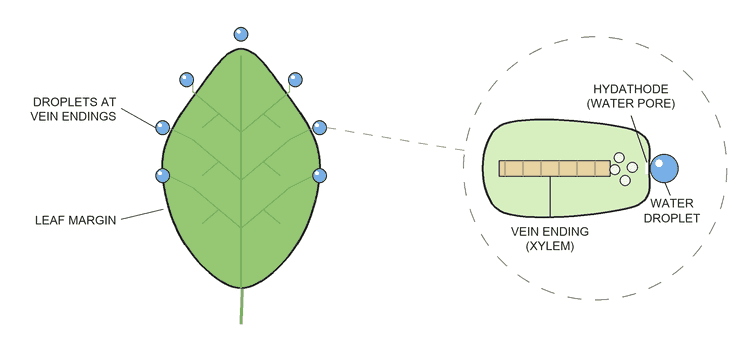
Watch out: Hydathodes are not stomata; they are always open and give out liquid water, not vapour.
Therefore, hydathodes are located on the margins of the leaves, at the tips of the veins.
- 85 marks
Question 8
The diagram below represents a process in plants. The set up was placed in bright sunlight. Answer the following questions:
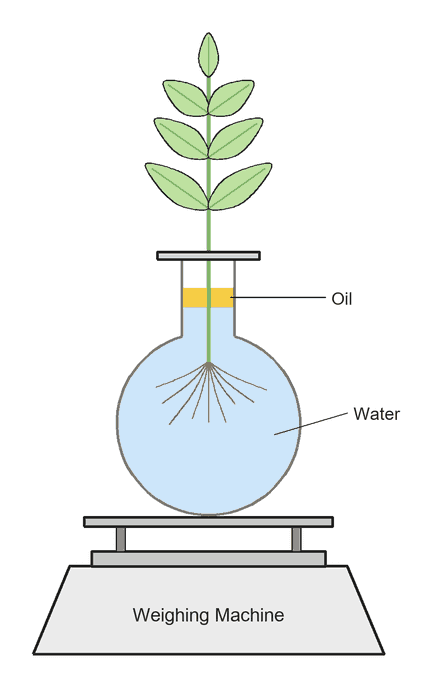
(i) Name the physiological process depicted in the diagram. Why was oil added to the water?
(ii) When placed in bright sunlight for four hours, what do you observe with regard to the initial and final weight of the plant? Give a suitable reason for your answer.
(iii) What happens to the level of water when this setup is placed in:
(a) Humid conditions?
(b) Windy conditions?
(iv) Mention any three adaptations found in plants to overcome the process mentioned in (i).
(v) Explain the term 'Guttation'
Solve with AIWritten solution
Solution:
Concept: Transpiration is the loss of water in the form of water vapour from the aerial parts of a plant, mainly through the stomata of the leaves. Water lost from a closed set-up can leave it only by the routes we leave open.
Step 1 — (i) Name the process and the use of the oil.
The plant gives out water vapour from its leaves, so the process is transpiration.
The oil forms a layer on the water surface and prevents evaporation of water from the flask. So any water that leaves the set-up must have left through the plant.
Step 2 — (ii) Compare the weights.
The final weight is less than the initial weight. In bright sunlight the leaves lose water vapour by transpiration, and the roots draw water from the flask to replace it. Because the oil stops evaporation from the water surface, the loss in weight is the water lost by transpiration.

Step 3 — (iii) Predict the water level.
(a) Humid conditions: the level falls only slowly. Humid air already holds much water vapour, so vapour diffuses out of the leaves slowly and less water is drawn from the flask.
(b) Windy conditions: the level falls faster. Wind carries away the moist air around the leaves, so vapour keeps diffusing out quickly and more water is drawn from the flask.
Step 4 — (iv) List three adaptations.
Plants cut down transpiration in these ways (any three):
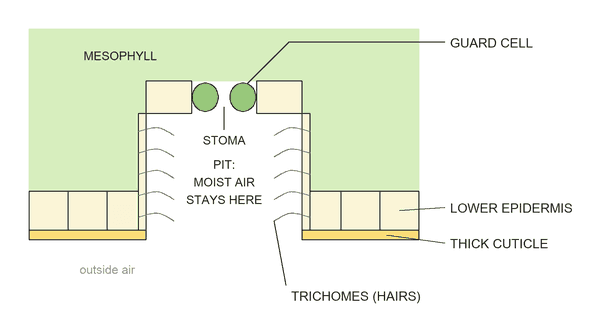
- Sunken stomata: the stomata lie in pits, often lined with hairs (as in Nerium), so moist air stays trapped near them and vapour diffuses out slowly.
- Fewer stomata: fewer openings means fewer exits for water vapour.
- Thick, waxy cuticle: wax stops water evaporating from the leaf surface (as in many evergreen trees).
- Leaves reduced to spines or shed: as in most cacti, which cuts the surface that loses water.
- Narrow, rolled or folded leaves: less surface is exposed to the sun and the wind.
Step 5 — (v) Explain guttation.
Guttation is the loss of water as liquid droplets from the margins (edges) of leaves, through special pores called hydathodes at the ends of the veins. It happens in warm, humid conditions, usually at night or early in the morning, when transpiration is very low but the roots go on absorbing water. Root pressure then builds up and forces the extra water out through the hydathodes; the droplets carry some dissolved salts. It is seen in banana, nasturtium, tomato and grasses.
Watch out: The oil does not stop transpiration; it only stops evaporation from the WATER SURFACE in the flask.
Therefore, (i) transpiration, and the oil prevents evaporation from the water surface; (ii) the final weight is less, because the plant loses water by transpiration; (iii) the level falls slowly in humid air and faster in wind; (iv) sunken stomata, fewer stomata, a thick cuticle (or spines, rolled leaves); (v) guttation is the loss of liquid water droplets from the leaf margins through hydathodes.
- 91 mark
Question 9
Choose the correct answer from the four options given below:
Which one of the following does not affect the rate of transpiration ?
Solve with AIAnswer
(A) Light
(B) Humidity
(C) Wind
- Correct
(D) Age of the plant
Answer: (D) Age of the plant
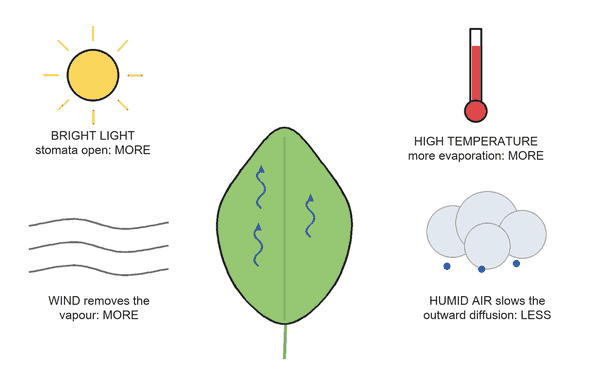
Concept: The rate of transpiration depends on the conditions around the leaves: it rises with light (the stomata open), high temperature and wind, and falls with high humidity of the air.
Step 1 — List the outside factors.
Light, temperature, wind and humidity of the air all change the rate at which water vapour leaves the leaves.
Step 2 — Test each option.
Light, humidity and wind are all in this list. The age of the plant is not one of the external factors that the chapter lists, so it is the odd one out.
Watch out: The question asks which factor does NOT affect the rate; three options do affect it.
Note: a plant's age can change its leaf area, but it is not one of the conditions that the chapter lists as controlling the rate of transpiration, which is what this question tests.
Why the other options are wrong:
- (A) Light: light does affect it: in light the stomata open for photosynthesis, so transpiration is faster by day than at night.
- (B) Humidity: humidity does affect it: humid air slows the outward diffusion of water vapour, so transpiration decreases.
- (C) Wind: wind does affect it: wind removes the moist air near the leaf, so transpiration increases.
Therefore, the age of the plant is the option that does not affect the rate of transpiration, option (D).
- 105 marks
Question 10
Given alongside is an apparatus which was set up to investigate a physiological process in plants. The setup was placed in bright sunlight. Answer the questions that follow :
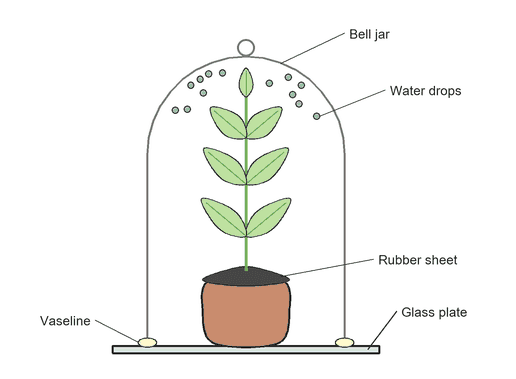
(i) Name the process being studied. Define the process.
(ii) Why was the pot enclosed in a rubber sheet?
(iii) Mention two external factors which can accelerate the above process.
(iv) List two adaptations in plants to reduce the above process.
(v) Draw a neat, labelled diagram of a stomatal apparatus.
Solve with AIWritten solution
Solution:
Concept: Transpiration is the loss of water in the form of water vapour from the aerial parts of a plant, mainly through the stomata of the leaves. Water vapour given out inside a closed bell jar condenses as drops on the cooler glass.
Step 1 — (i) Name and define the process.
The drops inside the jar come from water vapour given out by the leaves, so the process is transpiration: the loss of water in the form of water vapour from the aerial parts of the plant.
Step 2 — (ii) Explain the rubber sheet.
The rubber sheet covers the pot and the soil, so it prevents evaporation of water from the soil and the pot. The drops on the inner wall of the jar must then have come from the plant alone.
Step 3 — (iii) Name two factors that speed it up.
Any two of these external factors increase transpiration:
- High temperature: more water evaporates from the leaf cells.
- Bright light: the stomata open wider.
- Wind: it removes the moist air around the leaves.
- Low humidity (dry air): vapour diffuses out faster.
Step 4 — (iv) List two adaptations.
Plants cut down transpiration in these ways (any two):
- Sunken stomata: the stomata lie in pits, often lined with hairs (as in Nerium), so moist air stays trapped near them and vapour diffuses out slowly.
- Fewer stomata: fewer openings means fewer exits for water vapour.
- Thick, waxy cuticle: wax stops water evaporating from the leaf surface (as in many evergreen trees).
- Leaves reduced to spines or shed: as in most cacti, which cuts the surface that loses water.
- Narrow, rolled or folded leaves: less surface is exposed to the sun and the wind.
Step 5 — (v) Draw the stomatal apparatus.
The diagram shows a stoma, the pore, with two bean-shaped guard cells around it, set among the epidermal cells.
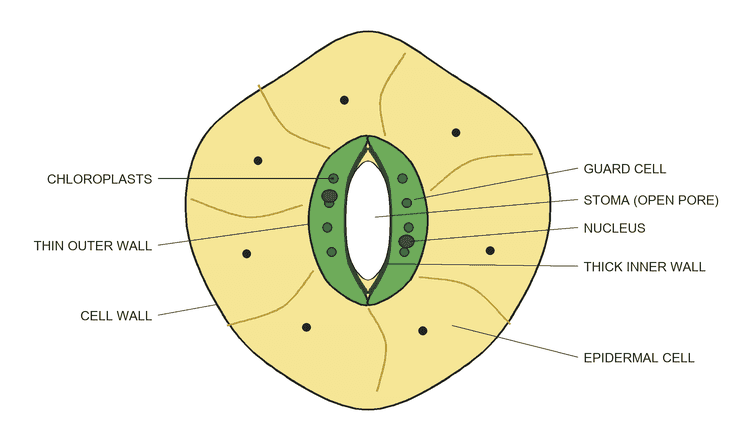
Each guard cell has a nucleus and chloroplasts, a thick inner wall next to the pore and a thin outer wall. When the guard cells are turgid they bow outwards and the pore opens; when flaccid, it closes.
Watch out: The bell jar must stand on a glass plate sealed with vaseline, so no water vapour from outside can get in.
Therefore, (i) transpiration, the loss of water as vapour from the aerial parts; (ii) the rubber sheet stops evaporation from the soil, so the drops come from the plant alone; (iii) high temperature and bright light (also wind, dry air); (iv) sunken stomata and a thick cuticle (or fewer stomata, spines); (v) the labelled stomatal apparatus shown above.
- 111 mark
Question 11
Match the items given in column A with the most appropriate ones in Column B and REWRITE the correct matching pairs:
Column A: (v) Stomata
Column B: Calcium; balance of the body; Light independent reaction; diffusion of gases; gonad; Peppered moth; Light dependent reaction; Chlorophyll
Solve with AIWritten solution
Solution:
Concept: A stoma is a tiny pore in the epidermis of a leaf. It is bordered by two bean-shaped guard cells, whose change of shape opens and closes the pore.
Step 1 — Recall what passes through the stomata.
Through the open stomata, carbon dioxide diffuses into the leaf for photosynthesis, and oxygen and water vapour diffuse out. Each gas moves from where it is more concentrated to where it is less concentrated.
Step 2 — Pick the matching item.
Of the items in Column B, only diffusion of gases describes this. The other items belong to other chapters (calcium, balance of the body, the light reactions, gonad, peppered moth, chlorophyll).
Therefore, the matching pair is stomata with diffusion of gases.
- 121 mark
Question 12
Differentiate between the following pairs on the basis of what is mentioned in the brackets:
(i) Transpiration and Guttation (place of occurrence)
Solve with AIWritten solution
Solution:
Concept: Transpiration is the loss of water in the form of water vapour from the aerial parts of a plant, mainly through the stomata of the leaves. Guttation is the loss of water as liquid droplets from the margins (edges) of leaves, through special pores called hydathodes at the ends of the veins.
Step 1 — Locate transpiration.
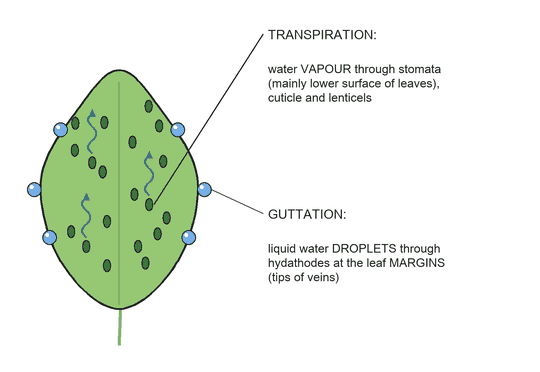
Transpiration takes place from the aerial parts of the plant, mainly through the stomata of the leaves (more of them on the lower surface), and also through the cuticle and the lenticels of woody stems.
Step 2 — Locate guttation.
Guttation takes place from the margins (edges) of the leaves, through the hydathodes at the tips of the veins.
Step 3 — Set them side by side.
The table gives the difference asked for.
Transpiration Guttation Through the stomata of the leaves (also the cuticle and lenticels), as water vapour Through the hydathodes at the leaf margins, as liquid droplets Watch out: Stomata and hydathodes are different openings: water VAPOUR leaves by stomata, liquid DROPS by hydathodes.
Therefore, transpiration occurs mainly through the stomata of the leaves (and the cuticle and lenticels), while guttation occurs through the hydathodes at the margins of the leaves.
- 135 marks
Question 13
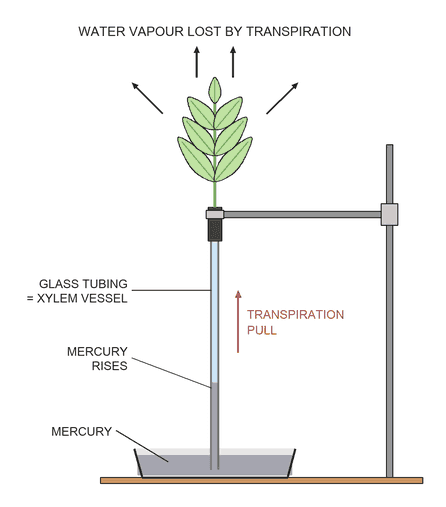
The diagram below represents an experiment to demonstrate a certain phenomenon in a green plant:

(i) Will the level of mercury in the glass tubing rise or fall? Which conducting tissue of the plant does the glass-tubing represent?
(ii) Define Transpiration.
(iii) How will the rate of the above process differ if the environment of the plant has:
(a) Less humidity
(b) High temperature?
(iv) State any two advantages of transpiration to the plant.
(v) Draw a neat labelled diagram of a Plasmolysed cell.
Solve with AIWritten solution
Solution:
Concept: Transpiration is the loss of water in the form of water vapour from the aerial parts of a plant, mainly through the stomata of the leaves. The water lost from the leaves is replaced by water pulled up from below (transpiration pull).
Step 1 — (i) Predict the mercury level.
The leaves lose water by transpiration, and the water lost is replaced from the glass tubing. The suction force (transpiration pull) draws the water column up, and the mercury follows it, so the level of mercury in the glass tubing rises.
The glass tubing plays the part of the xylem (xylem vessels), which conduct water up from the roots.
Step 2 — (ii) Define transpiration.
Transpiration is the loss of water in the form of water vapour from the aerial parts of the plant, mainly through the stomata of the leaves.
Step 3 — (iii) Predict the rate.
(a) Less humidity: the rate increases, because water vapour diffuses out of the leaf faster into dry air.
(b) High temperature: the rate increases, because more water evaporates from the leaf cells and warm air can hold more water vapour.
Step 4 — (iv) State two advantages.
Transpiration helps the plant in these ways (any two):
- Cooling effect: the evaporation of water takes heat from the leaf, so the leaf stays cooler on hot, sunny days.
- Suction force (transpiration pull): the loss of water from the leaves pulls water and dissolved minerals up the xylem from the roots (ascent of sap).
- Distribution of water and minerals: water drawn towards the leaves at every branch tip carries minerals to all parts of the plant.
Step 5 — (v) Draw a plasmolysed cell.
In a strong (hypertonic) solution, water leaves the cell by exosmosis. The cytoplasm shrinks away from the cell wall, and the outside solution fills the space between them.
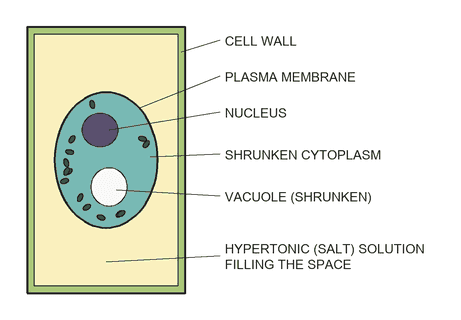
Watch out: The mercury RISES; it is pulled up by the leaves, not pushed up by the stand or the dish.
Therefore, (i) the mercury rises, and the glass tubing represents the xylem; (ii) transpiration is the loss of water as vapour from the aerial parts; (iii) the rate increases in both cases; (iv) cooling of the leaves and the suction force for the ascent of sap (or distribution of minerals); (v) the labelled plasmolysed cell shown above.
- 141 mark
Question 14
The paper used to demonstrate unequal transpiration in a dicot leaf is:
Solve with AIAnswer
(A) Filter paper
(B) Litmus paper
(C) Starch paper
- Correct
(D) Cobalt chloride paper
Answer: (D) Cobalt chloride paper
Concept: The experiment needs a paper that changes colour with moisture. Dry cobalt chloride paper is blue, and it turns pink when it absorbs moisture.
Step 1 — Recall the set-up.
Pieces of dry cobalt chloride paper are fixed on the upper and lower surfaces of a leaf, held by glass slides and clips, with the leaf still on the plant.
Step 2 — Read the result.
The paper on the lower surface turns pink much faster, because the lower surface of a dicot leaf has more stomata and gives out more water vapour. This shows the unequal transpiration.
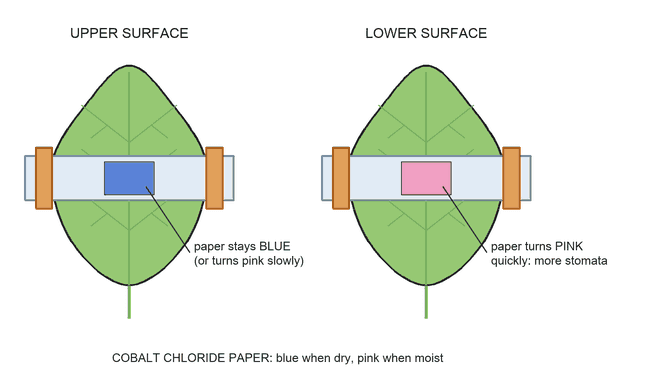
Why the other options are wrong:
- (A) Filter paper: filter paper soaks up water but does not change colour, so it cannot show which surface gives out more vapour.
- (B) Litmus paper: litmus paper tests for acids and bases; water vapour does not change its colour.
- (C) Starch paper: starch paper is not a moisture indicator; it shows no colour change with water vapour.
Therefore, the paper used is cobalt chloride paper, option (D).
- 151 mark
Question 15
Name the following:
(d) The openings on the barks of trees through which transpiration occurs.
Solve with AIWritten solution
Solution:
Concept: Lenticels are small openings in the bark (cork) of older woody stems, filled with loosely packed cells. They have no guard cells, so they stay open all the time.
Step 1 — Find openings in the bark.
Older woody stems are covered by bark (cork), through which water cannot pass. Small lens-shaped openings, the lenticels, break through it.
Step 2 — Say what passes through.
Lenticels allow gases to pass in and out for respiration, and some water vapour escapes through them as lenticular transpiration. It is a very small part of the total, much less than stomatal transpiration.
Watch out: Lenticels are in the BARK of stems; stomata are in the leaves.
Therefore, the openings on the bark are lenticels.
- 161 mark
Question 16
Define the term Transpiration.
Solve with AIWritten solution
Solution:
Concept: Transpiration is the loss of water in the form of water vapour from the aerial parts of a plant, mainly through the stomata of the leaves.
Step 1 — Say what is lost and in what form.
The plant loses water in the form of water vapour (a gas), not as liquid drops.
Step 2 — Say where it is lost from.
It is lost from the aerial parts of the plant: mainly through the stomata of the leaves (stomatal transpiration), and a little through the cuticle and the lenticels.
Watch out: Loss of liquid drops from leaf margins is guttation, not transpiration.
Therefore, transpiration is the loss of water in the form of water vapour from the aerial parts of the plant.
- 172 marks
Question 17
State any two adaptations in plants to reduce transpiration.
Solve with AIWritten solution
Solution:
Concept: Plants of dry places cut down the loss of water vapour by reducing the surface that loses water and by slowing the escape of vapour from the stomata.
Step 1 — Think about how water vapour escapes.
Water vapour leaves mainly through the stomata of the leaves, and a little through the leaf surface, so a plant saves water by having fewer or protected stomata and less exposed surface.
Step 2 — List the adaptations.
Any two of these:
- Sunken stomata: the stomata lie in pits, often lined with hairs (as in Nerium), so moist air stays trapped near them and vapour diffuses out slowly.
- Fewer stomata: fewer openings means fewer exits for water vapour.
- Thick, waxy cuticle: wax stops water evaporating from the leaf surface (as in many evergreen trees).
- Leaves reduced to spines or shed: as in most cacti, which cuts the surface that loses water.
- Narrow, rolled or folded leaves: less surface is exposed to the sun and the wind.
In sunken stomata, shown above, the pore lies in a pit lined with hairs. Moist air stays trapped in the pit, so water vapour diffuses out of the stoma more slowly.
Therefore, two adaptations are sunken stomata and a thick waxy cuticle (fewer stomata, leaves reduced to spines or rolled leaves are also correct).
- 182 marks
Question 18
Leaves of certain plants roll up on a hot sunny day. Explain by giving suitable reasons.
Solve with AIWritten solution
Solution:
Concept: On a hot sunny day transpiration is very fast. A plant that loses water faster than it absorbs it must cut down the loss to survive.
Step 1 — Find the cause of rolling.
On a hot sunny day the temperature is high and transpiration is fast. In plants such as many grasses, large thin-walled motor (bulliform) cells on the upper surface lose water first and become flaccid, so the leaf rolls up.
Step 2 — See what rolling does.
A rolled leaf exposes a smaller surface to the sun and the wind. The surface that bears most stomata is turned inwards, so moist air is trapped around the stomata and water vapour diffuses out more slowly.

Step 3 — State the result.
Rolling reduces transpiration and helps the plant conserve water during the hottest part of the day; the leaves unroll when water is plentiful again.
Watch out: Rolling is not wilting from damage; it is a protective response that saves water.
Therefore, leaves of certain plants roll up on a hot sunny day to reduce the exposed surface and trap moist air around their stomata, which cuts down transpiration and conserves water.
- 191 mark
Question 19
The process in which water is lost from the margins of strawberry leaves is:
Solve with AIAnswer
(A) Osmosis
(B) Imbibition
(C) Diffusion
- Correct
(D) Guttation
Answer: (D) Guttation
Concept: Guttation is the loss of water as liquid droplets from the margins (edges) of leaves, through special pores called hydathodes at the ends of the veins.
Step 1 — Note the clue in the question.
Water is lost from the margins of the leaves, and strawberry is one of the plants in which drops of water are seen along the leaf edges.
Step 2 — Explain why it happens.
In warm, humid conditions transpiration is low, but the roots go on absorbing water. Root pressure then forces the extra water out through the hydathodes at the vein tips, as droplets along the leaf margins. This is guttation.
Watch out: Loss of water VAPOUR through stomata is transpiration; loss of liquid DROPS from the margins is guttation.
Why the other options are wrong:
- (A) Osmosis: osmosis is the passage of water through a semi-permeable membrane from a dilute to a more concentrated solution, as from the soil into a root hair; it does not push drops out of leaf margins.
- (B) Imbibition: imbibition is the soaking up of water by dry solids such as seeds and wood.
- (C) Diffusion: diffusion is the spreading of molecules from higher to lower concentration; water leaving by diffusion through the stomata goes out as vapour, not as drops on the margins.
Therefore, the process is guttation, option (D).
- 201 mark
Question 20
Which one of the following helps in the opening of stomata:
Solve with AIAnswer
(A) Cobalt ions
- Correct
(B) Potassium ions
(C) Magnesium ions
(D) Aluminium ions
Answer: (B) Potassium ions
Concept: By the potassium ion theory, a stoma opens when potassium ions () move into its guard cells, and water follows them by osmosis.
Step 1 — Ions move in.
In daylight the guard cells use energy (ATP) to pump ions in from the neighbouring epidermal cells.
Step 2 — Water follows.
The guard-cell sap becomes more concentrated (hypertonic), so water enters the guard cells by endosmosis and they become turgid.
Step 3 — The pore opens.
The turgid guard cells bow outwards and the stoma opens. When the ions move back out, water leaves, the guard cells become flaccid and the stoma closes.

Watch out: It is the movement of potassium ions, not of sugar alone, that the theory names.
Why the other options are wrong:
- (A) Cobalt ions: cobalt appears in this chapter only in cobalt chloride paper, a moisture indicator; cobalt ions do not open the stomata.
- (C) Magnesium ions: magnesium is part of the chlorophyll molecule; its ions are not pumped in and out to open the stomata.
- (D) Aluminium ions: aluminium ions play no part in opening the stomata.
Therefore, potassium ions help in the opening of stomata, option (B).
- 211 mark
Question 21
Arrange and rewrite the terms in each group in the correct order to be in a logical sequence beginning with the term that is underlined:
(e) Water vapour, Soil water, Leaves, Ascent of Sap
Solve with AIWritten solution
Solution:
Concept: Follow the path of water through the plant: it is absorbed from the soil, rises in the stem, reaches the leaves and leaves the plant as vapour.
Step 1 — Start with the underlined term.
The sequence begins with soil water, which the root hairs absorb and pass on to the xylem of the root.
Step 2 — Follow the water up.
The water rises through the xylem of the stem; this upward movement is the ascent of sap. It reaches the leaves through the veins.
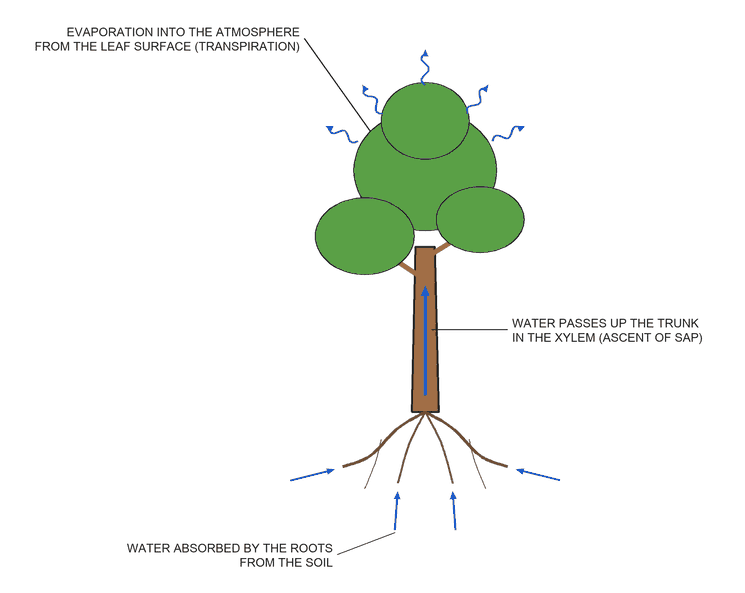
Step 3 — End with its loss.
In the leaves the water evaporates and escapes through the stomata as water vapour (transpiration).
Watch out: Ascent of sap comes BEFORE the leaves: the water must rise through the stem to reach them.
Therefore, the sequence is Soil water → Ascent of Sap → Leaves → Water vapour.
- 222 marks
Question 22
Mention two advantages of Transpiration.
Solve with AIWritten solution
Solution:
Concept: Transpiration is the loss of water in the form of water vapour from the aerial parts of a plant, mainly through the stomata of the leaves. Though it costs the plant water, it is useful in several ways.
Step 1 — Think about what the loss of vapour does.
Evaporation takes heat away, and the loss of water from the leaves pulls more water up from below.
Step 2 — List the advantages.
Any two of these:
- Cooling effect: the evaporation of water takes heat from the leaf, so the leaf stays cooler on hot, sunny days.
- Suction force (transpiration pull): the loss of water from the leaves pulls water and dissolved minerals up the xylem from the roots (ascent of sap).
- Distribution of water and minerals: water drawn towards the leaves at every branch tip carries minerals to all parts of the plant.
Therefore, two advantages of transpiration are the cooling of the leaves and the suction force that draws water and minerals up the xylem (distribution of water and minerals is also correct).
- 232 marks
Question 23
Write any two limitations of using a Ganong's Potometer to demonstrate the uptake of water.
Solve with AIWritten solution
Solution:
Concept: A potometer (Ganong's potometer) measures the rate at which a cut leafy shoot takes up water. Because nearly all the water taken up is lost by transpiration, this rate is almost equal to the rate of transpiration.
Step 1 — Recall how it gives a reading.
The volume of water taken up is read from how far an air bubble moves along a graduated capillary tube in a given time.
Step 2 — List the limitations.
Any two of these:
- Introducing the air bubble is not easy.
- The cut twig may not remain fully alive for long, so its uptake changes during the experiment.
- Changes in air temperature around the tube may shift the air bubble on their own.
- It measures the water taken up, not exactly the water lost: a little of the water is used by the cells (for example in photosynthesis).
Therefore, two limitations are that introducing the air bubble is not easy and that the twig may not remain alive for long (temperature changes moving the bubble, and uptake not equalling loss, are also correct).
- 241 mark
Question 24
Name the following:
(b) A waxy layer on the upper epidermis of leaves meant to reduce Transpiration.
Solve with AIWritten solution
Solution:
Concept: The cuticle is a waxy layer secreted by the epidermis over the surface of the leaf. Water cannot pass through wax easily, so the cuticle cuts down the evaporation of water from the leaf surface.
Step 1 — Find the waxy layer.
The epidermis secretes a waxy layer over the leaf surface; on the upper surface, which faces the sun, it is usually thicker. This layer is the cuticle.
Step 2 — Say how it reduces transpiration.
Wax keeps water from evaporating through the surface, so the thicker the cuticle, the less water the leaf loses.
Therefore, the waxy layer is the cuticle.
- 251 mark
Question 25
Read the explanations given below and name the structures:
Example: The tubules which produce sperms.
Answer: Seminiferous tubules
(e) Regulation of the opening and closing of stomata.
Solve with AIWritten solution
Solution:
Concept: A stoma is a tiny pore in the epidermis of a leaf. It is bordered by two bean-shaped guard cells, whose change of shape opens and closes the pore.
Step 1 — Find the cells around the pore.
Each stoma is bordered by two bean-shaped guard cells.
Step 2 — Say how they regulate it.
When the guard cells become turgid they bow outwards and the stoma opens; when they become flaccid they straighten and the stoma closes.
Therefore, the structures are the guard cells.
- 261 mark
Question 26
Where are Hydathodes located?
Solve with AIWritten solution
Solution:
Concept: Guttation is the loss of water as liquid droplets from the margins (edges) of leaves, through special pores called hydathodes at the ends of the veins.
Step 1 — Recall their job.
Hydathodes are the water pores through which guttation takes place.
Step 2 — Give their location.
They are found on the margins (edges) of the leaves, at the tips of the veins, for example in banana, nasturtium and strawberry leaves.
Watch out: Hydathodes are always open and give out liquid water; stomata give out vapour and can close.
Therefore, hydathodes are located on the margins of the leaves, at the tips of the veins.
- 271 mark
Question 27
Which adaptation is NOT associated with desert plants to minimise water loss through transpiration?
Solve with AIAnswer
(A) Reduced number of stomata
(B) Thick, waxy cuticle
(C) Deep root systems
- Correct
(D) Increased leaf surface area
Answer: (D) Increased leaf surface area
Concept: Desert plants must save water, so their leaf adaptations reduce the surface and the openings through which water vapour escapes.
Step 1 — Check the leaf features.
A reduced number of stomata and a thick, waxy cuticle both cut down transpiration, so they are desert adaptations.
Step 2 — Check the roots.
Deep roots are also found in many desert plants, such as acacias and mesquite; they help the plant reach water deep in the soil and so keep its water balance.
Step 3 — Find the odd one out.
A larger leaf surface has more stomata and more surface for evaporation, so it increases transpiration. Desert plants have small, narrow or spiny leaves instead.
Watch out: Read 'NOT' in the question: three options are real desert features.
Note: Strictly, deep roots help a plant obtain water rather than reduce its loss; but only option (D) would increase transpiration, so (D) is the intended key.
Why the other options are wrong:
- (A) Reduced number of stomata: a reduced number of stomata means fewer exits for water vapour, a real desert adaptation.
- (B) Thick, waxy cuticle: a thick, waxy cuticle lowers evaporation from the leaf surface, a real desert adaptation.
- (C) Deep root systems: deep root systems are a real desert feature (in acacias and mesquite, for example); they help the plant obtain water rather than reduce its loss, but they are associated with desert plants. Cacti themselves have shallow, wide-spreading roots that catch light rain.
Therefore, the adaptation not associated with desert plants is an increased leaf surface area, option (D).
- 285 marks
Question 28
Given below is an experiment to demonstrate the magnitude of transpiration in a dicot leaf. Read the information given below and fill in the blanks.
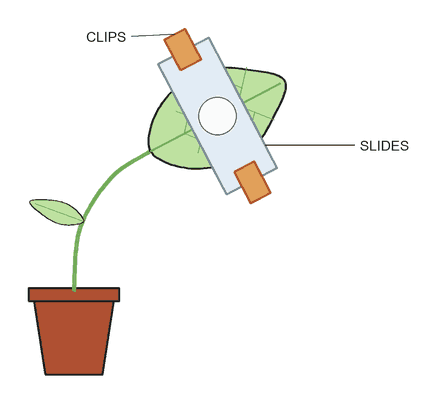
Transpiration is the process of loss of water as water vapour from the aerial parts of the plant. It is the essential driving force for the ascent of sap. Less than 1% of the water absorbed by the roots is used in photosynthesis and plant growth. The rest of the water is lost during transpiration.
Pieces of dried (a) ............... paper are fixed to the two surfaces of a leaf. The leaf should remain attached to the plant. The plant is exposed to bright sunlight for a few hours. The colour of the paper on the lower surface of the leaf turns (b) ............... faster than the one on the upper surface. This proves that more (c) ............... occurs from the (d) ............... surface of the leaf as it has a greater number of (e) ............... .
Solve with AIWritten solution
Solution:
Concept: Cobalt chloride paper is an indicator of moisture: blue when dry, pink when moist. The paper on the surface that gives out more water vapour turns pink first.
Step 1 — Fill blank (a).
The paper used must show moisture, so it is cobalt chloride paper, dried before use so that it is blue.
Step 2 — Fill blank (b).
As it absorbs water vapour, the blue paper turns pink.
Step 3 — Fill blanks (c) and (d).
The paper on the lower surface turns pink faster, so more transpiration occurs from the lower surface.
Step 4 — Fill blank (e).
The lower surface of a dicot leaf has a greater number of stomata, which is why it loses more water vapour.
The paper on the upper surface stays blue, or turns pink only after a much longer time. The leaf is kept on the plant so that it stays alive and goes on transpiring normally.
Step 5 — Read the completed passage.
Pieces of dried cobalt chloride paper are fixed to the two surfaces of a leaf … The colour of the paper on the lower surface of the leaf turns pink faster than the one on the upper surface. This proves that more transpiration occurs from the lower surface of the leaf as it has a greater number of stomata.
Watch out: The paper must be DRY (blue) at the start, or it will already be pink.
Note: The passage says less than 1% of the absorbed water is used in photosynthesis and growth. Books quote this share differently (about 1–2%); either way, almost all the water absorbed is lost by transpiration.
Therefore, (a) cobalt chloride, (b) pink, (c) transpiration, (d) lower, (e) stomata.
- 293 marks
Question 29
Navya is a high school biology student who recently visited a local farm as part of a school project. She observed water droplets on the leaves of certain plants early in the morning as shown in the figure.
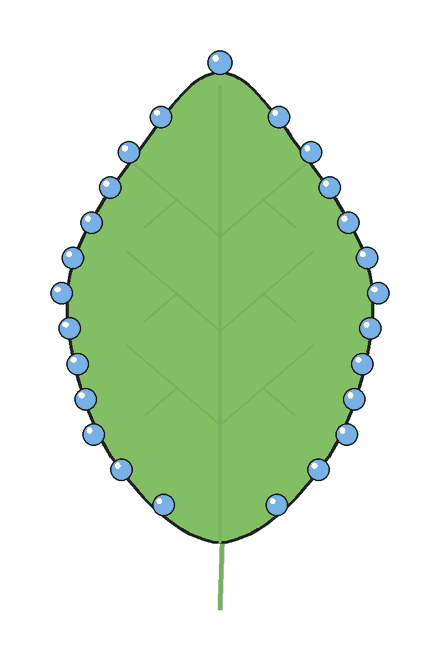
(a) Name the process observed.
(b) Explain the process mentioned in (a).
(c) Give the reason for the occurrence of the above-mentioned process.
Solve with AIWritten solution
Solution:
Concept: Guttation is the loss of water as liquid droplets from the margins (edges) of leaves, through special pores called hydathodes at the ends of the veins.
Step 1 — (a) Name the process.
Drops of liquid water along the edges of leaves early in the morning are pushed out of the leaf itself, so the process is guttation.
Step 2 — (b) Explain the process.
In guttation, water is lost as liquid droplets along the margins of the leaves. It comes out through special pores called hydathodes, present at the tips of the veins on the leaf margin. The fluid is mainly water with some dissolved mineral salts.
Step 3 — (c) Give the reason.
It happens in warm, humid conditions, usually at night or early in the morning. The humid air slows transpiration, but the roots go on absorbing water from the moist soil. Root pressure builds up in the xylem and forces out the extra water through the hydathodes as droplets.

Watch out: These droplets are not dew: dew condenses from the air onto any surface, while guttation drops come out of the leaf at the vein endings.
Therefore, (a) the process is guttation; (b) water is lost as liquid droplets through hydathodes at the leaf margins; (c) in warm, humid conditions transpiration is low while the roots keep absorbing water, so root pressure forces the excess water out.
- 303 marks
Question 30
Draw a neat, labelled diagram of a stomatal apparatus.
Solve with AIWritten solution
Solution:
Concept: A stomatal apparatus is the stoma (pore) together with its two bean-shaped guard cells, set among the epidermal cells of the leaf.
Step 1 — Draw the guard cells and the pore.
Draw two bean-shaped guard cells facing each other, with the pore (stoma) between them. Show each guard cell with a nucleus and chloroplasts, a thick inner wall next to the pore and a thin outer wall.
Step 2 — Add the surrounding cells and labels.
Draw the irregular epidermal cells around the guard cells, and label: guard cell, stoma, nucleus, chloroplasts, thick inner wall, thin outer wall, epidermal cell and cell wall.
Step 3 — Say how it works.
When the guard cells are turgid they bow outwards and the pore opens; when they are flaccid the pore closes.
Watch out: Only the guard cells have chloroplasts; do not draw chloroplasts in the ordinary epidermal cells.
Therefore, the stomatal apparatus is drawn as two bean-shaped guard cells around the stoma, among the epidermal cells, labelled as shown above.
- 311 mark
Question 31
Assertion (A): A thick cuticle reduces transpiration by acting as a barrier.
Reason (R): Desert plants have large, thin leaves for transpiration.
Solve with AIAnswer
- Correct
(A) (A) is true and (R) is false
(B) (A) is false and (R) is true
(C) Both (A) and (R) are true and (R) is the correct explanation of (A).
(D) Both (A) and (R) are true and (R) is not the correct explanation of (A).
Answer: (A) (A) is true and (R) is false
Concept: In an assertion–reason item, judge the Assertion (A) and the Reason (R) separately as true or false; only when both are true do we ask whether R correctly explains A.
Step 1 — Judge the Assertion.
A is true. The cuticle is a waxy layer that prevents evaporation of water from the leaf surface; the thicker the cuticle, the less the transpiration.
Step 2 — Judge the Reason.
R is false. Desert plants need to save water, so they have small, narrow or spiny leaves, not large thin leaves; large thin leaves would lose much more water.
Step 3 — Decide the option.
A is true and R is false, so the question of R explaining A does not arise.
Why the other options are wrong:
- (B) (A) is false and (R) is true: it says the Assertion is false, but a thick cuticle does reduce transpiration.
- (C) Both (A) and (R) are true and (R) is the correct explanation of (A): it says the Reason is true, but desert plants do not have large, thin leaves.
- (D) Both (A) and (R) are true and (R) is not the correct explanation of (A): it also says the Reason is true, which it is not.
Therefore, A is true and R is false, option (A).
- 322 marks
Question 32
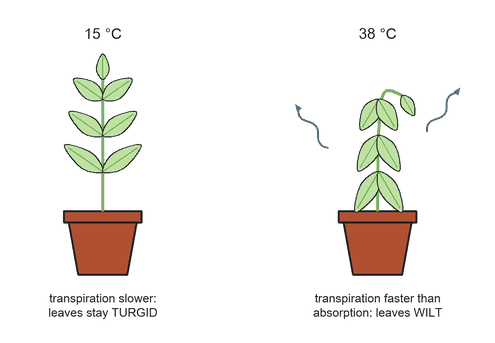
Two well-watered, identical plants were placed in brightly lit rooms at different temperatures — one at 15°C and the other at 38°C. The plant in the warmer room showed wilting by the end of the day.
(a) Which plant phenomenon resulted in the wilting of the leaves?
(b) Mention the factor of the phenomenon that is being tested.
Solve with AIWritten solution
Solution:
Concept: The rate of transpiration depends on the conditions around the leaves: it rises with light (the stomata open), high temperature and wind, and falls with high humidity of the air.
Step 1 — Spot the one difference.
The two plants are identical, well watered and brightly lit; they differ only in the temperature of the room (15 °C and 38 °C).
Step 2 — (a) Name the phenomenon.
At 38 °C more water evaporates from the leaf cells, so the plant loses water by transpiration faster than its roots can absorb it. The leaf cells lose turgidity and the leaves wilt.
Step 3 — (b) Name the factor tested.
Since only the temperature differs, the factor being tested is temperature: a higher temperature increases the rate of transpiration.
Watch out: Light is the same in both rooms, so it is not the factor being tested.
Therefore, (a) the wilting resulted from transpiration (excess loss of water), and (b) the factor being tested is temperature.
- 331 mark
Question 33
Assertion (A): Transpiration decreases the amount of moisture in the atmosphere.
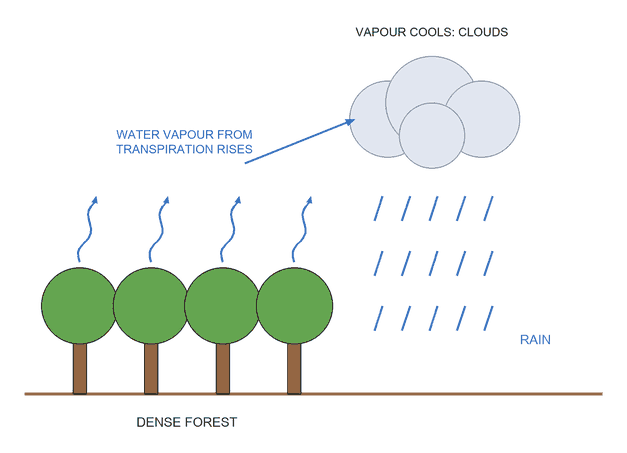
Reason (R): A dense forest contributes to bringing rain due to transpiration.
Solve with AIAnswer
(A) (A) is true and (R) is false.
- Correct
(B) (A) is false and (R) is true.
(C) Both (A) and (R) are true and (R) is the correct explanation of (A).
(D) Both (A) and (R) are true, but (R) is not the correct explanation of (A).
Answer: (B) (A) is false and (R) is true.
Concept: In an assertion–reason item, judge the Assertion (A) and the Reason (R) separately as true or false; only when both are true do we ask whether R correctly explains A. Plants give out huge amounts of water vapour: a single large tree can lose hundreds of litres of water in a hot day.
Step 1 — Judge the Assertion.
A is false. Transpiration adds water vapour to the air, so it increases the moisture in the atmosphere; it does not decrease it.
Step 2 — Judge the Reason.
R is true. The water vapour given out by a dense forest rises, cools and forms clouds, which bring rain, so forests help to bring rain through transpiration.
Step 3 — Decide the option.
A is false and R is true.
Why the other options are wrong:
- (A) (A) is true and (R) is false: it says the Assertion is true, but transpiration adds moisture to the air.
- (C) Both (A) and (R) are true and (R) is the correct explanation of (A): it says both are true, but the Assertion is false.
- (D) Both (A) and (R) are true, but (R) is not the correct explanation of (A): it also says the Assertion is true, which it is not.
Therefore, A is false and R is true, option (B).
- 341 mark
Question 34
Give the biological / technical terms for the following:
(e) The epidermal pores through which guttation takes place.
Solve with AIWritten solution
Solution:
Concept: Guttation is the loss of water as liquid droplets from the margins (edges) of leaves, through special pores called hydathodes at the ends of the veins.
Step 1 — Note the process named.
The question asks for the pores of guttation, not of transpiration.
Step 2 — Name the pores.
Guttation takes place through hydathodes, special water pores on the margins of the leaves at the tips of the veins. Excess water is forced out through them as droplets, as in banana, nasturtium, strawberry and grasses.
Watch out: Stomata are the pores of transpiration; hydathodes are the pores of guttation.
Therefore, the epidermal pores through which guttation takes place are hydathodes.
- 355 marks
Question 35
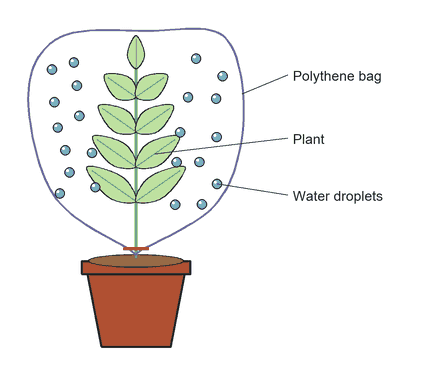
A potted plant is kept in sunlight and the plant is covered with a polythene cover. Water droplets appear inside the cover after few hours. Answer the following questions:
(a) Name the process that is observed in the above experiment.
(b) From which part of the plant does water loss mainly occur?
(c) How does this process help in water conduction?
(d) Name one environmental factor that can increase the process mentioned in (a).
(e) What will happen if the process in (a) stops?
Solve with AIWritten solution
Solution:
Concept: Transpiration is the loss of water in the form of water vapour from the aerial parts of a plant, mainly through the stomata of the leaves. Vapour that cannot escape from a closed bag condenses as drops on its inner surface.
Step 1 — (a) Name the process.
The plant gives out water vapour, which condenses as droplets inside the cover, so the process is transpiration.
Step 2 — (b) Name the main part.
Water is lost mainly from the leaves, through their stomata (more of them on the lower surface).
Step 3 — (c) Explain the help in conduction.
As water evaporates from the leaves, a suction force (transpiration pull) is produced at the top of the plant. It draws water up through the xylem of the stem (ascent of sap) and makes the roots absorb more water from the soil.
Step 4 — (d) Name one factor.
High temperature increases transpiration (bright light, wind and low humidity also increase it).
Step 5 — (e) Predict the effect of stopping it.
With no suction force, the upward movement of water and minerals and their absorption by the roots would slow down greatly. The leaves would also lose the cooling effect of transpiration and could be harmed by heat on hot days.
Watch out: The droplets inside the bag are condensed VAPOUR from transpiration, not guttation drops.
Therefore, (a) transpiration; (b) the leaves, through their stomata; (c) it creates a suction force that pulls water up the xylem; (d) high temperature; (e) the ascent of water and minerals would slow down and the leaves would lose their cooling.
- 362 marks
Question 36
Sanjay, a 14-year-old boy observed droplets of water on the grass when he went for a walk in the morning.
(a) What is this phenomenon of formation of water droplets on grass called?
(b) Name the structures through which the water droplets come out.
Solve with AIWritten solution
Solution:
Concept: Guttation is the loss of water as liquid droplets from the margins (edges) of leaves, through special pores called hydathodes at the ends of the veins.
Step 1 — (a) Name the phenomenon.
Drops of liquid water at the tips and edges of grass blades early in the morning are pushed out of the plant itself. In warm, humid conditions the roots go on absorbing water while transpiration is low, and root pressure forces the extra water out. This is guttation.
Step 2 — (b) Name the structures.
The drops come out through hydathodes, special water pores at the tips of the veins on the leaf margins and blade tips.
Watch out: Some drops on grass in the morning may also be dew, which condenses from the air; the drops forced out at the blade tips are guttation drops.
Therefore, (a) the phenomenon is guttation, and (b) the droplets come out through hydathodes.