
Question 172 marksAsked 2023Easy
State any two adaptations in plants to reduce transpiration.
Confirming your payment
Sign up now and get 250 free tokens.
Previous Year Questions · Question 17 of 36
State any two adaptations in plants to reduce transpiration.
Solution:
Concept: Plants of dry places cut down the loss of water vapour by reducing the surface that loses water and by slowing the escape of vapour from the stomata.
Step 1 — Think about how water vapour escapes.
Water vapour leaves mainly through the stomata of the leaves, and a little through the leaf surface, so a plant saves water by having fewer or protected stomata and less exposed surface.
Step 2 — List the adaptations.
Any two of these:
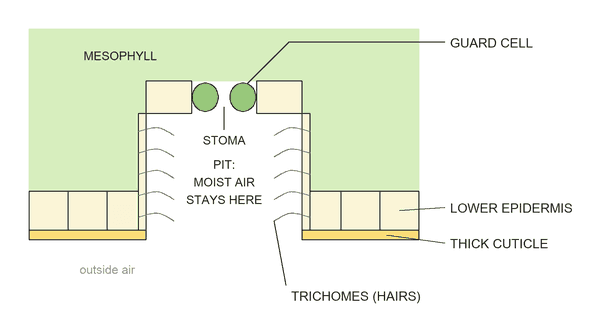
In sunken stomata, shown above, the pore lies in a pit lined with hairs. Moist air stays trapped in the pit, so water vapour diffuses out of the stoma more slowly.
Therefore, two adaptations are sunken stomata and a thick waxy cuticle (fewer stomata, leaves reduced to spines or rolled leaves are also correct).