Solution:
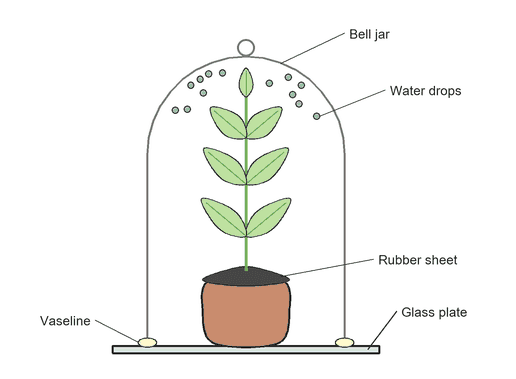
Concept: Transpiration is the loss of water in the form of water vapour from the aerial parts of a plant, mainly through the stomata of the leaves. Water vapour given out inside a closed bell jar condenses as drops on the cooler glass.
Step 1 — (i) Name and define the process.
The drops inside the jar come from water vapour given out by the leaves, so the process is transpiration: the loss of water in the form of water vapour from the aerial parts of the plant.
Step 2 — (ii) Explain the rubber sheet.
The rubber sheet covers the pot and the soil, so it prevents evaporation of water from the soil and the pot. The drops on the inner wall of the jar must then have come from the plant alone.
Step 3 — (iii) Name two factors that speed it up.
Any two of these external factors increase transpiration:
- High temperature: more water evaporates from the leaf cells.
- Bright light: the stomata open wider.
- Wind: it removes the moist air around the leaves.
- Low humidity (dry air): vapour diffuses out faster.
Step 4 — (iv) List two adaptations.
Plants cut down transpiration in these ways (any two):
- Sunken stomata: the stomata lie in pits, often lined with hairs (as in Nerium), so moist air stays trapped near them and vapour diffuses out slowly.
- Fewer stomata: fewer openings means fewer exits for water vapour.
- Thick, waxy cuticle: wax stops water evaporating from the leaf surface (as in many evergreen trees).
- Leaves reduced to spines or shed: as in most cacti, which cuts the surface that loses water.
- Narrow, rolled or folded leaves: less surface is exposed to the sun and the wind.
Step 5 — (v) Draw the stomatal apparatus.
The diagram shows a stoma, the pore, with two bean-shaped guard cells around it, set among the epidermal cells.
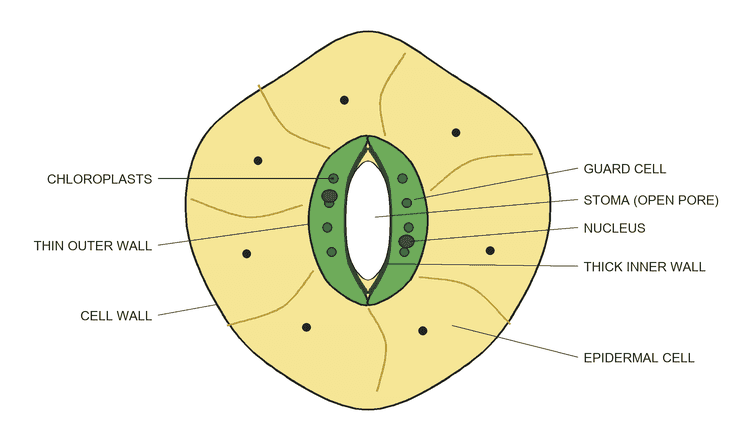
Each guard cell has a nucleus and chloroplasts, a thick inner wall next to the pore and a thin outer wall. When the guard cells are turgid they bow outwards and the pore opens; when flaccid, it closes.
Watch out: The bell jar must stand on a glass plate sealed with vaseline, so no water vapour from outside can get in.
Therefore, (i) transpiration, the loss of water as vapour from the aerial parts; (ii) the rubber sheet stops evaporation from the soil, so the drops come from the plant alone; (iii) high temperature and bright light (also wind, dry air); (iv) sunken stomata and a thick cuticle (or fewer stomata, spines); (v) the labelled stomatal apparatus shown above.