Solution:
Concept: Transpiration is the loss of water in the form of water vapour from the aerial parts of a plant, mainly through the stomata of the leaves. The water lost from the leaves is replaced by water pulled up from below (transpiration pull).
Step 1 — (i) Predict the mercury level.
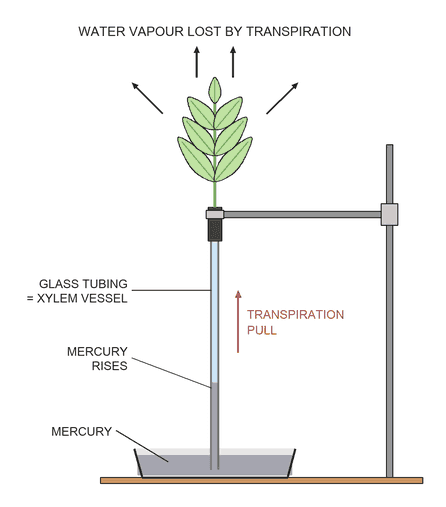
The leaves lose water by transpiration, and the water lost is replaced from the glass tubing. The suction force (transpiration pull) draws the water column up, and the mercury follows it, so the level of mercury in the glass tubing rises.
The glass tubing plays the part of the xylem (xylem vessels), which conduct water up from the roots.
Step 2 — (ii) Define transpiration.
Transpiration is the loss of water in the form of water vapour from the aerial parts of the plant, mainly through the stomata of the leaves.
Step 3 — (iii) Predict the rate.
(a) Less humidity: the rate increases, because water vapour diffuses out of the leaf faster into dry air.
(b) High temperature: the rate increases, because more water evaporates from the leaf cells and warm air can hold more water vapour.
Step 4 — (iv) State two advantages.
Transpiration helps the plant in these ways (any two):
- Cooling effect: the evaporation of water takes heat from the leaf, so the leaf stays cooler on hot, sunny days.
- Suction force (transpiration pull): the loss of water from the leaves pulls water and dissolved minerals up the xylem from the roots (ascent of sap).
- Distribution of water and minerals: water drawn towards the leaves at every branch tip carries minerals to all parts of the plant.
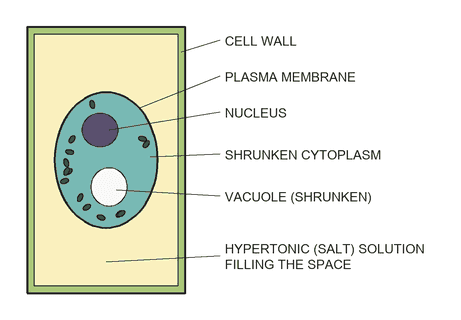
Step 5 — (v) Draw a plasmolysed cell.
In a strong (hypertonic) solution, water leaves the cell by exosmosis. The cytoplasm shrinks away from the cell wall, and the outside solution fills the space between them.
Watch out: The mercury RISES; it is pulled up by the leaves, not pushed up by the stand or the dish.
Therefore, (i) the mercury rises, and the glass tubing represents the xylem; (ii) transpiration is the loss of water as vapour from the aerial parts; (iii) the rate increases in both cases; (iv) cooling of the leaves and the suction force for the ascent of sap (or distribution of minerals); (v) the labelled plasmolysed cell shown above.

