Solution:
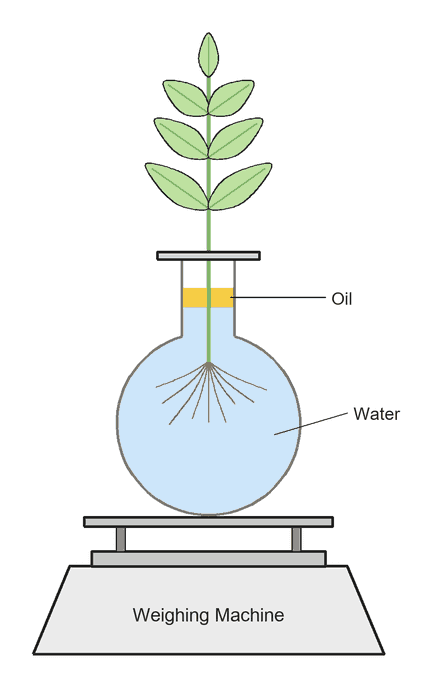
Concept: Transpiration is the loss of water in the form of water vapour from the aerial parts of a plant, mainly through the stomata of the leaves. Water lost from a closed set-up can leave it only by the routes we leave open.
Step 1 — (i) Name the process and the use of the oil.
The plant gives out water vapour from its leaves, so the process is transpiration.
The oil forms a layer on the water surface and prevents evaporation of water from the flask. So any water that leaves the set-up must have left through the plant.
Step 2 — (ii) Compare the weights.
The final weight is less than the initial weight. In bright sunlight the leaves lose water vapour by transpiration, and the roots draw water from the flask to replace it. Because the oil stops evaporation from the water surface, the loss in weight is the water lost by transpiration.

Step 3 — (iii) Predict the water level.
(a) Humid conditions: the level falls only slowly. Humid air already holds much water vapour, so vapour diffuses out of the leaves slowly and less water is drawn from the flask.
(b) Windy conditions: the level falls faster. Wind carries away the moist air around the leaves, so vapour keeps diffusing out quickly and more water is drawn from the flask.
Step 4 — (iv) List three adaptations.
Plants cut down transpiration in these ways (any three):
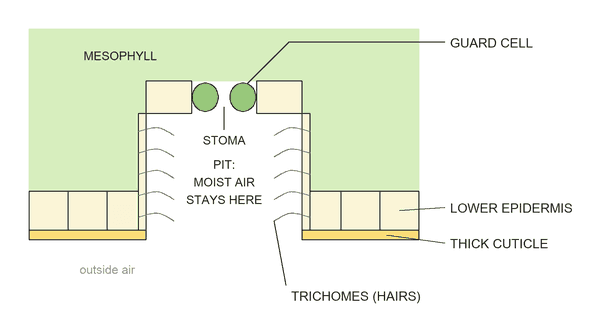
- Sunken stomata: the stomata lie in pits, often lined with hairs (as in Nerium), so moist air stays trapped near them and vapour diffuses out slowly.
- Fewer stomata: fewer openings means fewer exits for water vapour.
- Thick, waxy cuticle: wax stops water evaporating from the leaf surface (as in many evergreen trees).
- Leaves reduced to spines or shed: as in most cacti, which cuts the surface that loses water.
- Narrow, rolled or folded leaves: less surface is exposed to the sun and the wind.
Step 5 — (v) Explain guttation.
Guttation is the loss of water as liquid droplets from the margins (edges) of leaves, through special pores called hydathodes at the ends of the veins. It happens in warm, humid conditions, usually at night or early in the morning, when transpiration is very low but the roots go on absorbing water. Root pressure then builds up and forces the extra water out through the hydathodes; the droplets carry some dissolved salts. It is seen in banana, nasturtium, tomato and grasses.
Watch out: The oil does not stop transpiration; it only stops evaporation from the WATER SURFACE in the flask.
Therefore, (i) transpiration, and the oil prevents evaporation from the water surface; (ii) the final weight is less, because the plant loses water by transpiration; (iii) the level falls slowly in humid air and faster in wind; (iv) sunken stomata, fewer stomata, a thick cuticle (or spines, rolled leaves); (v) guttation is the loss of liquid water droplets from the leaf margins through hydathodes.