Solution:
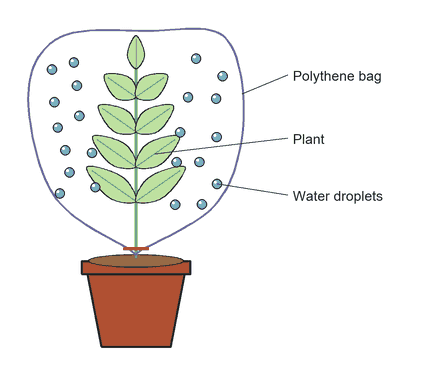
Concept: Transpiration is the loss of water in the form of water vapour from the aerial parts of a plant, mainly through the stomata of the leaves. Vapour that cannot escape from a closed bag condenses as drops on its inner surface.
Step 1 — (a) Name the process.
The plant gives out water vapour, which condenses as droplets inside the cover, so the process is transpiration.
Step 2 — (b) Name the main part.
Water is lost mainly from the leaves, through their stomata (more of them on the lower surface).
Step 3 — (c) Explain the help in conduction.
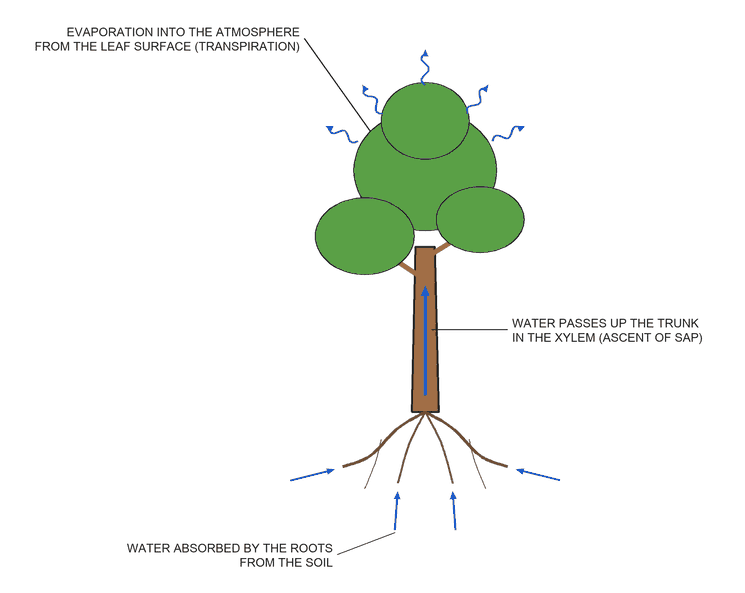
As water evaporates from the leaves, a suction force (transpiration pull) is produced at the top of the plant. It draws water up through the xylem of the stem (ascent of sap) and makes the roots absorb more water from the soil.
Step 4 — (d) Name one factor.
High temperature increases transpiration (bright light, wind and low humidity also increase it).
Step 5 — (e) Predict the effect of stopping it.
With no suction force, the upward movement of water and minerals and their absorption by the roots would slow down greatly. The leaves would also lose the cooling effect of transpiration and could be harmed by heat on hot days.
Watch out: The droplets inside the bag are condensed VAPOUR from transpiration, not guttation drops.
Therefore, (a) transpiration; (b) the leaves, through their stomata; (c) it creates a suction force that pulls water up the xylem; (d) high temperature; (e) the ascent of water and minerals would slow down and the leaves would lose their cooling.