
Question 32 marksEasy
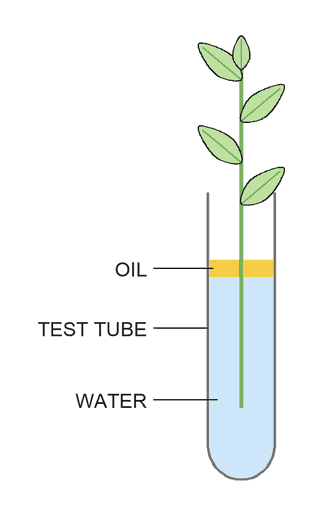
Look at the experiment shown in Fig. 5.4. Suppose you took a single flower with a long stalk dipping in water, instead of a leafy twig. Will it serve the purpose?
Yes/No. Give reason.
Confirming your payment
Sign up now and get 250 free tokens.
Transpiration · Question 3 of 45
Look at the experiment shown in Fig. 5.4. Suppose you took a single flower with a long stalk dipping in water, instead of a leafy twig. Will it serve the purpose?
Yes/No. Give reason.
Solution:
Concept: Most transpiration takes place through the stomata of the leaves. The set-up shows transpiration by a loss in weight, so the shoot must lose a measurable amount of water.
Step 1 — Compare the two shoots.
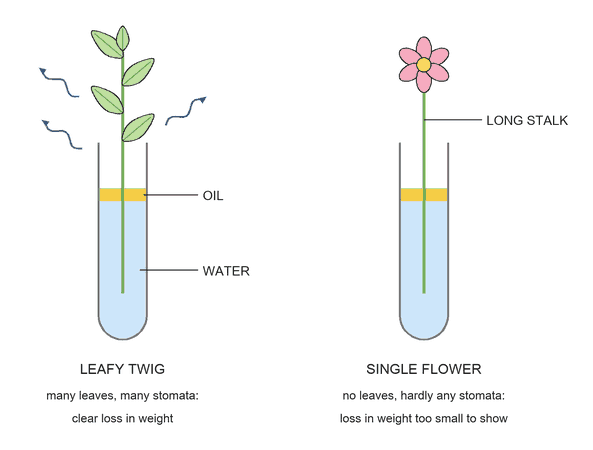
A single flower on a long stalk has no leaves, so it has hardly any stomata. A leafy twig has a large leaf surface with numerous stomata.
Step 2 — Predict the result.
The flower loses very little water, so the loss in weight of the test tube would be too small to notice. The leafy twig gives a clear loss in weight in a few hours.
Step 3 — Note the oil.
In both cases the oil layer stops evaporation from the water surface, so any loss in weight is due to the shoot alone.
Therefore, no: a single flower will not serve the purpose, because without leaves (and their stomata) it transpires too little to show a clear loss in weight.