Solution:
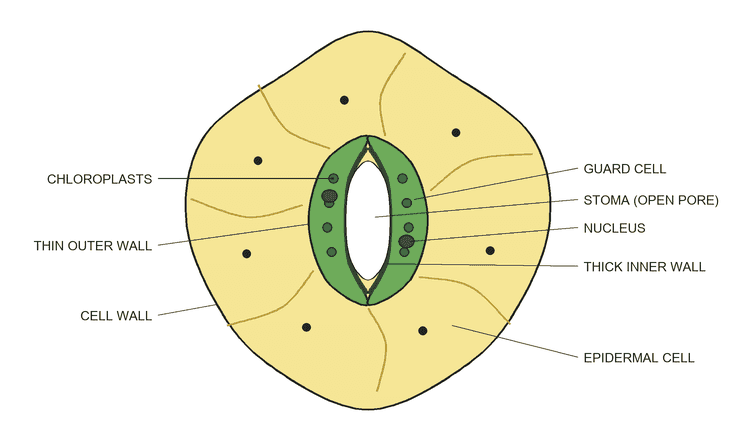
Concept: A stoma is a minute opening (B) in the leaf epidermis, surrounded by two bean-shaped guard cells (A).
Step 1 — (a) Label A and B.
A: guard cells. B: stoma (the stomatal pore).
Step 2 — (b) Exact location.
They occur in the epidermis of leaves, in large numbers on the lower epidermis of a dicot leaf.
Step 3 — (c) One role of A.
The guard cells regulate the opening and closing of the stoma: turgid guard cells open it, flaccid ones close it.
Step 4 — (d) Three roles of B.
- Transpiration: water vapour escapes through it.
- Photosynthesis: carbon dioxide diffuses in (and oxygen out).
- Respiration: it allows exchange of gases for respiration.
Step 5 — (e) Redraw with flaccid guard cells (printed as a second "(c)").
When the guard cells are flaccid, their thick inner walls straighten and come together, so the stoma closes. This happens when the water content of the leaf falls (for example, during heavy water loss on a hot afternoon) and at night. Labels: flaccid guard cell, stoma closed, nucleus, chloroplasts, epidermal cell.
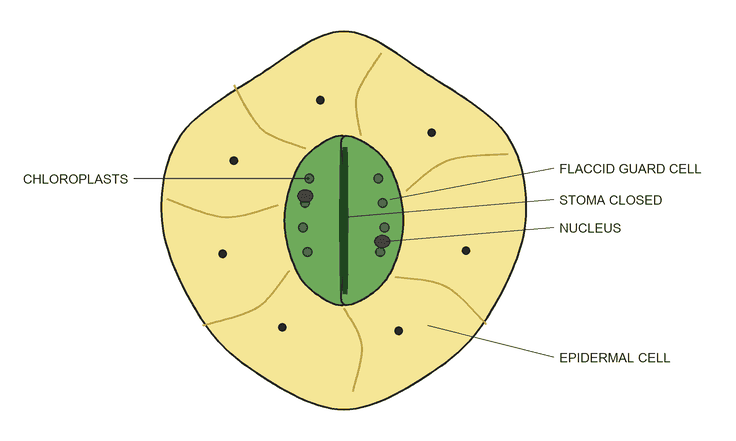
Therefore, (a) A guard cells, B stoma; (b) in the leaf epidermis, mostly the lower one; (c) A open and close the stoma; (d) transpiration, photosynthesis, respiration; (e) flaccid guard cells close the stoma, as drawn.

