Solution:
Concept: Each part asks for one technical term of the chapter. The clue words are "stem", "droplets", "rate", "sunken" and "margins".
Step 1 — (a) Openings on the stem.
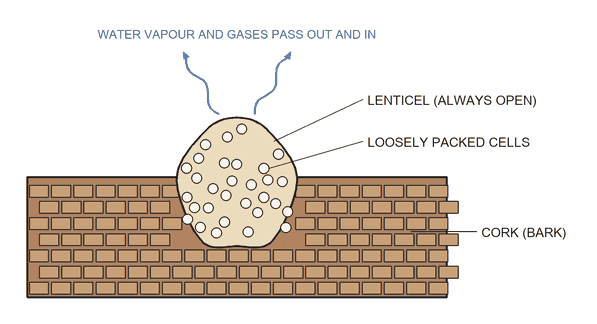
Minute openings on old woody stems, always open, through which lenticular transpiration occurs: lenticels.
Step 2 — (b) An intact plant losing droplets.
Loss of liquid water as droplets from an uninjured plant, through the hydathodes: guttation.
Step 3 — (c) Instrument for the rate of transpiration.
It measures the rate of water uptake, which is almost equal to the water lost: the potometer.
Step 4 — (d) A plant with sunken stomata.
Nerium (oleander); its sunken, hairy stomata reduce transpiration.
Step 5 — (e) Apparatus for a cut shoot.
A cut twig is fixed in it and an air bubble moves along a graduated capillary: a potometer (for example, Ganong's potometer).
Step 6 — (f) Two parts of a leaf that allow transpiration.
The stomata (stomatal transpiration) and the cuticle (cuticular transpiration).
Step 7 — (g) Structure that allows guttation.
Pores on the leaf margins at the tips of the veins: hydathodes.

Step 8 — (h) Droplets from the margins of certain leaves.
Guttation, common in banana, nasturtium and strawberry growing in warm, humid conditions.
Watch out: (c) and (e) have the same answer; (e) asks for the apparatus used with a cut shoot, which is Ganong's potometer.
Therefore, (a) lenticels, (b) guttation, (c) potometer, (d) Nerium, (e) Ganong's potometer, (f) stomata and cuticle, (g) hydathodes, (h) guttation.
