Solution:
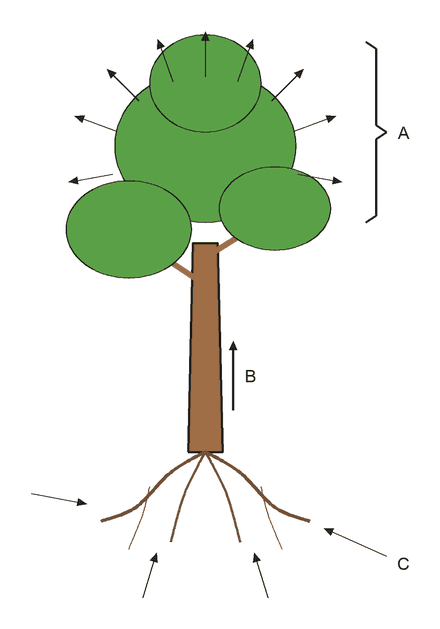
Concept: The diagram shows the transpiration stream: water enters at the roots (C), passes up the trunk (B) and is lost from the leaves (A).
Step 1 — (a) Name and define A.
A is transpiration: the loss of water in the form of water vapour from the leaves and other aerial parts of the plant.
Step 2 — (b) Significance of A.
- Cooling effect: evaporation lowers the leaf temperature on hot days.
- Suction force: it pulls water up (ascent of sap) and helps the roots absorb water.
- Distribution of water and mineral salts to all parts of the plant.
Step 3 — (c) What B and C show.
B: the arrow points up the trunk, showing water rising through the xylem: ascent of sap.
C: the arrows point into the roots, showing water absorbed from the soil by osmosis: absorption of water.

Step 4 — (d) Draw an open stoma.
Draw two bean-shaped guard cells bulging outwards with a clear pore between their thick inner walls. Labels: guard cell, stoma (open pore), thick inner wall, thin outer wall, nucleus, chloroplasts, epidermal cell, cell wall.
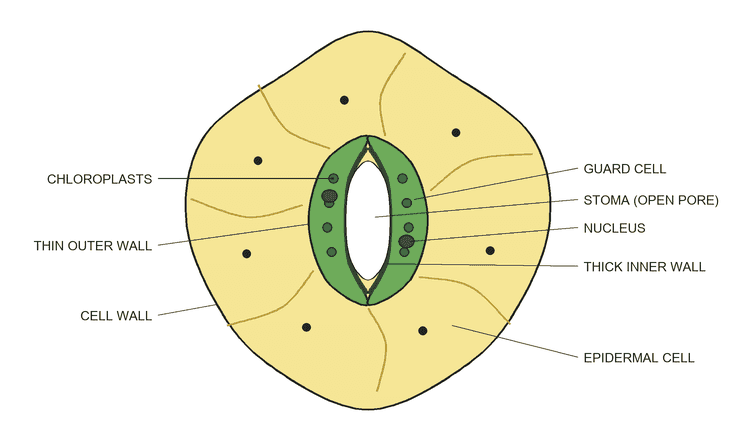
Therefore, (a) A is transpiration; (b) cooling, suction and distribution of water; (c) B ascent of sap, C absorption of water by the roots; (d) the open stoma as drawn.