
Opening your dashboard
Class 10 Biology Chapter 5 Transpiration: Practice Questions
44 questions on Chapter 5, each worked through on its own page with the AI tutor. Class 10 Biology, ICSE 2026-27.
44 questions
1–5 marks · Mixed difficulty
- 11 mark
Question 1
Bloom's level: Remember
Of all the water absorbed by the roots of a plant, the part actually used in photosynthesis and other activities is only about :
- 21 mark
Question 2
Bloom's level: Remember
In the three-bell-jar experiment on transpiration, the bell jar that holds only a piece of dry cobalt chloride paper and no plant is called the :
- 31 mark
Question 3
Bloom's level: Remember
Of these four changes in the surroundings of a leafy plant, pick the one that would make its leaves lose less water vapour :
- 41 mark
Question 4
Bloom's level: Remember
Unlike Ganong's potometer, Darwin's potometer is mainly used to show :
- 51 mark
Question 5
Bloom's level: Understand
While setting up a Ganong's potometer, the twig is cut under water. This is done so that :
- 61 mark
Question 6
Bloom's level: Understand
When the roots cannot absorb enough water, the leaves wilt and transpiration falls. This fall happens because :
- 71 mark
Question 7
Bloom's level: Understand
Transpiration is not considered an excretory process in plants because :
- 81 mark
Question 8
Bloom's level: Apply
A gardener switches on a large fan to blow air across potted plants in a closed, still greenhouse. The rate of transpiration of the plants will most likely :
- 91 mark
Question 9
Bloom's level: Apply
In a maize leaf the stomata are present in nearly equal numbers on both surfaces. Two pieces of dry cobalt chloride paper are clipped on its upper and lower surfaces, with the leaf still attached to the plant. The most likely result is :
- 101 mark
Question 10
Bloom's level: Analyse
Assertion (A): The leaves of a balsam plant may wilt at midday even though the soil is well watered.
Reason (R): At midday the rate of transpiration may exceed the rate at which the roots absorb water.
- 111 mark
Question 11
Bloom's level: Evaluate
Assertion (A): Guttation helps to cool a plant on a hot afternoon.
Reason (R): Guttation occurs in warm, humid conditions when transpiration is low.
- 121 mark
Question 12
Bloom's level: Understand
Assertion (A): Cuticular transpiration is greater than lenticular transpiration.
Reason (R): Lenticels remain open all the time.
- 132 marks
Question 13
Bloom's level: Understand
A plant uses only a small part of the water it absorbs. Explain why its roots must still go on absorbing water all the time.
- 142 marks
Question 14
Bloom's level: Understand
On a dry afternoon, water vapour moves out of the leaf through the stomata and not into it. Explain why.
- 152 marks
Question 15
Bloom's level: Understand
The leaves of a cactus are reduced to spines. Explain how this helps the plant, and how the cactus still makes its food.
- 162 marks
Question 16
Bloom's level: Apply
Predict how the rate of transpiration of a potted plant will change, with a reason, if :
(a) It is taken from the plains to a hill station where the atmospheric pressure is lower (other conditions kept the same).
(b) The air of its greenhouse is enriched with carbon dioxide to about 0.1%.
- 172 marks
Question 17
Bloom's level: Apply
A small potted plant, with its pot and soil surface completely covered, weighs 846 g at 8 a.m. and 828 g at 2 p.m. on the same day. Find the volume of water lost by transpiration and the average rate of loss per hour. (1 cc of water weighs 1 g.)
- 181 mark
Question 18
Bloom's level: Apply
A gardener prunes a grapevine in spring, and sap keeps dripping from the cut ends for several hours. Name this phenomenon and the force in the plant that assists it.
- 192 marks
Question 19
Bloom's level: Apply
A full-grown sunflower plant loses about half a litre of water a day by transpiration. A farmer's field has 4000 sunflower plants. How much water does the field release into the air in one day, and in a 30-day month ? What effect does this have on the climate of the area ?
- 202 marks
Question 20
Bloom's level: Analyse
Study the features of the leaves of two plants P and Q :
Feature Plant P Plant Q Shape of leaf Broad and thin Narrow and leathery Cuticle Thin Thick and waxy Stomata Many, on the surface Few, sunken and covered by hairs Which plant is more likely to grow in a dry climate ? Give two features from the table that support your answer.
- 212 marks
Question 21
Bloom's level: Analyse
A strawberry bed is watered well every evening. After a still, humid night, droplets of water are seen along the leaf margins at dawn, but after a dry, windy night no droplets appear. Analyse the reason for the difference.
- 222 marks
Question 22
Bloom's level: Evaluate
Arun put a polythene bag over a whole potted plant and tied its mouth around the rim of the pot, so that the soil was also inside the bag. After two hours in sunlight he saw water drops inside the bag and concluded that all of it came from transpiration. Is his conclusion valid ? Justify and suggest a correction.
- 233 marks
Question 23
Bloom's level: Apply
Three similar leafy shoots are placed in test tubes of water with a layer of oil on the surface, and weighed. They are kept for four hours as follows :
- Shoot A : bright sunlight, dry air, a fan blowing.
- Shoot B : bright sunlight, dry air, still air.
- Shoot C : a dark, humid room, still air.
(a) Arrange the shoots in decreasing order of the loss in weight.
(b) Give the reason for the position of each shoot.
(c) Why is oil poured on the water in each test tube ?
- 244 marks
Question 24
Bloom's level: Apply
Case: A nursery worker shifts young mango saplings from pots into a field. Many of the saplings wilt within a day. Next time, she cuts off about half the leaves of each sapling and does the transplanting in the evening; this time very few saplings wilt.
(a) Why did the saplings wilt after the first transplanting ?
(b) How does removing some of the leaves help ?
(c) Why is evening a better time for transplanting than noon ?
- 254 marks
Question 25
Bloom's level: Apply
In a Ganong's potometer, the air bubble moves 4.5 cm along the capillary tube in 15 minutes. The inner cross-section of the tube has an area of 2 mm². When a fan is switched on near the twig, the bubble moves 7.5 cm in the next 15 minutes.
(a) Find the volume of water taken up by the twig in the first 15 minutes, in cm³. (Volume = distance moved area; 1 cm³ = 1000 mm³.)
(b) Find the rate of water uptake per hour without and with the fan. How many times faster is it with the fan ?
(c) Strictly, the potometer measures water uptake, not water loss. Explain why the two are not exactly equal.
- 264 marks
Question 26
Bloom's level: Analyse
Case: For a school project, Tanvi covered the pot and soil of a small potted plant with polythene and weighed it every three hours, starting at 6 a.m. :
Time 6 a.m. 9 a.m. 12 noon 3 p.m. 6 p.m. 6 a.m. (next day) Mass (g) 1500 1488 1458 1428 1416 1410 (a) Find the total water lost in 24 hours, and the fraction of it lost between 9 a.m. and 3 p.m.
(b) Compare the rate of loss per hour between 9 a.m. and 12 noon with the rate during the night (6 p.m. to 6 a.m.). Explain the difference.
(c) The stomata are closed at night, yet the plant still lost some water. Through which parts did it lose this water ?
- 273 marks
Question 27
Bloom's level: Analyse
A deciduous tree sheds all its leaves in winter, yet a small amount of transpiration continues.
(a) Through which openings, and by which kind of transpiration, does the leafless tree lose water ?
(b) Why is this loss much smaller than the tree's loss in summer ?
(c) A leafy tree can cut down its water loss at midday, but the leafless tree cannot cut down this winter loss. Analyse why.
- 284 marks
Question 28
Bloom's level: Evaluate
Case: In a class debate, Rohit says: "A plant absorbs a lot of water but uses only about 2% of it. Transpiration is a pure waste. A plant that could stop transpiring completely would grow better."
(a) State two ways in which transpiration is useful to the plant itself.
(b) State one way in which the transpiration of forests is useful to the surroundings.
(c) Evaluate Rohit's claim. Is there any truth in it ?
- 295 marks
Question 29
Bloom's level: Create
Plan an experiment, using the test-tube-and-oil weighing method, to find out whether moving air (wind) increases the rate of transpiration.
(a) List the materials and describe the set-up of the experimental and control tubes.
(b) Draw up a table to record your readings, and fill it with the kind of result you expect.
(c) State the conclusion and two precautions.
- 305 marks
Question 30
Bloom's level: Create
Construct a labelled flow chart that traces the path of a water molecule from the soil to the atmosphere through a plant.
(a) Show at least seven stages in the correct order.
(b) Write beside the arrows the process or force that moves water at four different stages.
(c) State what would happen to this flow if all the stomata of the plant were closed for a long time.
- 311 mark
Question 31
Which one of the following is true of lenticels but not of stomata ?
- 321 mark
Question 32
Which one of the following changes in the surroundings of a leafy plant would increase its rate of transpiration ?
- 331 mark
Question 33
Assertion (A): The readings of a potometer do not give the exact amount of water lost by the twig in transpiration.
Reason (R): Some of the water taken up by the twig is used by its cells in other processes such as photosynthesis.
- 342 marks
Question 34
(i) Explain how the evaporation of water from the leaves produces a suction force that draws water up from the cells at lower levels.
(ii) How is transpiration useful to a plant on a hot sunny day ?
- 352 marks
Question 35
A leafy plant is fixed in a glass bottle full of water. The bottle is linked by a rubber tube to a graduated side tube, also filled with water. In 3 hours the water level in the side tube falls from the 18.5 cc mark to the 12.5 cc mark.
(i) Calculate the volume of water lost in the 3 hours and the average volume lost per hour.
(ii) By how many grams should the weight of the whole apparatus fall in the 3 hours ? State the fact you have used.
- 362 marks
Question 36
The figure shows the surface view of the same stoma of a balsam leaf at two different times, P and Q.
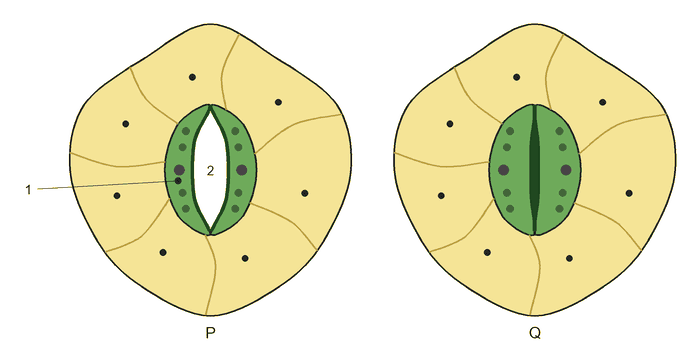
(i) Name the cell numbered 1 and the opening numbered 2.
(ii) At midday the leaf ran short of water and began to wilt. Which of the two, P or Q, shows the stoma at that time ? State the condition of the cells numbered 1 then, and how this helps the plant.
- 372 marks
Question 37
(i) State two ways in which the leaves of Nerium (oleander) are adapted to reduce transpiration.
(ii) Name one plant whose leaves are covered by a thick cuticle. How does the thickness of the cuticle affect transpiration ?
- 384 marks
Question 38
Three bell jars, A, B and C, were arranged as shown in the figure. In A and B, the pot of a well-watered plant is completely enclosed in a polythene bag whose mouth is tied firmly round the base of the stem. X is a piece of dry paper that is used as an indicator of moisture. All the three bell jars were kept together in the sun for about half an hour.
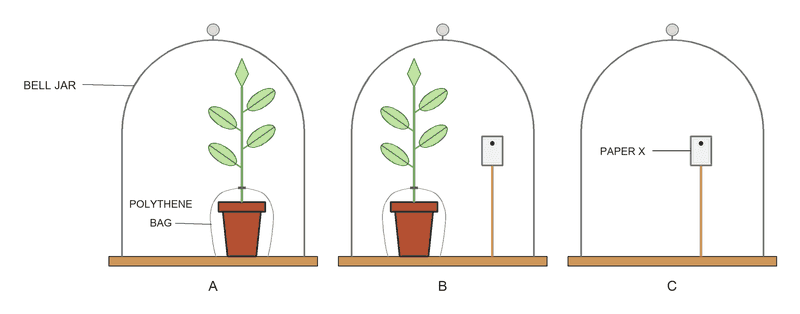
(i) Name the paper X. State its colour at the start, and its colour at the end in bell jar B and in bell jar C.
(ii) What is seen on the inner walls of bell jars A and B at the end ? Why is it not seen in bell jar C ?
(iii) Why was the pot enclosed in a polythene bag ? What is set-up C called ?
- 394 marks
Question 39
A leafy twig of coleus was fixed in a Ganong's potometer kept in a bright room. The distance moved by the air bubble in 10 minutes was noted under three conditions. The bubble was brought back to its starting position before each reading.
Reading Condition of the twig Distance moved by the bubble in 10 minutes (mm) A in still air 30 B under a fan 54 C in still air, with a moist transparent polythene bag over the twig 6 (i) Calculate the rate of movement of the bubble, in mm per minute, in readings A and B. How many times as fast as in A does the bubble move in B ?
(ii) Give a reason for the result of reading B and for the result of reading C.
(iii) How is the air bubble brought back to its starting position ? Why would a change in the temperature of the room during the experiment make the readings unreliable ?
- 403 marks
Question 40
Early in the morning, droplets of water are seen along the margins of the leaves of a nasturtium plant growing in a well-watered garden bed.
(i) What is this loss of water in liquid form called ? Through which openings of the leaf does it take place, and where exactly are they found ?
(ii) Is the liquid in the droplets pure water ? How does this loss of water differ from transpiration in its effect on the temperature of the plant ?
(iii) A gardener cuts off a branch of the same plant and sap oozes out at the cut. Name this phenomenon. What does this exudate mainly contain, and which pressure assists its flow ?
- 411 mark
Question 41
Class 10 Sample Paper 1 · Section A
Fill in the blank:
The rate of transpiration increases with the increase in ...........
- 421 mark
Question 42
Class 10 Sample Paper 2 · Section A
Complete the following:
Transpiration normally takes place in the presence of ...........
- 431 mark
Question 43
Class 10 Sample Paper 2 · Section A
Fill in the blank:
The chemical used in the demonstration of the experiment on transpiration is ...........
- 441 mark
Question 44
Class 10 Sample Paper 2 · Section A
Fill in the blank:
.......... are the tiny pores present on the lower epidermis of the leaves.