
Opening your dashboard
Class 10 Biology Chapter 5 Transpiration: Competency-Based Questions (CBQ)
40 questions on Chapter 5, each worked through on its own page with the AI tutor. Class 10 Biology, ICSE 2026-27.
40 questions
1–5 marks · Mixed difficulty
- 11 mark
Question 1
Cognitive domain: Application
A research team grows identical, well-watered potted plants in two sealed growth chambers. The light, temperature, humidity and movement of air are kept exactly the same in both. After a day, the plants in chamber 2 are found to have lost distinctly more water by transpiration than the plants in chamber 1. Which one difference between the two chambers could account for this result ?
- 21 mark
Question 2
Cognitive domain: Analysis
A student peeled the epidermis from both surfaces of the leaves of four different plants and counted the stomata under a microscope.
Leaf Stomata per of upper surface Stomata per of lower surface W 1,200 9,400 X 6,800 1,100 Y 4,000 4,100 Z 2,500 7,000 Pieces of dry cobalt chloride paper are now clipped to both surfaces of a fresh leaf of each plant, the leaves remaining attached to their plants. On which leaf will the paper on the upper surface turn pink well before the paper on the lower surface ?
- 31 mark
Question 3
Cognitive domain: Application
Before sending young saplings on a long truck journey in summer, a nursery sprays their leaves with a harmless, colourless liquid that dries into a thin waxy film over both surfaces of every leaf. The treated saplings wilt much less on the way. Which natural adaptation of plants does this film copy most closely ?
- 41 mark
Question 4
Cognitive domain: Analysis
A leafy shoot was fixed in a bottle of water joined to a graduated side tube, and the whole set-up was placed on a weighing machine. Every exposed water surface was covered with oil. After six hours in sunlight the readings were :
Measurement Reading Fall of water level in the side tube cc Loss in weight of the whole set-up g Remembering that cc of water weighs g, which conclusion do the readings best support ?
- 51 mark
Question 5
Cognitive domain: Understanding
Assertion (A): Transpiration helps the leaves of a plant to go on working in the intense heat of a sunny summer afternoon.
Reason (R): Evaporation of water from a leaf reduces the temperature of the leaf surface.
- 61 mark
Question 6
Cognitive domain: Understanding
Assertion (A): In the bell jar experiment on transpiration, the pot of the plant is enclosed completely in a polythene bag tied firmly around the base of the stem.
Reason (R): Dry cobalt chloride paper turns from blue to pink when it is exposed to moisture.
- 71 mark
Question 7
Cognitive domain: Application
To get a better crop, a grower raises the carbon dioxide in a closed greenhouse well above the normal of the outside air. A Ganong's potometer fitted with a leafy twig has been kept inside the greenhouse all along, with the light and the temperature unchanged.
After the carbon dioxide is raised, the air bubble in the potometer moves more ______ than before, because the extra carbon dioxide makes the stomata ______.
- 81 mark
Question 8
Cognitive domain: Analysis
Early on a warm, humid morning Kabir found droplets along the margins of the banana leaves in his garden. He let a few of these droplets dry on a clean glass slide and saw a faint whitish deposit. Drops of water that had collected inside a polythene bag tied over a potted plant left no deposit when dried in the same way.
So the droplets on the leaf margins had come out of the leaf in ______ form, carrying dissolved substances, by the process called ______.
- 91 mark
Question 9
Cognitive domain: Understanding
A wet cotton towel and a leafy potted plant, with its pot and soil wrapped in polythene, are kept side by side in the sun. Both lose weight, but the towel loses it much faster and cannot slow the loss in any way.
The towel loses water by ______, which is only a physical change, whereas the plant can regulate its transpiration by adjusting the size of its ______.
- 102 marks
Question 10
Cognitive domain: Evaluation
On a May afternoon, when the temperature outside was , Dev covered a well-watered potted plant with a transparent polythene bag, tied its mouth around the base of the stem and left it in the sun for an hour. No drops of water appeared inside the bag. He wrote in his record: "This plant does not transpire in summer."
Is Dev's conclusion sound ? Give a reason, and suggest one way in which he could check whether water vapour was given out.
- 112 marks
Question 11
Cognitive domain: Application
A vegetable seller in a hot, dry and windy market sprinkles water on her bundles of spinach (palak) every half hour and keeps them covered with a wet jute cloth. Her leaves stay crisp till evening, while the uncovered bundles at the next stall become limp by noon.
Using two factors that affect the loss of water vapour from leaves, explain why her method works.
- 122 marks
Question 12
Cognitive domain: Application
At 10 a.m. two similar leafy balsam shoots are stood in beakers of water coloured with red ink. Shoot 1 is left near an open, sunny window. Shoot 2 is kept at the same window but is covered with a transparent polythene bag. After an hour the veins of the top leaves of shoot 1 are red, while in shoot 2 the red colour has hardly risen up the stem.
Explain the difference between the two shoots.
- 135 marks
Question 13
Cognitive domain: Analysis
Case: A well-watered balsam plant growing in a garden bed was studied on a clear, hot day. The rate at which its leaves lost water (curve T) and the rate at which its roots absorbed water (curve A) were found every two hours and plotted as shown.
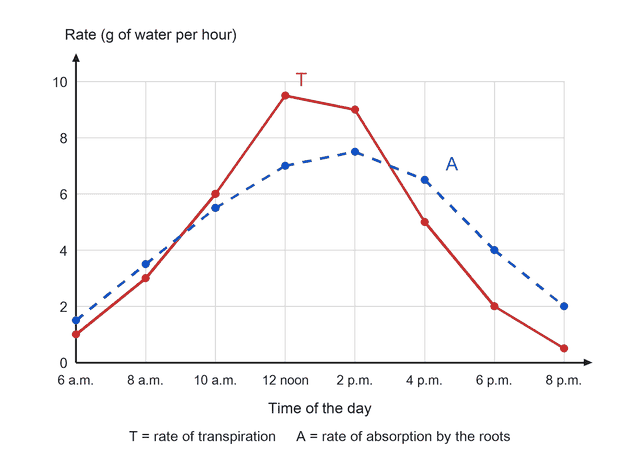
(a) At what time was the rate of transpiration the highest ? State two external factors that make it high at this time.
(b) Between which two times of the day would the leaves of this plant be found wilting ? Use the graph to explain why they wilt although the soil is wet.
(c) By the evening the leaves stand out erect again. Explain this with the help of the graph.
(d) Suppose the next day is cloudy and humid. How would curve T change, and is the plant likely to wilt ? Give reasons.
- 145 marks
Question 14
Cognitive domain: Evaluation
Case: Asha and Imran wanted to find out whether wind increases transpiration. They cut a leafy coleus twig with scissors, carried it to the laboratory and fixed it in a Ganong's potometer. They then took two readings.
Trial Place Table fan Air temperature Distance moved by the air bubble in 10 minutes 1 Inside the laboratory, away from the window Off mm 2 On a sunny window sill On mm Their conclusion: "Wind alone makes a plant lose two and a half times as much water."
(a) Calculate the rate of movement of the bubble in mm per minute in each trial. How many times faster is it in trial 2 ?
(b) Is the conclusion that wind alone caused this increase justified ? Give a reason and say how trial 2 should have been done.
(c) Point out what was wrong in the way the twig was cut. How should it be cut, and why ?
(d) Strictly, what does a potometer measure ? Why is this not exactly the water lost by the twig, and how is the bubble brought back to repeat a reading ?
- 155 marks
Question 15
Cognitive domain: Creativity
Case: The eco-club of a school in Jodhpur wants to set up a small garden of potted plants on the open roof of the school. The roof is hot, dry and windy for most of the year, and water is scarce. The club has shade-net, bamboo mats, clips, glass slides and dry cobalt chloride paper.
(a) List three features of leaves the club should look for while choosing the plants, and say how each one saves water.
(b) Design two arrangements for the garden itself that would lower the transpiration of the plants. Link each one to a factor that affects transpiration.
(c) The club has to choose between two kinds of plants, P and Q. Design a simple fair test with the cobalt chloride paper to find out which of them loses less water from its leaves. State what you would keep the same and how you would read the result.
- 163 marks
Question 16
CISCE Competency-Focused Practice Questions (2024) · Cognitive domain: Analysis
Study the diagram given below and answer the questions that follow:

(a) Identify the apparatus.
(b) What is it used to measure?
(c) Mention any one limitation of using the apparatus.
- 173 marks
Question 17
CISCE Competency-Focused Practice Questions (2024) · Cognitive domain: Analysis & Understanding
How is the rate of transpiration affected under the following environmental conditions:
(a) High temperature
(b) Low humidity
(c) Low intensity of sunlight
- 181 mark
Question 18
Cognitive domain: Understanding
A thin section of a leaf shows the epidermis with a stoma, the mesophyll cells below it and the air spaces between the mesophyll cells. Water from the xylem of a vein spreads into the mesophyll cells. In which place does this water mainly change from liquid to water vapour before it leaves the leaf ?
- 191 mark
Question 19
Cognitive domain: Analysis
Squares of dry cobalt chloride paper of the same size were held with clips and glass slides on the upper and lower surfaces of one leaf each of three plants, P, Q and R. All the leaves were still attached to well-watered plants standing side by side in the same light and air. (Hypothetical data.) The time taken by each paper to turn pink is given below.
Leaf Upper surface Lower surface P minutes minutes Q minutes minutes R minutes minutes Which conclusion do these readings support best ?
- 201 mark
Question 20
Cognitive domain: Analysis
At 6 a.m., after a calm, cool and humid night, Meera saw drops of water on a spider's web, on the seat of a parked scooter and at the tips and margins of the leaves of the tomato plants in her garden. Her teacher said that the drops on the web and the scooter are dew, but the drops on the leaves are guttation. Which further observation supports the teacher's statement about the leaves ?
- 211 mark
Question 21
Cognitive domain: Understanding
Assertion (A): Transpiration helps in carrying minerals from the roots to the leaves of a plant.
Reason (R): Evaporation of water from the leaves sets up a suction that pulls water, with the minerals dissolved in it, up through the xylem.
- 221 mark
Question 22
Cognitive domain: Analysis
Kavya cut a leafy twig of balsam in the open air with a blade, fixed it in a clean Ganong's potometer and kept it in bright sunlight. All the joints were tested and found air-tight. After 30 minutes the air bubble had not moved at all, yet a dry cobalt chloride paper clipped to one leaf of the twig had turned pink in 10 minutes. What is the most likely fault ?
- 231 mark
Question 23
Cognitive domain: Understanding
Assertion (A): A stoma opens when its guard cells lose water and become flaccid.
Reason (R): Guard cells swell and become turgid when they take in water.
- 241 mark
Question 24
Cognitive domain: Analysis
A well-watered potted plant, with its pot and soil covered, was kept in the same light and still air, and its rate of transpiration was measured at four temperatures, once in dry air (relative humidity ) and once in humid air (relative humidity ). The results are shown in the graph. (Hypothetical data.)

Which statement is correct ?
- 251 mark
Question 25
Cognitive domain: Application
Four observations were noted in a garden.
Observation 1: Clear sap dripping from the cut end of a pruned grapevine in spring.
Observation 2: Water vapour escaping through the stomata of a mango leaf at noon.
Observation 3: Drops of water at the tips of grass blades at dawn.
Observation 4: A trace of water vapour leaving through the lenticels on the bark of an old guava branch.
Which of these are examples of transpiration ?
- 261 mark
Question 26
Cognitive domain: Evaluation
A student writes: "The leaves of a cactus are reduced to spines, so a cactus does not lose any water by transpiration, and it can be kept without water for ever." How should this statement be judged ?
- 271 mark
Question 27
Cognitive domain: Understanding
A strip of cobalt chloride paper that has been lying in a damp cupboard is pink. Before using it in a bell-jar experiment on transpiration, a student warms it gently with a pair of forceps over a hot plate until it turns ______ in colour. She then keeps it in a closed bottle with a drying agent, because the paper turns ______ in colour when it takes up moisture from the air.
- 281 mark
Question 28
Cognitive domain: Application
A Ganong's potometer with a leafy twig is moved from a dry room into a bathroom full of steam from a hot bath. The light and the temperature are adjusted to be the same as before. In the steamy air the air bubble moves more ______, and a dry cobalt chloride paper clipped to a leaf takes ______ time to turn pink.
- 292 marks
Question 29
Cognitive domain: Analysis
Under a microscope, each guard cell of a stoma is bean-shaped. The wall next to the pore (the inner wall) is thick and does not stretch much, while the wall on the far side (the outer wall) is thin and stretches easily. Explain how this difference in the walls makes the pore open when the guard cells become turgid.
- 302 marks
Question 30
Cognitive domain: Application
Fruit sellers and cold stores coat apples and oranges with a thin layer of food-grade wax. Washed, uncoated apples kept in a warm room start to shrivel within two or three weeks, but coated ones stay firm for much longer.
Name the two kinds of transpiration through which an apple loses water vapour, and explain how the wax coating helps to keep the apple firm.
- 312 marks
Question 31
Cognitive domain: Understanding
The leaves of the aak (Calotropis) plant, which grows in dry, open fields, are covered with fine, cottony hairs. Give two ways in which these hairs help the plant to lose less water.
- 322 marks
Question 32
Cognitive domain: Evaluation
Early one morning a neighbour sees drops of water along the margins of the leaves of a tomato plant that is growing well in a moist garden bed. She says: "The leaves are sweating because the plant is sick with fever. Spray some medicine on it."
Is her reasoning sound ? Give two reasons for your answer.
- 333 marks
Question 33
Cognitive domain: Analysis
A student fixed a leafy twig in a Ganong's potometer in a laboratory kept at , and noted how far the air bubble moved in minutes under four sets of conditions. The bubble was brought back to its starting point before each reading. (Hypothetical data.)
Set Light Relative humidity Air movement Bubble moved in minutes 1 Bright Still mm 2 Bright Breeze from a fan mm 3 Bright Still mm 4 Dim Still mm (a) For each of the three factors (air movement, humidity and light), name the two sets that must be compared to find its effect.
(b) Compared with set 1, which change made the biggest difference to the distance moved: adding a breeze, raising the humidity, or dimming the light ? Show your working.
(c) A classmate compares set 3 with set 4 and says that humid air lowers transpiration less than dim light does. Can sets 3 and 4 be compared directly to find the effect of one factor ? Give a reason.
- 343 marks
Question 34
Cognitive domain: Analysis
The loss of water from the leaves of a rubber plant was measured per square centimetre of leaf surface, first in bright light with the stomata open, and then in the dark, when the stomata are closed. (Hypothetical data.) Assume that the loss with the stomata closed takes place through the cuticle only, and that the cuticular loss is the same in light as in the dark.
Leaf Loss with stomata open (mg per per hour) Loss with stomata closed (mg per per hour) Mature leaf Young tender leaf (a) What percentage of the total loss in light is cuticular in each leaf ?
(b) Which leaf has the thicker cuticle ? Give a reason.
(c) In a long dry spell the stomata of both leaves stay closed. Compare the losses of the two leaves and state what this means for a young seedling.
- 353 marks
Question 35
Cognitive domain: Evaluation
Before the summer holidays, a student suggests that the school should smear petroleum jelly on both surfaces of all the leaves of the potted plants, so that the plants lose no water in the hot weeks.
Evaluate this suggestion. Give three reasons why it is not a good plan, and state one better way to save the plants.
- 363 marks
Question 36
Cognitive domain: Creativity
Design an experiment with a Ganong's potometer to find out whether the intensity of light affects the rate of transpiration of a leafy twig. State what you keep the same, what you change, what you measure and how you would deal with the heat of the lamp.
- 373 marks
Question 37
Cognitive domain: Application
Priya cut two similar branches of a guava plant. Branch X kept all its leaves; from branch Y she removed every leaf. She stood each branch in a flask of water, covered the water with a thin layer of oil and kept both in the same sunny window. After three hours the water level had fallen by mL in the flask of X and by mL in the flask of Y. (Hypothetical data.)
(a) Why did X take up much more water than Y ?
(b) Why did Y take up some water at all ?
(c) State what this shows about the role of the leaves in the rise of water.
- 385 marks
Question 38
Cognitive domain: Analysis
Case: Nikhil fixed a leafy twig of coleus, cut under water, in a Ganong's potometer kept in a room, and read the position of the air bubble every minutes. At minutes he switched on a bright table lamp placed near the twig, and at minutes he also switched on a table fan. The graph shows the distance moved by the bubble. (Hypothetical data.)
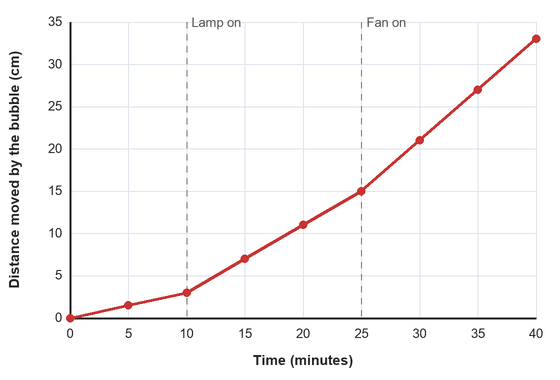
(a) Find the rate of movement of the bubble, in cm per minute, (i) from to minutes, (ii) from to minutes and (iii) from to minutes.
(b) Explain why the rate rose at minutes and again at minutes. Which of the two changes raised the rate by more ?
(c) At minutes Nikhil switches off both the lamp and the fan and goes on reading the bubble. Predict how the graph after minutes would differ from the part between and minutes, and give a reason.
- 395 marks
Question 39
Cognitive domain: Analysis
Case: A student grew wheat seedlings in three pots, with seedling leaves in each pot. Each pot was kept for one night (nights 1, 2 and 3) under the conditions given in the table, and at 6 a.m. the next morning she counted how many of its leaves carried drops of water at their tips. (Hypothetical data.)
Night Soil Air during the night Leaves with drops (out of ) 1 Well watered Humid (), still 2 Well watered Dry (), breezy 3 Almost dry Humid (), still (a) Under which conditions did most leaves show drops ? Give one reason why these conditions favour the drops.
(b) Explain why no leaf had drops on night 3.
(c) A classmate looks at nights 1 and 2 and concludes: "Dry air stops the roots from pushing water up." Evaluate this conclusion, and say why the count for night 2 may show less guttation than really took place.
- 404 marks
Question 40
Cognitive domain: Creativity
Case: In a vegetable farm in Punjab, a grower covered a bed of 50 chilli seedlings with a transparent polythene tunnel at noon in May, and left a similar bed of 50 seedlings uncovered. After three hours, the readings were as follows. (Hypothetical data.)
Reading Under the tunnel In the open Temperature of the air Relative humidity Air movement None Breeze Seedlings wilted (out of ) (a) Name the two factors under the tunnel that reduce transpiration and the one factor that raises it.
(b) Find the percentage of seedlings wilted under the tunnel and in the open.
(c) A neighbour suggests that the tunnel should be kept shut all day. Suggest two changes that would make the covering safer for the seedlings, and give a reason for each.