
Opening your dashboard
Class 9 Physics Chapter 7: Reflection of Light Solutions
134 textbook questions with step-by-step answers, free to read, for ICSE 2026-27.
Get talked through Ch 7, not just shown the answer
Reading a finished solution is not the same as being able to do it. The AI tutor takes one question at a time and works it with you, in your own words, until you can.
- Ask it out loud, in your own words
- It gives you the next step, not the answer
- Stuck on part (ii)? Start there
134 questions with solutions
1–5 marks · Mixed difficulty
The first 91 solutions are on this page. This chapter is a long one, so the rest open on their own page to keep this one quick to load.
- 11 mark
Question 1
The angle which the ............ ray makes with the ........ at the point of incidence is called angle of incidence.
Solve with AIAnswer
(A) reflected, mirror
(B) incidence, mirror
- Correct
(C) incidence, normal
(D) reflected, normal
Answer: (C) incidence, normal
Concept: When light strikes a mirror, the incident ray is the ray that falls on it, the point of incidence is where it strikes, the normal is the perpendicular to the mirror there, and the reflected ray is the ray sent back. The angle of incidence is the angle between the incident ray and the normal; the angle of reflection is the angle between the reflected ray and the normal.
Step 1 — See what the blanks describe.
The sentence defines the angle of incidence, so the first blank names the ray that makes this angle and the second names the line it is measured from.
Step 2 — Fill the blanks.
The angle of incidence is made by the incident ray with the normal at the point of incidence, not with the mirror surface.
Watch out: Angles in reflection are always measured from the normal, never from the mirror surface.
Why the other options are wrong:
- (A) reflected, mirror: the reflected ray makes the angle of reflection, and the angle is measured from the normal, not the mirror.
- (B) incidence, mirror: the incident ray is right, but the angle is measured from the normal, not from the mirror.
- (D) reflected, normal: the reflected ray and the normal make the angle of reflection, not the angle of incidence.
Therefore, the blanks are 'incidence' and 'normal', option (C).
- 21 mark
Question 2
The plane containing the incident ray and normal is called :
Solve with AIAnswer
(A) plane of reflection
(B) normal plane
- Correct
(C) plane of incidence
(D) none of the above
Answer: (C) plane of incidence
Concept: When light strikes a mirror, the incident ray is the ray that falls on it, the point of incidence is where it strikes, the normal is the perpendicular to the mirror there, and the reflected ray is the ray sent back. The angle of incidence is the angle between the incident ray and the normal; the angle of reflection is the angle between the reflected ray and the normal.
Step 1 — Recall the name of this plane.
The incident ray and the normal at the point of incidence are two lines meeting at one point, so they fix one plane. The book calls it the plane of incidence.
Step 2 — Link it to the second law.
By the second law of reflection the reflected ray also lies in this same plane.
Why the other options are wrong:
- (A) plane of reflection: this is the name used for the plane holding the reflected ray and the normal, not the incident ray.
- (B) normal plane: 'normal plane' is not the name given to this plane.
- (D) none of the above: option (C) names the plane correctly, so 'none of the above' is wrong.
Therefore, the plane containing the incident ray and the normal is the plane of incidence, option (C).
- 31 mark
Question 3
Regular reflection occurs when a beam of light falls on a ..............
Solve with AIAnswer
(A) smooth surface
(B) polished surface
(C) rough surface
- Correct
(D) Both (A) and (B)
Answer: (D) Both (A) and (B)
Concept: Regular reflection happens at a smooth, polished surface: all its normals are parallel, so a parallel beam stays parallel after reflection. Irregular (diffused) reflection happens at a rough surface: the normals point in many directions, so a parallel beam is scattered. Each single ray obeys the laws of reflection in both cases.
Step 1 — Recall when reflection is regular.
Regular reflection needs a surface whose normals are all parallel, which is true only for a surface that is smooth and polished, such as a plane mirror.
Step 2 — Match with the options.
A smooth surface (A) and a polished surface (B) both give regular reflection, so the answer is 'Both (A) and (B)'.
Watch out: A surface may look flat and still be rough on a small scale (a wall, paper); that gives irregular reflection.
Why the other options are wrong:
- (A) smooth surface: a smooth surface does give regular reflection, but so does a polished one, so (A) alone is incomplete.
- (B) polished surface: a polished surface does give regular reflection, but so does a smooth one, so (B) alone is incomplete.
- (C) rough surface: a rough surface scatters a parallel beam in many directions: that is irregular (diffused) reflection.
Therefore, regular reflection occurs at a smooth, polished surface, option (D).
- 41 mark
Question 4
According to the law of reflection :
Solve with AIAnswer
(A) = constant
(B) = constant
(C) = constant
- Correct
(D)
Answer: (D)
Concept: Laws of reflection. (1) The angle of incidence is equal to the angle of reflection . (2) The incident ray, the reflected ray and the normal at the point of incidence all lie in the same plane. Both angles are measured from the normal, the line drawn perpendicular to the surface at the point of incidence.
Step 1 — State the first law.
The first law of reflection says that the angle of incidence is equal to the angle of reflection.
Step 2 — Match with the options.
Only option (D) states this law.
Watch out: = constant looks similar, but it is Snell's law of refraction, not reflection.
Why the other options are wrong:
- (A) the ratio i/r is constant: since , the ratio is 1, but the law is stated as , and the ratio has no meaning for .
- (B) the ratio sin i/sin r is constant: = constant is Snell's law of refraction.
- (C) the sum i + r is constant: is not constant: it is , so it changes when changes.
Therefore, the law of reflection is , option (D).
- 51 mark
Question 5
For a ray incident normally on a plane mirror, the angle of incidence is :
Solve with AIAnswer
(A) 90°
(B) 45°
(C) 30°
- Correct
(D) 0°
Answer: (D) 0°
Concept: When light strikes a mirror, the incident ray is the ray that falls on it, the point of incidence is where it strikes, the normal is the perpendicular to the mirror there, and the reflected ray is the ray sent back. The angle of incidence is the angle between the incident ray and the normal; the angle of reflection is the angle between the reflected ray and the normal.
Step 1 — Picture normal incidence.
A ray incident normally falls perpendicular to the mirror, so it travels along the normal itself.
Step 2 — Measure from the normal.
The angle between the ray and the normal is therefore zero.
Watch out: 90° is the angle the ray makes with the mirror surface, not with the normal.
Why the other options are wrong:
- (A) 90°: 90° is the angle between the ray and the mirror surface, not the normal.
- (B) 45°: 45° would mean the ray is tilted halfway between the normal and the mirror.
- (C) 30°: 30° would mean the ray is tilted from the normal, but a normal ray is not tilted at all.
Therefore, the angle of incidence is 0°, option (D).
- 61 mark
Question 6
For a ray incident normally on a plane mirror, the angle of reflection is :
Solve with AIAnswer
(A) 90°
- Correct
(B) 0°
(C) 45°
(D) 30°
Answer: (B) 0°
Concept: Laws of reflection. (1) The angle of incidence is equal to the angle of reflection . (2) The incident ray, the reflected ray and the normal at the point of incidence all lie in the same plane. Both angles are measured from the normal, the line drawn perpendicular to the surface at the point of incidence.
Step 1 — Find the angle of incidence.
A ray incident normally travels along the normal, so its angle of incidence is 0°.
Step 2 — Use the first law.
The angle of reflection equals the angle of incidence, which is 0°.
Step 3 — Describe the reflected ray.
With the reflected ray also travels along the normal, so the ray goes back along its own path.
Watch out: For normal incidence both angles are 0°, not 90°.
Why the other options are wrong:
- (A) 90°: 90° is the angle with the mirror surface, not with the normal.
- (C) 45°: 45° would need an angle of incidence of 45°, but here it is 0°.
- (D) 30°: 30° would need an angle of incidence of 30°, but here it is 0°.
Therefore, the angle of reflection is 0°, option (B).
- 71 mark
Question 7
The perpendicular drawn on the surface at the point of incidence is called :
Solve with AIAnswer
- Correct
(A) normal
(B) incident ray
(C) reflected ray
(D) none of the above
Answer: (A) normal
Concept: When light strikes a mirror, the incident ray is the ray that falls on it, the point of incidence is where it strikes, the normal is the perpendicular to the mirror there, and the reflected ray is the ray sent back. The angle of incidence is the angle between the incident ray and the normal; the angle of reflection is the angle between the reflected ray and the normal.
Step 1 — Recall the definition.
The line drawn perpendicular to the reflecting surface at the point of incidence is called the normal.
Step 2 — See why it matters.
Both the angle of incidence and the angle of reflection are measured from this line.
Why the other options are wrong:
- (B) incident ray: the incident ray is the ray falling on the surface; it is usually not perpendicular to it.
- (C) reflected ray: the reflected ray is the ray sent back from the surface; it is usually not perpendicular to it.
- (D) none of the above: option (A) is correct, so 'none of the above' is wrong.
Therefore, the perpendicular at the point of incidence is the normal, option (A).
- 81 mark
Question 8
The image formed due to the actual intersection of the reflected rays is :
Solve with AIAnswer
(A) virtual
(B) diminished
- Correct
(C) real
(D) enlarged
Answer: (C) real
Concept: A real image is formed where reflected rays actually meet; it can be caught on a screen. A virtual image is formed where reflected rays only appear to meet when produced backwards; it cannot be caught on a screen.
Step 1 — Note what the rays do.
The stem says the reflected rays actually intersect.
Step 2 — Name the image.
An image formed where the rays actually meet is a real image, and it can be obtained on a screen.
Why the other options are wrong:
- (A) virtual: a virtual image is formed where rays only appear to meet when produced backwards.
- (B) diminished: 'diminished' describes the size of an image, not how it is formed.
- (D) enlarged: 'enlarged' describes the size of an image, not how it is formed.
Therefore, the image formed by actual intersection of reflected rays is real, option (C).
- 91 mark
Question 9
The image formed by a plane mirror is :
Solve with AIAnswer
(A) erect and diminished
(B) erect and enlarged
(C) inverted and of same size
- Correct
(D) erect and of same size.
Answer: (D) erect and of same size
Concept: A plane mirror forms an image that is virtual (the reflected rays only appear to meet behind the mirror), erect, of the same size as the object, laterally inverted, and as far behind the mirror as the object is in front of it, on the normal drawn from the object to the mirror.
Step 1 — Recall the orientation.
A plane mirror always forms an erect (upright) image.
Step 2 — Recall the size.
The image is of the same size as the object, because each image point is as far behind the mirror as its object point is in front.
Watch out: A plane mirror never changes the size of the image; an object looks smaller only when it is farther from the eye.
Why the other options are wrong:
- (A) erect and diminished: the image is erect, but it is of the same size, not diminished.
- (B) erect and enlarged: the image is erect, but it is of the same size, not enlarged.
- (C) inverted and of same size: the image of a plane mirror is erect, not inverted.
Therefore, the image formed by a plane mirror is erect and of the same size, option (D).
- 101 mark
Question 10
The image formed by a plane mirror is :
Solve with AIAnswer
(A) real
(B) virtual
- Correct
(C) virtual with lateral inversion
(D) real with lateral inversion.
Answer: (C) virtual with lateral inversion
Concept: A plane mirror forms an image that is virtual (the reflected rays only appear to meet behind the mirror), erect, of the same size as the object, laterally inverted, and as far behind the mirror as the object is in front of it, on the normal drawn from the object to the mirror.
Step 1 — Decide real or virtual.
The reflected rays from a plane mirror only appear to meet behind it, so the image is virtual.
Step 2 — Add lateral inversion.
The image is also laterally inverted: its left and right are interchanged.
Step 3 — Pick the fullest correct option.
Option (C) gives both true properties, so it is the best answer.
Watch out: (B) 'virtual' is true but incomplete; the fuller option (C) is the answer.
Why the other options are wrong:
- (A) real: a plane mirror never forms a real image.
- (B) virtual: the image is virtual, but this option leaves out lateral inversion, which (C) includes.
- (D) real with lateral inversion: the image is laterally inverted, but it is virtual, not real.
Therefore, the image formed by a plane mirror is virtual with lateral inversion, option (C).
- 111 mark
Question 11
A concave mirror forms ............ image whereas a convex mirror forms ............ .
Solve with AIAnswer
(A) real, real
(B) virtual, real
(C) virtual, virtual
- Correct
(D) real, virtual
Answer: (D) real, virtual
Concept: For a concave mirror the image depends on where the object is: object at infinity → image at F; beyond C → between F and C; at C → at C; between C and F → beyond C; at F → at infinity; between F and P → behind the mirror. Only the last image is virtual and erect; all the others are real and inverted. A convex mirror always forms a virtual, erect and diminished image, behind the mirror between its pole P and focus F, whatever the position of the object.
Step 1 — Concave mirror.
A concave mirror forms a real image for every object placed beyond its focus. It is the only one of the two that can form a real image.
Step 2 — Convex mirror.
A convex mirror always forms a virtual image.
Step 3 — Fill the blanks.
The blanks ask for the property that tells the two mirrors apart: real, virtual.
Watch out: A concave mirror also forms a virtual image when the object is between its pole and focus, so the blank names the image it alone can form.
Why the other options are wrong:
- (A) real, real: a convex mirror never forms a real image.
- (B) virtual, real: it reverses the two: the convex mirror's image is the one that is always virtual.
- (C) virtual, virtual: it misses the real image that a concave mirror forms for an object beyond F.
Therefore, a concave mirror forms a real image whereas a convex mirror forms a virtual one, option (D).
- 121 mark
Question 12
Which of the following combination of letters does not show lateral inversion ?
Solve with AIAnswer
(A) A, C, I
- Correct
(B) M, T, V
(C) D, L, A
(D) X, Y, Z
Answer: (B) M, T, V
Concept: Lateral inversion is the interchange of left and right in the image formed by a plane mirror. It happens because each point of the image is straight behind its own object point, so the side of the object facing your right appears on the image's left as you look at it. A letter whose left half is the mirror copy of its right half (symmetric about a vertical line through its middle) looks the same after lateral inversion.
Step 1 — State the test.
Imagine a vertical line through the middle of each letter. If the two halves match, the letter does not show lateral inversion.
Step 2 — Test M, T and V.
M, T and V are each symmetric about a vertical line, so their mirror images look unchanged.
Step 3 — Test the other letters.
C, D, L and Z are not symmetric about a vertical line, so each of them looks reversed in a mirror.
Watch out: Symmetry about a HORIZONTAL line (like C or D) does not help; only vertical symmetry hides lateral inversion.
Why the other options are wrong:
- (A) A, C, I: A and I are symmetric about a vertical line, but C is not, so C shows lateral inversion.
- (C) D, L, A: A is symmetric, but D and L are not, so they show lateral inversion.
- (D) X, Y, Z: X and Y are symmetric about a vertical line, but Z is not, so Z shows lateral inversion.
Therefore, the letters that do not show lateral inversion are M, T, V, option (B).
- 131 mark
Question 13
If the object is shifted by a distance towards a plane mirror, the image will shift by distance ........... towards the mirror.
Solve with AIAnswer
- Correct
(A)
(B)
(C)
(D) None of the above
Answer: (A)
Concept: A plane mirror forms an image that is virtual (the reflected rays only appear to meet behind the mirror), erect, of the same size as the object, laterally inverted, and as far behind the mirror as the object is in front of it, on the normal drawn from the object to the mirror.
Step 1 — Write the distances before.
Let the object be in front of the mirror. Its image is then behind the mirror.
Step 2 — Write the distances after.
The object moves towards the mirror, so it is now in front. The image is therefore behind the mirror.
Step 3 — Find the shift of the image.
The image has moved from to behind the mirror.
Watch out: is how much the object–image distance decreases, not how far the image moves towards the mirror.
Why the other options are wrong:
- (B) : is the change in the distance between the object and its image.
- (C) : has no basis: neither the image nor the object–image gap changes by .
- (D) None of the above: option (A) is correct, so 'none of the above' is wrong.
Therefore, the image shifts by towards the mirror, option (A).
- 141 mark
Question 14
Select the luminous object(s) from the following :
Sun, Moon, Earth, Shooting star, Fire
Solve with AIWritten solution
Solution:
Concept: A luminous object gives out light of its own. A non-luminous object has no light of its own and is seen only because it reflects the light falling on it.
Step 1 — Check each object for its own light.
The Sun is a hot glowing star, and fire gives out light while it burns, so both are luminous.
Step 2 — The shooting star.
A shooting star is a meteor: a piece of rock that becomes white-hot as it rushes through the air, so it glows by itself and is luminous while it burns.
Step 3 — The Moon and the Earth.
The Moon and the Earth have no light of their own. We see the Moon only because it reflects sunlight, so both are non-luminous.
Watch out: The Moon looks bright at night, but its light is reflected sunlight, so it is not luminous.
Therefore, the luminous objects are the Sun, the shooting star and fire.
- 151 mark
Question 15
What do you mean by reflection of light ?
Solve with AIWritten solution
Solution:
Concept: Light travels in straight lines; when it meets a surface, part of it can be sent back.
Step 1 — Say what happens.
When light falling on a surface is turned back into the same medium from which it came, the process is called reflection of light.
Step 2 — Give an example.
Light from a lamp falling on a plane mirror is sent back into the air of the room; we see our image because of this reflected light.
Watch out: In reflection the light stays in the same medium; when it passes into another medium and bends, that is refraction.
Therefore, reflection of light is the return of light into the same medium after it strikes a surface.
- 161 mark
Question 16
State which surface of a plane mirror reflects most of the light incident on it : the front smooth surface or the back silvered surface.
Solve with AIWritten solution
Solution:
Concept: A plane mirror is a thin sheet of glass whose back surface is coated with silver (or aluminium) and painted. Glass lets most light through; the metal coating reflects most of the light that reaches it.
Step 1 — Light at the front glass surface.
When light falls on the mirror, only a small part (a few per cent) is reflected by the front glass surface; most of it passes into the glass.
Step 2 — Light at the silvered back.
This light reaches the silver coating at the back, which reflects most of it back out through the glass.
Step 3 — Compare.
So the back silvered surface sends back most of the light and forms the bright image.
Therefore, the back silvered surface reflects most of the light incident on a plane mirror.
- 172 marks
Question 17
A light ray is incident normally on a plane mirror.
(a) What is its angle of incidence ?
(b) What is the direction of reflected ray ? Show it on a diagram.
Solve with AIWritten solution
Solution:
Concept: Laws of reflection. (1) The angle of incidence is equal to the angle of reflection . (2) The incident ray, the reflected ray and the normal at the point of incidence all lie in the same plane. Both angles are measured from the normal, the line drawn perpendicular to the surface at the point of incidence.
Step 1 — Angle of incidence.
A ray incident normally falls perpendicular to the mirror, so it travels along the normal. The angle between the ray and the normal is zero.
Step 2 — Angle of reflection.
By the first law of reflection the angle of reflection equals the angle of incidence.
Step 3 — Direction of the reflected ray.
Since , the reflected ray also travels along the normal, but in the opposite direction. It goes back along the same path as the incident ray (it retraces its path). In the diagram the incident ray AO falls normally at O on the mirror MM₁, and the reflected ray OA goes back along the same line.
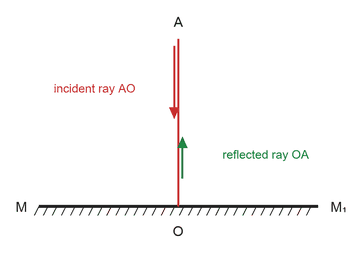
Watch out: The reflected ray does not go along the mirror; it comes straight back.
Therefore, (a) the angle of incidence is 0°, and (b) the reflected ray goes back along its own path (it retraces its path), as shown in the diagram.
- 181 mark
Question 18
For a ray reflected on a plane mirror, find the ratio of sin /sin .
Solve with AIWritten solution
Solution:
Concept: Laws of reflection. (1) The angle of incidence is equal to the angle of reflection . (2) The incident ray, the reflected ray and the normal at the point of incidence all lie in the same plane. Both angles are measured from the normal, the line drawn perpendicular to the surface at the point of incidence.
Step 1 — Use the first law.
For reflection, the angle of reflection equals the angle of incidence.
Step 2 — Compare the sines.
Equal angles have equal sines, so the numerator and the denominator of the ratio are the same number.
Step 3 — Find the ratio.
Dividing a number by itself gives 1.
Watch out: The ratio is not some property of the mirror (as for refraction); for reflection it is always exactly 1 (for any other than 0°, where both sines are 0).
Therefore, sin i/sin r = 1 for reflection at a plane mirror.
- 192 marks
Question 19
Light from a torch is reflected by a white sheet of paper and a black polished mica sheet. Which of the two will produce a stronger reflected beam ?
Solve with AIWritten solution
Solution:
Concept: Regular reflection happens at a smooth, polished surface: all its normals are parallel, so a parallel beam stays parallel after reflection. Irregular (diffused) reflection happens at a rough surface: the normals point in many directions, so a parallel beam is scattered. Each single ray obeys the laws of reflection in both cases.
Step 1 — Look at the mica sheet.
The black mica sheet is smooth and polished. Its normals are parallel at all points, so it reflects the torch beam regularly, and the reflected light stays together as one beam.
Step 2 — Look at the white paper.
White paper reflects most of the light falling on it, but its surface is rough on a small scale. It reflects the light irregularly, scattering it in all directions, so no strong beam is formed in any one direction.
Step 3 — Compare.
So the polished black sheet gives the stronger reflected beam, even though it reflects less light in total than the white paper.
Watch out: The phrase 'stronger beam' depends on how smooth the surface is, not on how white it is.
Therefore, the black polished mica sheet produces a stronger reflected beam.
- 201 mark
Question 20
A light ray strikes a mirror and retraces its path. What is the angle of incidence and angle of reflection ?
Solve with AIWritten solution
Solution:
Concept: Laws of reflection. (1) The angle of incidence is equal to the angle of reflection . (2) The incident ray, the reflected ray and the normal at the point of incidence all lie in the same plane. Both angles are measured from the normal, the line drawn perpendicular to the surface at the point of incidence.
Step 1 — Find when a ray retraces its path.
A ray comes back along its own path only if the reflected ray lies along the incident ray. Since the two rays make equal angles with the normal on opposite sides of it, this can happen only when both lie along the normal.
Step 2 — Write the angles.
A ray along the normal makes zero angle with it.
Therefore, the angle of incidence is 0° and the angle of reflection is 0°.
- 213 marks
Question 21
Explain the following terms :
(a) plane mirror, (b) incident ray, (c) reflected ray, (d) angle of incidence, and (e) angle of reflection.
Draw diagram/diagrams to show them.
Solve with AIWritten solution
Solution:
Concept: When light strikes a mirror, the incident ray is the ray that falls on it, the point of incidence is where it strikes, the normal is the perpendicular to the mirror there, and the reflected ray is the ray sent back. The angle of incidence is the angle between the incident ray and the normal; the angle of reflection is the angle between the reflected ray and the normal.
Step 1 — Look at the diagram.
In the diagram, MM₁ is a plane mirror, AO is a ray falling on it at the point O, ON is the normal at O, and OB is the ray sent back.
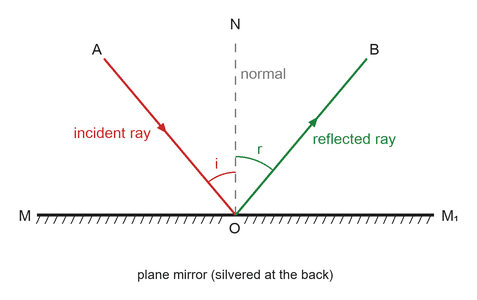
Step 2 — Plane mirror and incident ray.
(a) A plane mirror is a highly polished flat surface that reflects most of the light falling on it; usually it is a thin glass sheet silvered at the back (MM₁ in the diagram). (b) The incident ray is the ray of light that strikes the reflecting surface (AO).
Step 3 — Reflected ray.
(c) The reflected ray is the ray of light sent back from the surface into the same medium in which the incident ray was travelling (OB).
Step 4 — The two angles.
(d) The angle of incidence is the angle which the incident ray makes with the normal at the point of incidence: ∠AON = i.
(e) The angle of reflection is the angle which the reflected ray makes with the normal at the point of incidence: ∠BON = r.
Watch out: Both angles are measured from the normal ON, not from the mirror MM₁.
Therefore, MM₁ is the plane mirror, AO the incident ray, OB the reflected ray, ∠AON = i the angle of incidence and ∠BON = r the angle of reflection.
- 223 marks
Question 22
Differentiate between reflection of light from a plane mirror and that from a plane wall.
Solve with AIWritten solution
Solution:
Concept: Regular reflection happens at a smooth, polished surface: all its normals are parallel, so a parallel beam stays parallel after reflection. Irregular (diffused) reflection happens at a rough surface: the normals point in many directions, so a parallel beam is scattered. Each single ray obeys the laws of reflection in both cases.
Step 1 — The two surfaces.
A plane mirror is truly smooth and polished. A plane wall looks flat, but on a small scale it has many tiny bumps, so its normal points in a different direction at each point.
Step 2 — What happens to a parallel beam.
At the mirror all the normals are parallel, so every ray of a parallel beam has the same angle of incidence and is reflected in the same direction: regular reflection. At the wall each ray meets a surface tilted differently, so the rays go off in different directions: irregular (diffused) reflection.
Step 3 — Tabulate the differences.
The differences that follow from this are listed below.
Reflection from a plane mirror Reflection from a plane wall The surface is smooth and polished. The surface has tiny bumps, though it looks smooth. Regular reflection takes place. Irregular (diffused) reflection takes place. A parallel beam stays parallel and goes in one direction. A parallel beam is scattered in many directions. The reflected light is seen only from one direction. The reflected light is seen from every direction. A clear image is formed. No image is formed. Watch out: Each single ray obeys the laws of reflection at the wall too; only the direction of the normal changes from point to point.
Therefore, a plane mirror gives regular reflection with a clear image, while a plane wall gives irregular (diffused) reflection and no image.
- 232 marks
Question 23
State the two laws of reflection of light.
Solve with AIWritten solution
Solution:
Concept: The laws of reflection connect the incident ray, the reflected ray and the normal drawn at the point of incidence.
Step 1 — Look at the diagram.
In the diagram, AO is the incident ray, ON the normal at the point of incidence O, and OB the reflected ray; i and r are the angles of incidence and reflection.
Step 2 — First law.
The angle of incidence is equal to the angle of reflection.
Step 3 — Second law.
The incident ray, the reflected ray and the normal at the point of incidence all lie in the same plane.
Therefore, the two laws are: (1) ∠i = ∠r, and (2) the incident ray, the reflected ray and the normal at the point of incidence all lie in one plane.
- 243 marks
Question 24
Draw a diagram to show the reflection of a ray of light by a plane mirror. In the diagram, label the incident ray, the reflected ray, the normal, the angle of incidence and the angle of reflection.
Solve with AIWritten solution
Solution:
Concept: Laws of reflection. (1) The angle of incidence is equal to the angle of reflection . (2) The incident ray, the reflected ray and the normal at the point of incidence all lie in the same plane. Both angles are measured from the normal, the line drawn perpendicular to the surface at the point of incidence.
Step 1 — Draw the mirror and the normal.
Draw a line MM₁ for the plane mirror (with short hatching on its back), mark the point of incidence O, and draw the normal ON perpendicular to MM₁ at O.
Step 2 — Draw the incident ray.
Draw the incident ray AO making an angle i with the normal ON.
Step 3 — Draw the reflected ray.
On the other side of the normal, draw the reflected ray OB making the same angle with ON, so that ∠BON = ∠AON. Mark both angles and label all the parts.
Watch out: Measure both angles from the normal, and put the arrow on AO towards O and on OB away from O.
Therefore, in the diagram AO is the incident ray, OB the reflected ray, ON the normal, ∠AON = i the angle of incidence and ∠BON = r the angle of reflection, with i = r.
- 253 marks
Question 25
(a) Write three characteristics of the image formed by a plane mirror ?
(b) How is the position of image related to the position of the object ?
Solve with AIWritten solution
Solution:
Concept: A plane mirror forms an image that is virtual (the reflected rays only appear to meet behind the mirror), erect, of the same size as the object, laterally inverted, and as far behind the mirror as the object is in front of it, on the normal drawn from the object to the mirror.
Step 1 — Look at the diagram.
In the diagram, rays from the top A of the object AB are reflected by the mirror MM₁ into the eye. Produced backwards (dashed), they meet at A′ behind the mirror, so A′B′ is the image.

Step 2 — Characteristics of the image (a).
The image is (1) erect (upright), (2) virtual (the rays only appear to come from it, so it cannot be caught on a screen), and (3) of the same size as the object. It is also laterally inverted.
Step 3 — Position of the image (b).
The image lies on the normal drawn from the object to the mirror, and it is as far behind the mirror as the object is in front of it (distance d in the diagram).
Therefore, (a) the image is erect, virtual and of the same size as the object, and (b) it is as far behind the mirror as the object is in front, on the same normal to the mirror.
- 262 marks
Question 26
Differentiate between a real and a virtual image.
Solve with AIWritten solution
Solution:
Concept: A real image is formed where reflected rays actually meet; it can be caught on a screen. A virtual image is formed where reflected rays only appear to meet when produced backwards; it cannot be caught on a screen.
Step 1 — The deciding question.
Ask whether the reflected rays actually meet, or only appear to meet when produced backwards. Every other difference follows from this.
Step 2 — Tabulate the differences.
The differences are listed below.
Real image Virtual image Formed where the reflected rays actually meet. Formed where the reflected rays appear to meet when produced backwards. It can be obtained on a screen. It cannot be obtained on a screen. It is inverted with respect to the object. It is erect with respect to the object. (For a mirror) it is formed in front of the mirror. (For a mirror) it is formed behind the mirror. Example: image of the sun formed by a concave mirror. Example: image in a plane mirror. Therefore, a real image is formed by the actual meeting of rays and can be taken on a screen, while a virtual image is formed where rays only appear to meet and cannot be taken on a screen.
- 273 marks
Question 27
What is meant by lateral inversion of an image in a plane mirror ? Explain it with the help of a ray diagram.
Solve with AIWritten solution
Solution:
Concept: Lateral inversion is the interchange of left and right in the image formed by a plane mirror. It happens because each point of the image is straight behind its own object point, so the side of the object facing your right appears on the image's left as you look at it.
Step 1 — Define the term.
Lateral inversion is the interchange of the left and right sides in the image of an object seen in a plane mirror. For example, a ring on the left hand appears on the right hand of the image.
Step 2 — Draw the rays.
In the diagram the letter P stands in front of a plane mirror. A ray from the point L (on the stem) and a ray from R (on the bowl) are reflected into the eye. Produced backwards, they appear to come from L′ and R′, each as far behind the mirror as its object point is in front.
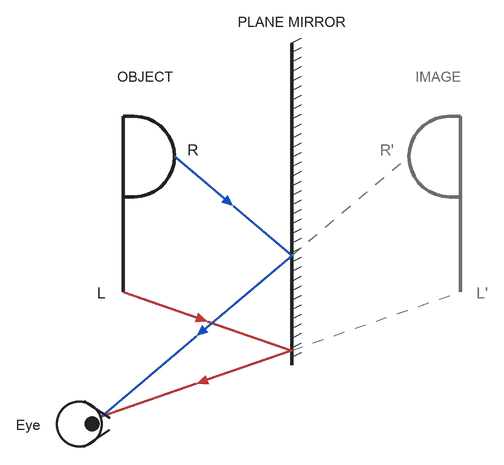
Step 3 — Read the image.
The bowl R, which is on the right side of the object, appears at R′ on the left side of the image as you look at it, and the stem appears on the right. So the letter P appears reversed left to right.
Watch out: The image is not turned upside down; only left and right are interchanged.
Therefore, lateral inversion is the left-right interchange in a plane-mirror image, as the ray diagram of the letter P shows.
- 282 marks
Question 28
The letters on the front of an ambulance are written laterally inverted like

Give reason.
Solve with AIWritten solution
Solution:
Concept: Lateral inversion is the interchange of left and right in the image formed by a plane mirror. It happens because each point of the image is straight behind its own object point, so the side of the object facing your right appears on the image's left as you look at it.
Step 1 — Who reads the word.
The driver of a vehicle ahead of the ambulance sees the ambulance in his rear-view mirror, not directly.
Step 2 — What the mirror does.
The mirror laterally inverts whatever it shows. The word is already written laterally inverted, so its image is inverted once more and reads correctly.

Step 3 — Why it matters.
The driver at once reads AMBULANCE in the mirror and gives way to let it pass.
Therefore, the word is written laterally inverted so that its image in the rear-view mirror of the vehicle ahead reads correctly as AMBULANCE.
- 295 marks
Question 29
With the help of diagrams, explain the difference between regular and irregular reflection.
Solve with AIWritten solution
Solution:
Concept: Regular reflection happens at a smooth, polished surface: all its normals are parallel, so a parallel beam stays parallel after reflection. Irregular (diffused) reflection happens at a rough surface: the normals point in many directions, so a parallel beam is scattered. Each single ray obeys the laws of reflection in both cases.
Step 1 — Look at the diagrams.
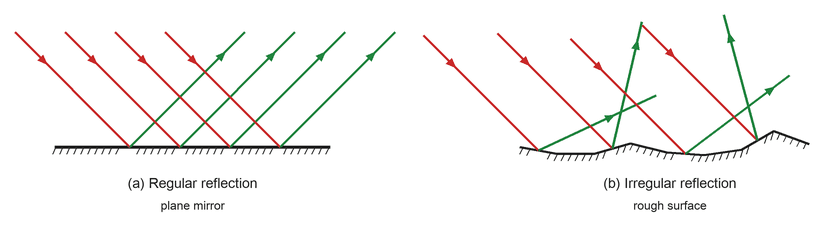
Figure (a) shows a parallel beam falling on a plane mirror; figure (b) shows the same beam falling on a rough surface.
Step 2 — Regular reflection, figure (a).
It occurs when a beam falls on a smooth, polished surface such as a plane mirror. The normals at all points are parallel, so the parallel incident rays all have the same angle of incidence and are reflected at the same angle. The reflected rays are also parallel and go in one definite direction. The light is seen only from that direction, and a clear image is formed.
Step 3 — Irregular reflection, figure (b).
It occurs when a beam falls on a rough surface such as a wall or the page of a book. The surface has many tiny bumps, so the normal points in a different direction at each point. The parallel incident rays therefore have different angles of incidence and are reflected in different directions. The light spreads out and can be seen from everywhere, but no image is formed.
Step 4 — Sum up the differences.
The main differences are listed below.
Regular reflection Irregular reflection Smooth, polished surface Rough, uneven surface Parallel rays stay parallel after reflection Parallel rays are scattered in many directions Seen only from one direction Seen from all directions Forms an image Does not form an image Watch out: Irregular reflection does not break the laws of reflection; each ray still has i = r at its own small part of the surface. It is this diffused light from ordinary objects that lets us see them from all sides.
Therefore, regular reflection keeps a parallel beam parallel (smooth surface, image formed), while irregular reflection scatters it (rough surface, no image).
- 305 marks
Question 30
State the laws of reflection and describe an experiment to verify them.
Solve with AIWritten solution
Solution:
Concept: Laws of reflection. (1) The angle of incidence is equal to the angle of reflection . (2) The incident ray, the reflected ray and the normal at the point of incidence all lie in the same plane. Both angles are measured from the normal, the line drawn perpendicular to the surface at the point of incidence.
Step 1 — State the laws.
First law: the angle of incidence is equal to the angle of reflection, ∠i = ∠r. Second law: the incident ray, the reflected ray and the normal at the point of incidence all lie in the same plane.
Step 2 — Set up.
Fix a sheet of white paper on a drawing board and draw a line MM₁ on it. Mark a point O near its middle and draw the normal ON at O. Draw a line AO making ∠AON = 30°. Stand a plane mirror vertically with its silvered surface along MM₁.
Step 3 — Mark the incident ray.
Fix two pins P and Q vertically on the line AO, about 5 cm apart.
Step 4 — Find the reflected ray.
Look into the mirror from the other side of the normal and find the images P′ and Q′ of the pins. Fix a pin R so that it hides P′ and Q′, and then a pin S in line with R, P′ and Q′. Join S and R and produce the line to meet MM₁ at O: this line OB is the reflected ray.
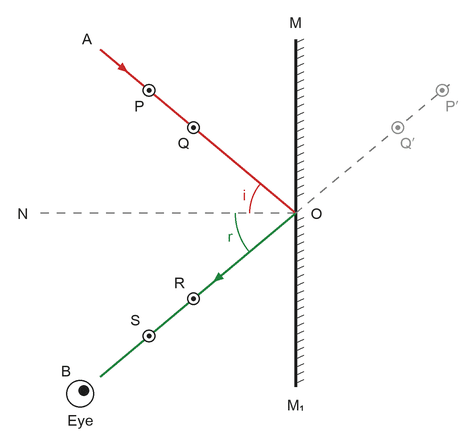
Step 5 — Measure and repeat.
Measure the angle of incidence ∠AON and the angle of reflection ∠BON with a protractor. Repeat the experiment with angles of incidence of 40°, 50° and 60°. Typical observations are shown below.
S. No. Angle of incidence i Angle of reflection r 1 30° 30° 2 40° 40° 3 50° 50° 4 60° 60° Step 6 — Conclusions.
In every case ∠i = ∠r, which verifies the first law. The mirror stands perpendicular to the board, and the feet of all the pins, the incident ray AO, the reflected ray OB and the normal ON all lie on the plane of the paper, which verifies the second law.
Watch out: Look at the feet of the pins (where they meet the paper), and keep the pins vertical, or the line SR will not pass exactly through O.
Therefore, ∠i = ∠r in every reading and all the rays and the normal lie on the paper, which verifies both laws of reflection.
- 314 marks
Question 31
Fig. 7.15 shows an incident ray and the normal on a plane mirror. The angle which the incident ray makes with the mirror is 30°. (a) Find the angle of incidence. (b) Draw the reflected ray and then find the angle between the incident and reflected rays.
 Solve with AI
Written solution
Solution:
Concept: Laws of reflection. (1) The angle of incidence is equal to the angle of reflection . (2) The incident ray, the reflected ray and the normal at the point of incidence all lie in the same plane. Both angles are measured from the normal, the line drawn perpendicular to the surface at the point of incidence.
Step 1 — Find the angle of incidence (a).
The normal ON is at 90° to the mirror, and AO makes 30° with the mirror, so the angle between AO and ON is the rest of the right angle.
Step 2 — Draw the reflected ray (b).
By the first law the angle of reflection is also 60°. Draw OB on the other side of the normal making 60° with ON (that is, 30° with the mirror on the right).
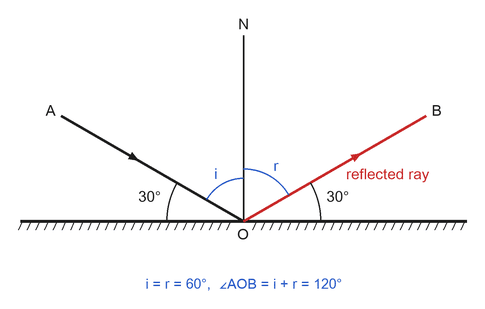
Step 3 — Find the angle between the rays.
The angle between the incident and reflected rays is the sum of the two angles on either side of the normal.
Watch out: The 30° is measured from the mirror; the angle of incidence is measured from the normal, so it is 90° − 30°.
Therefore, (a) the angle of incidence is 60°, and (b) the angle between the incident and reflected rays is 120°.
- 325 marks
Question 32
The diagram in Fig. 7.16 shows a point object in front of a plane mirror .
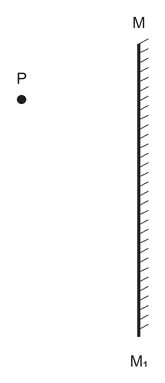
(a) Complete the diagram by taking two rays from the point to show the formation of its image.
(b) In the diagram, mark the position of eye to see the image.
(c) Is the image formed real or virtual ? Explain why ?
Solve with AIWritten solution
Solution:
Concept: A plane mirror forms an image that is virtual (the reflected rays only appear to meet behind the mirror), erect, of the same size as the object, laterally inverted, and as far behind the mirror as the object is in front of it, on the normal drawn from the object to the mirror.
Step 1 — Draw two rays (a).
From P draw two rays to two points of the mirror MM₁. At each point draw the reflected ray so that the angle of reflection equals the angle of incidence (measured from the normal at that point).
Step 2 — Locate the image.
Produce the two reflected rays backwards (dashed). They meet at P′ behind the mirror, on the perpendicular from P to the mirror and as far behind it as P is in front. P′ is the image of P.
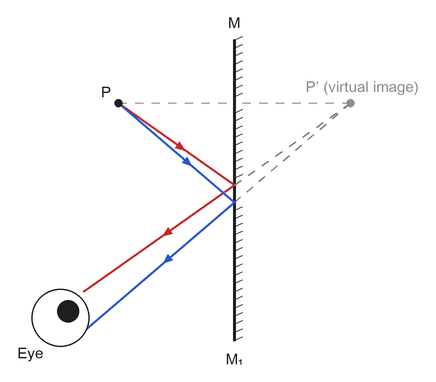
Step 3 — Mark the eye (b).
The eye is placed in front of the mirror, in the path of the reflected rays (lower left in the figure), so that both rays enter it.
Step 4 — Real or virtual (c).
The reflected rays do not actually meet; they only appear to meet at P′ when produced backwards. So the image is virtual, and it cannot be obtained on a screen.
Watch out: The eye must be placed where the reflected rays go, not near P or behind the mirror.
Therefore, (a) the reflected rays produced backwards meet at P′ behind the mirror, (b) the eye is placed in the path of the reflected rays, and (c) the image is virtual because the rays only appear to meet at P′.
- 334 marks
Question 33
The diagram below in Fig. 7.17 shows an object in front of a plane mirror . Draw on the diagram, path of two rays from each point and of the object to show the formation of its image.
 Solve with AI
Written solution
Solution:
Concept: A plane mirror forms an image that is virtual (the reflected rays only appear to meet behind the mirror), erect, of the same size as the object, laterally inverted, and as far behind the mirror as the object is in front of it, on the normal drawn from the object to the mirror.
Step 1 — Locate each image point.
Draw perpendiculars from X and Y to the mirror MM₁ and mark X′ and Y′ behind the mirror, each as far behind it as its own point is in front. Join X′Y′ (dashed): this is the image.
Step 2 — Two rays from Y.
From Y draw two rays to the mirror and reflect each so that i = r. Produced backwards, both reflected rays pass through Y′.
Step 3 — Two rays from X.
In the same way draw two rays from X; their reflected rays, produced backwards, pass through X′.
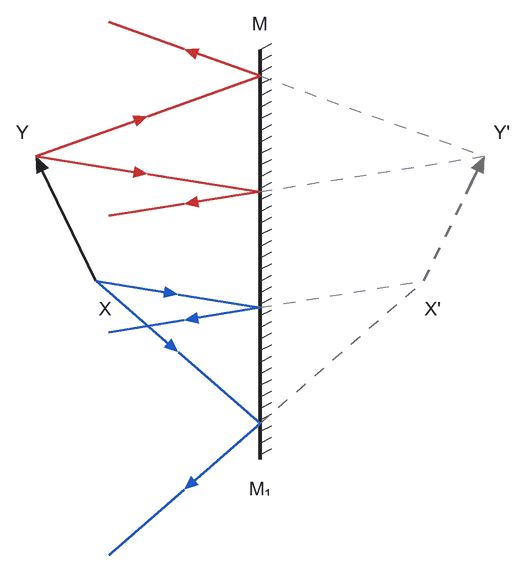
Step 4 — See the image.
An eye placed in the path of the reflected rays sees them coming from X′Y′, which is the image of XY.
Therefore, the image X′Y′ is virtual, erect and of the same size as XY, and it is as far behind the mirror as the object is in front.
- 343 marks
Question 34
A ray is incident on a plane mirror. Its reflected ray is perpendicular to the incident ray.
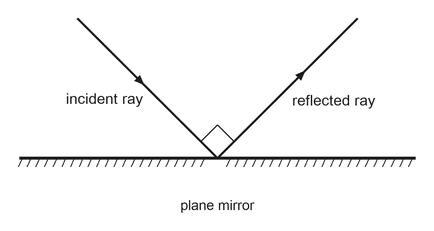
Find the angle of incidence.
Solve with AIWritten solution
Solution:
Concept: Laws of reflection. (1) The angle of incidence is equal to the angle of reflection . (2) The incident ray, the reflected ray and the normal at the point of incidence all lie in the same plane. Both angles are measured from the normal, the line drawn perpendicular to the surface at the point of incidence.
Given: The reflected ray is perpendicular to the incident ray.
Step 1 — Write the angle between the rays.
The incident ray makes angle with the normal on one side, and the reflected ray makes angle on the other side, so the angle between them is . The stem says this is 90°.
Step 2 — Use the first law.
Since , replace by .
Step 3 — Solve.
Divide both sides by 2.
Watch out: The 90° is the angle between the two rays, not the angle of incidence.
Therefore, the angle of incidence is 45°.
- 353 marks
Question 35
A man standing in front of a plane mirror finds his image at a distance 6 metre from himself. What is the distance of man from the mirror ?
Solve with AIWritten solution
Solution:
Concept: A plane mirror forms an image that is virtual (the reflected rays only appear to meet behind the mirror), erect, of the same size as the object, laterally inverted, and as far behind the mirror as the object is in front of it, on the normal drawn from the object to the mirror.
Given: Distance between the man and his image is 6 m.
Step 1 — Name the unknown.
Let the man be m in front of the mirror. His image is then m behind it, so the distance between him and his image is .
Step 2 — Form the equation.
This distance is given as 6 m.
Step 3 — Solve.
Divide both sides by 2.
Watch out: 6 m is the man–image distance; the man–mirror distance is half of it.
Therefore, the man is 3 m from the mirror.
- 363 marks
Question 36
An insect is sitting in front of a plane mirror at a distance 1 m from it.
(a) Where is the image of the insect formed ?
(b) What is the distance between the insect and its image ?
Solve with AIWritten solution
Solution:
Concept: A plane mirror forms an image that is virtual (the reflected rays only appear to meet behind the mirror), erect, of the same size as the object, laterally inverted, and as far behind the mirror as the object is in front of it, on the normal drawn from the object to the mirror.
Given: The insect is 1 m in front of the plane mirror.
Step 1 — Position of the image (a).
The image is as far behind the mirror as the insect is in front, on the perpendicular from the insect to the mirror. So it is 1 m behind the mirror.
Step 2 — Distance between the insect and its image (b).
Add the distance of the insect in front and of the image behind.
Therefore, (a) the image is 1 m behind the mirror, and (b) the insect and its image are 2 m apart.
- 374 marks
Question 37
An object is kept at 60 cm in front of a plane mirror. If the mirror is now moved 25 cm away from the object, how does the image shift from its previous position ?
Solve with AIWritten solution
Solution:
Concept: A plane mirror forms an image that is virtual (the reflected rays only appear to meet behind the mirror), erect, of the same size as the object, laterally inverted, and as far behind the mirror as the object is in front of it, on the normal drawn from the object to the mirror.
Given: Object 60 cm in front of the plane mirror; mirror moved 25 cm away from the object.
Step 1 — Before the mirror moves.
The object is 60 cm in front of the mirror, so the image is 60 cm behind it. Measured from the (fixed) object, the image is at
Step 2 — After the mirror moves.
The mirror moves 25 cm away from the object, so the object is now 60 + 25 = 85 cm in front of it, and the image is 85 cm behind it. From the object, the image is now at
Step 3 — Find the shift.
The object has not moved, so the shift of the image is the change in its distance from the object.
Watch out: The image moves twice as far as the mirror: here 2 × 25 cm, not 25 cm.
Therefore, the image shifts 50 cm away from its previous position (away from the object).
- 383 marks
Question 38
An optician while testing the eyes of a patient keeps a chart of letters 3 m behind the patient and asks him to see the letters on the image of chart formed in a plane mirror kept at distance 2 m in front of him.
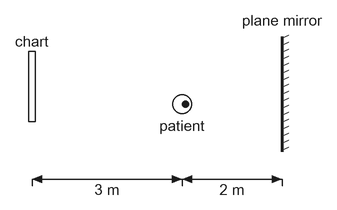
At what distance is the chart seen by the patient ?
Solve with AIWritten solution
Solution:
Concept: A plane mirror forms an image that is virtual (the reflected rays only appear to meet behind the mirror), erect, of the same size as the object, laterally inverted, and as far behind the mirror as the object is in front of it, on the normal drawn from the object to the mirror.
Given: Chart 3 m behind the patient; plane mirror 2 m in front of the patient.
Step 1 — Distance of the chart from the mirror.
The chart is 3 m behind the patient and the mirror is 2 m in front of him, so the distance of the chart from the mirror is the sum of the two.
Step 2 — Position of the image.
The image of the chart is as far behind the mirror as the chart is in front, so it is 5 m behind the mirror.

Step 3 — Distance seen by the patient.
The patient is 2 m in front of the mirror and the image is 5 m behind it.
Watch out: Measure the image from the mirror (5 m), then add the patient's distance from the mirror (2 m).
Therefore, the patient sees the chart at a distance of 7 m.
- 391 mark
Question 39
If angle between two mirrors is such that is odd and the object is placed asymmetrically between the mirrors, then the number of images formed is :
Solve with AIAnswer
(A)
(B)
(C)
- Correct
(D)
Answer: (D)
Concept: For two plane mirrors inclined at an angle θ, first find . If is even, the number of images is for every position of the object. If is odd, the number is when the object is placed asymmetrically and when it is placed symmetrically (on the bisector of the angle between the mirrors).
Step 1 — Note the two conditions.
Here is odd and the object is placed asymmetrically, that is, not on the bisector of the angle between the mirrors.
Step 2 — Apply the rule.
For an asymmetric object the last image formed by one mirror and the last image formed by the other fall at different points, so none of the images overlap and all are seen.
Step 3 — Check with an example.
Take θ = 72° and divide 360° by it.
Since 5 is odd, an asymmetric object gives 5 images.
Watch out: The answer is for an odd with the object on the bisector, or for an even .
Why the other options are wrong:
- (A) : is more images than two inclined mirrors can form.
- (B) : is more images than two inclined mirrors can form.
- (C) : is the number for a symmetric object (or for an even ), not for an asymmetric one.
Therefore, the number of images is , option (D).
- 401 mark
Question 40
If in the question (1) given above the object is placed symmetrically between the mirrors, then the number of images formed will be :
Solve with AIAnswer
(A)
(B)
- Correct
(C)
(D) 0
Answer: (C)
Concept: For two plane mirrors inclined at an angle θ, first find . If is even, the number of images is for every position of the object. If is odd, the number is when the object is placed asymmetrically and when it is placed symmetrically (on the bisector of the angle between the mirrors).
Step 1 — Note the new condition.
Now is still odd, but the object is placed symmetrically, on the bisector of the angle between the mirrors.
Step 2 — See which images overlap.
For a symmetric object, the last image formed by one mirror falls at the same point as the last image formed by the other. These two coincide and are seen as one image.
Step 3 — Count.
So one image fewer is seen, . For θ = 72°, where n is 5, this gives 4 images.
Why the other options are wrong:
- (A) : is the number for an asymmetric object, where no two images overlap.
- (B) : is more images than two inclined mirrors can form.
- (D) 0: images are always formed by mirrors inclined at an angle; the count is never zero.
Therefore, the number of images is , option (C).
- 411 mark
Question 41
Two plane mirrors are placed making an angle 60° in between them. For an object placed in between the mirrors, the number of images formed will be :
Solve with AIAnswer
(A) 3
(B) 6
- Correct
(C) 5
(D) infinite.
Answer: (C) 5
Concept: For two plane mirrors inclined at an angle θ, first find . If is even, the number of images is for every position of the object. If is odd, the number is when the object is placed asymmetrically and when it is placed symmetrically (on the bisector of the angle between the mirrors).
Step 1 — Find n.
Divide 360° by the angle between the mirrors.
Step 2 — Apply the rule for an even n.
Since 6 is even, the number of images is for every position of the object.
Watch out: Do not stop at ; one is subtracted because is even.
Why the other options are wrong:
- (A) 3: 3 is the number for mirrors at 90° (n = 4).
- (B) 6: 6 is itself; for an even the number of images is .
- (D) infinite: infinitely many images are formed only by parallel mirrors (θ = 0°).
Therefore, the number of images is 5, option (C).
- 421 mark
Question 42
In a barber's shop, two plane mirrors are placed :
Solve with AIAnswer
(A) perpendicular to each other
- Correct
(B) parallel to each other
(C) at an angle of 60° between them
(D) at an angle of 45° between them.
Answer: (B) parallel to each other
Concept: Two plane mirrors facing each other and parallel form a long row of images, because each image formed by one mirror acts as an object for the other.
Step 1 — Recall the arrangement.
In a barber's shop one mirror is fixed on the wall in front of the customer and another on the wall behind him, facing each other, so the two are parallel.
Step 2 — See why it is useful.
The many images formed between them let the customer see the back of his head in the mirror in front of him.
Why the other options are wrong:
- (A) perpendicular to each other: perpendicular mirrors give only 3 images and are not the barber's-shop arrangement.
- (C) at an angle of 60° between them: mirrors at 60° are used in a kaleidoscope, not in a barber's shop.
- (D) at an angle of 45° between them: mirrors at 45° to each other are not the barber's-shop arrangement.
Therefore, in a barber's shop the two mirrors are parallel to each other, option (B).
- 431 mark
Question 43
For two mirrors kept parallel to each other, the number of images formed is :
Solve with AIAnswer
(A) 5
(B) 7
(C) 0
- Correct
(D) infinity
Answer: (D) infinity
Concept: For two plane mirrors inclined at an angle θ, first find . If is even, the number of images is for every position of the object. If is odd, the number is when the object is placed asymmetrically and when it is placed symmetrically (on the bisector of the angle between the mirrors).
Step 1 — Use the angle.
For parallel mirrors the angle between them is 0°, so has no finite value: it becomes infinitely large.
Step 2 — Explain it with images.
Each image formed in one mirror acts as an object for the other mirror, which forms a new image, and so on without end.
Step 3 — What is seen in practice.
Some light is lost at every reflection, so the farther images become fainter and only a limited number are actually seen.
Watch out: The phrase 'only a few are seen' is about brightness; the number formed is still infinite.
Why the other options are wrong:
- (A) 5: 5 is the number for mirrors inclined at 60°.
- (B) 7: 7 is a finite number; parallel mirrors form endlessly many images.
- (C) 0: parallel mirrors form many images, not none.
Therefore, parallel mirrors form an infinite number of images, option (D).
- 441 mark
Question 44
The number of images formed for two mirrors kept perpendicular to each other is :
Solve with AIAnswer
(A) 1
(B) 2
- Correct
(C) 3
(D) 5
Answer: (C) 3
Concept: For two plane mirrors inclined at an angle θ, first find . If is even, the number of images is for every position of the object. If is odd, the number is when the object is placed asymmetrically and when it is placed symmetrically (on the bisector of the angle between the mirrors).
Step 1 — Find n.
Mirrors perpendicular to each other are at 90°.
Step 2 — Apply the rule for an even n.
Since 4 is even, the number of images is .
Watch out: Two images come from single reflections, and the third from two reflections, one in each mirror.
Why the other options are wrong:
- (A) 1: 1 image is formed by a single plane mirror, not by two perpendicular mirrors.
- (B) 2: 2 counts only the images formed by one reflection and misses the image formed by two reflections.
- (D) 5: 5 is the number for mirrors inclined at 60°.
Therefore, two perpendicular mirrors form 3 images, option (C).
- 451 mark
Question 45
A thick plane mirror, silvered at its back, forms multiple number of images. Out of these, the brightest image is :
Solve with AIAnswer
(A) first image
- Correct
(B) second image
(C) third image
(D) All are of equal brightness
Answer: (B) second image
Concept: A thick plane mirror is a glass plate silvered at the back. Light is partly reflected at the front glass surface and mostly reflected at the silvered back, and some light is reflected again and again inside the glass, giving several images.
Step 1 — The first image.
The first image is formed by the light reflected at the front glass surface. Glass reflects only a small part of the light, so this image is faint.
Step 2 — The second image.
Most of the light enters the glass and is reflected by the silvered back, which reflects strongly. This light forms the second image, which is therefore the brightest.
Step 3 — The later images.
The later images come from light reflected again inside the glass; only a little light is left each time, so they become fainter and fainter.
Watch out: The first image is not the brightest just because it is formed first.
Why the other options are wrong:
- (A) first image: the first image comes from the weak reflection at the front glass surface, so it is faint.
- (C) third image: the third image is formed after further internal reflections and is fainter than the second.
- (D) All are of equal brightness: the images differ in brightness: the second is the brightest and the later ones get fainter.
Therefore, the brightest image is the second image, option (B).
- 461 mark
Question 46
How many plane mirrors are used in a periscope and a kaleidoscope ?
Solve with AIAnswer
- Correct
(A) 2 and 3 respectively
(B) 3 each
(C) 3 and 2 respectively
(D) 2 and 4 respectively
Answer: (A) 2 and 3 respectively
Concept: A periscope turns light twice through 90° with two parallel plane mirrors, each at 45° to its tube. A kaleidoscope uses plane mirrors inclined at 60° to each other to form many images of coloured pieces.
Step 1 — Periscope.
A periscope has two plane mirrors, one at the top and one at the bottom of the tube, facing each other.
Step 2 — Kaleidoscope.
A kaleidoscope has three plane mirrors forming a triangular tube, each inclined at 60° to the others.
Step 3 — Match the order.
The stem asks for the periscope first, then the kaleidoscope: 2 and 3.
Watch out: Keep the order of the stem: the periscope's number comes first.
Why the other options are wrong:
- (B) 3 each: a periscope uses 2 mirrors, not 3.
- (C) 3 and 2 respectively: it swaps the two numbers: the periscope uses 2 and the kaleidoscope 3.
- (D) 2 and 4 respectively: a kaleidoscope uses 3 mirrors, not 4.
Therefore, a periscope uses 2 and a kaleidoscope 3 plane mirrors, option (A).
- 471 mark
Question 47
In a kaleidoscope, three plane mirrors are inclined with each other at an angle of :
Solve with AIAnswer
(A) 0°
(B) 30°
- Correct
(C) 60°
(D) 90°
Answer: (C) 60°
Concept: For two plane mirrors inclined at an angle θ, first find . If is even, the number of images is for every position of the object. If is odd, the number is when the object is placed asymmetrically and when it is placed symmetrically (on the bisector of the angle between the mirrors).
Step 1 — Recall the shape.
The three mirrors of a kaleidoscope form a tube with a triangular cross-section. For the pattern to repeat neatly, the triangle is equilateral.
Step 2 — Find the angle.
Each angle of an equilateral triangle is 60°, so each mirror is inclined at 60° to the others. For two such mirrors, 360° ÷ 60° = 6, so the pieces of glass with their images make a six-fold (hexagonal) pattern.
Why the other options are wrong:
- (A) 0°: 0° would mean parallel mirrors, which give a row of images, not a kaleidoscope pattern.
- (B) 30°: 30° is not the angle used; the triangle of mirrors is equilateral.
- (D) 90°: mirrors at 90° cannot form a closed triangular tube of three mirrors.
Therefore, the mirrors of a kaleidoscope are inclined at 60°, option (C).
- 481 mark
Question 48
In a periscope, two plane mirrors are inclined at an angle of .......... with the vertical walls.
Solve with AIAnswer
(A) 0°
(B) 30°
- Correct
(C) 45°
(D) 60°
Answer: (C) 45°
Concept: Laws of reflection. (1) The angle of incidence is equal to the angle of reflection . (2) The incident ray, the reflected ray and the normal at the point of incidence all lie in the same plane. Both angles are measured from the normal, the line drawn perpendicular to the surface at the point of incidence.
Step 1 — What each mirror must do.
Light entering the top of the periscope horizontally must be turned through 90° to travel down the tube, and turned through 90° again at the bottom to come out horizontally.
Step 2 — Find the angle.
A ray is turned through 90° when its angles of incidence and reflection are each 45°, which happens when the mirror is at 45° to the incoming (horizontal) ray and to the vertical wall of the tube.
Step 3 — Conclude.
So each mirror is fixed at 45° to the vertical walls, and the two mirrors are parallel.
Why the other options are wrong:
- (A) 0°: a mirror at 0° (along the wall) would not turn the light into or out of the tube.
- (B) 30°: a mirror at 30° to the wall meets a horizontal ray at 60°, so it turns the ray through 120°, not 90°.
- (D) 60°: a mirror at 60° to the wall meets a horizontal ray at 30°, so it turns the ray through 60°, not 90°.
Therefore, the mirrors of a periscope are inclined at 45° to the vertical walls, option (C).
- 491 mark
Question 49
What is the most common use of a plane mirror ?
Solve with AIWritten solution
Solution:
Concept: A plane mirror forms an image that is virtual (the reflected rays only appear to meet behind the mirror), erect, of the same size as the object, laterally inverted, and as far behind the mirror as the object is in front of it, on the normal drawn from the object to the mirror.
Step 1 — Think of the property used.
A plane mirror shows an erect image of the same size as the object, which is exactly what we need to see ourselves.
Step 2 — Name the use.
So its most common use is as a looking glass, to see our own face and dress.
Therefore, the most common use of a plane mirror is as a looking glass.
- 502 marks
Question 50
How does an optician increase the effective length of his room by using a mirror ? Where does he place the sign board ?
Solve with AIWritten solution
Solution:
Concept: A plane mirror forms an image that is virtual (the reflected rays only appear to meet behind the mirror), erect, of the same size as the object, laterally inverted, and as far behind the mirror as the object is in front of it, on the normal drawn from the object to the mirror.
Step 1 — Where the mirror goes.
The optician fixes a plane mirror on the front wall of the room, facing the patient.
Step 2 — Where the sign board goes.
He places the sign board (letter chart) on the opposite wall, just behind (above) the patient. The patient looks at the image of the chart in the mirror, not at the chart itself.

Step 3 — Why the room seems longer.
The chart is nearly the length of the room (d) in front of the mirror, so its image is the same distance d behind the mirror. The patient, sitting near the chart, sees the image nearly 2d away: about double the length of the room.
Watch out: The patient must look at the image in the mirror; the effect comes from the image being behind the mirror.
Therefore, with a plane mirror on the front wall and the sign board on the wall behind the patient, the chart is seen at nearly double the length of the room.
- 512 marks
Question 51
What relationship do the images formed by two inclined plane mirrors have for their location with respect to the object placed between them ?
Solve with AIWritten solution
Solution:
Concept: A plane mirror forms an image that is virtual (the reflected rays only appear to meet behind the mirror), erect, of the same size as the object, laterally inverted, and as far behind the mirror as the object is in front of it, on the normal drawn from the object to the mirror.
Step 1 — One mirror at a time.
Each image is as far behind its mirror as its object is in front, on the normal from the object. So the object and its image are mirror points of each other in the line of that mirror.
Step 2 — Distance from the meeting point.
The point O where the two mirrors meet lies on both mirror lines, so every image is at the same distance from O as the object (or image) that produced it. Hence every image is as far from O as the object itself.

Step 3 — State the result.
All the images therefore lie on a circle whose centre is the point of intersection of the two mirrors and whose radius equals the distance of the object from that point.
Therefore, the object and all its images lie on a circle centred at the meeting point of the mirrors, with radius equal to the object's distance from that point.
- 523 marks
Question 52
Two plane mirrors are placed making an angle in between them. Write an expression for the number of images formed if an object is placed in between the mirrors. State the condition, if any.
Solve with AIWritten solution
Solution:
Concept: For two plane mirrors inclined at an angle θ, first find . If is even, the number of images is for every position of the object. If is odd, the number is when the object is placed asymmetrically and when it is placed symmetrically (on the bisector of the angle between the mirrors).
Step 1 — Find n.
For two plane mirrors inclined at an angle θ, first find
Step 2 — If n is even.
The number of images is , wherever the object is placed between the mirrors.
Step 3 — If n is odd.
The number of images is when the object is placed asymmetrically, and when it is placed symmetrically (on the bisector of the angle between the mirrors).
Step 4 — Condition.
The rule holds when 360° ÷ θ is a whole number, and the object must lie between the mirrors.
Therefore, the number of images is n − 1 when n = 360°/θ is even (or odd with a symmetric object), and n when n is odd with an asymmetric object.
- 532 marks
Question 53
Two plane mirrors are placed making an angle in between them. For an object placed in between the mirrors, if angle is gradually increased from 0° to 180°, how will the number of images change: increase, decrease or remain unchanged ?
Solve with AIWritten solution
Solution:
Concept: For two plane mirrors inclined at an angle θ, first find . If is even, the number of images is for every position of the object. If is odd, the number is when the object is placed asymmetrically and when it is placed symmetrically (on the bisector of the angle between the mirrors).
Step 1 — See how n changes.
The number of images depends on . As θ increases, becomes smaller.
Step 2 — Check some angles.
At θ = 0° (parallel mirrors) the number is infinite; at 60° it is 5; at 90° it is 3; at 120° it is 3 (or 2 for an object on the bisector); at 180° the two mirrors form one plane mirror and give only 1 image.
Therefore, as the angle is increased from 0° to 180°, the number of images decreases.
- 542 marks
Question 54
State two uses of a plane mirror.
Solve with AIWritten solution
Solution:
Concept: A plane mirror forms an image that is virtual (the reflected rays only appear to meet behind the mirror), erect, of the same size as the object, laterally inverted, and as far behind the mirror as the object is in front of it, on the normal drawn from the object to the mirror.
Step 1 — Think of the useful properties.
A plane mirror gives an erect, same-size image and turns light in a chosen direction, so it has many uses.
Step 2 — List the uses.
Any two of the following.
- As a looking glass.
- In an optician's room, to make the room seem double its length for testing eyes.
- In a barber's shop, two parallel mirrors let a customer see the back of his head.
- In a periscope (two mirrors at 45°) and a kaleidoscope (three mirrors at 60°).
- In solar cookers, to reflect sunlight onto the food.
Therefore, two uses of a plane mirror are as a looking glass and in a periscope (any two from the list).
- 555 marks
Question 55
How many images are formed for a point object kept in between the two plane mirrors at right angles to each other ? Show them by drawing a ray diagram.
Solve with AIWritten solution
Solution:
Concept: For two plane mirrors inclined at an angle θ, first find . If is even, the number of images is for every position of the object. If is odd, the number is when the object is placed asymmetrically and when it is placed symmetrically (on the bisector of the angle between the mirrors).
Step 1 — Count the images.
The mirrors are at 90°, so find first.
Since 4 is even, the number of images is one less than n.
Step 2 — Look at the ray diagram.
In the figure OA and OB are the two mirrors at right angles and P is the object.
Step 3 — Images by one reflection.
P₁ is the image of P in mirror OA (red ray, one reflection) and P₂ is the image of P in mirror OB (blue ray, one reflection).
Step 4 — Image by two reflections.
P₃ is formed by two reflections (green ray: first at OA, then at OB). The image P₁ acts as an object for mirror OB and the image P₂ acts as an object for mirror OA; both give an image at the same point P₃, so they are seen as one image.
Step 5 — Check the positions.
In each case the reflected ray entering the eye, produced backwards (dashed), passes through the image. All three images lie on a circle with centre O and radius OP.
Watch out: The images of P₁ in OB and of P₂ in OA fall at the same point, so they are counted once.
Therefore, three images are formed by two plane mirrors at right angles to each other.
- 565 marks
Question 56
Two plane mirrors are arranged parallel and facing each other at some separation. How many images are formed for a point object kept in between them ? Show the formation of images with the help of a ray diagram.
Solve with AIWritten solution
Solution:
Concept: For two plane mirrors inclined at an angle θ, first find . If is even, the number of images is for every position of the object. If is odd, the number is when the object is placed asymmetrically and when it is placed symmetrically (on the bisector of the angle between the mirrors).
Step 1 — Count the images.
For parallel mirrors the angle between them is 0°, so is infinitely large: an infinite number of images is formed.
Step 2 — Look at the ray diagram.
In the figure M and M₁ are the parallel mirrors and P is the object between them.

Step 3 — Images from mirror M.
Mirror M forms the image I₁ of P (red ray: one reflection). I₁ acts as an object for M₁, giving I″; I″ acts as an object for M, giving I₃; and so on.
Step 4 — Images from mirror M₁.
Mirror M₁ forms the image I′ of P; I′ acts as an object for M, giving I₂ (blue ray: two reflections, first at M₁ and then at M); and so on.
Step 5 — Why only a few are seen.
All the images lie on the line through P perpendicular to the mirrors. Some light is absorbed at each reflection, so the farther images become fainter and only a few are actually seen. This arrangement is used in a barber's shop.
Therefore, an infinite number of images is formed by two parallel plane mirrors.
- 573 marks
Question 57
State the number of images of an object placed between the two plane mirrors, formed in each case when the mirrors are inclined to each other at (a) 90°, and (b) 60°.
Solve with AIWritten solution
Solution:
Concept: For two plane mirrors inclined at an angle θ, first find . If is even, the number of images is for every position of the object. If is odd, the number is when the object is placed asymmetrically and when it is placed symmetrically (on the bisector of the angle between the mirrors).
Step 1 — Mirrors at 90° (a).
Find and apply the rule for an even .
Since 4 is even, the number of images is n − 1.
Step 2 — Mirrors at 60° (b).
Find again.
Since 6 is even, the number of images is n − 1.
Watch out: Subtract 1 when n is even, whatever the position of the object.
Therefore, (a) 3 images and (b) 5 images are formed.
- 584 marks
Question 58
An object is placed (i) asymmetrically (ii) symmetrically, between two plane mirrors inclined at an angle of 50°. Find the number of images formed.
Solve with AIWritten solution
Solution:
Concept: For two plane mirrors inclined at an angle θ, first find . If is even, the number of images is for every position of the object. If is odd, the number is when the object is placed asymmetrically and when it is placed symmetrically (on the bisector of the angle between the mirrors).
Step 1 — Find n.
Divide 360° by the angle between the mirrors.
This is not a whole number. Following the book, take its whole-number part, n = 7, which is odd.
Step 2 — Object placed asymmetrically (i).
For an odd n and an asymmetric object, the number of images is .
Step 3 — Object placed symmetrically (ii).
For an odd n and an object on the bisector, two images coincide, so the number is n − 1.
Note: the n / n − 1 rule is exact only for angles that divide 360° exactly. Since 360° ÷ 50° = 7.2, the answer above treats n as 7; for such an angle the number of images actually seen can depend on the exact position of the object.
Therefore, (i) 7 images and (ii) 6 images are formed (the book's answers).
- 591 mark
Question 59
A spherical mirror is made by silvering a part of a :
Solve with AIAnswer
(A) solid metal sphere
(B) hollow metal sphere
- Correct
(C) hollow glass sphere
(D) None of the above
Answer: (C) hollow glass sphere
Concept: A spherical mirror is a part of a hollow sphere silvered on one side. If the outer surface is silvered, reflection takes place at the inner (hollow) surface and the mirror is concave. If the inner surface is silvered, reflection takes place at the outer (bulging) surface and the mirror is convex.
Step 1 — Recall how it is made.
A spherical mirror is cut from a hollow glass sphere, and one of its two surfaces is silvered.
Step 2 — See why glass is used.
The silver coating on one side makes the other side reflect, just as a plane mirror is glass silvered at the back.
Why the other options are wrong:
- (A) solid metal sphere: a solid metal sphere is not cut and silvered to make an ordinary spherical mirror.
- (B) hollow metal sphere: a hollow metal sphere needs no silvering; the book's mirror is made from glass.
- (D) None of the above: option (C) is correct, so 'none of the above' is wrong.
Therefore, a spherical mirror is made by silvering a part of a hollow glass sphere, option (C).
- 601 mark
Question 60
A .......... mirror is made by silvering the ........... surface of a piece of a hollow sphere.
Solve with AIAnswer
(A) convex, outer
(B) plane, outer
- Correct
(C) concave, outer
(D) concave, inner
Answer: (C) concave, outer
Concept: A spherical mirror is a part of a hollow sphere silvered on one side. If the outer surface is silvered, reflection takes place at the inner (hollow) surface and the mirror is concave. If the inner surface is silvered, reflection takes place at the outer (bulging) surface and the mirror is convex.
Step 1 — Silvered side and reflecting side.
The silvered surface is the back of the mirror; light is reflected from the other surface.
Step 2 — Outer surface silvered.
If the outer (bulging) surface is silvered, the light is reflected from the inner, hollow surface, which caves in towards the light. Such a mirror is concave.
Watch out: The name comes from the REFLECTING surface, which is the one NOT silvered.
Why the other options are wrong:
- (A) convex, outer: silvering the outer surface leaves the inner, hollow surface to reflect, so the mirror is concave, not convex.
- (B) plane, outer: a piece of a sphere is curved, so it cannot be a plane mirror.
- (D) concave, inner: silvering the inner surface leaves the outer, bulging surface to reflect, which makes a convex mirror.
Therefore, a concave mirror is made by silvering the outer surface, option (C).
- 611 mark
Question 61
A ............ mirror is made by silvering the ........ surface of a piece of a hollow sphere.
Solve with AIAnswer
(A) concave, inner
- Correct
(B) convex, inner
(C) convex, outer
(D) None of the above
Answer: (B) convex, inner
Concept: A spherical mirror is a part of a hollow sphere silvered on one side. If the outer surface is silvered, reflection takes place at the inner (hollow) surface and the mirror is concave. If the inner surface is silvered, reflection takes place at the outer (bulging) surface and the mirror is convex.
Step 1 — Silvered side and reflecting side.
Light is reflected from the surface that is NOT silvered.
Step 2 — Inner surface silvered.
If the inner surface is silvered, the light is reflected from the outer, bulging surface. Such a mirror is convex.
Watch out: The name comes from the reflecting surface, which is the one not silvered.
Why the other options are wrong:
- (A) concave, inner: silvering the inner surface makes the outer surface reflect, which gives a convex mirror, not a concave one.
- (C) convex, outer: silvering the outer surface makes the inner, hollow surface reflect, which gives a concave mirror.
- (D) None of the above: option (B) is correct, so 'none of the above' is wrong.
Therefore, a convex mirror is made by silvering the inner surface, option (B).
- 621 mark
Question 62
The correct statement(s) is/are :
(i) The radius of a sphere of which the spherical mirror is a part is called the radius of curvature.
(ii) The geometric centre of the spherical surface of a mirror is called the centre of curvature.
(iii) Principal axis is the straight line joining the pole of the mirror to its aperture.
Solve with AIAnswer
- Correct
(A) (i)
(B) (ii)
(C) (iii)
(D) None of the above
Answer: (A) statement 1
Concept: For a spherical mirror: the pole P is the mid-point of its reflecting surface; the centre of curvature C is the centre of the sphere of which it is a part; the radius of curvature R is the radius of that sphere (R = PC); the principal axis is the line through P and C; the aperture is the diameter of the reflecting surface.
Step 1 — Judge statement 1.
The radius of the sphere of which the mirror is a part is called its radius of curvature R. Statement 1 is true.
Step 2 — Judge statement 2.
The centre of curvature is the centre of the whole sphere, which lies away from the mirror. The geometric centre (mid-point) of the mirror's own surface is the pole. Statement 2 is false.
Step 3 — Judge statement 3.
The principal axis is the straight line through the pole and the centre of curvature, not a line joining the pole to the aperture. Statement 3 is false.
Watch out: The centre of the SPHERE is C; the centre of the mirror's surface is the pole P.
Why the other options are wrong:
- (B) statement 2: statement 2 describes the pole, not the centre of curvature, so it is false.
- (C) statement 3: statement 3 is false: the principal axis joins the pole to the centre of curvature.
- (D) None of the above: statement 1 is correct, so 'none of the above' is wrong.
Therefore, only statement 1 is correct, option (A).
- 631 mark
Question 63
The focus of a concave mirror is a point on the ......... through which the light rays incident ............ to the principal axis pass after reflection from the mirror.
Solve with AIAnswer
(A) centre of curvature, perpendicular
- Correct
(B) principal axis, parallel
(C) principal axis, perpendicular
(D) aperture, parallel
Answer: (B) principal axis, parallel
Concept: Rays parallel to the principal axis, after reflection, pass through a point F on the axis (concave mirror, real focus) or appear to come from a point F behind the mirror (convex mirror, virtual focus). F is the focus. Its distance from the pole is the focal length f (f = PF), and it is half the radius of curvature (f = R/2).
Step 1 — Where the focus lies.
The focus F is a point on the principal axis.
Step 2 — Which rays define it.
Rays incident parallel to the principal axis all pass through F after reflection from a concave mirror.
Why the other options are wrong:
- (A) centre of curvature, perpendicular: the focus is not at the centre of curvature (it is midway between P and C), and rays perpendicular to the axis do not define it.
- (C) principal axis, perpendicular: the place is right, but rays perpendicular to the axis do not define the focus.
- (D) aperture, parallel: the focus lies on the principal axis, not on the aperture.
Therefore, the blanks are 'principal axis' and 'parallel', option (B).
- 641 mark
Question 64
A concave mirror has a ........ focus, whereas a convex mirror has a ............ focus.
Solve with AIAnswer
(A) real and virtual, real
- Correct
(B) real, virtual
(C) virtual, real
(D) virtual, real and virtual
Answer: (B) real, virtual
Concept: Rays parallel to the principal axis, after reflection, pass through a point F on the axis (concave mirror, real focus) or appear to come from a point F behind the mirror (convex mirror, virtual focus). F is the focus. Its distance from the pole is the focal length f (f = PF), and it is half the radius of curvature (f = R/2).
Step 1 — Concave mirror.
Parallel rays actually meet at the focus after reflection, so the focus of a concave mirror is real.
Step 2 — Convex mirror.
The reflected rays spread out and only appear to come from a point behind the mirror, so the focus of a convex mirror is virtual.
Why the other options are wrong:
- (A) real and virtual, real: a concave mirror's focus is only real, because the rays actually pass through it.
- (C) virtual, real: it swaps the two: the concave mirror has the real focus.
- (D) virtual, real and virtual: it swaps the two, and a convex mirror's focus is never real.
Therefore, a concave mirror has a real focus and a convex mirror a virtual focus, option (B).
- 651 mark
Question 65
A focal plane passes through the focus and is .......... to the principal axis.
Solve with AIAnswer
(A) parallel
(B) inclined
- Correct
(C) normal
(D) none of the above
Answer: (C) normal
Concept: Rays parallel to the principal axis, after reflection, pass through a point F on the axis (concave mirror, real focus) or appear to come from a point F behind the mirror (convex mirror, virtual focus). F is the focus. Its distance from the pole is the focal length f (f = PF), and it is half the radius of curvature (f = R/2).
Step 1 — Recall the definition.
The focal plane is the plane that passes through the focus and is normal (perpendicular) to the principal axis.
Step 2 — See its use.
A parallel beam that is inclined to the principal axis is focused at a point in this plane, not at F itself.
Why the other options are wrong:
- (A) parallel: a plane through F parallel to the axis would contain the axis; it is not the focal plane.
- (B) inclined: the focal plane is perpendicular to the axis, not inclined to it.
- (D) none of the above: option (C) is correct, so 'none of the above' is wrong.
Therefore, the focal plane is normal to the principal axis, option (C).
- 661 mark
Question 66
For an incident ray directed towards centre of curvature of a spherical mirror, the reflected ray :
Solve with AIAnswer
- Correct
(A) retraces its path
(B) passes through the focus
(C) passes through the pole
(D) becomes parallel to the principal axis.
Answer: (A) retraces its path
Concept: Four rays are easy to draw after reflection from a spherical mirror: (1) a ray parallel to the principal axis passes through F (concave) or appears to come from F (convex); (2) a ray through or towards F becomes parallel to the axis; (3) a ray through or towards C falls normally and retraces its path; (4) a ray striking the pole is reflected at an equal angle on the other side of the axis.
Step 1 — The line from C is a normal.
Every line from the centre of curvature C to a point of the mirror is a radius, and a radius is perpendicular to the sphere's surface. So a ray directed towards C meets the mirror normally.
Step 2 — Apply the law of reflection.
For normal incidence , so , and the ray is reflected back along its own path.
Why the other options are wrong:
- (B) passes through the focus: a ray parallel to the principal axis is the one that passes through the focus.
- (C) passes through the pole: a ray directed towards C meets the mirror at the pole only if it travels along the principal axis.
- (D) becomes parallel to the principal axis: a ray through the focus is the one that becomes parallel to the axis.
Therefore, a ray directed towards the centre of curvature retraces its path, option (A).
- 671 mark
Question 67
A ray either incident from the focus (or converging at the focus), after reflection from a spherical mirror :
Solve with AIAnswer
(A) becomes perpendicular to the principal axis
- Correct
(B) becomes parallel to the principal axis
(C) becomes normal to the focus
(D) passes through the centre of curvature
Answer: (B) becomes parallel to the principal axis
Concept: Four rays are easy to draw after reflection from a spherical mirror: (1) a ray parallel to the principal axis passes through F (concave) or appears to come from F (convex); (2) a ray through or towards F becomes parallel to the axis; (3) a ray through or towards C falls normally and retraces its path; (4) a ray striking the pole is reflected at an equal angle on the other side of the axis.
Step 1 — Use the reversibility of light.
A ray parallel to the axis is reflected through F (or as if from F). Light retraces its path when reversed, so a ray coming through F (or aimed at F) is reflected parallel to the axis.
Step 2 — State the rule.
So the reflected ray becomes parallel to the principal axis.
Why the other options are wrong:
- (A) becomes perpendicular to the principal axis: the reflected ray is parallel to the axis, not perpendicular to it.
- (C) becomes normal to the focus: 'normal to the focus' has no meaning; the reflected ray is parallel to the axis.
- (D) passes through the centre of curvature: a ray through C is the one that retraces its path; this ray does not pass through C.
Therefore, the reflected ray becomes parallel to the principal axis, option (B).
- 681 mark
Question 68
For a concave mirror, when the object is at infinity, the nature of the image formed at focus is :
Solve with AIAnswer
(A) virtual, inverted
(B) virtual, diminished to a point
(C) real, enlarged, inverted
- Correct
(D) real, inverted, diminished to a point
Answer: (D) real, inverted, diminished to a point
Concept: For a concave mirror the image depends on where the object is: object at infinity → image at F; beyond C → between F and C; at C → at C; between C and F → beyond C; at F → at infinity; between F and P → behind the mirror. Only the last image is virtual and erect; all the others are real and inverted.
Step 1 — Rays from infinity.
Rays from an object at infinity reach the mirror parallel to each other.
Step 2 — After reflection.
A concave mirror converges them to its focus, where they actually meet. So the image is real and inverted, and it is a point: diminished to a point.
Why the other options are wrong:
- (A) virtual, inverted: the rays actually meet at F, so the image is real, not virtual.
- (B) virtual, diminished to a point: the image is diminished to a point, but it is real, not virtual.
- (C) real, enlarged, inverted: the image at F is a point, so it is highly diminished, not enlarged.
Therefore, the image is real, inverted and diminished to a point, option (D).
- 691 mark
Question 69
For a concave mirror, when the object is at the centre of curvature, the place and nature of the image formed is :
Solve with AIAnswer
(A) at focus, real, inverted
(B) at focus, virtual, inverted
(C) at centre of curvature, real, inverted, diminished
- Correct
(D) at centre of curvature, real, same size as that of the object
Answer: (D) at centre of curvature, real, same size as that of the object
Concept: For a concave mirror the image depends on where the object is: object at infinity → image at F; beyond C → between F and C; at C → at C; between C and F → beyond C; at F → at infinity; between F and P → behind the mirror. Only the last image is virtual and erect; all the others are real and inverted.
Step 1 — Use the mirror formula.
With the object at C, (both negative). Then the formula gives
so : the image is also at C.
Step 2 — Find the size.
The magnification is
so the image is real, inverted and of the same size as the object.
Why the other options are wrong:
- (A) at focus, real, inverted: the image of an object at C is at C, not at F.
- (B) at focus, virtual, inverted: the image is at C, not at F, and it is real.
- (C) at centre of curvature, real, inverted, diminished: the image is at C, but it is of the same size, not diminished.
Therefore, the image is at the centre of curvature, real and of the same size, option (D).
- 701 mark
Question 70
For a concave mirror, when the object is at focus, the size of the image formed is :
Solve with AIAnswer
(A) magnified
- Correct
(B) highly magnified
(C) diminished
(D) of the same size
Answer: (B) highly magnified
Concept: For a concave mirror the image depends on where the object is: object at infinity → image at F; beyond C → between F and C; at C → at C; between C and F → beyond C; at F → at infinity; between F and P → behind the mirror. Only the last image is virtual and erect; all the others are real and inverted.
Step 1 — Rays from F.
Every ray from an object at the focus becomes parallel to the principal axis after reflection.
Step 2 — Where the image forms.
Parallel rays meet only at infinity, so the image is formed at infinity, where it is real, inverted and highly magnified.
Why the other options are wrong:
- (A) magnified: 'magnified' fits an object between C and F; an object at F gives a highly magnified image.
- (C) diminished: a diminished image is formed for an object beyond C.
- (D) of the same size: a same-size image is formed for an object at C.
Therefore, the image is highly magnified, option (B).
- 711 mark
Question 71
The image formed by a convex mirror is :
Solve with AIAnswer
- Correct
(A) erect and diminished
(B) erect and enlarged
(C) inverted and diminished
(D) inverted and enlarged.
Answer: (A) erect and diminished
Concept: A convex mirror always forms a virtual, erect and diminished image, behind the mirror between its pole P and focus F, whatever the position of the object.
Step 1 — What the rays do.
A convex mirror makes the reflected rays spread out, so they only appear to meet behind it: the image is virtual and erect.
Step 2 — The size.
The image is always formed between P and F and is always diminished.
Why the other options are wrong:
- (B) erect and enlarged: a convex mirror never forms an enlarged image.
- (C) inverted and diminished: a convex mirror never forms an inverted image.
- (D) inverted and enlarged: a convex mirror forms neither an inverted nor an enlarged image.
Therefore, the image formed by a convex mirror is erect and diminished, option (A).
- 721 mark
Question 72
For a convex mirror, when the object is in front of the mirror, the image formed is :
Solve with AIAnswer
(A) real, upright and magnified
(B) real, inverted and diminished
(C) virtual, upright and magnified
- Correct
(D) virtual, upright and diminished
Answer: (D) virtual, upright and diminished
Concept: A convex mirror always forms a virtual, erect and diminished image, behind the mirror between its pole P and focus F, whatever the position of the object.
Step 1 — Real or virtual.
The reflected rays from a convex mirror diverge and only appear to meet behind it, so the image is virtual and upright.
Step 2 — The size.
The image always lies between P and F and is diminished.
Why the other options are wrong:
- (A) real, upright and magnified: a convex mirror never forms a real image, and its image is never magnified.
- (B) real, inverted and diminished: a convex mirror never forms a real or an inverted image.
- (C) virtual, upright and magnified: the image is virtual and upright, but it is diminished, not magnified.
Therefore, the image is virtual, upright and diminished, option (D).
- 731 mark
Question 73
For a spherical mirror, the focal length is ............ its radius of curvature.
Solve with AIAnswer
(A) equal to
- Correct
(B) half of
(C) twice of
(D) one-third of
Answer: (B) half of
Concept: Rays parallel to the principal axis, after reflection, pass through a point F on the axis (concave mirror, real focus) or appear to come from a point F behind the mirror (convex mirror, virtual focus). F is the focus. Its distance from the pole is the focal length f (f = PF), and it is half the radius of curvature (f = R/2).
Step 1 — Recall the relation.
The focus lies midway between the pole and the centre of curvature, so the focal length is half the radius of curvature.
Why the other options are wrong:
- (A) equal to: f equals R only if F and C coincide, which they do not.
- (C) twice of: it reverses the relation: R is twice f.
- (D) one-third of: one-third is not the relation; the focus is midway between P and C.
Therefore, the focal length is half the radius of curvature, option (B).
- 741 mark
Question 74
The wrong rule of sign convention is :
(i) All distances are measured from the centre of curvature of the mirror taken as origin.
(ii) The distances measured along the principal axis in the direction of incident light are positive.
(iii) The distances above the principal axis are taken positive.
Solve with AIAnswer
- Correct
(A) (i)
(B) (ii)
(C) (iii)
(D) both (i) and (ii)
Answer: (A) rule 1
Concept: New Cartesian sign convention (as in the book): all distances are measured from the pole of the mirror. Distances measured in the direction of the incident light are positive and those against it are negative; heights above the principal axis are positive and those below it are negative. So for an object in front of the mirror is negative, is negative for a concave mirror and positive for a convex mirror, and is negative for an image in front of the mirror and positive for one behind it.
Step 1 — Judge rule 1.
All distances are measured from the pole of the mirror, not from the centre of curvature. Rule 1 is wrong.
Step 2 — Judge rule 2.
Distances measured in the direction of the incident light are positive. Rule 2 is a correct rule.
Step 3 — Judge rule 3.
Heights above the principal axis are positive (below it, negative). Rule 3 is a correct rule.
Watch out: The origin of the sign convention is the pole P.
Why the other options are wrong:
- (B) rule 2: rule 2 is a correct rule of the sign convention.
- (C) rule 3: rule 3 is a correct rule of the sign convention.
- (D) both rules 1 and 2: only rule 1 is wrong; rule 2 is correct.
Therefore, the wrong rule is rule 1, option (A).
- 751 mark
Question 75
For a convex mirror, the value of is always ........... and the value of is .................. .
Solve with AIAnswer
(A) positive, positive
(B) positive, negative
(C) negative, negative
- Correct
(D) negative, positive
Answer: (D) negative, positive
Concept: New Cartesian sign convention (as in the book): all distances are measured from the pole of the mirror. Distances measured in the direction of the incident light are positive and those against it are negative; heights above the principal axis are positive and those below it are negative. So for an object in front of the mirror is negative, is negative for a concave mirror and positive for a convex mirror, and is negative for an image in front of the mirror and positive for one behind it.
Step 1 — Sign of u.
The object is in front of the mirror, measured against the direction of the incident light, so is negative.
Step 2 — Sign of v.
A convex mirror forms its image behind the mirror, in the direction of the incident light, so is positive.
Why the other options are wrong:
- (A) positive, positive: u is negative for an object in front of the mirror.
- (B) positive, negative: it reverses both signs.
- (C) negative, negative: a negative v would mean an image in front of the mirror, which a convex mirror never forms.
Therefore, u is negative and v is positive, option (D).
- 761 mark
Question 76
A real and enlarged image can be obtained by using a:
Solve with AIAnswer
(A) convex mirror
(B) plane mirror
- Correct
(C) concave mirror
(D) either convex or plane mirror.
Answer: (C) concave mirror
Concept: For a concave mirror the image depends on where the object is: object at infinity → image at F; beyond C → between F and C; at C → at C; between C and F → beyond C; at F → at infinity; between F and P → behind the mirror. Only the last image is virtual and erect; all the others are real and inverted.
Step 1 — Which mirror forms real images.
Only a concave mirror can form a real image.
Step 2 — When it is enlarged.
With the object between C and F, the image is beyond C, real, inverted and enlarged.
Why the other options are wrong:
- (A) convex mirror: a convex mirror forms only virtual, diminished images.
- (B) plane mirror: a plane mirror forms only virtual images of the same size.
- (D) either convex or plane mirror: neither a convex nor a plane mirror can form a real image.
Therefore, a real and enlarged image is obtained with a concave mirror, option (C).
- 771 mark
Question 77
The type of mirror used as a reflector in the street lights is :
Solve with AIAnswer
(A) plane mirror
- Correct
(B) convex mirror
(C) concave mirror
(D) parabolic mirror
Answer: (B) convex mirror
Concept: A convex surface diverges the light falling on it, while a concave or parabolic reflector with the lamp at its focus sends the light out as a narrow parallel beam.
Step 1 — What a street light needs.
A street lamp must spread its light over a wide area of the road.
Step 2 — Choose the mirror.
A convex reflector diverges the light and spreads it over a large area, so the book names it as the reflector used in street lights.
Why the other options are wrong:
- (A) plane mirror: a plane mirror only turns the light; it does not spread it over a wider area.
- (C) concave mirror: a concave reflector concentrates the light into a beam, as in a torch.
- (D) parabolic mirror: a parabolic reflector gives a strong parallel beam, as in search-lights and headlights.
Therefore, the reflector used in street lights is a convex mirror, option (B).
- 781 mark
Question 78
The type of mirror used as a shaving mirror in daily life is :
Solve with AIAnswer
(A) plane mirror
(B) convex mirror
- Correct
(C) concave mirror
(D) parabolic mirror
Answer: (C) concave mirror
Concept: For a concave mirror the image depends on where the object is: object at infinity → image at F; beyond C → between F and C; at C → at C; between C and F → beyond C; at F → at infinity; between F and P → behind the mirror. Only the last image is virtual and erect; all the others are real and inverted.
Step 1 — What a shaving mirror needs.
It must show an upright, enlarged image of the face.
Step 2 — Choose the mirror.
When the face is held between the pole and the focus of a concave mirror, the image is virtual, erect and magnified.
Why the other options are wrong:
- (A) plane mirror: a plane mirror gives an image of the same size, not an enlarged one.
- (B) convex mirror: a convex mirror gives a diminished image.
- (D) parabolic mirror: a parabolic mirror is used in search-lights and headlights, not as a shaving mirror.
Therefore, a shaving mirror is a concave mirror, option (C).
- 791 mark
Question 79
Which mirror always forms a diminished image for all positions of the object placed in front of it ?
Solve with AIAnswer
(A) plane mirror
- Correct
(B) convex mirror
(C) concave mirror
(D) parabolic mirror
Answer: (B) convex mirror
Concept: A convex mirror always forms a virtual, erect and diminished image, behind the mirror between its pole P and focus F, whatever the position of the object.
Step 1 — Check each mirror.
A plane mirror always gives a same-size image, and a concave mirror gives enlarged images for some positions of the object.
Step 2 — Choose.
Only a convex mirror forms a diminished image for every position of the object.
Why the other options are wrong:
- (A) plane mirror: a plane mirror forms an image of the same size, not a diminished one.
- (C) concave mirror: a concave mirror forms enlarged images when the object is inside C.
- (D) parabolic mirror: a parabolic (concave) mirror can also form enlarged images.
Therefore, a convex mirror always forms a diminished image, option (B).
- 801 mark
Question 80
What is a spherical mirror ?
Solve with AIWritten solution
Solution:
Concept: A spherical mirror is a part of a hollow sphere silvered on one side. If the outer surface is silvered, reflection takes place at the inner (hollow) surface and the mirror is concave. If the inner surface is silvered, reflection takes place at the outer (bulging) surface and the mirror is convex.
Step 1 — Define it.
A spherical mirror is a mirror whose reflecting surface is a part of a hollow sphere. It is made by silvering one surface of a piece of a hollow glass sphere.
Step 2 — Name the kinds.
It is of two kinds: concave (reflecting from the hollow side) and convex (reflecting from the bulging side).
Therefore, a spherical mirror is a mirror whose reflecting surface is part of a hollow sphere.
- 811 mark
Question 81
Define centre of curvature of a spherical mirror.
Solve with AIWritten solution
Solution:
Concept: For a spherical mirror: the pole P is the mid-point of its reflecting surface; the centre of curvature C is the centre of the sphere of which it is a part; the radius of curvature R is the radius of that sphere (R = PC); the principal axis is the line through P and C; the aperture is the diameter of the reflecting surface.
Step 1 — Define it.
The centre of curvature C of a spherical mirror is the centre of the hollow sphere of which the mirror is a part.
Step 2 — Where it lies.
It is not on the mirror; it lies on the principal axis, at a distance R from the pole (in front of a concave mirror, behind a convex one).
Therefore, the centre of curvature is the centre of the sphere of which the mirror is a part.
- 821 mark
Question 82
Define radius of curvature of a spherical mirror.
Solve with AIWritten solution
Solution:
Concept: For a spherical mirror: the pole P is the mid-point of its reflecting surface; the centre of curvature C is the centre of the sphere of which it is a part; the radius of curvature R is the radius of that sphere (R = PC); the principal axis is the line through P and C; the aperture is the diameter of the reflecting surface.
Step 1 — Define it.
The radius of curvature R of a spherical mirror is the radius of the hollow sphere of which the mirror is a part.
Step 2 — How to find it.
It equals the distance between the pole P and the centre of curvature C.
Therefore, the radius of curvature is the radius of the sphere of which the mirror is a part.
- 831 mark
Question 83
What is the aperture of a spherical mirror ?
Solve with AIWritten solution
Solution:
Concept: For a spherical mirror: the pole P is the mid-point of its reflecting surface; the centre of curvature C is the centre of the sphere of which it is a part; the radius of curvature R is the radius of that sphere (R = PC); the principal axis is the line through P and C; the aperture is the diameter of the reflecting surface.
Step 1 — Define it.
The aperture of a spherical mirror is the diameter of its reflecting surface, that is, the distance between the two ends M and M′ of the mirror's boundary.
Therefore, the aperture is the diameter (size) of the reflecting surface of the mirror.
- 841 mark
Question 84
Define the pole of a spherical mirror.
Solve with AIWritten solution
Solution:
Concept: For a spherical mirror: the pole P is the mid-point of its reflecting surface; the centre of curvature C is the centre of the sphere of which it is a part; the radius of curvature R is the radius of that sphere (R = PC); the principal axis is the line through P and C; the aperture is the diameter of the reflecting surface.
Step 1 — Define it.
The pole P of a spherical mirror is the geometric centre (mid-point) of its reflecting surface.
Step 2 — Why it matters.
All distances (u, v, f, R) are measured from the pole.
Therefore, the pole is the mid-point of the reflecting surface of a spherical mirror.
- 852 marks
Question 85
Name the spherical mirror which always produces an erect and virtual image. How is the size of image related to the size of object ?
Solve with AIWritten solution
Solution:
Concept: A convex mirror always forms a virtual, erect and diminished image, behind the mirror between its pole P and focus F, whatever the position of the object.
Step 1 — Name the mirror.
A convex mirror makes the reflected rays diverge, so they always only appear to meet behind it. Its image is therefore always erect and virtual.
Step 2 — Compare the sizes.
The image always lies between P and F and is always smaller (diminished) than the object.
Therefore, a convex mirror always forms an erect, virtual image, which is smaller than the object.
- 862 marks
Question 86
(a) For what position of object, the image formed by a concave mirror is magnified and erect ?
(b) State whether the image in part (a) is real or virtual?
Solve with AIWritten solution
Solution:
Concept: For a concave mirror the image depends on where the object is: object at infinity → image at F; beyond C → between F and C; at C → at C; between C and F → beyond C; at F → at infinity; between F and P → behind the mirror. Only the last image is virtual and erect; all the others are real and inverted.
Step 1 — Position of the object (a).
A concave mirror forms an erect, magnified image only when the object is between the pole and the focus.
Step 2 — Nature of the image (b).
The reflected rays diverge and only appear to meet behind the mirror, so the image is virtual.
Therefore, (a) the object is between the pole and the focus, and (b) the image is virtual.
- 872 marks
Question 87
(a) State the position of object for which the image formed by a concave mirror is of same size.
(b) Write two more characteristics of the image.
Solve with AIWritten solution
Solution:
Concept: For a concave mirror the image depends on where the object is: object at infinity → image at F; beyond C → between F and C; at C → at C; between C and F → beyond C; at F → at infinity; between F and P → behind the mirror. Only the last image is virtual and erect; all the others are real and inverted.
Step 1 — Position of the object (a).
The image is of the same size when , which happens when the object is at the centre of curvature C. For , the mirror formula gives an image distance of as well.
Step 2 — Two more characteristics (b).
The image is real and inverted, and it is formed at C itself.
Therefore, (a) the object is at the centre of curvature, and (b) the image is real and inverted (formed at C).
- 882 marks
Question 88
(a) What is a real image ?
(b) What type of mirror can be used to obtain a real image of an object ?
(c) Does the mirror mentioned in part (b) form real image for all locations of the object ?
Solve with AIWritten solution
Solution:
Concept: A real image is formed where reflected rays actually meet; it can be caught on a screen. A virtual image is formed where reflected rays only appear to meet when produced backwards; it cannot be caught on a screen.
Step 1 — Real image (a).
A real image is formed by the actual meeting of the reflected rays, so it can be obtained on a screen.
Step 2 — Mirror (b).
A concave mirror can form a real image.
Step 3 — All positions? (c).
No. When the object is between the pole and the focus, a concave mirror forms a virtual image behind it; and for an object at the focus the image is at infinity.
Therefore, (a) a real image is one formed where rays actually meet and can be caught on a screen, (b) a concave mirror is used, and (c) it does not form a real image for every position of the object.
- 892 marks
Question 89
Name the kind of mirror used to obtain :
(a) a real and enlarged image,
(b) a virtual and enlarged image,
(c) a virtual and diminished image,
(d) a real and diminished image.
Solve with AIWritten solution
Solution:
Concept: For a concave mirror the image depends on where the object is: object at infinity → image at F; beyond C → between F and C; at C → at C; between C and F → beyond C; at F → at infinity; between F and P → behind the mirror. Only the last image is virtual and erect; all the others are real and inverted. A convex mirror always forms a virtual, erect and diminished image, behind the mirror between its pole P and focus F, whatever the position of the object.
Step 1 — Real and enlarged (a).
A concave mirror, with the object between C and F.
Step 2 — Virtual and enlarged (b).
A concave mirror, with the object between F and P.
Step 3 — Virtual and diminished (c).
A convex mirror (for any position of the object).
Step 4 — Real and diminished (d).
A concave mirror, with the object beyond C.
Watch out: A plane mirror never gives an enlarged or diminished image, so it fits none of these.
Therefore, (a) concave, (b) concave, (c) convex and (d) concave mirror.
- 901 mark
Question 90
How is the focal length of a spherical mirror related to its radius of curvature ?
Solve with AIWritten solution
Solution:
Concept: Rays parallel to the principal axis, after reflection, pass through a point F on the axis (concave mirror, real focus) or appear to come from a point F behind the mirror (convex mirror, virtual focus). F is the focus. Its distance from the pole is the focal length f (f = PF), and it is half the radius of curvature (f = R/2).
Step 1 — Where F lies.
The focus lies midway between the pole and the centre of curvature.
Step 2 — Write the relation.
So the focal length is half the radius of curvature.
Therefore, the focal length is half the radius of curvature, f = R/2.
- 912 marks
Question 91
Write the spherical mirror's formula and explain the meaning of each symbol used in it.
Solve with AIWritten solution
Solution:
Concept: New Cartesian sign convention (as in the book): all distances are measured from the pole of the mirror. Distances measured in the direction of the incident light are positive and those against it are negative; heights above the principal axis are positive and those below it are negative. So for an object in front of the mirror is negative, is negative for a concave mirror and positive for a convex mirror, and is negative for an image in front of the mirror and positive for one behind it.
Step 1 — Write the formula.
The mirror formula is
Step 2 — Meaning of each symbol.
Each symbol is a distance measured from the pole of the mirror.
- : distance of the object from the pole;
- : distance of the image from the pole;
- : focal length of the mirror.
Watch out: Put each distance in with its sign: negative in front of the mirror, positive behind it.
Therefore, the mirror formula is 1/u + 1/v = 1/f, where u, v and f are the object distance, the image distance and the focal length, all measured from the pole.
- 922 marks
Question 92
State the kind of mirror used
(a) by a dentist, (b) as a search-light reflector.
- 932 marks
Question 93
Which mirror will you prefer to use as a rear view mirror in a car : plane mirror or convex mirror ? Give one reason.
- 941 mark
Question 94
How is magnification () related to the distance of the object () and the distance of the image () ?
- 953 marks
Question 95
Name the two kinds of spherical mirrors and distinguish between them.
- 962 marks
Question 96
Define the terms pole, principal axis and centre of curvature with reference to a spherical mirror.
- 973 marks
Question 97
Name the spherical mirror which (i) diverges (ii) converges the beam of light incident on it. Justify your answer by drawing a ray diagram in each case.
- 983 marks
Question 98
Define the terms focus and focal length of a concave mirror. Draw a diagram to illustrate your answer.
- 992 marks
Question 99
State the direction of incident ray which after reflection from a spherical mirror retraces its path. Give a reason to your answer.
- 1003 marks
Question 100
What is meant by magnification ? Write its expression. What is its sign for the (a) real (b) virtual, image ?
- 1012 marks
Question 101
Upto what maximum distance from the pole, the image in a convex mirror can be obtained ? What will be the location of object then ?
- 1022 marks
Question 102
Upto what maximum distance from a concave mirror, the image can be obtained ? What will be the location of object for it ?
- 1033 marks
Question 103
How will you distinguish between a plane mirror, a concave mirror and a convex mirror, without touching them ?
- 1042 marks
Question 104
State two uses of a concave mirror.
- 1053 marks
Question 105
(a) When a concave mirror is used as a shaving mirror, where is the person's face in relation to the focus of mirror ?
(b) State three characteristics of the image seen in part (a).
- 1064 marks
Question 106
Draw suitable diagrams to illustrate the action of (i) concave mirror, and (ii) convex mirror, on a beam of light incident parallel to the principal axis.
- 1074 marks
Question 107
Explain the meaning of the terms focus and focal length in case of a convex mirror, with the help of a suitable ray diagram.
- 1085 marks
Question 108
(i) Name the mirrors shown in Fig. 7.49 (a) and (b).
(ii) In each case (a) and (b), draw the reflected rays for the given incident rays and mark focus by the symbol .

- 1094 marks
Question 109
Complete the following diagrams in Fig. 7.50 by drawing the reflected rays for the incident rays 1 and 2.
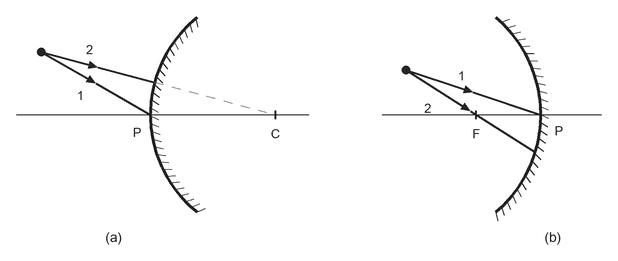
- 1104 marks
Question 110
Complete the following diagrams shown in Fig. 7.51 by drawing the reflected ray for each of the incident ray and .

- 1115 marks
Question 111
State the two convenient rays that are chosen to construct the image by a spherical mirror for a given object ? Explain your answer with the help of suitable ray diagrams.
- 1125 marks
Question 112
Fig. 7.52 shows a concave mirror with its pole at , focus and centre of curvature . Draw ray diagram to show the formation of image of an object .

- 1135 marks
Question 113
Fig. 7.53 shows a concave mirror with its pole at , focus and centre of curvature . Draw ray diagram to show the formation of image of an object .
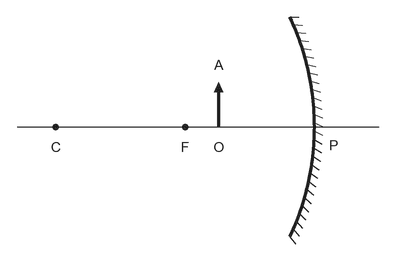
- 1145 marks
Question 114
The diagram below in Fig. 7.54 shows a convex mirror. is its centre of curvature and is its focus. (i) Draw two rays from and hence locate the position of image of object . Label the image . (ii) State three characteristics of the image.
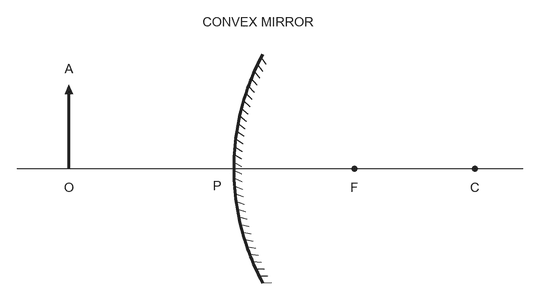
- 1155 marks
Question 115
Draw a ray diagram to show the formation of image by a concave mirror for an object placed between its pole and focus. State three characteristics of the image.
- 1165 marks
Question 116
Draw a ray diagram to show the formation of image by a concave mirror for an object beyond its centre of curvature. State three characteristics of the image.
- 1175 marks
Question 117
Draw a ray diagram to show the formation of image of an object kept in front of a convex mirror. State three characteristics of the image.
- 1185 marks
Question 118
Discuss the position and nature of image formed by a concave mirror when an object is moved from infinity towards the pole of mirror.
- 1194 marks
Question 119
Discuss the position and nature of image formed by a convex mirror when an object is moved from infinity towards the pole of mirror.
- 1205 marks
Question 120
Why does a driver use a convex mirror instead of a plane mirror as a rear view mirror ? Illustrate your answer with the help of a ray diagram.
- 1213 marks
Question 121
The radius of curvature of a convex mirror is 40 cm. Find its focal length.
- 1223 marks
Question 122
The focal length of a concave mirror is 10 cm. Find its radius of curvature.
- 1234 marks
Question 123
An object of height 2 cm is placed at a distance 20 cm in front of a concave mirror of focal length 12 cm. Find the position, size and nature of the image.
- 1244 marks
Question 124
An object is placed at 4 cm distance in front of a concave mirror of radius of curvature 24 cm. Find the position of image. Is the image magnified ?
- 1253 marks
Question 125
At what distance from a concave mirror of focal length 25 cm should an object be placed so that the size of image is equal to the size of the object.
- 1264 marks
Question 126
An object 5 cm high is placed at a distance 60 cm in front of a concave mirror of focal length 10 cm. Find (i) the position and (ii) size, of the image.
- 1273 marks
Question 127
A point light source is kept in front of a convex mirror at a distance of 40 cm. The focal length of the mirror is 40 cm. Find the position of image.
- 1283 marks
Question 128
When an object of height 1 cm is kept at a distance 4 cm from a concave mirror, its erect image of height 1.5 cm is formed at a distance 6 cm behind the mirror. Find the focal length of mirror.
- 1294 marks
Question 129
An object of length 4 cm is placed in front of a concave mirror at distance 30 cm. The focal length of mirror is 15 cm. (a) Where will the image form? (b) What will be the length of image ?
- 1304 marks
Question 130
A concave mirror forms a real image of an object placed in front of it at a distance 30 cm, of size three times the size of object. Find (a) the focal length of mirror (b) position of image.
- 1314 marks
Question 131
A concave mirror forms a virtual image of size twice that of the object placed at a distance 5 cm from it. Find: (a) the focal length of the mirrror (b) position of image.
- 1323 marks
Question 132
The image formed by a convex mirror is of size one-third the size of object. How are and related ?
- 1333 marks
Question 133
The erect image formed by a concave mirror is of size double the size of object. How are and related ?
- 1343 marks
Question 134
The magnification for a mirror is −3. How are and related ?
What Class 9 Physics Ch 7 covers
The sections of the chapter, in the order the book takes them. Every question above comes from one of these.
- 01Reflection of Light
- 02Laws of Reflection
- 03Formation of Image by Reflection
- 04Lateral Inversion
- 05Images Formed in a Pair of Mirrors
- 06Spherical Mirrors
More ways to study this chapter
The same chapter asked three other ways. Practise it, revise it, and see what the board has set on Ch 7 before.
Class 9 Physics Ch 7 questions students ask
How many questions are there in Class 9 Physics Ch 7?
134 questions. Every one is solved step by step on this page.
Are these Class 9 Physics solutions free?
Yes. Every question and its full working is free to read, with no account needed.
Can I download the Class 9 Physics Ch 7 solutions as a PDF?
There is no PDF to download. Every solution is on this page instead, which means it is searchable, always the current syllabus, and readable on a phone. Use your browser's print option if you want it on paper.