
Opening your dashboard
Class 9 Physics Chapter 7 Reflection of Light: Competency-Based Questions (CBQ)
40 questions on Chapter 7, each worked through on its own page with the AI tutor. Class 9 Physics, ICSE 2026-27.
40 questions
1–5 marks · Mixed difficulty
- 11 mark
Question 1
Competency: Application
In a dark hall, a narrow laser beam is aimed at a small plane mirror lying flat on the floor. The beam meets the mirror at a point 1.5 m from a vertical wall, with an angle of incidence of 45°, and the reflected beam travels towards the wall.

At what height above the floor does the reflected beam strike the wall ?
- 21 mark
Question 2
Competency: Analysis
The figure is the plan of a room drawn on a square grid. A plane mirror MN is fixed on one wall. A girl's eye is at E, and P, Q and R are three small lamps.
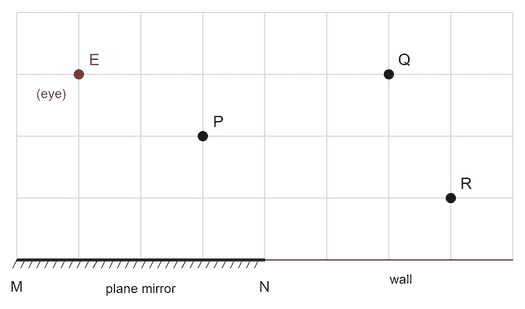
Without moving her eye, the images of which lamps can the girl see in the mirror ?
- 31 mark
Question 3
Competency: Application
A jeweller displays a ring between two plane mirrors hinged along one edge. She wants a customer to see exactly 7 images of the ring, wherever the ring is placed between the mirrors. At which angle should she set the mirrors ?
- 41 mark
Question 4
Competency: Analysis
In the record of an experiment with a spherical mirror, Sana has written the object distance and the image distance with their signs, following the sign convention :
cm, cm
Which of the following correctly describes the mirror and the image ?
- 51 mark
Question 5
Competency: Understanding
Assertion (A): The screen of a cinema hall is made rough and white, and is not a large polished mirror.
Reason (R): The rays of light reflected from a rough surface do not obey the laws of reflection.
- 61 mark
Question 6
Competency: Understanding
Assertion (A): A dentist uses a small concave mirror to see an enlarged image of a tooth.
Reason (R): A concave mirror can form a real image, which can be obtained on a screen.
- 72 marks
Question 7
Competency: Application & Analysis
Kabir stands facing a large plane mirror fixed on a wall, 2 m in front of it. A clock hangs on the opposite wall, 3 m behind him.

(a) How far from Kabir does the image of the clock appear to be ?
(b) Kabir takes a step of 0.5 m towards the mirror. By how much does his distance from the image of the clock change ? By how much does his distance from his own image change ?
- 82 marks
Question 8
Competency: Analysis
Sitting in a barber's chair, Zoya sees in the mirror the image of a wall clock that hangs behind her. The clock has no numerals. The image looks as shown.

(a) What is the actual time by the clock ? Show how you get it.
(b) Why does the image show a different time ? At which time of the day would the image of this clock look exactly like the clock itself ? Give one such time.
- 92 marks
Question 9
Competency: Evaluation
A candle is placed 20 cm in front of a concave mirror, and its sharp image is caught on a screen held 60 cm in front of the mirror. Rohan writes in his notebook :
" = 20 cm, = 60 cm, so . The image is three times as large as the candle and erect."
(a) Write and with their correct signs and find the magnification correctly.
(b) Which part of Rohan's conclusion is right and which is wrong ? How could he have known the nature of the image without any calculation ?
- 102 marks
Question 10
Competency: Analysis
A pen 4 cm tall is held upright at different distances in front of a convex mirror of focal length 20 cm. The position and the height of its image are given in the table.
Distance of the pen from the mirror 20 cm 60 cm 180 cm Distance of the image behind the mirror 10 cm 15 cm 18 cm Height of the image 2.0 cm 1.0 cm 0.4 cm (a) State two things that the table shows about the image as the pen is moved away from the mirror.
(b) Anu predicts, "At 540 cm the image will be 21 cm behind the mirror." Without using the mirror formula, explain why this cannot be right.
- 114 marks
Question 11
Competency: Application & Analysis
Case study: Ishaan tests a concave make-up mirror of focal length 10 cm with a small candle AB, whose flame tip A is 2 cm above the principal axis. He first puts the candle 15 cm from the pole P and starts a ray diagram, drawing two rays from A up to the mirror.
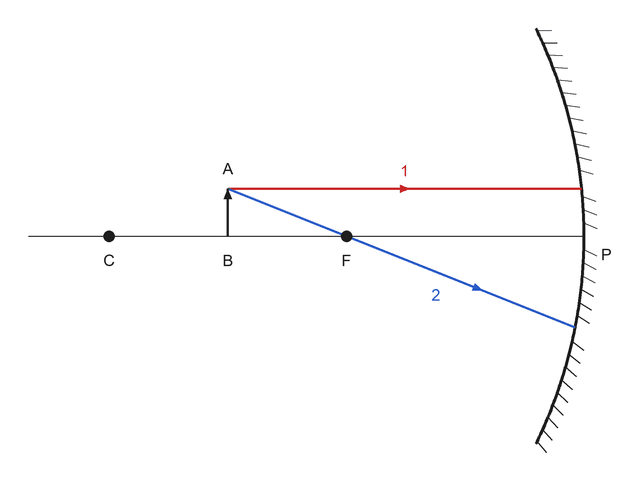
(a) State how ray 1 and ray 2 will travel after reflection.
(b) Using the mirror formula, find the position of the image and its height. State whether the image is real or virtual, and erect or inverted.
(c) Ishaan now brings the candle to 5 cm from the pole. Find the new position and magnification of the image. In what way is this image like the first one, and in what two ways is it different ?
- 124 marks
Question 12
Competency: Analysis
Case study: In a hair salon, two large plane mirrors and are fixed on opposite walls, parallel to each other and 4 m apart. A customer sits between them facing , with his head 1 m from and 3 m from .
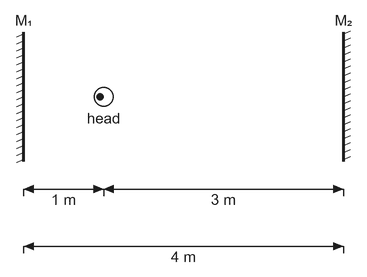
(a) Where is the image of his head formed (i) by directly, (ii) by directly ?
(b) The image formed by acts as an object for . Find where forms the image of this image, and how far it is from the customer's head.
(c) Looking into , the customer sees his face in one of these images and the back of his head in another. Which is which ? Why is the image of the back of his head fainter than the image of his face ?
- 134 marks
Question 13
Competency: Application & Evaluation
Case study: Dev has three spherical mirrors and wants to put each to a good use.
Mirror Kind Focal length X concave 10 cm Y concave 100 cm Z convex 20 cm (a) Dev wants a shaving mirror for use with his face 25 cm from the mirror. Which mirror should he choose ? Find the position and the magnification of the image of his face in it.
(b) He fixes mirror Z as the rear-view mirror of his cycle. A bus is 3.8 m behind the mirror. Find the position and the magnification of its image.
(c) His friend says, "Mirror X can also be used as a rear-view mirror, because it too makes vehicles far behind look small." Judge this statement.
- 144 marks
Question 14
Competency: Creation & Application
You are given a concave mirror whose focal length is not known, a small white screen, a metre rule and a candle. The laboratory has a window through which a building far away can be seen.
(a) Plan a quick method to find the approximate focal length of the mirror without using the candle. State what you will measure and why it gives the focal length.
(b) In a trial, the sharp image of the distant building was obtained with the screen 12 cm from the mirror. Find the focal length and the radius of curvature of the mirror.
(c) Plan a check of your result with the candle: state where you will place the candle so that its image is of the same size as the candle, where the screen must then be, and one precaution that will make your result more reliable.
- 154 marks
Question 15
Competency: Application & Analysis
Case study: Workers have to clean the bottom of a deep, dry well. To light it, they want to hold a plane mirror at the point O, at the centre of the mouth of the well, so that a ray of sunlight is reflected straight down the middle of the well. At 9 a.m. the sun's rays make an angle of 40° with the level ground, as shown.

(a) What must be the angle between the incident ray and the reflected ray at O ? Hence find the angle of incidence.
(b) At what angle to the level ground must the mirror be held ?
(c) By 11 a.m. the sun's rays make 60° with the ground. Find the new angle of the mirror with the ground. Through what angle has the mirror been turned, compared with the angle through which the sun's rays have turned ?
- 161 mark
Question 16
Competency: Analysis
On a rainy night, Arjun notices how the streetlights look on the road. On the dry tarmac, each light makes only a dull glow. On the wet part of the road, the reflection of each light stretches into a long, bright streak that dazzles the drivers coming towards it. Which statement explains the difference ?
- 171 mark
Question 17
Competency: Application
In a dark room, Meera holds a torch at T, 1.5 m above the floor. She wants its narrow beam to reach a small card C on the opposite wall, 0.5 m above the floor, after reflection from a small plane mirror strip that lies flat on the floor. The foot of the torch and the foot of the card are 4 m apart, as shown. (Hypothetical data.)

How far from the foot of the torch should the beam strike the mirror ?
- 181 mark
Question 18
Competency: Analysis
Sunita stands 2 m in front of a long plane mirror fixed on a wall. She walks 3 m along the wall, parallel to the mirror, and keeps 2 m away from it all the time. Which statement is correct when she stops ?
- 191 mark
Question 19
Competency: Analysis
A digital clock hangs on a wall facing a large plane mirror, and its image is seen in the mirror. The clock shows the time with seven-segment digits, shaped as in the figure.
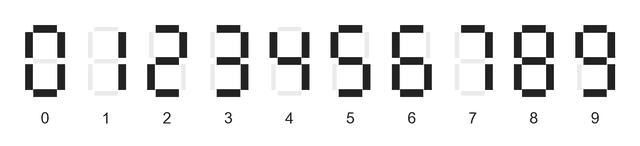
At which of these times will the image of the clock in the mirror look exactly like the clock itself, with the same digits in the same order ?
- 201 mark
Question 20
Competency: Application
A toy maker fixes two plane mirrors along the edges of a wedge-shaped block, with an angle of 40° between the mirrors. She places one red bead between the mirrors, nearer to one mirror than to the other. How many red beads in all, counting the real bead as well, will a child see ?
- 211 mark
Question 21
Competency: Application
A student cuts a small piece from a hollow glass ball of radius 24 cm. He silvers the inner surface of the piece, so that light falls on the outer, bulging surface and is reflected from it. What kind of mirror has he made, and what is its focal length with the correct sign ?
- 221 mark
Question 22
Competency: Understanding
Assertion (A): A lighted candle placed at the focus of a concave mirror forms a sharp image on a screen kept 2 m in front of the mirror.
Reason (R): The rays from a point of an object at the focus become parallel to each other after reflection and meet only at infinity.
- 231 mark
Question 23
Competency: Analysis
Ravi holds a pencil 12 cm long upright, 40 cm in front of each of two convex mirrors in turn. Mirror P has a focal length of 10 cm and mirror Q has a focal length of 60 cm. (Hypothetical data.) Which statement about the two images is correct ?
- 241 mark
Question 24
Competency: Analysis & Evaluation
Kavya is told that a spherical mirror in the laboratory is a convex mirror of focal length cm. In her notebook she records four pairs of values of and , each in cm and each with its sign. Only one pair can belong to this mirror. Which pair is it ?
- 251 mark
Question 25
Competency: Understanding
Assertion (A): If the upper half of a concave mirror is covered with black paper, the mirror still forms the complete image of an object, but the image is less bright.
Reason (R): Rays from each point of the object fall on every part of the mirror, and the rays reflected from any part of the mirror meet at the same image point.
- 262 marks
Question 26
Competency: Analysis
After a hot shower, the mirror in a bathroom is covered with a thin layer of tiny water droplets, and Nisha can no longer see a clear image of her face in it.
(a) Why does the fogged mirror no longer give a clear image ?
(b) Do the rays of light that fall on the droplets obey the laws of reflection ? Explain.
- 272 marks
Question 27
Competency: Evaluation
In an experiment on the laws of reflection, Dev measures the angle of incidence and the angle of reflection with a protractor that is marked in whole degrees. His readings are :
Reading 1 2 3 4 20° 35° 50° 65° 21° 34° 50° 66° Dev says, "The angle of reflection is not always equal to the angle of incidence, so this law is not true."
(a) Find the difference for each reading.
(b) Is Dev's conclusion justified ? Give a reason.
- 282 marks
Question 28
Competency: Understanding & Analysis
Neha holds a polished steel spoon about 30 cm in front of her face. In the inner (bowl) side of the spoon she sees a small, upside-down image of her face. When she turns the spoon over and looks at its back, she sees a small, upright image. The bowl of the spoon has a radius of curvature of about 4 cm. (Hypothetical data.)
(a) What kind of spherical mirror does each side of the spoon form ?
(b) Explain, from the nature of the images formed by the two kinds of mirror, why the two images are different.
- 292 marks
Question 29
Competency: Application
A lighted lamp is placed 48 cm in front of a concave mirror of focal length 16 cm, and a sharp image of the lamp falls on a small screen held in front of the mirror. (Hypothetical data.)
(a) Find the distance of the screen from the mirror, and the magnification.
(b) The lamp and the screen now exchange places: the lamp goes where the screen was and the screen goes where the lamp was. Will a sharp image fall on the screen again ? Find the new magnification.
- 302 marks
Question 30
Competency: Application & Evaluation
A shop has two spherical mirrors whose labels have fallen off. A box says cm for one mirror and cm for the other. A customer holds each mirror with her face 20 cm in front of it and says, "Both mirrors give an erect, virtual image, so I cannot tell them apart by the images." (Hypothetical data.)
(a) For each mirror, find the image distance and the magnification , with their signs.
(b) Is the customer right ? Give the difference that she can see at once.
- 312 marks
Question 31
Competency: Analysis
A concave mirror has a focal length of 20 cm. A small object is placed on its principal axis, first 24 cm and then 16 cm from the mirror, that is 4 cm on either side of the focus. (Hypothetical data.)
(a) Find the image distance and the magnification in each case.
(b) Compare the two images: what is the same and what is different ?
- 323 marks
Question 32
Competency: Application & Analysis
A large plane mirror covers one wall of a dance studio. Two dancers, Asha at A and Bela at B, stand in the studio as shown in the plan, which is a view from above. Asha is 3 m from the mirror and Bela is 1 m from it, and the two are 3 m apart measured along the wall. (Hypothetical data.)
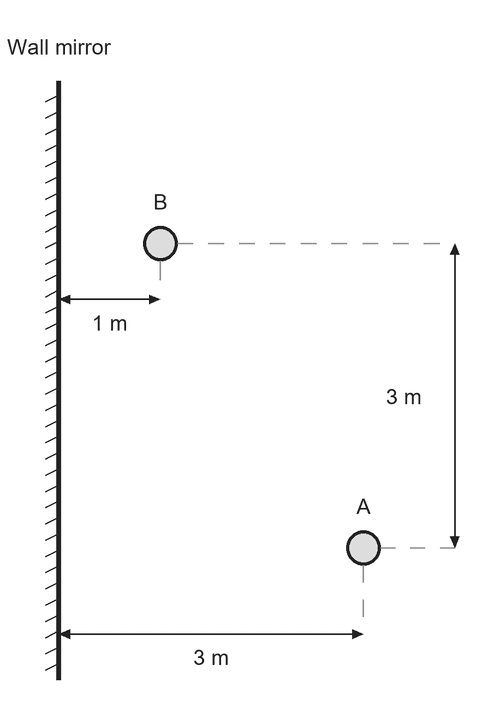
(a) How far behind the mirror is the image B′ of Bela, and where is it with respect to Bela ?
(b) Find the distance between Asha and the image of Bela.
(c) Bela flashes a torch so that the beam reaches Asha after reflection from the mirror. How long is the path of the light from Bela to Asha ? Explain your answer.
- 333 marks
Question 33
Competency: Analysis
Two plane mirrors and are fixed at right angles to each other and meet at O, as in the plan. A small lamp P is 4 cm from and 3 cm from .

(a) Take O as the origin, with along the horizontal axis and along the vertical axis. Write the coordinates, in cm, of P and of the three images of P.
(b) Which image is formed after two reflections, and how far is it from P ?
(c) Why are only three images formed ?
- 343 marks
Question 34
Competency: Application
A teacher wants to project an image of a candle flame on the classroom wall with a concave mirror of focal length 12 cm. The flame is 2 cm tall, and the wall is 84 cm from the mirror. (Hypothetical data.)
(a) At what distance from the mirror must she place the candle to get a sharp image on the wall ?
(b) Find the height of the image on the wall.
(c) The mirror is now moved back so that the wall is 156 cm from it. By how much, and in which direction, must she move the candle with respect to the mirror to get a sharp image again ? What happens to the height of the image ?
- 353 marks
Question 35
Competency: Creativity & Application
A school club wants to make a low-cost solar heater for its science fair. It will use a large concave mirror, made of shiny aluminium foil on a bowl-shaped frame, with the mirror facing the Sun. A small black kettle of water will be held on a stand in front of the mirror. The stand is fixed so that the kettle is 60 cm from the pole of the mirror. (Hypothetical data.)
(a) Where, with respect to the mirror, should the kettle be placed, and why ? What focal length and what radius of curvature must the mirror have ?
(b) The club finds that the heating becomes slower as the Sun moves across the sky. Give a reason, and say what the club should do.
(c) A member suggests moving the kettle to the centre of curvature to get heat over a bigger area. Evaluate the suggestion. Then suggest one other change to the heater that would make the water heat faster, and give the reason.
- 363 marks
Question 36
Competency: Application & Evaluation
A convex mirror of focal length 1.0 m is fixed on a pole at a sharp hairpin bend of a hill road, so that drivers can see the vehicles coming round the bend. A driver sees in it the image of a car that is 1.5 m high, and the image is 10 cm high. (Hypothetical data.)
(a) Find the magnification, and hence the distance of the car from the mirror.
(b) Where is the image of the car formed, and what is its nature ?
(c) The driver thinks, "The car looks tiny in the mirror, so it must be very far away and I have plenty of time." Evaluate his thinking.
- 374 marks
Question 37
Competency: Analysis & Evaluation
Case study: Ritu fixes a small polished steel plate on a table and shines a narrow torch beam on it at an angle of incidence of 40°. She moves a small light meter along a circular arc around the point of incidence and notes its reading at different values of the angle that its direction makes with the normal, on the side away from the torch. She then repeats the experiment with a sheet of white drawing paper in place of the steel plate. (Hypothetical data.)
Angle 0° 20° 40° 60° 80° Reading, steel plate (units) 0 1 92 1 0 Reading, white paper (units) 30 29 27 19 7 (a) For which angle is the reading from the steel plate the largest ? What does this show about the angle of reflection ?
(b) Which surface gives regular reflection and which gives irregular reflection ? Support each answer with the readings.
(c) Ritu next crumples a sheet of shiny aluminium foil, flattens it out again and uses it in place of the steel plate. Predict how its readings would compare with those of the steel plate and of the paper, and say whether she could see a clear image of her face in it. Give reasons.
- 384 marks
Question 38
Competency: Application & Analysis
Case study: A small torch has a concave reflector of focal length 2.0 cm. Dev slides the bulb along the principal axis and draws a ray diagram for each of three positions. In set-up A the bulb is 2.0 cm from the pole of the reflector, in set-up B it is 1.5 cm from the pole and in set-up C it is 3.0 cm from the pole. The diagram shows two rays from the bulb in each case. (Hypothetical data.)
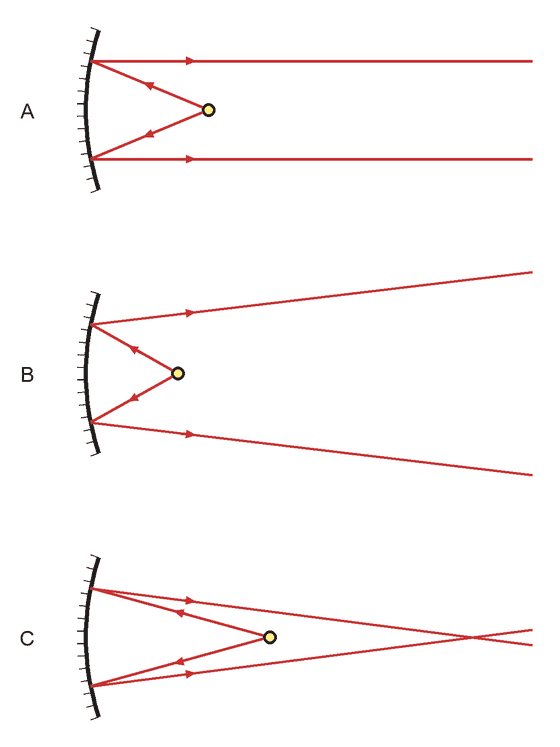
(a) In which set-up does the torch give a parallel beam ? Where is the bulb with respect to the reflector in that set-up, and why does it give a parallel beam ?
(b) Use the mirror formula to find the position and nature of the image of the bulb in set-up B and in set-up C.
(c) Describe the beam from the torch in set-up B and in set-up C. Which set-up should Dev use to light up a wide area of the floor near him ?
- 395 marks
Question 39
Competency: Analysis
Case study: Hari places a small lighted candle at different distances from a concave mirror and finds the linear magnification of the image for each position. The value of is positive for an erect image and negative for an inverted image. He plots against and draws a smooth curve through his seven points. He leaves out the candle positions between 11 cm and 17 cm, because the images there were too large and too far away to measure. (Hypothetical data.)
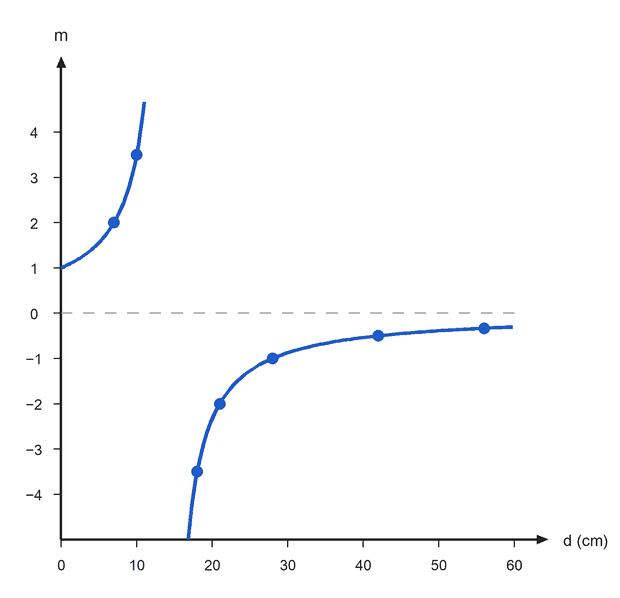
(a) Use the sign of in the graph to say for which positions of the candle the image is virtual and erect, and for which it is real and inverted. What does the gap in the readings between 11 cm and 17 cm suggest about the focal length ?
(b) Read from the graph at cm. Find the image distance from it, and check the result with the mirror formula, taking the focal length from part (a).
(c) Aman says, "When the candle is moved from 56 cm to 21 cm, the image becomes larger and moves farther from the mirror." Check his statement with the graph and the mirror formula.
- 404 marks
Question 40
Competency: Application & Analysis
Case study: A laser pointer sends a narrow horizontal beam towards a small plane mirror . The mirror is turned so that it makes an angle of 20° with the incoming beam, and the reflected beam travels on to a second plane mirror , which is set so that the beam falls on it at right angles, as in the figure. The room is dark and the beams can be seen in a thin cloud of chalk dust. (Hypothetical data.)
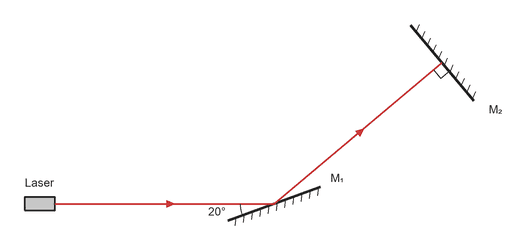
(a) Find the angle of incidence at and the angle between the incident ray and the reflected ray at .
(b) State the angle of incidence at and the path of the beam after it meets . What angle does make with the horizontal ?
(c) Dev now turns through 10°, keeping fixed. Find the new angle of incidence at and the angle between the beam falling on and the beam reflected from it. Will the beam still return to the laser ? Explain.