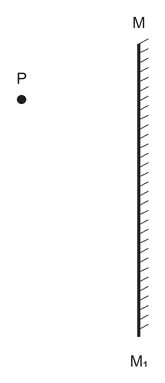
Solution:
Concept: A plane mirror forms an image that is virtual (the reflected rays only appear to meet behind the mirror), erect, of the same size as the object, laterally inverted, and as far behind the mirror as the object is in front of it, on the normal drawn from the object to the mirror.
Step 1 — Draw two rays (a).
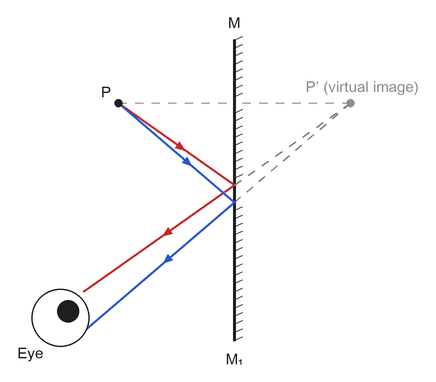
From P draw two rays to two points of the mirror MM₁. At each point draw the reflected ray so that the angle of reflection equals the angle of incidence (measured from the normal at that point).
Step 2 — Locate the image.
Produce the two reflected rays backwards (dashed). They meet at P′ behind the mirror, on the perpendicular from P to the mirror and as far behind it as P is in front. P′ is the image of P.
Step 3 — Mark the eye (b).
The eye is placed in front of the mirror, in the path of the reflected rays (lower left in the figure), so that both rays enter it.
Step 4 — Real or virtual (c).
The reflected rays do not actually meet; they only appear to meet at P′ when produced backwards. So the image is virtual, and it cannot be obtained on a screen.
Watch out: The eye must be placed where the reflected rays go, not near P or behind the mirror.
Therefore, (a) the reflected rays produced backwards meet at P′ behind the mirror, (b) the eye is placed in the path of the reflected rays, and (c) the image is virtual because the rays only appear to meet at P′.