Solution:
Concept: Laws of reflection. (1) The angle of incidence i is equal to the angle of reflection r. (2) The incident ray, the reflected ray and the normal at the point of incidence all lie in the same plane. Both angles are measured from the normal, the line drawn perpendicular to the surface at the point of incidence.
Step 1 — Find the angle of incidence (a).
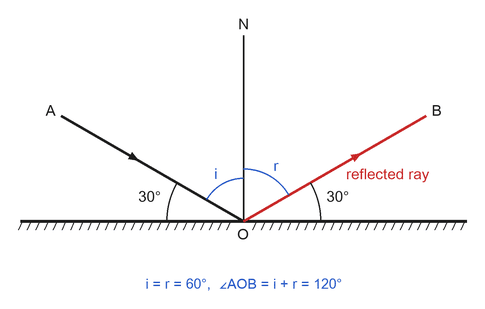
The normal ON is at 90° to the mirror, and AO makes 30° with the mirror, so the angle between AO and ON is the rest of the right angle.
i=90°−30°=60°
Step 2 — Draw the reflected ray (b).
By the first law the angle of reflection is also 60°. Draw OB on the other side of the normal making 60° with ON (that is, 30° with the mirror on the right).
Step 3 — Find the angle between the rays.
The angle between the incident and reflected rays is the sum of the two angles on either side of the normal.
∠AOB=i+r=60°+60°=120°
Watch out: The 30° is measured from the mirror; the angle of incidence is measured from the normal, so it is 90° − 30°.
Therefore, (a) the angle of incidence is 60°, and (b) the angle between the incident and reflected rays is 120°.

