
Opening your dashboard
Class 9 Physics Chapter 7 Reflection of Light: Practice Questions
41 questions on Chapter 7, each worked through on its own page with the AI tutor. Class 9 Physics, ICSE 2026-27.
41 questions
1–4 marks · Mixed difficulty
- 11 mark
Question 1
Bloom's level: Remember
In a spherical mirror, the line that passes through the pole and the centre of curvature is known as the :
- 21 mark
Question 2
Bloom's level: Remember
In the headlight of a car, a parallel beam of light is obtained from a concave reflector when the bulb is placed :
- 31 mark
Question 3
Bloom's level: Understand
The words on a very glossy page of a magazine sometimes cannot be read from one particular direction because of a bright glare, while an ordinary page can be read from any direction. This is because :
- 41 mark
Question 4
Bloom's level: Apply
A ray of light falls on a plane mirror making an angle of 35° with the surface of the mirror.

The angle between the incident ray and the reflected ray is :
- 51 mark
Question 5
Bloom's level: Apply
Priya walks straight towards a large plane mirror at a steady speed of 1.5 m s. The distance between Priya and her image decreases at the rate of :
- 61 mark
Question 6
Bloom's level: Analyse
Two plane mirrors are inclined to each other at 72°. A candle is placed exactly on the line bisecting the angle between them (symmetrically). The number of images formed is :
- 71 mark
Question 7
Bloom's level: Apply
A small toy stands on the principal axis of a concave mirror, 18 cm from its pole. The mirror has a focal length of 12 cm. Taking the sign convention, where is the image formed ?
- 81 mark
Question 8
Bloom's level: Evaluate
Riya says, "A concave mirror should be used as the rear-view mirror of a car, because its magnified image will make the vehicles behind easier to see." Which is the best judgement of her statement ?
- 91 mark
Question 9
Bloom's level: Understand
An object is moved from a large distance towards a convex mirror. Its image :
- 101 mark
Question 10
Bloom's level: Understand
Read the Assertion (A) and the Reason (R) and choose the correct option.
Assertion (A): When you raise your right hand in front of a plane mirror, your image appears to raise its left hand.
Reason (R): The image formed by a plane mirror is virtual.
- 111 mark
Question 11
Bloom's level: Understand
Read the Assertion (A) and the Reason (R) and choose the correct option.
Assertion (A): A concave mirror always forms a virtual image.
Reason (R): A concave mirror forms a virtual, erect and magnified image when the object is between its pole and focus.
- 121 mark
Question 12
Bloom's level: Analyse
Read the Assertion (A) and the Reason (R) and choose the correct option.
Assertion (A): For a real image formed by a concave mirror, the magnification is negative.
Reason (R): For a real image both and are negative, so is negative.
- 131 mark
Question 13
Bloom's level: Remember
When light falls on a surface, a part of it is reflected. What happens to the remaining part if the surface is (a) opaque, (b) transparent ?
- 142 marks
Question 14
Bloom's level: Apply
Two plane mirrors and are placed at right angles to each other. A ray falls on at the point A with an angle of incidence 30°, as shown.
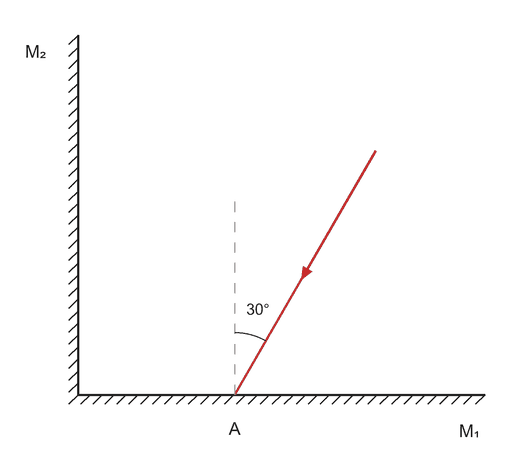
(a) Find the angle of incidence of the reflected ray on , and its angle of reflection there.
(b) How is the final ray related to the original incident ray ?
- 152 marks
Question 15
Bloom's level: Understand
A student sees the image of a candle in a plane mirror. He places a white screen behind the mirror exactly where the image seems to be. Will the image appear on the screen ? Explain.
- 162 marks
Question 16
Bloom's level: Analyse
A sheet showing the words MOM, TOMATO, WOW and TAXI is held in front of a plane mirror. Which words will look exactly the same in the mirror ? Explain what two conditions a word must satisfy.
- 172 marks
Question 17
Bloom's level: Apply
In a dark room, a narrow laser beam falls on a plane mirror and the reflected beam then falls on a white wall. A student standing to one side cannot see any bright spot on the mirror, but he can see the bright spot on the wall from anywhere in the room. Explain both observations.
- 182 marks
Question 18
Bloom's level: Remember
Write :
(a) the relation between the focal length and the radius of curvature of a spherical mirror,
(b) the mirror formula,
(c) the formula for linear magnification in terms of and ,
(d) the value of used to find the number of images formed by two plane mirrors inclined at an angle .
- 192 marks
Question 19
Bloom's level: Understand
Seen in a large concave mirror, the image of a tree far away is small and upside down, but the image of your face held close to the mirror is upright and enlarged. Explain this difference.
- 202 marks
Question 20
Bloom's level: Apply
A shopkeeper fixes a small convex security mirror (focal length 20 cm) on a shelf. A toy car stands 30 cm in front of it. Where will the toy's image be, and what is the magnification ?
- 212 marks
Question 21
Bloom's level: Apply
A ray of light falls on a concave mirror at a point D. The line joining D to the centre of curvature C makes an angle of 25° with the incident ray.

(a) What is the angle of reflection ?
(b) Find the angle between the incident ray and the reflected ray, and say how you would draw the reflected ray.
- 222 marks
Question 22
Bloom's level: Evaluate
Aman stands 3 m in front of a plane mirror and then walks 2 m towards it. He says, "My image has now come 4 m closer to the mirror." Check his statement and correct it.
- 234 marks
Question 23
Bloom's level: Apply
Case study: For a science exhibition, Tara wants to throw an enlarged image of a toy soldier 4 cm tall on a white card using a concave mirror of focal length 15 cm. She stands the toy 20 cm from the mirror.
(a) Between which two points (, , ) does the toy lie ? Where should she expect the image ?
(b) Using the mirror formula, find where she must hold the card.
(c) How tall will the image on the card be, and what will be its nature ?
- 244 marks
Question 24
Bloom's level: Analyse
In an experiment with a concave mirror, a student places a candle at different distances in front of the mirror and finds a sharp image on a screen. Her readings (distances from the mirror) are :
Object distance (cm) 60 40 30 25 15 Image distance (cm) 30 40 60 100 no image on screen (a) For which reading are the object and image at the same place ? Use it to find the radius of curvature and the focal length.
(b) Check your focal length with the mirror formula for the first reading.
(c) In which readings was the image larger than the object ? Give a reason from the data.
(d) Why was no image obtained on the screen when the candle was 15 cm away ?
- 254 marks
Question 25
Bloom's level: Apply
Case study: Mr. Rao's family uses mirrors in many ways. His car has a rear-view mirror and two headlights. At home he uses a mirror for shaving, and at the clinic his dentist uses a small mirror on a handle.
(a) Which type of mirror is used as the rear-view mirror of the car ? Give two reasons.
(b) Which type of mirror is used in the headlights, and where is the bulb placed ? Why ?
(c) Which type of mirror is used for shaving, where must the face be kept, and why should the mirror have a large focal length ?
- 264 marks
Question 26
Bloom's level: Analyse
Two plane mirrors are hinged together and the angle between them is changed. A small object is kept between them.
(a) Complete the table of the number of images.
120° 90° 72° 60° 45° 30° Object placed asymmetrically ? ? ? ? ? ? Object placed symmetrically ? ? ? ? ? ? (b) What pattern do you find as decreases ? When does the position of the object make a difference ?
(c) What happens when the mirrors are made parallel () ? Why do we see only a limited number of images in practice, as in a barber's shop ?
- 274 marks
Question 27
Bloom's level: Evaluate
A student wrote the following statements about a convex mirror. Check each one; say whether it is correct, and correct it if it is wrong.
- A convex mirror can form a real image if the object is placed far enough from it.
- The image formed by a convex mirror always lies between its pole and its focus, behind the mirror.
- When the object comes very close to a convex mirror, its image becomes larger than the object.
- By the sign convention, the focal length of a convex mirror is positive.
Draw a ray diagram to support your judgement of statement 2.
- 284 marks
Question 28
Bloom's level: Create
Design a simple periscope that lets you see over a wall taller than you, using a long cardboard tube and two small plane mirrors.
(a) Describe how you will arrange the mirrors and the openings, giving the angle of each mirror.
(b) Draw the path of a ray from the object to your eye, and state the angles of incidence and reflection at each mirror.
(c) Will the image you see be erect ? Will it be laterally inverted ? Explain.
- 294 marks
Question 29
Bloom's level: Create
Frame a numerical problem in which a concave mirror of focal length 10 cm forms a real image twice the size of the object. Your problem should ask for the object distance and the image distance. Then solve it and verify your answer with the mirror formula.
- 303 marks
Question 30
Bloom's level: Understand
Sunlight falls on (a) a polished steel plate, (b) a sheet of white paper, (c) a piece of black cloth and (d) a clear glass window. Explain what happens to most of the light in each case. Which of them can form a clear image of your face ?
- 314 marks
Question 31
An object of height 20 cm is kept at a distance of 48 cm in front of a mirror of focal length 12 cm. The mirror forms a virtual and diminished image of the object. Find the distance of the image from the mirror and its magnification.
- 321 mark
Question 32
On reflection at a plane mirror, a ray of light is turned so that the reflected ray is inclined at 130° to the incident ray.

The incident ray is inclined to the surface of the mirror at :
- 331 mark
Question 33
Two plane mirrors are kept inclined to each other at an angle of 36°. The number of images of a small object placed between them is :
- 341 mark
Question 34
Assertion (A): A convex mirror is used as the rear-view mirror of a car.
Reason (R): A convex mirror always forms an erect and diminished image, so it gives a wider field of view than a plane mirror of the same size.
- 352 marks
Question 35
(i) State what is meant by irregular (diffused) reflection of light.
(ii) A student says, "The laws of reflection are not obeyed in irregular reflection." Is the student correct ? Give a reason for your answer.
- 362 marks
Question 36
A boy stands 2.4 m in front of a large plane mirror fixed on a wall.
(i) Find the distance between the boy and his image.
(ii) The boy now steps 0.6 m back, away from the mirror. By how much does the distance between the boy and his image change ?
- 372 marks
Question 37
A card with the word LEFT printed on it in capital letters is held facing a plane mirror. In the mirror the word appears reversed sideways.
(i) Name this effect and state what gets interchanged in it.
(ii) Which one letter of the word looks exactly the same in the mirror ? Give a reason.
- 382 marks
Question 38
The radius of curvature of a convex mirror is 36 cm.
(i) Find the focal length of the mirror and write it with its sign according to the sign convention.
(ii) Is the focus of this mirror real or virtual ? Give a reason.
- 394 marks
Question 39
A pencil 5 cm tall stands upright on the principal axis of a convex mirror of focal length 15 cm, at a distance of 10 cm from the mirror.
(i) Calculate the position of the image.
(ii) Calculate the height of the image.
(iii) From the signs of your answers, state whether the image is real or virtual, and whether it is erect or inverted.
- 404 marks
Question 40
A concave mirror forms, on a screen, an image three times the size of a candle flame placed 24 cm in front of the mirror.
(i) Is the image erect or inverted ? Write the magnification with its proper sign.
(ii) Calculate the distance of the screen from the mirror.
(iii) Calculate the focal length of the mirror.
- 413 marks
Question 41
A man uses a concave mirror as a shaving mirror. He keeps his face between the pole and the focus of the mirror.
(i) Draw a labelled ray diagram to show the formation of the image of an object AB placed between the pole and the focus of a concave mirror.
(ii) State three characteristics of the image formed.
(iii) State how the image changes if the man moves his face back to a position between the focus and the centre of curvature of the mirror.