
Question 1085 marksEasy
(i) Name the mirrors shown in Fig. 7.49 (a) and (b).
(ii) In each case (a) and (b), draw the reflected rays for the given incident rays and mark focus by the symbol .

Confirming your payment
Sign up now and get 250 free tokens.
Reflection of Light · Question 108 of 134
(i) Name the mirrors shown in Fig. 7.49 (a) and (b).
(ii) In each case (a) and (b), draw the reflected rays for the given incident rays and mark focus by the symbol .
Solution:
Concept: A spherical mirror is a part of a hollow sphere silvered on one side. If the outer surface is silvered, reflection takes place at the inner (hollow) surface and the mirror is concave. If the inner surface is silvered, reflection takes place at the outer (bulging) surface and the mirror is convex. Rays parallel to the principal axis, after reflection, pass through a point F on the axis (concave mirror, real focus) or appear to come from a point F behind the mirror (convex mirror, virtual focus). F is the focus. Its distance from the pole is the focal length f (f = PF), and it is half the radius of curvature (f = R/2).
Step 1 — Name the mirrors (i).
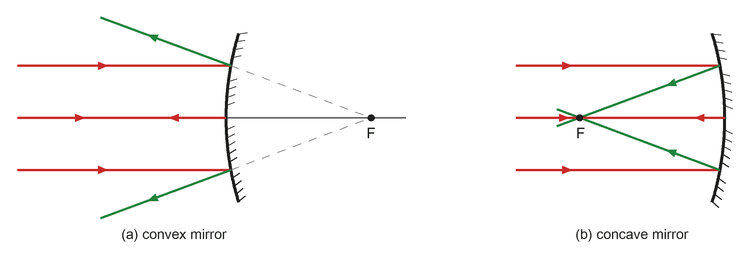
In (a) the mirror bulges towards the incident light, so it is a convex mirror. In (b) it is hollow towards the light, so it is a concave mirror.
Step 2 — Draw the reflected rays (ii).
The completed diagrams are shown below.
Step 3 — Read the diagrams.
In (a) the rays above and below the axis are reflected so that they diverge; produced backwards (dashed) they meet at F behind the mirror. In (b) they are reflected so that they converge and pass through F in front of the mirror. In both, the ray along the principal axis meets the mirror normally and is reflected back along the axis.
Therefore, (i) (a) is a convex mirror and (b) a concave mirror, and (ii) the focus F is behind the mirror in (a) and in front of it in (b).