
Question 223 marksEasy
Differentiate between reflection of light from a plane mirror and that from a plane wall.
Confirming your payment
Sign up now and get 250 free tokens.
Reflection of Light · Question 22 of 134
Differentiate between reflection of light from a plane mirror and that from a plane wall.
Solution:
Concept: Regular reflection happens at a smooth, polished surface: all its normals are parallel, so a parallel beam stays parallel after reflection. Irregular (diffused) reflection happens at a rough surface: the normals point in many directions, so a parallel beam is scattered. Each single ray obeys the laws of reflection in both cases.
Step 1 — The two surfaces.
A plane mirror is truly smooth and polished. A plane wall looks flat, but on a small scale it has many tiny bumps, so its normal points in a different direction at each point.
Step 2 — What happens to a parallel beam.
At the mirror all the normals are parallel, so every ray of a parallel beam has the same angle of incidence and is reflected in the same direction: regular reflection. At the wall each ray meets a surface tilted differently, so the rays go off in different directions: irregular (diffused) reflection.
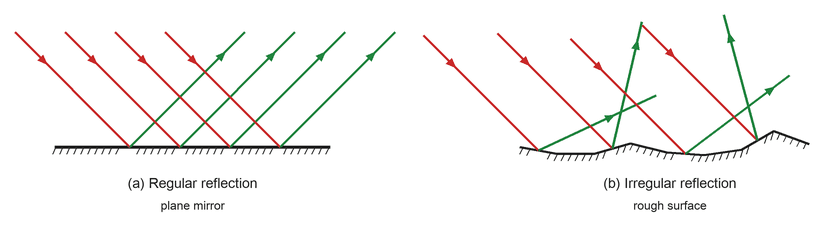
Step 3 — Tabulate the differences.
The differences that follow from this are listed below.
| Reflection from a plane mirror | Reflection from a plane wall |
|---|---|
| The surface is smooth and polished. | The surface has tiny bumps, though it looks smooth. |
| Regular reflection takes place. | Irregular (diffused) reflection takes place. |
| A parallel beam stays parallel and goes in one direction. | A parallel beam is scattered in many directions. |
| The reflected light is seen only from one direction. | The reflected light is seen from every direction. |
| A clear image is formed. | No image is formed. |
Watch out: Each single ray obeys the laws of reflection at the wall too; only the direction of the normal changes from point to point.
Therefore, a plane mirror gives regular reflection with a clear image, while a plane wall gives irregular (diffused) reflection and no image.