
Question 213 marksEasy
Explain the following terms :
(a) plane mirror, (b) incident ray, (c) reflected ray, (d) angle of incidence, and (e) angle of reflection.
Draw diagram/diagrams to show them.
Confirming your payment
Sign up now and get 250 free tokens.
Reflection of Light · Question 21 of 134
Explain the following terms :
(a) plane mirror, (b) incident ray, (c) reflected ray, (d) angle of incidence, and (e) angle of reflection.
Draw diagram/diagrams to show them.
Solution:
Concept: When light strikes a mirror, the incident ray is the ray that falls on it, the point of incidence is where it strikes, the normal is the perpendicular to the mirror there, and the reflected ray is the ray sent back. The angle of incidence is the angle between the incident ray and the normal; the angle of reflection is the angle between the reflected ray and the normal.
Step 1 — Look at the diagram.
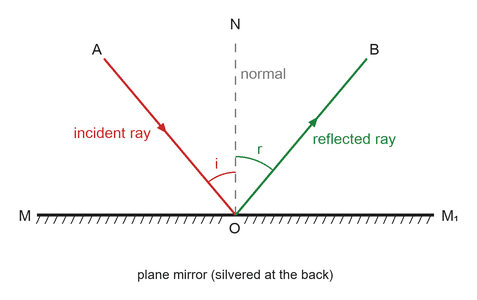
In the diagram, MM₁ is a plane mirror, AO is a ray falling on it at the point O, ON is the normal at O, and OB is the ray sent back.
Step 2 — Plane mirror and incident ray.
(a) A plane mirror is a highly polished flat surface that reflects most of the light falling on it; usually it is a thin glass sheet silvered at the back (MM₁ in the diagram). (b) The incident ray is the ray of light that strikes the reflecting surface (AO).
Step 3 — Reflected ray.
(c) The reflected ray is the ray of light sent back from the surface into the same medium in which the incident ray was travelling (OB).
Step 4 — The two angles.
(d) The angle of incidence is the angle which the incident ray makes with the normal at the point of incidence: ∠AON = i.
(e) The angle of reflection is the angle which the reflected ray makes with the normal at the point of incidence: ∠BON = r.
Watch out: Both angles are measured from the normal ON, not from the mirror MM₁.
Therefore, MM₁ is the plane mirror, AO the incident ray, OB the reflected ray, ∠AON = i the angle of incidence and ∠BON = r the angle of reflection.