
Question 1115 marksEasy
State the two convenient rays that are chosen to construct the image by a spherical mirror for a given object ? Explain your answer with the help of suitable ray diagrams.
Confirming your payment
Sign up now and get 250 free tokens.
Reflection of Light · Question 111 of 134
State the two convenient rays that are chosen to construct the image by a spherical mirror for a given object ? Explain your answer with the help of suitable ray diagrams.
Solution:
Concept: Four rays are easy to draw after reflection from a spherical mirror: (1) a ray parallel to the principal axis passes through F (concave) or appears to come from F (convex); (2) a ray through or towards F becomes parallel to the axis; (3) a ray through or towards C falls normally and retraces its path; (4) a ray striking the pole is reflected at an equal angle on the other side of the axis.
Step 1 — Why these rays.
We choose rays whose paths after reflection are known at once, without measuring angles. Any two of them, from the same point of the object, fix the image of that point.
Step 2 — Ray parallel to the principal axis.
After reflection it passes through the focus F (concave mirror) or appears to come from the focus F (convex mirror).
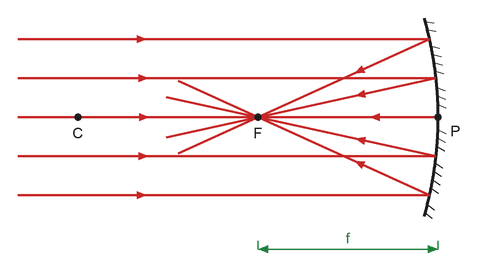
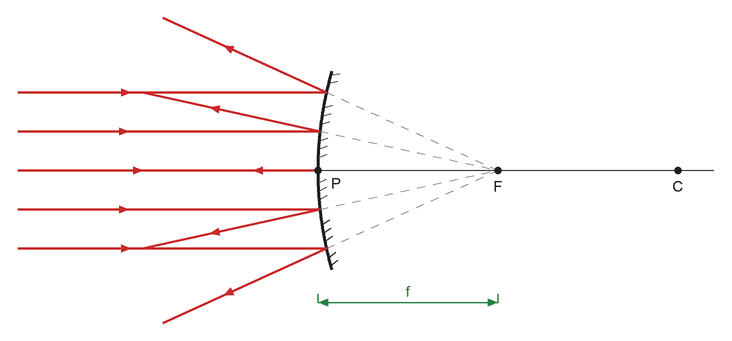
Step 3 — Ray through (or towards) the centre of curvature.
It falls normally on the mirror, so it is reflected back along its own path.
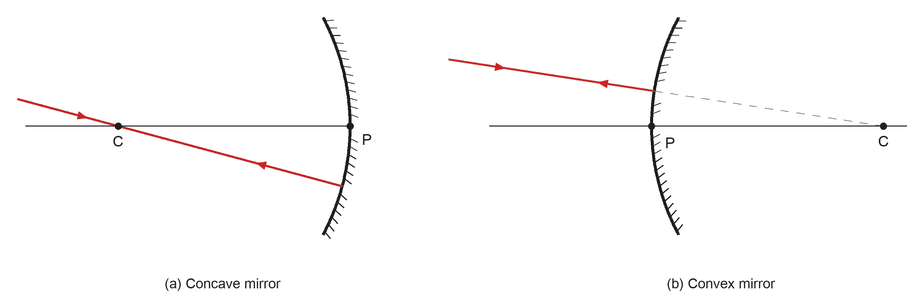
Step 4 — Locate the image.
The point where the two reflected rays meet (or appear to meet, when produced backwards) is the image of that point of the object. Two other rays may also be used: a ray through (or towards) F, which becomes parallel to the axis, and a ray to the pole, which is reflected at an equal angle on the other side of the axis.
Therefore, the two convenient rays are a ray parallel to the principal axis (reflected through, or as if from, F) and a ray through or towards C (reflected back along itself).