
Question 1104 marksEasy
Complete the following diagrams shown in Fig. 7.51 by drawing the reflected ray for each of the incident ray and .

Confirming your payment
Sign up now and get 250 free tokens.
Reflection of Light · Question 110 of 134
Complete the following diagrams shown in Fig. 7.51 by drawing the reflected ray for each of the incident ray and .
Solution:
Concept: Four rays are easy to draw after reflection from a spherical mirror: (1) a ray parallel to the principal axis passes through F (concave) or appears to come from F (convex); (2) a ray through or towards F becomes parallel to the axis; (3) a ray through or towards C falls normally and retraces its path; (4) a ray striking the pole is reflected at an equal angle on the other side of the axis.
Step 1 — The completed diagrams.
The reflected rays are drawn with the rules for the focus and the centre of curvature.
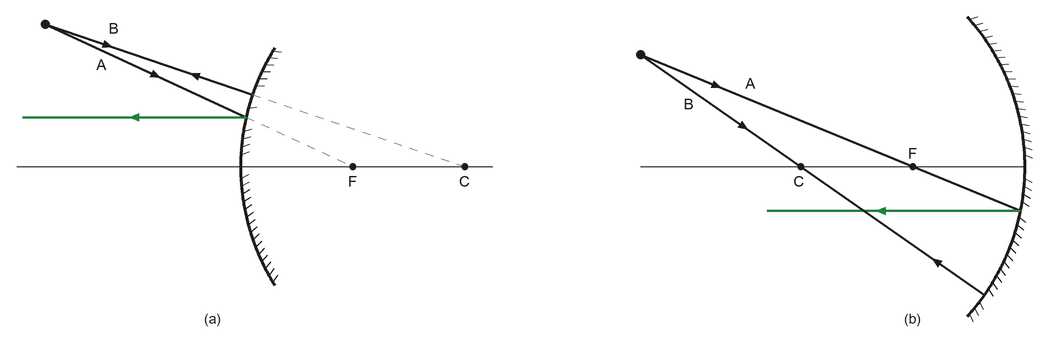
Step 2 — Convex mirror (a).
Ray A is directed towards the focus F behind the mirror, so after reflection it becomes parallel to the principal axis. Ray B is directed towards the centre of curvature C, so it falls normally and is reflected back along its own path.
Step 3 — Concave mirror (b).
Ray A passes through the focus F, so after reflection it becomes parallel to the principal axis. Ray B passes through the centre of curvature C, so it falls normally and is reflected back along its own path.
Therefore, in both mirrors ray A (towards or through F) leaves parallel to the principal axis and ray B (towards or through C) retraces its path.