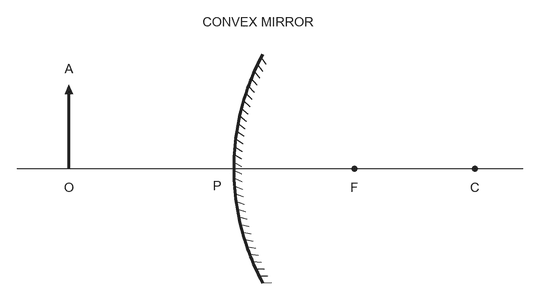
Solution:
Concept: Four rays are easy to draw after reflection from a spherical mirror: (1) a ray parallel to the principal axis passes through F (concave) or appears to come from F (convex); (2) a ray through or towards F becomes parallel to the axis; (3) a ray through or towards C falls normally and retraces its path; (4) a ray striking the pole is reflected at an equal angle on the other side of the axis. A convex mirror always forms a virtual, erect and diminished image, behind the mirror between its pole P and focus F, whatever the position of the object.
Step 1 — First ray (i).
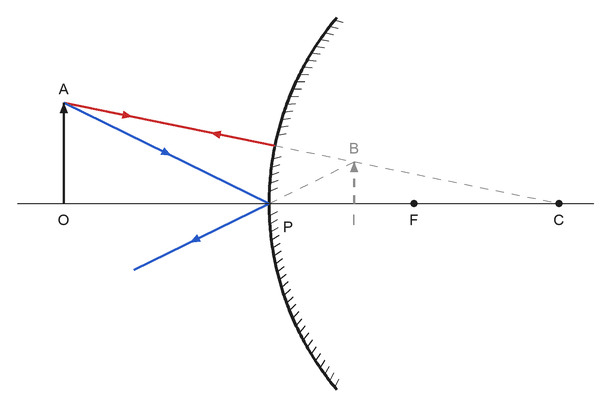
From A draw a ray directed towards C. It meets the mirror normally and is reflected back along its own path; produced backwards it goes towards C (dashed).
Step 2 — Second ray.
From A draw a ray to the pole P. It is reflected at an equal angle on the other side of the principal axis; produce it backwards behind the mirror (dashed).
Step 3 — Locate the image.
The two dashed lines meet at B. Draw BI perpendicular to the axis; IB is the image, between P and F.
Step 4 — Characteristics (ii).
The image is erect, virtual and diminished, and it lies behind the mirror between P and F.
Watch out: A ray from A parallel to the axis, reflected as if from F, may be used instead of either ray.
Therefore, (i) the image IB is behind the mirror between P and F, and (ii) it is erect, virtual and diminished.