
Question 1135 marksMedium
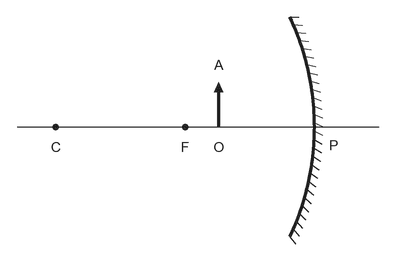
Fig. 7.53 shows a concave mirror with its pole at , focus and centre of curvature . Draw ray diagram to show the formation of image of an object .
Confirming your payment
Sign up now and get 250 free tokens.
Reflection of Light · Question 113 of 134
Fig. 7.53 shows a concave mirror with its pole at , focus and centre of curvature . Draw ray diagram to show the formation of image of an object .
Solution:
Concept: Four rays are easy to draw after reflection from a spherical mirror: (1) a ray parallel to the principal axis passes through F (concave) or appears to come from F (convex); (2) a ray through or towards F becomes parallel to the axis; (3) a ray through or towards C falls normally and retraces its path; (4) a ray striking the pole is reflected at an equal angle on the other side of the axis. For a concave mirror the image depends on where the object is: object at infinity → image at F; beyond C → between F and C; at C → at C; between C and F → beyond C; at F → at infinity; between F and P → behind the mirror. Only the last image is virtual and erect; all the others are real and inverted.
Step 1 — First ray.
From A draw a ray along the line from C through A. It meets the mirror normally and is reflected back along the same line.
Step 2 — Second ray.
From A draw a ray to the pole P. It is reflected at an equal angle on the other side of the principal axis.
Step 3 — Locate the image.
The two reflected rays diverge. Produce them backwards (dashed); they meet at B behind the mirror. Draw BI perpendicular to the axis; IB is the image of OA.

Step 4 — Describe the image.
The object is between F and P, so the image is formed behind the mirror and is virtual, erect and magnified.
Watch out: A ray from A parallel to the axis, reflected through F, could replace either ray; produced backwards it also passes through B.
Therefore, the image IB is formed behind the mirror and is virtual, erect and magnified.