
Question 295 marksEasy
With the help of diagrams, explain the difference between regular and irregular reflection.
Confirming your payment
Sign up now and get 250 free tokens.
Reflection of Light · Question 29 of 134
With the help of diagrams, explain the difference between regular and irregular reflection.
Solution:
Concept: Regular reflection happens at a smooth, polished surface: all its normals are parallel, so a parallel beam stays parallel after reflection. Irregular (diffused) reflection happens at a rough surface: the normals point in many directions, so a parallel beam is scattered. Each single ray obeys the laws of reflection in both cases.
Step 1 — Look at the diagrams.
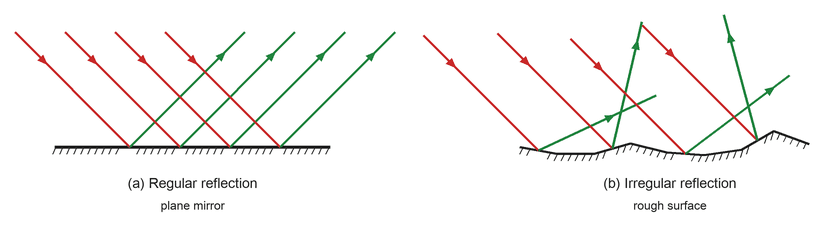
Figure (a) shows a parallel beam falling on a plane mirror; figure (b) shows the same beam falling on a rough surface.
Step 2 — Regular reflection, figure (a).
It occurs when a beam falls on a smooth, polished surface such as a plane mirror. The normals at all points are parallel, so the parallel incident rays all have the same angle of incidence and are reflected at the same angle. The reflected rays are also parallel and go in one definite direction. The light is seen only from that direction, and a clear image is formed.
Step 3 — Irregular reflection, figure (b).
It occurs when a beam falls on a rough surface such as a wall or the page of a book. The surface has many tiny bumps, so the normal points in a different direction at each point. The parallel incident rays therefore have different angles of incidence and are reflected in different directions. The light spreads out and can be seen from everywhere, but no image is formed.
Step 4 — Sum up the differences.
The main differences are listed below.
| Regular reflection | Irregular reflection |
|---|---|
| Smooth, polished surface | Rough, uneven surface |
| Parallel rays stay parallel after reflection | Parallel rays are scattered in many directions |
| Seen only from one direction | Seen from all directions |
| Forms an image | Does not form an image |
Watch out: Irregular reflection does not break the laws of reflection; each ray still has i = r at its own small part of the surface. It is this diffused light from ordinary objects that lets us see them from all sides.
Therefore, regular reflection keeps a parallel beam parallel (smooth surface, image formed), while irregular reflection scatters it (rough surface, no image).