
Opening your dashboard
Class 9 Maths Chapter 11: Inequalities Solutions
30 textbook questions with step-by-step answers, free to read, for ICSE 2026-27.
Get talked through Ch 11, not just shown the answer
Reading a finished solution is not the same as being able to do it. The AI tutor takes one question at a time and works it with you, in your own words, until you can.
- Ask it out loud, in your own words
- It gives you the next step, not the answer
- Stuck on part (ii)? Start there
30 questions with solutions
1–3 marks · Mixed difficulty
- 11 mark
Question 1
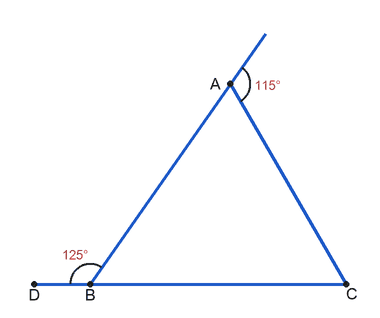
In the adjoining figure, we find :
 Solve with AI
Answer
(A) AB = AC
- Correct
(B) BC > AB
(C) AB > BC
(D) AC = BC
Answer: (B) BC > AB
Concept: The angles of a triangle add up to 180°, and two angles on a straight line (a linear pair) also add up to 180°. In any triangle, the greater angle has the greater side opposite to it, and the greater side has the greater angle opposite to it. The side opposite an angle is the side that does not touch that angle's vertex.
Step 1 — Find ∠ABC from the straight line DBC.
D, B and C lie on one straight line, so ∠ABD and ∠ABC form a linear pair and add up to 180°.
Step 2 — Find ∠BAC from the exterior angle at A.
The 115° angle at A lies between AC and BA produced. It forms a linear pair with ∠BAC.
Step 3 — Find the third angle.
The three angles of ΔABC add up to 180°.
Step 4 — Compare the sides.
BC is opposite ∠A = 65°, AB is opposite ∠C = 60° and AC is opposite ∠B = 55°. The greater angle has the greater side opposite to it, so the sides in order are BC > AB > AC.
Watch out: Match each side with the angle that does NOT touch it: in ΔABC, BC is opposite ∠A, CA is opposite ∠B and AB is opposite ∠C.
Why the other options are wrong:
- (A): Equal sides AB and AC would need equal opposite angles ∠C and ∠B, but these are 60° and 55°.
- (C): This is the wrong way round: AB is opposite 60° and BC is opposite 65°, so AB is the shorter of the two.
- (D): Equal sides AC and BC would need equal opposite angles ∠B and ∠A, but these are 55° and 65°.
Therefore, BC > AB, option (B).
- 21 mark
Question 2
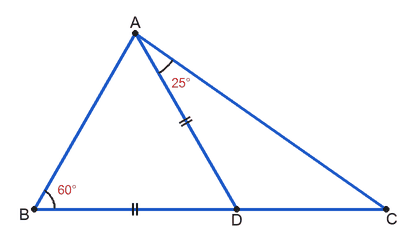
In the adjoining figure, we find :
 Solve with AI
Answer
(A) BD = DC
(B) BD < DC
- Correct
(C) BD > DC
(D) AD = CD
Answer: (C) BD > DC
Concept: Angles opposite equal sides of a triangle are equal. The angles of a triangle add up to 180°, and two angles on a straight line (a linear pair) also add up to 180°. In any triangle, the greater angle has the greater side opposite to it, and the greater side has the greater angle opposite to it. The side opposite an angle is the side that does not touch that angle's vertex.
Step 1 — Use AD = BD.
The figure marks AD = BD, so ΔABD is isosceles.
The angles opposite these equal sides are equal, so ∠BAD equals ∠ABD, which is 60°.
Step 2 — Find ∠ADB and ∠ADC.
The third angle of ΔABD follows from the angle sum.
B, D and C are on one straight line, so ∠ADC is the linear pair of ∠ADB.
Step 3 — Find ∠ACD.
In ΔADC we now know two angles, 120° at D and 25° at A.
Step 4 — Compare AD with DC.
In ΔADC, AD is opposite ∠ACD = 35° and DC is opposite ∠DAC = 25°. The greater angle has the greater side opposite to it, so AD > DC. As BD = AD, this gives BD > DC.
Watch out: Match each side with the angle that does NOT touch it: in ΔABC, BC is opposite ∠A, CA is opposite ∠B and AB is opposite ∠C.
Why the other options are wrong:
- (A): Since BD equals AD, this would need AD and DC to be equal, and so ∠ACD and ∠DAC to be equal in ΔADC; but these angles are 35° and 25°.
- (B): This reverses the result of Step 4: DC is opposite the smaller angle (25°), so DC is the shorter side.
- (D): In ΔADC, AD is opposite 35° and CD is opposite 25°, so AD > CD, not AD = CD.
Therefore, BD > DC, option (C).
- 31 mark
Question 3
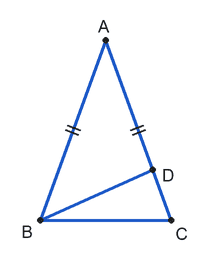
In the given figure, AB = AC, then :
 Solve with AI
Answer
(A) BD = BC
(B) BD = CD
(C) BD < CD
- Correct
(D) BD > CD
Answer: (D) BD > CD
Concept: Angles opposite equal sides of a triangle are equal. In any triangle, the greater angle has the greater side opposite to it, and the greater side has the greater angle opposite to it. The side opposite an angle is the side that does not touch that angle's vertex.
Step 1 — Use AB = AC.
The sides AB and AC are equal, so the angles opposite them are equal: ∠ABC = ∠ACB.
Step 2 — Compare the angles of ΔBDC.
D lies on AC, so BD runs inside ∠ABC and ∠DBC is only a part of ∠ABC. Hence ∠DBC < ∠ABC. Since ∠ABC = ∠ACB, and ∠ACB is the angle ∠DCB of ΔBDC, we get ∠DBC < ∠DCB.
Step 3 — Compare BD with CD.
In ΔBDC, BD is opposite ∠DCB and CD is opposite ∠DBC. The greater angle has the greater side opposite to it, so BD > CD.
Watch out: A part of an angle is smaller than the whole angle; that is what makes ∠DBC < ∠DCB here.
Why the other options are wrong:
- (A): Equal sides BD and BC would need equal opposite angles ∠BCD and ∠BDC in ΔBDC; nothing in the data makes these angles equal.
- (B): Equal sides BD and CD would need equal angles ∠DCB and ∠DBC, but Step 2 shows ∠DBC < ∠DCB.
- (C): This is the reverse of the result: BD is opposite the greater angle ∠DCB.
Therefore, BD > CD, option (D).
- 41 mark
Question 4
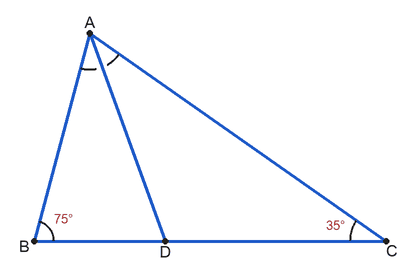
In the given figure, we find :
 Solve with AI
Answer
(A) BD > AB
- Correct
(B) BD < AB
(C) BD = AB
(D) DC < AB
Answer: (B) BD < AB
Concept: The angles of a triangle add up to 180°, and two angles on a straight line (a linear pair) also add up to 180°. In any triangle, the greater angle has the greater side opposite to it, and the greater side has the greater angle opposite to it. The side opposite an angle is the side that does not touch that angle's vertex.
Step 1 — Find ∠A and its halves.
The angles of ΔABC add up to 180°.
The figure marks AD as the bisector of ∠A, so each half is half of 70°.
Step 2 — Find ∠ADB.
In ΔABD the angles at B and A are 75° and 35°.
Step 3 — Compare BD with AB.
In ΔABD, BD is opposite ∠BAD = 35° and AB is opposite ∠ADB = 70°. The smaller angle has the smaller side opposite to it, so BD < AB.
Watch out: Match each side with the angle that does NOT touch it: in ΔABC, BC is opposite ∠A, CA is opposite ∠B and AB is opposite ∠C.
Note: The book's printed answer is BD > AB. With the figure's angles BD is the shortest side of ΔABD, so (B) is correct.
Why the other options are wrong:
- (A): This reverses Step 3: BD is opposite the smaller angle (35°), so BD is the shorter side.
- (C): Equal sides BD and AB would need equal opposite angles ∠BAD and ∠ADB, but these are 35° and 70°.
- (D): In ΔADC the angles ∠DAC and ∠C are both 35°, so the sides opposite them, DC and AD, are equal. In ΔABD, AD is opposite the 75° angle at B and AB is opposite the 70° angle at D, so AD > AB. Hence DC > AB, not DC < AB.
Therefore, BD < AB, option (B).
- 51 mark
Question 5
In the given figure, we find :
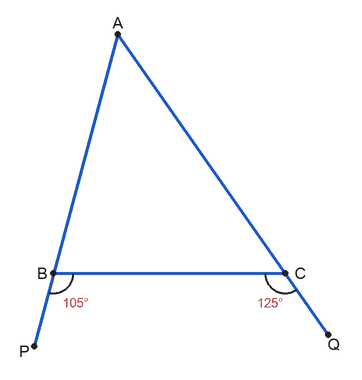 Solve with AI
Answer
(A) AB > AC
- Correct
(B) AC > AB
(C) AB < BC
(D) AC = AB
Answer: (B) AC > AB
Concept: The angles of a triangle add up to 180°, and two angles on a straight line (a linear pair) also add up to 180°. In any triangle, the greater angle has the greater side opposite to it, and the greater side has the greater angle opposite to it. The side opposite an angle is the side that does not touch that angle's vertex.
Step 1 — Turn the exterior angles into interior angles.
P lies on AB produced, so ∠PBC and ∠ABC form a linear pair. In the same way Q lies on AC produced.
Step 2 — Find ∠A.
The angles of ΔABC add up to 180°.
Step 3 — Compare the sides.
AC is opposite ∠B = 75°, AB is opposite ∠C = 55° and BC is opposite ∠A = 50°. So AC > AB > BC.
Watch out: Match each side with the angle that does NOT touch it: in ΔABC, BC is opposite ∠A, CA is opposite ∠B and AB is opposite ∠C.
Why the other options are wrong:
- (A): This reverses the result: AB is opposite the smaller angle 55°, AC the larger angle 75°.
- (C): BC is opposite ∠A = 50° and AB is opposite ∠C = 55°, so BC < AB, not AB < BC.
- (D): Equal sides AC and AB would need equal opposite angles ∠B and ∠C, but they are 75° and 55°.
Therefore, AC > AB, option (B).
- 61 mark
Question 6
In a quadrilateral ABCD,
 Solve with AI
Answer
- Correct
(A) AB + BC + CD + DA > AC + BD
(B) AB + BC + CD + DA < AC + BD
(C) AB + BC + CD + DA = AC + BD
(D) AB + BC < AC
Answer: (A) AB + BC + CD + DA > AC + BD
Concept: The sum of any two sides of a triangle is greater than the third side.
Step 1 — Use diagonal AC.
AC splits the quadrilateral into ΔABC and ΔACD. In each triangle two sides together are longer than the third side.
Step 2 — Use diagonal BD.
BD splits the quadrilateral into ΔABD and ΔBCD.
Step 3 — Add the four inequalities.
Each side of the quadrilateral appears twice on the left, and each diagonal twice on the right.
Dividing both sides by 2 keeps the inequality:
Watch out: Add all four triangle inequalities; using only two of them proves a weaker result.
Why the other options are wrong:
- (B): The perimeter is greater than the sum of the diagonals, as Step 3 shows, so it cannot be smaller.
- (C): Equality would need the four triangle inequalities to become equalities, which happens only if the points lie on one line; then ABCD would not be a quadrilateral.
- (D): In ΔABC the sum of two sides is greater than the third side, so AB + BC > AC, not less.
Therefore, AB + BC + CD + DA > AC + BD, option (A).
- 73 marks
Question 7
From the following figure, prove that : AB > CD.
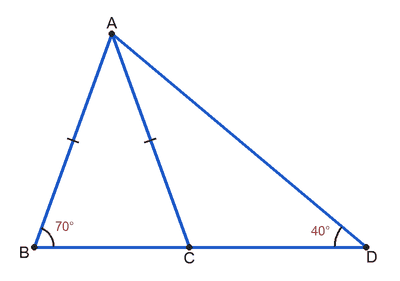 Solve with AI
Written solution
Solution:
Concept: Angles opposite equal sides of a triangle are equal. The angles of a triangle add up to 180°, and two angles on a straight line (a linear pair) also add up to 180°. In any triangle, the greater angle has the greater side opposite to it, and the greater side has the greater angle opposite to it. The side opposite an angle is the side that does not touch that angle's vertex.
Given: AB = AC (marked), ∠B = 70°, ∠D = 40°, B, C, D on a straight line.
Step 1 — Use AB = AC.
The figure marks AB = AC.
The angles opposite these equal sides are equal, so ∠ACB equals ∠B, which is 70°.
Step 2 — Find ∠ACD.
B, C and D lie on one straight line, so ∠ACD is the linear pair of ∠ACB.
Step 3 — Find ∠CAD.
In ΔACD the angles at C and D are 110° and 40°.
Step 4 — Compare AC with CD.
In ΔACD, AC is opposite ∠D = 40° and CD is opposite ∠CAD = 30°. The greater angle has the greater side opposite to it, so AC > CD.
Step 5 — Replace AC by AB.
Since AB = AC, the inequality AC > CD says AB > CD.
Watch out: Match each side with the angle that does NOT touch it: in ΔABC, BC is opposite ∠A, CA is opposite ∠B and AB is opposite ∠C.
Therefore, AB > CD. Hence proved.
- 83 marks
Question 8
In a triangle PQR; QR = PR and ∠P = 36°.
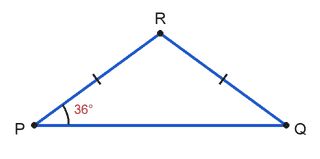
Which is the largest side of the triangle ?
Solve with AIWritten solution
Solution:
Concept: Angles opposite equal sides of a triangle are equal. In any triangle, the greater angle has the greater side opposite to it, and the greater side has the greater angle opposite to it. The side opposite an angle is the side that does not touch that angle's vertex.
Given: In ΔPQR, QR = PR and ∠P = 36°.
Step 1 — Find the equal angles.
QR = PR is given.
The side QR is opposite ∠P and the side PR is opposite ∠Q, so ∠Q equals ∠P, which is 36°.
Step 2 — Find ∠R.
The angles of ΔPQR add up to 180°.
Step 3 — Pick the largest side.
∠R = 108° is the largest angle, and the side opposite ∠R is PQ. The greater angle has the greater side opposite to it, so PQ is the largest side.
Watch out: The equal angles are the ones opposite the equal sides QR and PR, that is ∠P and ∠Q (not ∠R).
Therefore, the largest side of ΔPQR is PQ.
- 93 marks
Question 9
If two sides of a triangle are 8 cm and 13 cm, then the length of the third side is between cm and cm. Find the values of and such that is less than .
Solve with AIWritten solution
Solution:
Concept: The sum of any two sides of a triangle is greater than the third side. So the third side is less than the sum and greater than the difference of the other two.
Given: Two sides are 8 cm and 13 cm.
Step 1 — Upper limit.
The third side must be less than the sum of the other two sides.
Step 2 — Lower limit.
The third side must also be greater than the difference of the other two sides; otherwise 8 + (third side) would not be greater than 13.
Step 3 — Read off a and b.
So the third side lies between 5 cm and 21 cm, with a < b.
Watch out: Both limits are needed; 21 cm alone is not enough, since a side of 3 cm would not close the triangle.
Therefore, a = 5 cm and b = 21 cm.
- 103 marks
Question 10
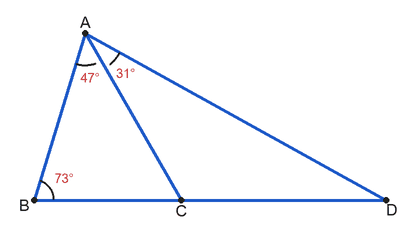
In each of following figures, write BC, AC and CD in ascending order of their lengths.
(i)
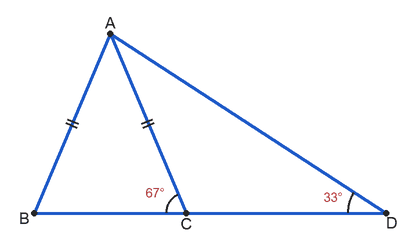
(ii)
 Solve with AI
Written solution
Solution:
Concept: In any triangle, the greater angle has the greater side opposite to it, and the greater side has the greater angle opposite to it. The side opposite an angle is the side that does not touch that angle's vertex. The angles of a triangle add up to 180°, and two angles on a straight line (a linear pair) also add up to 180°.
Step 1 — Figure (i): angles of ΔABC.
The figure marks AB = AC.
So the base angles are equal: ∠ABC equals ∠ACB, which is 67°. The angle sum gives ∠BAC.
In ΔABC, BC is opposite 46° and AC is opposite 67°, so BC < AC.
Step 2 — Figure (i): angles of ΔACD.
B, C and D are on one straight line, so ∠ACD is the linear pair of ∠ACB.
In ΔACD, AC is opposite ∠D = 33° and CD is opposite ∠CAD = 34°, so AC < CD.
Step 3 — Figure (i): order.
Putting the two results together gives BC < AC < CD.
Step 4 — Figure (ii): angles of ΔABC.
Here ∠B = 73° and ∠BAC = 47°.
In ΔABC, BC is opposite 47° and AC is opposite 73°, so BC < AC.
Step 5 — Figure (ii): angles of ΔACD.
Again ∠ACD is the linear pair of ∠ACB, and ∠CAD = 31°.
In ΔACD, AC is opposite ∠D = 29° and CD is opposite ∠CAD = 31°, so AC < CD.
Step 6 — Figure (ii): order.
Putting the two results together gives BC < AC < CD.
Watch out: AC belongs to both triangles, so compare it with BC in ΔABC and with CD in ΔACD; that links all three sides.
Therefore, in both figures the ascending order is BC < AC < CD.
- 113 marks
Question 11
Arrange the sides of Δ BOC in descending order of their lengths. BO and CO are bisectors of angles ABC and ACB respectively.
 Solve with AI
Written solution
Solution:
Concept: The angles of a triangle add up to 180°, and two angles on a straight line (a linear pair) also add up to 180°. In any triangle, the greater angle has the greater side opposite to it, and the greater side has the greater angle opposite to it. The side opposite an angle is the side that does not touch that angle's vertex.
Given: BO and CO bisect ∠ABC and ∠ACB; exterior angles 137° at A and 106° at B.
Step 1 — Find the angles of ΔABC.
D lies on CA produced and E on CB produced, so the 137° and 106° angles are linear pairs with ∠BAC and ∠ABC.
Step 2 — Halve the base angles.
BO bisects ∠ABC and CO bisects ∠ACB.
Step 3 — Find ∠BOC.
The angles of ΔBOC add up to 180°.
Step 4 — Order the sides of ΔBOC.
BC is opposite ∠BOC = 111.5°, CO is opposite ∠OBC = 37° and BO is opposite ∠OCB = 31.5°. The greater angle has the greater side opposite to it.
Watch out: Match each side with the angle that does NOT touch it: in ΔABC, BC is opposite ∠A, CA is opposite ∠B and AB is opposite ∠C.
Note: The book's answer key prints “BC < CO < BO”; the angles of ΔBOC give BC > CO > BO.
Therefore, in descending order, BC > CO > BO.
- 123 marks
Question 12
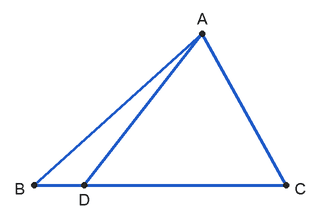
D is a point in side BC of triangle ABC. If AD > AC, show that AB > AC.
 Solve with AI
Written solution
Solution:
Concept: In any triangle, the greater angle has the greater side opposite to it, and the greater side has the greater angle opposite to it. The side opposite an angle is the side that does not touch that angle's vertex. An exterior angle of a triangle equals the sum of the two interior opposite angles, so it is greater than each of them.
Given: D is a point on BC of ΔABC and AD > AC.
Step 1 — Use AD > AC in ΔADC.
In ΔADC, AD is opposite ∠ACD and AC is opposite ∠ADC. The greater side has the greater angle opposite to it, so ∠ACD > ∠ADC.
Step 2 — Use the exterior angle of ΔABD.
D lies on BC, so ∠ADC is an exterior angle of ΔABD. It is greater than the interior opposite angle ∠ABD, so ∠ADC > ∠ABC.
Step 3 — Compare ∠C and ∠B of ΔABC.
∠ACD is the same angle as ∠ACB. Joining the two results, ∠ACB > ∠ADC and ∠ADC > ∠ABC, so ∠ACB > ∠ABC.
Step 4 — Compare the sides.
In ΔABC, AB is opposite ∠ACB and AC is opposite ∠ABC. As ∠ACB > ∠ABC, the side opposite the greater angle is greater: AB > AC.
Watch out: Go from sides to angles (Step 1), compare angles (Steps 2–3), then go back from angles to sides (Step 4).
Therefore, AB > AC. Hence shown.
- 133 marks
Question 13
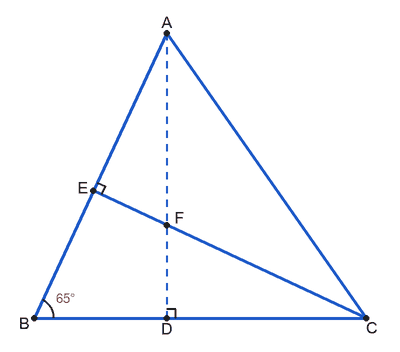
In the following figure, ∠BAC = 60° and ∠ABC = 65°.
Prove that :
(i) CF > AF
(ii) DC > DF
 Solve with AI
Written solution
Solution:
Concept: In a right triangle the two acute angles add up to 90°. In any triangle, the greater angle has the greater side opposite to it, and the greater side has the greater angle opposite to it. The side opposite an angle is the side that does not touch that angle's vertex.
Given: ∠BAC = 60°, ∠ABC = 65°, AD ⊥ BC, CE ⊥ AB, and AD, CE meet at F.
Step 1 — Find ∠ACB.
The figure marks AD ⊥ BC and CE ⊥ AB. First find the third angle of ΔABC.
Step 2 — Angles of ΔAFC for part (i).
In right ΔADC (right angle at D), the other two angles add up to 90°.
In right ΔAEC (right angle at E), ∠EAC = 60°.
Step 3 — Prove CF > AF.
In ΔAFC, ∠FAC is the same angle as ∠DAC, so it is 35°.
∠FCA is the same angle as ∠ACE, so it is 30°.
CF is opposite ∠FAC and AF is opposite ∠FCA. The greater angle has the greater side opposite to it, so CF > AF.
Step 4 — Angles of ΔDFC for part (ii).
In right ΔBEC (right angle at E), ∠EBC = 65°.
In right ΔFDC (right angle at D), ∠DCF = 25°.
Step 5 — Prove DC > DF.
In ΔDFC, DC is opposite ∠DFC = 65° and DF is opposite ∠DCF = 25°. So DC > DF.
Watch out: Match each side with the angle that does NOT touch it: in ΔABC, BC is opposite ∠A, CA is opposite ∠B and AB is opposite ∠C.
Therefore, (i) CF > AF and (ii) DC > DF. Hence proved.
- 143 marks
Question 14
In the following figure;
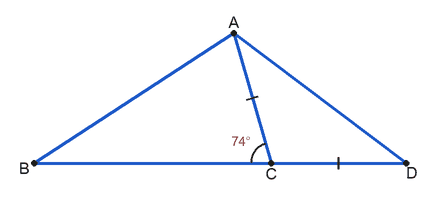
AC = CD; ∠BAD = 110° and ∠ACB = 74°.
Prove that : BC > CD.
 Solve with AI
Written solution
Solution:
Concept: Angles opposite equal sides of a triangle are equal. The angles of a triangle add up to 180°, and two angles on a straight line (a linear pair) also add up to 180°. In any triangle, the greater angle has the greater side opposite to it, and the greater side has the greater angle opposite to it. The side opposite an angle is the side that does not touch that angle's vertex.
Given: AC = CD, ∠BAD = 110°, ∠ACB = 74°.
Step 1 — Use AC = CD.
B, C and D lie on one straight line, so ∠ACD is the linear pair of ∠ACB = 74°.
AC = CD, so the angles opposite them in ΔACD are equal: ∠CAD = ∠CDA. They share what is left of 180°.
Step 2 — Find ∠BAC and ∠ABC.
∠BAD = 110° is made of ∠BAC and ∠CAD.
The angles of ΔABC add up to 180°.
Step 3 — Compare BC with AC.
In ΔABC, BC is opposite ∠BAC = 73° and AC is opposite ∠ABC = 33°. The greater angle has the greater side opposite to it, so BC > AC.
Step 4 — Replace AC by CD.
Since AC = CD, BC > AC gives BC > CD.
Watch out: ∠BAD is the whole angle at A; take away ∠CAD to get ∠BAC.
Therefore, BC > CD. Hence proved.
- 153 marks
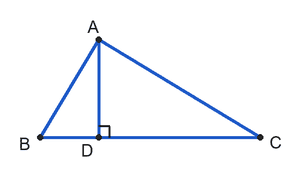
Question 15
From the following figure; prove that :
(i) AB > BD
(ii) AC > CD
(iii) AB + AC > BC
 Solve with AI
Written solution
Solution:
Concept: In a right triangle the right angle is the greatest angle, so the hypotenuse (opposite it) is the greatest side. In any triangle, the greater angle has the greater side opposite to it, and the greater side has the greater angle opposite to it. The side opposite an angle is the side that does not touch that angle's vertex.
Given: AD ⊥ BC with D on BC (marked).
Step 1 — Part (i): look at ΔADB.
The figure marks AD ⊥ BC, so ∠ADB = 90°. The other two angles of ΔADB add up to 90°, so each is smaller than 90°. ∠ADB is therefore the greatest angle, and the side opposite it, AB, is the greatest side: AB > BD.
Step 2 — Part (ii): look at ΔADC.
In the same way ∠ADC = 90° is the greatest angle of ΔADC, so the side opposite it is the greatest: AC > CD.
Step 3 — Part (iii): add the two results.
Adding the inequalities of parts (i) and (ii) keeps the inequality:
D lies on BC between B and C, so the two parts make up the whole side:
So AB + AC > BC.
Watch out: Two inequalities pointing the same way may be added side by side.
Therefore, AB > BD, AC > CD and AB + AC > BC. Hence proved.
- 163 marks
Question 16
In a quadrilateral ABCD; prove that :
(i) AB + BC + CD > DA
(ii) AB + BC + CD + DA > 2AC
(iii) AB + BC + CD + DA > 2BD
 Solve with AI
Written solution
Solution:
Concept: The sum of any two sides of a triangle is greater than the third side.
Given: ABCD is a quadrilateral.
Step 1 — Part (i).
Join AC. In ΔABC and in ΔACD, two sides together are longer than the third side.
Add CD to both sides of the first inequality:
The right side is greater than DA by the second inequality, so AB + BC + CD > DA.
Step 2 — Part (ii).
Use diagonal AC again, with ΔABC and ΔADC.
Adding these two inequalities gives AB + BC + CD + DA > 2AC.
Step 3 — Part (iii).
Join BD. Use ΔABD and ΔBCD.
Adding these two inequalities gives AB + BC + CD + DA > 2BD.
Watch out: In part (i), first add the same length CD to both sides; then link the two inequalities through AC + CD.
Therefore, (i) AB + BC + CD > DA, (ii) AB + BC + CD + DA > 2AC and (iii) AB + BC + CD + DA > 2BD. Hence proved.
- 173 marks
Question 17
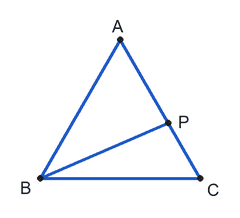
In the following figure, ABC is an equilateral triangle and P is any point in AC; prove that :
(i) BP > PA
(ii) BP > PC
 Solve with AI
Written solution
Solution:
Concept: Each angle of an equilateral triangle is 60°. In any triangle, the greater angle has the greater side opposite to it, and the greater side has the greater angle opposite to it. The side opposite an angle is the side that does not touch that angle's vertex.
Given: ABC is equilateral and P is a point in AC.
Step 1 — Angles of the equilateral triangle.
Every angle of an equilateral triangle is 60°, so ∠A, ∠ABC and ∠C are each 60°.
Step 2 — Part (i): compare in ΔABP.
P lies on AC, so BP runs inside ∠ABC and ∠ABP is only a part of it: ∠ABP < 60° = ∠A. In ΔABP, BP is opposite ∠A and PA is opposite ∠ABP. The greater angle has the greater side opposite to it, so BP > PA.
Step 3 — Part (ii): compare in ΔCBP.
In the same way ∠CBP is a part of ∠ABC, so ∠CBP < 60° = ∠C. In ΔCBP, BP is opposite ∠C and PC is opposite ∠CBP, so BP > PC.
Watch out: This works for every position of P strictly between A and C, because BP always splits ∠ABC into two smaller parts.
Therefore, BP > PA and BP > PC. Hence proved.
- 183 marks
Question 18
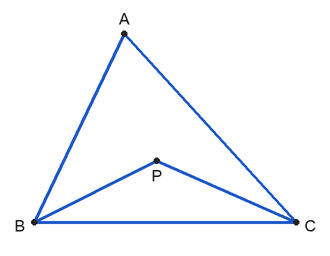
P is any point inside the triangle ABC. Prove that : ∠BPC > ∠BAC.
 Solve with AI
Written solution
Solution:
Concept: An exterior angle of a triangle equals the sum of the two interior opposite angles, so it is greater than each of them.
Given: P is any point inside ΔABC.
Step 1 — Construction.
Produce BP to meet AC at D. P is inside the triangle, so D lies on AC between A and C.

Step 2 — Exterior angle of ΔABD.
In ΔABD, ∠BDC is an exterior angle at D, so it is greater than the interior opposite angle ∠BAD. As ∠BAD is ∠BAC, this gives ∠BDC > ∠BAC.
Step 3 — Exterior angle of ΔPDC.
In ΔPDC, ∠BPC is an exterior angle at P (B, P, D are on one line), so ∠BPC > ∠PDC. ∠PDC is the same angle as ∠BDC, so ∠BPC > ∠BDC.
Step 4 — Join the two results.
∠BPC > ∠BDC and ∠BDC > ∠BAC, so ∠BPC > ∠BAC.
Watch out: Name the exterior angle and the triangle it belongs to each time; the same angle ∠BDC is used in both triangles.
Therefore, ∠BPC > ∠BAC. Hence proved.
- 193 marks
Question 19
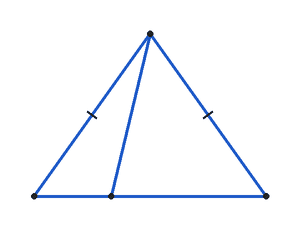
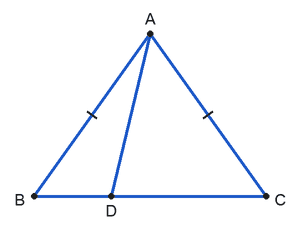
Prove that the straight line joining the vertex of an isosceles triangle to any point in the base is smaller than either of the equal sides of the triangle.
 Solve with AI
Written solution
Solution:
Concept: Angles opposite equal sides of a triangle are equal. An exterior angle of a triangle equals the sum of the two interior opposite angles, so it is greater than each of them. In any triangle, the greater angle has the greater side opposite to it, and the greater side has the greater angle opposite to it. The side opposite an angle is the side that does not touch that angle's vertex.
Given: An isosceles triangle ABC with AB = AC, and D any point on the base BC.
Step 1 — Set up the figure.
Let ABC be isosceles with AB = AC, and let D be any point on the base BC (between B and C). We must show AD < AB and AD < AC.
Step 2 — Equal base angles.
AB = AC, so the angles opposite them are equal: ∠B = ∠C.
Step 3 — Exterior angle at D.
In ΔADC, ∠ADB is an exterior angle at D, so ∠ADB > ∠C. As ∠C = ∠B, this gives ∠ADB > ∠B.
Step 4 — Compare AD with AB.
In ΔABD, AB is opposite ∠ADB and AD is opposite ∠B. The greater angle has the greater side opposite to it, so AB > AD. Since AC = AB, also AC > AD.
Watch out: Use the exterior angle of ΔADC (not of ΔABD) to compare ∠ADB with a base angle.
Therefore, the line joining the vertex A to any point D in the base is smaller than either equal side. Hence proved.
- 203 marks
Question 20
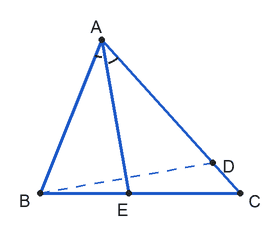
In the following diagram; AD = AB and AE bisects angle A. Prove that :
(i) BE = DE
(ii) ∠ABD > ∠C
 Solve with AI
Written solution
Solution:
Concept: S.A.S. congruence: two triangles are congruent if two sides and the angle between them are equal. Angles opposite equal sides of a triangle are equal. An exterior angle of a triangle equals the sum of the two interior opposite angles, so it is greater than each of them.
Given: AD = AB, AE bisects ∠A, D on AC and E on BC.
Step 1 — Part (i): ΔABE and ΔADE.
Compare the two triangles on either side of the bisector AE.
AB = AD (given)
∠BAE = ∠DAE (AE bisects ∠A)
AE is common to both triangles.
So ΔABE ≅ ΔADE by the S.A.S. rule, and the corresponding sides BE and DE are equal.
Step 2 — Part (ii): equal angles in ΔABD.
AB = AD, so the angles opposite them in ΔABD are equal: ∠ABD = ∠ADB.
Step 3 — Exterior angle of ΔBDC.
D lies on AC, so ∠ADB is an exterior angle of ΔBDC at D. It is greater than the interior opposite angle ∠C, so ∠ADB > ∠C.
Step 4 — Conclude.
Since ∠ABD = ∠ADB and ∠ADB > ∠C, we get ∠ABD > ∠C.
Watch out: ∠ADB belongs to ΔABD but is an EXTERIOR angle of ΔBDC; that is why it beats ∠C.
Therefore, (i) BE = DE and (ii) ∠ABD > ∠C. Hence proved.
- 213 marks
Question 21
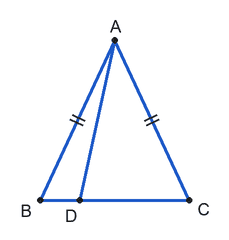
In the given figure, AB = AC and D is any point on BC, show that AB > AD.
 Solve with AI
Written solution
Solution:
Concept: Angles opposite equal sides of a triangle are equal. An exterior angle of a triangle equals the sum of the two interior opposite angles, so it is greater than each of them. In any triangle, the greater angle has the greater side opposite to it, and the greater side has the greater angle opposite to it. The side opposite an angle is the side that does not touch that angle's vertex.
Given: AB = AC and D is any point on BC.
Step 1 — Equal base angles.
AB = AC, so the angles opposite them are equal: ∠B = ∠C.
Step 2 — Exterior angle at D.
D lies on BC, so ∠ADB is an exterior angle of ΔADC. It is greater than the interior opposite angle ∠C, so ∠ADB > ∠C, and therefore ∠ADB > ∠B.
Step 3 — Compare AB with AD.
In ΔABD, AB is opposite ∠ADB and AD is opposite ∠B. The greater angle has the greater side opposite to it, so AB > AD.
Watch out: ∠ADB is an exterior angle of ΔADC, not of ΔABD.
Therefore, AB > AD. Hence shown.
- 223 marks
Question 22
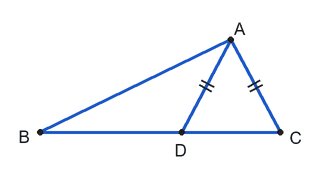
In the given figure, AD = AC and B is a point on CD produced, show that AB > AD.
 Solve with AI
Written solution
Solution:
Concept: Angles opposite equal sides of a triangle are equal. The angles of a triangle add up to 180°, and two angles on a straight line (a linear pair) also add up to 180°. In any triangle, the greater angle has the greater side opposite to it, and the greater side has the greater angle opposite to it. The side opposite an angle is the side that does not touch that angle's vertex.
Given: AD = AC, and B is a point on CD produced.
Step 1 — Equal angles in ΔADC.
AD = AC, so the angles opposite them are equal: ∠ACD = ∠ADC.
Step 2 — These angles are acute.
Two equal angles of one triangle add up to less than 180°, so each is less than 90°. Hence ∠ADC is acute.
Step 3 — ∠ADB is obtuse.
B lies on CD produced, so B, D and C are on one straight line and ∠ADB is the linear pair of ∠ADC.
180° minus an acute angle is more than 90°, so ∠ADB is obtuse.
Step 4 — Compare AB with AD.
A triangle can have only one obtuse angle, so ∠ADB is the greatest angle of ΔABD and is greater than ∠ABD. AB is opposite ∠ADB and AD is opposite ∠ABD, so AB > AD.
Watch out: The base angles of an isosceles triangle are always acute; that is the fact that makes ∠ADB obtuse.
Therefore, AB > AD. Hence shown.
- 233 marks
Question 23
S is any point on side QR of triangle PQR. Prove that :
PQ + QR + RP > 2PS
 Solve with AI
Written solution
Solution:
Concept: The sum of any two sides of a triangle is greater than the third side.
Given: S is any point on the side QR of ΔPQR.
Step 1 — Triangle inequality in ΔPQS.
S lies on QR, so PS splits ΔPQR into ΔPQS and ΔPSR. In ΔPQS two sides together exceed the third side:
Step 2 — Triangle inequality in ΔPSR.
In the same way, in ΔPSR:
Step 3 — Add the two inequalities.
Adding them gives PQ + (QS + SR) + PR > 2PS.
S lies between Q and R, so the two parts make up the side QR:
So PQ + QR + RP > 2PS.
Watch out: Choose the two sides in each triangle that leave PS on its own on the right.
Therefore, PQ + QR + RP > 2PS. Hence proved.
- 243 marks
Question 24
The sides AB and AC of a triangle ABC are produced; and the bisectors of the external angles at B and C meet at P.
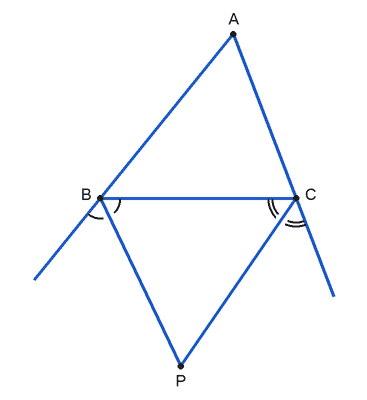
Prove that if AB > AC, then PC > PB.
Solve with AIWritten solution
Solution:
Concept: In any triangle, the greater angle has the greater side opposite to it, and the greater side has the greater angle opposite to it. The side opposite an angle is the side that does not touch that angle's vertex. The angles of a triangle add up to 180°, and two angles on a straight line (a linear pair) also add up to 180°.
Given: AB and AC are produced; the bisectors of the exterior angles at B and C meet at P; AB > AC.
Step 1 — Compare the interior angles.
AB > AC. AB is opposite ∠ACB and AC is opposite ∠ABC, so ∠ACB > ∠ABC.
Step 2 — Compare the exterior angles.
AB is produced beyond B and AC beyond C. Each exterior angle forms a linear pair with the interior angle:
Taking a larger angle from 180° leaves less, so the exterior angle at B is greater than the exterior angle at C.
Step 3 — Halve them.
BP and CP bisect these exterior angles, so ∠PBC is half the exterior angle at B and ∠PCB is half the exterior angle at C. Halves keep the same order: ∠PBC > ∠PCB.
Step 4 — Compare PC with PB.
In ΔPBC, PC is opposite ∠PBC and PB is opposite ∠PCB. The greater angle has the greater side opposite to it, so PC > PB.
Watch out: A larger interior angle means a SMALLER exterior angle; the order reverses in Step 2.
Therefore, PC > PB. Hence proved.
- 253 marks
Question 25
In the following figure; AB is the largest side and BC is the smallest side of triangle ABC.
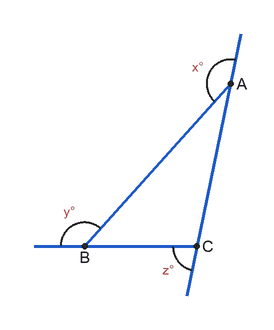
Write the angles , and in ascending order of their values.
Solve with AIWritten solution
Solution:
Concept: In any triangle, the greater angle has the greater side opposite to it, and the greater side has the greater angle opposite to it. The side opposite an angle is the side that does not touch that angle's vertex. The angles of a triangle add up to 180°, and two angles on a straight line (a linear pair) also add up to 180°.
Given: AB is the largest side and BC the smallest side of ΔABC; x°, y°, z° are the exterior angles at A, B and C.
Step 1 — Order the interior angles.
AB is the largest side, so the angle opposite it, ∠C, is the largest angle. BC is the smallest side, so the angle opposite it, ∠A, is the smallest angle. So ∠A < ∠B < ∠C.
Step 2 — Write the exterior angles.
Each marked angle forms a linear pair with the interior angle at the same vertex:
Step 3 — Reverse the order.
The larger the interior angle, the smaller the exterior angle. ∠C is the largest, so z° is the smallest; ∠A is the smallest, so x° is the largest.
Watch out: Do not copy the order of the interior angles; subtracting from 180° turns the order round.
Therefore, in ascending order, z° < y° < x°.
- 263 marks
Question 26
In quadrilateral ABCD, side AB is the longest and side DC is the shortest.
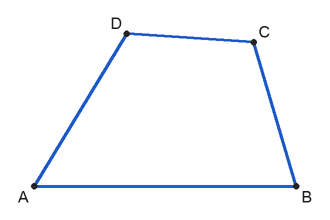
Prove that :
(i) ∠C > ∠A
(ii) ∠D > ∠B
Solve with AIWritten solution
Solution:
Concept: In any triangle, the greater angle has the greater side opposite to it, and the greater side has the greater angle opposite to it. The side opposite an angle is the side that does not touch that angle's vertex.
Given: In quadrilateral ABCD, AB is the longest side and DC is the shortest side.
Step 1 — Part (i): split ∠A and ∠C by diagonal AC.
Join AC.
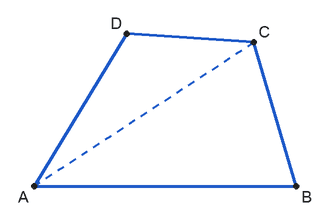
AB is the longest side, so AB > BC. In ΔABC, AB is opposite ∠BCA and BC is opposite ∠BAC, so ∠BCA > ∠BAC.
Step 2 — Part (i): the second triangle.
DC is the shortest side, so AD > DC. In ΔADC, AD is opposite ∠DCA and DC is opposite ∠DAC, so ∠DCA > ∠DAC.
Step 3 — Part (i): add.
Adding the two results, ∠BCA + ∠DCA > ∠BAC + ∠DAC. The left side is the whole angle C of the quadrilateral and the right side is the whole angle A, so ∠C > ∠A.
Step 4 — Part (ii): split ∠B and ∠D by diagonal BD.
Join BD.

In ΔABD, AB > AD (AB is the longest side), so ∠ADB > ∠ABD. In ΔBCD, BC > DC (DC is the shortest side), so ∠BDC > ∠DBC.
Step 5 — Part (ii): add.
Adding, ∠ADB + ∠BDC > ∠ABD + ∠DBC, that is ∠D > ∠B.
Watch out: Each diagonal splits two angles of the quadrilateral; compare the parts in each triangle, then add them.
Therefore, (i) ∠C > ∠A and (ii) ∠D > ∠B. Hence proved.
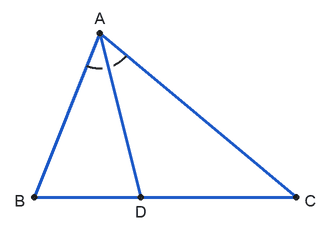
- 273 marks
Question 27
In triangle ABC, side AC is greater than side AB. If the internal bisector of angle A meets the opposite side at point D, prove that : ∠ADC is greater than ∠ADB.
 Solve with AI
Written solution
Solution:
Concept: In any triangle, the greater angle has the greater side opposite to it, and the greater side has the greater angle opposite to it. The side opposite an angle is the side that does not touch that angle's vertex. An exterior angle of a triangle equals the sum of the two interior opposite angles, so it is greater than each of them.
Given: In ΔABC, AC > AB and the bisector of ∠A meets BC at D.
Step 1 — Compare ∠B and ∠C.
AC > AB. AC is opposite ∠B and AB is opposite ∠C, so ∠B > ∠C.
Step 2 — Name the halves of ∠A.
AD bisects ∠A, so the two halves ∠BAD and ∠DAC are equal. Call each of them x.
Step 3 — Write ∠ADC and ∠ADB as exterior angles.
∠ADC is an exterior angle of ΔABD, and ∠ADB is an exterior angle of ΔADC. Each equals the sum of its two interior opposite angles.
Step 4 — Compare.
Both sums contain the same x, and ∠B > ∠C, so ∠B + x > ∠C + x.
Watch out: ∠ADC is the exterior angle of the triangle on the OTHER side, ΔABD.
Therefore, ∠ADC > ∠ADB. Hence proved.
- 283 marks
Question 28
In isosceles triangle ABC, sides AB and AC are equal. If point D lies in base BC and point E lies on BC produced (BC being produced through vertex C), prove that :
(i) AC > AD
(ii) AE > AC
(iii) AE > AD
 Solve with AI
Written solution
Solution:
Concept: Angles opposite equal sides of a triangle are equal. An exterior angle of a triangle equals the sum of the two interior opposite angles, so it is greater than each of them. In any triangle, the greater angle has the greater side opposite to it, and the greater side has the greater angle opposite to it. The side opposite an angle is the side that does not touch that angle's vertex.
Given: AB = AC, D lies in BC and E lies on BC produced beyond C.
Step 1 — Equal base angles.
AB = AC, so ∠B = ∠ACB. Both are base angles of an isosceles triangle, so each is acute.
Step 2 — Part (i): compare AC and AD.
D lies in BC, so ∠ADC is an exterior angle of ΔABD and ∠ADC > ∠B = ∠ACD. In ΔADC, AC is opposite ∠ADC and AD is opposite ∠ACD, so AC > AD.
Step 3 — Part (ii): compare AE and AC.
E lies on BC produced beyond C, so ∠ACE is the linear pair of the acute angle ∠ACB. Hence ∠ACE is obtuse and is the greatest angle of ΔACE, greater than ∠AEC. AE is opposite ∠ACE and AC is opposite ∠AEC, so AE > AC.
Step 4 — Part (iii): join the results.
AE > AC from part (ii) and AC > AD from part (i), so AE > AD.
Watch out: For part (ii), use the obtuse angle at C; an obtuse angle is always the greatest angle of its triangle.
Therefore, (i) AC > AD, (ii) AE > AC and (iii) AE > AD. Hence proved.
- 293 marks
Question 29
Given : ED = EC
Prove : AB + AD > BC.
 Solve with AI
Written solution
Solution:
Concept: The sum of any two sides of a triangle is greater than the third side.
Given: ED = EC, with E on BD (figure).
Step 1 — Triangle inequality in ΔABD.
In ΔABD two sides together exceed the third side:
E lies on BD, so BD is made of the two parts BE and ED:
Since ED = EC, we can write EC in place of ED. So AB + AD > BE + EC.
Step 2 — Triangle inequality in ΔBEC.
In ΔBEC two sides together exceed the third side:
Step 3 — Join the two results.
AB + AD > BE + EC and BE + EC > BC, so AB + AD > BC.
Watch out: Replace ED by EC before using ΔBEC; that is where the given ED = EC is used.
Therefore, AB + AD > BC. Hence proved.
- 303 marks
Question 30
In triangle ABC, AB > AC and D is a point in side BC.
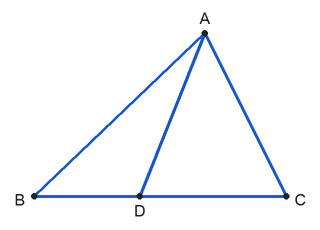
Show that : AB > AD.
Solve with AIWritten solution
Solution:
Concept: In any triangle, the greater angle has the greater side opposite to it, and the greater side has the greater angle opposite to it. The side opposite an angle is the side that does not touch that angle's vertex. An exterior angle of a triangle equals the sum of the two interior opposite angles, so it is greater than each of them.
Given: In ΔABC, AB > AC and D is a point in BC.
Step 1 — Compare ∠C and ∠B.
AB > AC. AB is opposite ∠C and AC is opposite ∠B, so ∠C > ∠B.
Step 2 — Exterior angle at D.
D lies in BC, so ∠ADB is an exterior angle of ΔADC and ∠ADB > ∠C. With Step 1, ∠ADB > ∠B.
Step 3 — Compare AB with AD.
In ΔABD, AB is opposite ∠ADB and AD is opposite ∠B, so AB > AD.
Watch out: Chain the angle facts first (∠ADB > ∠C > ∠B), then turn back to sides.
Therefore, AB > AD. Hence shown.
What Class 9 Maths Ch 11 covers
The sections of the chapter, in the order the book takes them. Every question above comes from one of these.
- 01Theorem 3: Greater Side Has Greater Opposite Angle
- 02Theorem 4: Greater Angle Has Greater Opposite Side
- 03Theorem 5: Perpendicular Is the Shortest Line Segment
- 04Corollaries on Sides of a Triangle
More ways to study this chapter
The same chapter asked three other ways. Practise it, revise it, and see what the board has set on Ch 11 before.
Class 9 Maths Ch 11 questions students ask
How many questions are there in Class 9 Maths Ch 11?
30 questions. Every one is solved step by step on this page.
Are these Class 9 Maths solutions free?
Yes. Every question and its full working is free to read, with no account needed.
Can I download the Class 9 Maths Ch 11 solutions as a PDF?
There is no PDF to download. Every solution is on this page instead, which means it is searchable, always the current syllabus, and readable on a phone. Use your browser's print option if you want it on paper.