
Question 153 marksEasy
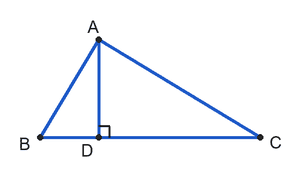
From the following figure; prove that :
(i) AB > BD
(ii) AC > CD
(iii) AB + AC > BC
Confirming your payment
Sign up now and get 250 free tokens.
Inequalities · Question 15 of 30
From the following figure; prove that :
(i) AB > BD
(ii) AC > CD
(iii) AB + AC > BC
Solution:
Concept: In a right triangle the right angle is the greatest angle, so the hypotenuse (opposite it) is the greatest side. In any triangle, the greater angle has the greater side opposite to it, and the greater side has the greater angle opposite to it. The side opposite an angle is the side that does not touch that angle's vertex.
Given: AD ⊥ BC with D on BC (marked).
Step 1 — Part (i): look at ΔADB.
The figure marks AD ⊥ BC, so ∠ADB = 90°. The other two angles of ΔADB add up to 90°, so each is smaller than 90°. ∠ADB is therefore the greatest angle, and the side opposite it, AB, is the greatest side: AB > BD.
Step 2 — Part (ii): look at ΔADC.
In the same way ∠ADC = 90° is the greatest angle of ΔADC, so the side opposite it is the greatest: AC > CD.
Step 3 — Part (iii): add the two results.
Adding the inequalities of parts (i) and (ii) keeps the inequality:
D lies on BC between B and C, so the two parts make up the whole side:
So AB + AC > BC.
Watch out: Two inequalities pointing the same way may be added side by side.
Therefore, AB > BD, AC > CD and AB + AC > BC. Hence proved.