
Question 243 marksMedium
The sides AB and AC of a triangle ABC are produced; and the bisectors of the external angles at B and C meet at P.
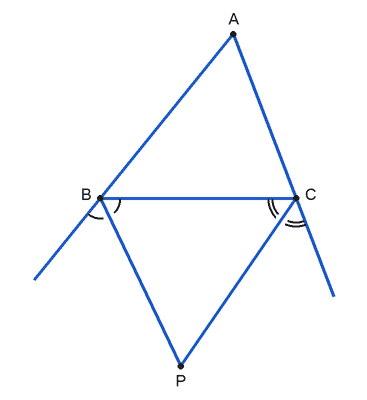
Prove that if AB > AC, then PC > PB.
Confirming your payment
Sign up now and get 250 free tokens.
Inequalities · Question 24 of 30
The sides AB and AC of a triangle ABC are produced; and the bisectors of the external angles at B and C meet at P.
Prove that if AB > AC, then PC > PB.
Solution:
Concept: In any triangle, the greater angle has the greater side opposite to it, and the greater side has the greater angle opposite to it. The side opposite an angle is the side that does not touch that angle's vertex. The angles of a triangle add up to 180°, and two angles on a straight line (a linear pair) also add up to 180°.
Given: AB and AC are produced; the bisectors of the exterior angles at B and C meet at P; AB > AC.
Step 1 — Compare the interior angles.
AB > AC. AB is opposite ∠ACB and AC is opposite ∠ABC, so ∠ACB > ∠ABC.
Step 2 — Compare the exterior angles.
AB is produced beyond B and AC beyond C. Each exterior angle forms a linear pair with the interior angle:
Taking a larger angle from 180° leaves less, so the exterior angle at B is greater than the exterior angle at C.
Step 3 — Halve them.
BP and CP bisect these exterior angles, so ∠PBC is half the exterior angle at B and ∠PCB is half the exterior angle at C. Halves keep the same order: ∠PBC > ∠PCB.
Step 4 — Compare PC with PB.
In ΔPBC, PC is opposite ∠PBC and PB is opposite ∠PCB. The greater angle has the greater side opposite to it, so PC > PB.
Watch out: A larger interior angle means a SMALLER exterior angle; the order reverses in Step 2.
Therefore, PC > PB. Hence proved.