
Question 103 marksMedium
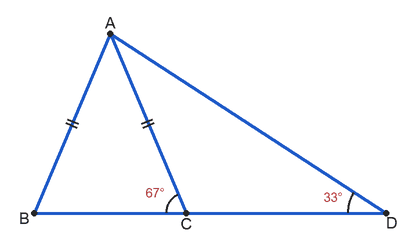
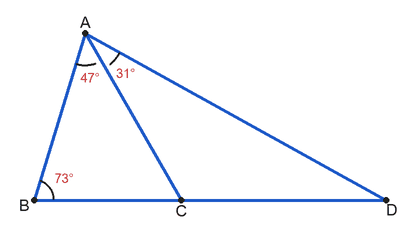
In each of following figures, write BC, AC and CD in ascending order of their lengths.
(i)
(ii)
Confirming your payment
Sign up now and get 250 free tokens.
Inequalities · Question 10 of 30
In each of following figures, write BC, AC and CD in ascending order of their lengths.
(i)
(ii)
Solution:
Concept: In any triangle, the greater angle has the greater side opposite to it, and the greater side has the greater angle opposite to it. The side opposite an angle is the side that does not touch that angle's vertex. The angles of a triangle add up to 180°, and two angles on a straight line (a linear pair) also add up to 180°.
Step 1 — Figure (i): angles of ΔABC.
The figure marks AB = AC.
So the base angles are equal: ∠ABC equals ∠ACB, which is 67°. The angle sum gives ∠BAC.
In ΔABC, BC is opposite 46° and AC is opposite 67°, so BC < AC.
Step 2 — Figure (i): angles of ΔACD.
B, C and D are on one straight line, so ∠ACD is the linear pair of ∠ACB.
In ΔACD, AC is opposite ∠D = 33° and CD is opposite ∠CAD = 34°, so AC < CD.
Step 3 — Figure (i): order.
Putting the two results together gives BC < AC < CD.
Step 4 — Figure (ii): angles of ΔABC.
Here ∠B = 73° and ∠BAC = 47°.
In ΔABC, BC is opposite 47° and AC is opposite 73°, so BC < AC.
Step 5 — Figure (ii): angles of ΔACD.
Again ∠ACD is the linear pair of ∠ACB, and ∠CAD = 31°.
In ΔACD, AC is opposite ∠D = 29° and CD is opposite ∠CAD = 31°, so AC < CD.
Step 6 — Figure (ii): order.
Putting the two results together gives BC < AC < CD.
Watch out: AC belongs to both triangles, so compare it with BC in ΔABC and with CD in ΔACD; that links all three sides.
Therefore, in both figures the ascending order is BC < AC < CD.