
Question 41 markMCQEasy
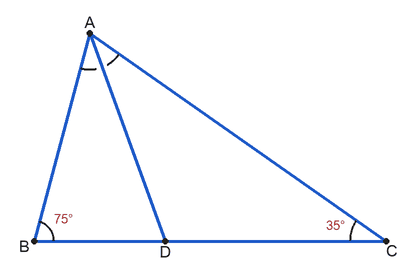
In the given figure, we find :
Confirming your payment
Sign up now and get 250 free tokens.
Inequalities · Question 4 of 30
In the given figure, we find :
(A) BD > AB
(B) BD < AB
(C) BD = AB
(D) DC < AB
Answer: (B) BD < AB
Concept: The angles of a triangle add up to 180°, and two angles on a straight line (a linear pair) also add up to 180°. In any triangle, the greater angle has the greater side opposite to it, and the greater side has the greater angle opposite to it. The side opposite an angle is the side that does not touch that angle's vertex.
Step 1 — Find ∠A and its halves.
The angles of ΔABC add up to 180°.
The figure marks AD as the bisector of ∠A, so each half is half of 70°.
Step 2 — Find ∠ADB.
In ΔABD the angles at B and A are 75° and 35°.
Step 3 — Compare BD with AB.
In ΔABD, BD is opposite ∠BAD = 35° and AB is opposite ∠ADB = 70°. The smaller angle has the smaller side opposite to it, so BD < AB.
Watch out: Match each side with the angle that does NOT touch it: in ΔABC, BC is opposite ∠A, CA is opposite ∠B and AB is opposite ∠C.
Note: The book's printed answer is BD > AB. With the figure's angles BD is the shortest side of ΔABD, so (B) is correct.
Why the other options are wrong:
Therefore, BD < AB, option (B).