
Question 21 markMCQEasy
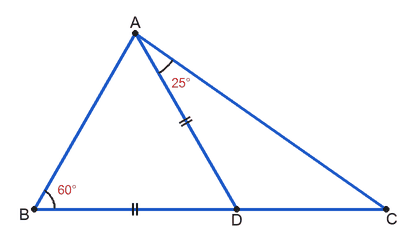
In the adjoining figure, we find :
Confirming your payment
Sign up now and get 250 free tokens.
Inequalities · Question 2 of 30
In the adjoining figure, we find :
(A) BD = DC
(B) BD < DC
(C) BD > DC
(D) AD = CD
Answer: (C) BD > DC
Concept: Angles opposite equal sides of a triangle are equal. The angles of a triangle add up to 180°, and two angles on a straight line (a linear pair) also add up to 180°. In any triangle, the greater angle has the greater side opposite to it, and the greater side has the greater angle opposite to it. The side opposite an angle is the side that does not touch that angle's vertex.
Step 1 — Use AD = BD.
The figure marks AD = BD, so ΔABD is isosceles.
The angles opposite these equal sides are equal, so ∠BAD equals ∠ABD, which is 60°.
Step 2 — Find ∠ADB and ∠ADC.
The third angle of ΔABD follows from the angle sum.
B, D and C are on one straight line, so ∠ADC is the linear pair of ∠ADB.
Step 3 — Find ∠ACD.
In ΔADC we now know two angles, 120° at D and 25° at A.
Step 4 — Compare AD with DC.
In ΔADC, AD is opposite ∠ACD = 35° and DC is opposite ∠DAC = 25°. The greater angle has the greater side opposite to it, so AD > DC. As BD = AD, this gives BD > DC.
Watch out: Match each side with the angle that does NOT touch it: in ΔABC, BC is opposite ∠A, CA is opposite ∠B and AB is opposite ∠C.
Why the other options are wrong:
Therefore, BD > DC, option (C).