
Question 133 marksMedium
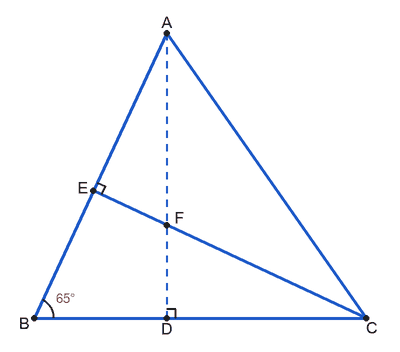
In the following figure, ∠BAC = 60° and ∠ABC = 65°.
Prove that :
(i) CF > AF
(ii) DC > DF
Confirming your payment
Sign up now and get 250 free tokens.
Inequalities · Question 13 of 30
In the following figure, ∠BAC = 60° and ∠ABC = 65°.
Prove that :
(i) CF > AF
(ii) DC > DF
Solution:
Concept: In a right triangle the two acute angles add up to 90°. In any triangle, the greater angle has the greater side opposite to it, and the greater side has the greater angle opposite to it. The side opposite an angle is the side that does not touch that angle's vertex.
Given: ∠BAC = 60°, ∠ABC = 65°, AD ⊥ BC, CE ⊥ AB, and AD, CE meet at F.
Step 1 — Find ∠ACB.
The figure marks AD ⊥ BC and CE ⊥ AB. First find the third angle of ΔABC.
Step 2 — Angles of ΔAFC for part (i).
In right ΔADC (right angle at D), the other two angles add up to 90°.
In right ΔAEC (right angle at E), ∠EAC = 60°.
Step 3 — Prove CF > AF.
In ΔAFC, ∠FAC is the same angle as ∠DAC, so it is 35°.
∠FCA is the same angle as ∠ACE, so it is 30°.
CF is opposite ∠FAC and AF is opposite ∠FCA. The greater angle has the greater side opposite to it, so CF > AF.
Step 4 — Angles of ΔDFC for part (ii).
In right ΔBEC (right angle at E), ∠EBC = 65°.
In right ΔFDC (right angle at D), ∠DCF = 25°.
Step 5 — Prove DC > DF.
In ΔDFC, DC is opposite ∠DFC = 65° and DF is opposite ∠DCF = 25°. So DC > DF.
Watch out: Match each side with the angle that does NOT touch it: in ΔABC, BC is opposite ∠A, CA is opposite ∠B and AB is opposite ∠C.
Therefore, (i) CF > AF and (ii) DC > DF. Hence proved.