
Question 123 marksMedium
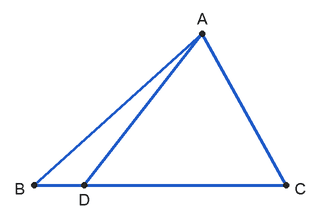
D is a point in side BC of triangle ABC. If AD > AC, show that AB > AC.
Confirming your payment
Sign up now and get 250 free tokens.
Inequalities · Question 12 of 30
D is a point in side BC of triangle ABC. If AD > AC, show that AB > AC.
Solution:
Concept: In any triangle, the greater angle has the greater side opposite to it, and the greater side has the greater angle opposite to it. The side opposite an angle is the side that does not touch that angle's vertex. An exterior angle of a triangle equals the sum of the two interior opposite angles, so it is greater than each of them.
Given: D is a point on BC of ΔABC and AD > AC.
Step 1 — Use AD > AC in ΔADC.
In ΔADC, AD is opposite ∠ACD and AC is opposite ∠ADC. The greater side has the greater angle opposite to it, so ∠ACD > ∠ADC.
Step 2 — Use the exterior angle of ΔABD.
D lies on BC, so ∠ADC is an exterior angle of ΔABD. It is greater than the interior opposite angle ∠ABD, so ∠ADC > ∠ABC.
Step 3 — Compare ∠C and ∠B of ΔABC.
∠ACD is the same angle as ∠ACB. Joining the two results, ∠ACB > ∠ADC and ∠ADC > ∠ABC, so ∠ACB > ∠ABC.
Step 4 — Compare the sides.
In ΔABC, AB is opposite ∠ACB and AC is opposite ∠ABC. As ∠ACB > ∠ABC, the side opposite the greater angle is greater: AB > AC.
Watch out: Go from sides to angles (Step 1), compare angles (Steps 2–3), then go back from angles to sides (Step 4).
Therefore, AB > AC. Hence shown.