
Question 263 marksMedium
In quadrilateral ABCD, side AB is the longest and side DC is the shortest.
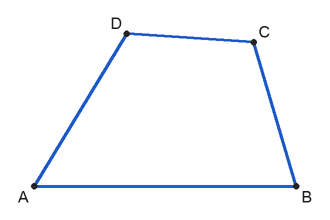
Prove that :
(i) ∠C > ∠A
(ii) ∠D > ∠B
Confirming your payment
Sign up now and get 250 free tokens.
Inequalities · Question 26 of 30
In quadrilateral ABCD, side AB is the longest and side DC is the shortest.
Prove that :
(i) ∠C > ∠A
(ii) ∠D > ∠B
Solution:
Concept: In any triangle, the greater angle has the greater side opposite to it, and the greater side has the greater angle opposite to it. The side opposite an angle is the side that does not touch that angle's vertex.
Given: In quadrilateral ABCD, AB is the longest side and DC is the shortest side.
Step 1 — Part (i): split ∠A and ∠C by diagonal AC.
Join AC.
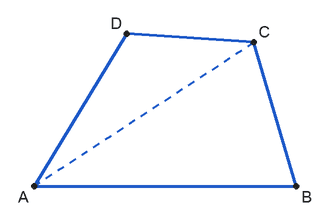
AB is the longest side, so AB > BC. In ΔABC, AB is opposite ∠BCA and BC is opposite ∠BAC, so ∠BCA > ∠BAC.
Step 2 — Part (i): the second triangle.
DC is the shortest side, so AD > DC. In ΔADC, AD is opposite ∠DCA and DC is opposite ∠DAC, so ∠DCA > ∠DAC.
Step 3 — Part (i): add.
Adding the two results, ∠BCA + ∠DCA > ∠BAC + ∠DAC. The left side is the whole angle C of the quadrilateral and the right side is the whole angle A, so ∠C > ∠A.
Step 4 — Part (ii): split ∠B and ∠D by diagonal BD.
Join BD.

In ΔABD, AB > AD (AB is the longest side), so ∠ADB > ∠ABD. In ΔBCD, BC > DC (DC is the shortest side), so ∠BDC > ∠DBC.
Step 5 — Part (ii): add.
Adding, ∠ADB + ∠BDC > ∠ABD + ∠DBC, that is ∠D > ∠B.
Watch out: Each diagonal splits two angles of the quadrilateral; compare the parts in each triangle, then add them.
Therefore, (i) ∠C > ∠A and (ii) ∠D > ∠B. Hence proved.