
Question 193 marksMedium
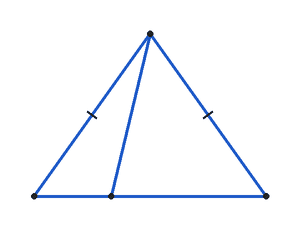
Prove that the straight line joining the vertex of an isosceles triangle to any point in the base is smaller than either of the equal sides of the triangle.
Confirming your payment
Sign up now and get 250 free tokens.
Inequalities · Question 19 of 30
Prove that the straight line joining the vertex of an isosceles triangle to any point in the base is smaller than either of the equal sides of the triangle.
Solution:
Concept: Angles opposite equal sides of a triangle are equal. An exterior angle of a triangle equals the sum of the two interior opposite angles, so it is greater than each of them. In any triangle, the greater angle has the greater side opposite to it, and the greater side has the greater angle opposite to it. The side opposite an angle is the side that does not touch that angle's vertex.
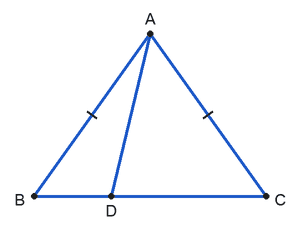
Given: An isosceles triangle ABC with AB = AC, and D any point on the base BC.
Step 1 — Set up the figure.
Let ABC be isosceles with AB = AC, and let D be any point on the base BC (between B and C). We must show AD < AB and AD < AC.
Step 2 — Equal base angles.
AB = AC, so the angles opposite them are equal: ∠B = ∠C.
Step 3 — Exterior angle at D.
In ΔADC, ∠ADB is an exterior angle at D, so ∠ADB > ∠C. As ∠C = ∠B, this gives ∠ADB > ∠B.
Step 4 — Compare AD with AB.
In ΔABD, AB is opposite ∠ADB and AD is opposite ∠B. The greater angle has the greater side opposite to it, so AB > AD. Since AC = AB, also AC > AD.
Watch out: Use the exterior angle of ΔADC (not of ΔABD) to compare ∠ADB with a base angle.
Therefore, the line joining the vertex A to any point D in the base is smaller than either equal side. Hence proved.