
Question 203 marksMedium
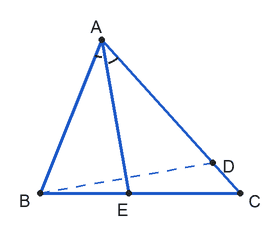
In the following diagram; AD = AB and AE bisects angle A. Prove that :
(i) BE = DE
(ii) ∠ABD > ∠C
Confirming your payment
Sign up now and get 250 free tokens.
Inequalities · Question 20 of 30
In the following diagram; AD = AB and AE bisects angle A. Prove that :
(i) BE = DE
(ii) ∠ABD > ∠C
Solution:
Concept: S.A.S. congruence: two triangles are congruent if two sides and the angle between them are equal. Angles opposite equal sides of a triangle are equal. An exterior angle of a triangle equals the sum of the two interior opposite angles, so it is greater than each of them.
Given: AD = AB, AE bisects ∠A, D on AC and E on BC.
Step 1 — Part (i): ΔABE and ΔADE.
Compare the two triangles on either side of the bisector AE.
AB = AD (given)
∠BAE = ∠DAE (AE bisects ∠A)
AE is common to both triangles.
So ΔABE ≅ ΔADE by the S.A.S. rule, and the corresponding sides BE and DE are equal.
Step 2 — Part (ii): equal angles in ΔABD.
AB = AD, so the angles opposite them in ΔABD are equal: ∠ABD = ∠ADB.
Step 3 — Exterior angle of ΔBDC.
D lies on AC, so ∠ADB is an exterior angle of ΔBDC at D. It is greater than the interior opposite angle ∠C, so ∠ADB > ∠C.
Step 4 — Conclude.
Since ∠ABD = ∠ADB and ∠ADB > ∠C, we get ∠ABD > ∠C.
Watch out: ∠ADB belongs to ΔABD but is an EXTERIOR angle of ΔBDC; that is why it beats ∠C.
Therefore, (i) BE = DE and (ii) ∠ABD > ∠C. Hence proved.