
Opening your dashboard
Class 9 Maths Chapter 11 Inequalities: Practice Questions
40 questions on Chapter 11, each worked through on its own page with the AI tutor. Class 9 Maths, ICSE 2026-27.
40 questions
1–5 marks · Mixed difficulty
- 11 mark
Question 1
Bloom's level: Remember
The statement “ is less than ” is written in symbols as :
- 21 mark
Question 2
Bloom's level: Remember
Of all the line segments that can be drawn from a point outside a straight line to that line, the shortest is :
- 31 mark
Question 3
Bloom's level: Remember
In every triangle, the sum of the lengths of any two sides is :
- 41 mark
Question 4
Bloom's level: Understand
In ΔABC, AB = 5 cm, BC = 7 cm and CA = 6 cm.
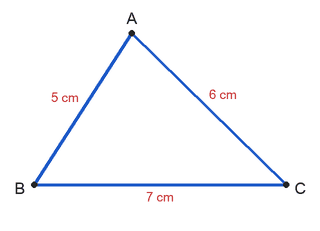
The angles of the triangle in ascending order are :
- 51 mark
Question 5
Bloom's level: Understand
In ΔPQR, ∠P = 45° and ∠Q = 75°.
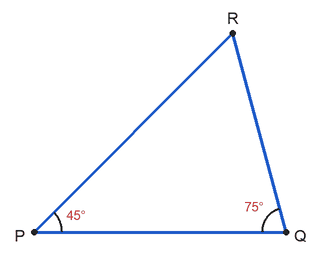
The longest side of the triangle is :
- 61 mark
Question 6
Bloom's level: Apply
Which of the following sets of lengths can be the sides of a triangle?
- 71 mark
Question 7
Bloom's level: Apply
Two sides of a triangle are 6 cm and 10 cm. If the third side is a whole number of centimetres, how many different lengths are possible for it?
- 81 mark
Question 8
Bloom's level: Apply
The angles A, B and C of ΔABC are in the ratio 2 : 3 : 4. The longest side of the triangle is :
- 91 mark
Question 9
Bloom's level: Analyse
In ΔABC, ∠B = 70° and ∠C = 50°. The bisector of ∠A meets BC at D.
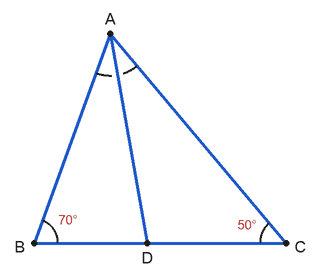
The shortest side of ΔADC is :
- 101 mark
Question 10
Bloom's level: Understand
Assertion (A) : The perpendicular from a point to a straight line is the shortest line segment from the point to the line.
Reason (R) : The sum of any two sides of a triangle is greater than the third side.
- 111 mark
Question 11
Bloom's level: Analyse
Assertion (A) : Line segments of lengths 4 cm, 9 cm and 5 cm cannot form a triangle.
Reason (R) : The sum of the lengths of any two sides of a triangle is greater than the third side.
- 121 mark
Question 12
Bloom's level: Evaluate
Assertion (A) : In ΔABC, if AB > AC, then ∠B > ∠C.
Reason (R) : If two sides of a triangle are unequal, the greater side has the greater angle opposite to it.
- 131 mark
Question 13
Bloom's level: Remember
State Theorem 3 of this chapter, about unequal sides of a triangle.
- 141 mark
Question 14
Bloom's level: Understand
In ΔABC, AB > BC and BC > CA. Write the three sides in a single inequality and say whether AB > CA. Give a reason.
- 152 marks
Question 15
Bloom's level: Apply
In ΔABC, ∠A = , ∠B = and ∠C = .
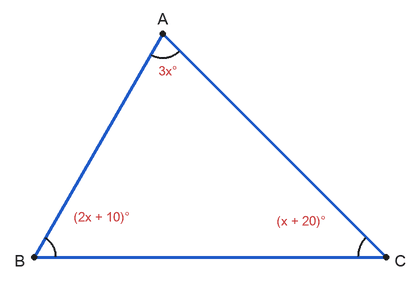
Find the angles and arrange the sides of the triangle in descending order of length.
- 162 marks
Question 16
Bloom's level: Apply
Check whether a triangle can be drawn with sides of length :
(a) 7 cm, 11 cm, 19 cm
(b) 7 cm, 11 cm, 17 cm
- 172 marks
Question 17
Bloom's level: Understand
Explain why the distance of a point from a straight line is always measured along the perpendicular from the point to the line.
- 182 marks
Question 18
Bloom's level: Understand
In ΔPQR, PQ = QR = 8 cm and PR = 11 cm.

Which angle of the triangle is the greatest? Which two angles are equal? Give reasons.
- 192 marks
Question 19
Bloom's level: Apply
In ΔXYZ, XY = cm, YZ = cm and XZ = cm.
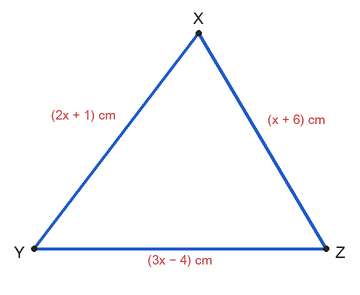
If , find the sides and write the angles of the triangle in descending order.
- 202 marks
Question 20
Bloom's level: Analyse
In ΔABC, ∠B = 35° and ∠C = 65°. AD is perpendicular to BC.

Arrange AB, AC and AD in descending order of length. Give reasons.
- 212 marks
Question 21
Bloom's level: Evaluate
Sam says, “A triangle with a perimeter of 20 cm can have one side of length 10 cm.” Is he correct? Justify your answer.
- 222 marks
Question 22
Bloom's level: Apply
Point O is at a perpendicular distance OP = 5 cm from a line , P being on . Q is another point on with OQ = 13 cm.
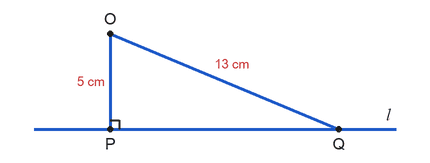
Find PQ, and say which of OP and OQ is shorter, giving the reason.
- 234 marks
Question 23
Bloom's level: Analyse
P is any point inside ΔABC. BP is produced to meet AC at Q.
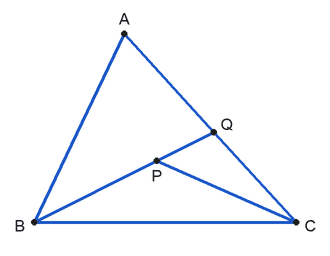
(a) Using ΔABQ, show that AB + AQ > BP + PQ.
(b) Using ΔPQC, show that PQ + QC > PC.
(c) Hence prove that AB + AC > PB + PC.
- 243 marks
Question 24
Bloom's level: Understand
(a) Explain why, in a right-angled triangle, the hypotenuse is the longest side.
(b) Explain why, in an obtuse-angled triangle, the side opposite the obtuse angle is the longest side.
(c) In ΔLMN, ∠M = 100°.
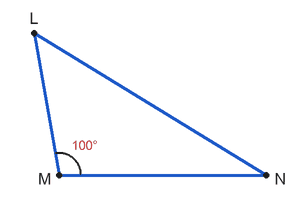
Name the longest side.
- 254 marks
Question 25
Bloom's level: Apply
In the quadrilateral ABCD shown, AB = 5 cm, BC = 7 cm, CD = 9 cm, DA = 6 cm and the diagonal AC = 8 cm.
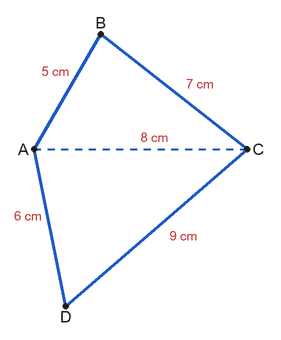
(a) In ΔABC, name the greatest and the smallest angle.
(b) In ΔACD, name the greatest and the smallest angle.
(c) Prove that ∠BAD > ∠BCD.
- 264 marks
Question 26
Bloom's level: Analyse
(a) In ΔABC, BC is the longest side. Prove that ∠A > 60°.
(b) In ΔPQR, PQ = 6 cm, QR = 4 cm and PR = 5 cm.
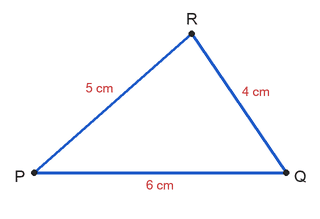
Without measuring, show that ∠R > 60° and ∠P < 60°.
(c) Can a triangle whose longest side is BC have ∠A = 58°? Give a reason.
- 275 marks
Question 27
Bloom's level: Apply
Case study: A village V is near a straight highway . The road VP meets the highway at right angles, with VP = 3 km. A bus stop B is on the highway, 4 km from P. A straight path also joins V directly to B.
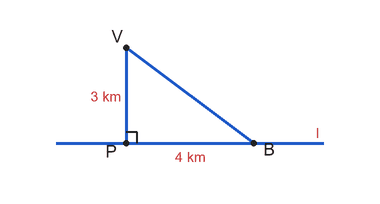
(a) Which is the shortest possible road from the village to the highway? Name the theorem that tells you this.
(b) Find the length of the path VB and check that it is longer than VP.
(c) A shopkeeper says it is shorter to go from V to B along VP and then PB than along VB. Use a corollary from this chapter to decide whether he is right, and find how much longer his route is.
- 285 marks
Question 28
Bloom's level: Evaluate
Case study: Three towns A, B and C are joined by straight roads and do not lie on one straight line. The road AB is 12 km and the road BC is 7 km. A planner claims the road AC is 20 km long; another planner claims it is 4 km long.
(a) Using the corollaries of this chapter, find the range in which the length of AC must lie.
(b) Evaluate each planner's claim.
(c) If AC is a whole number of kilometres, find its least and greatest possible values. What would happen if AC were exactly 19 km?
- 294 marks
Question 29
Bloom's level: Create
You have a 24 cm piece of wire to bend into a triangle with whole-number side lengths (in cm).
(a) Design a set of three lengths that forms a triangle with all sides different.
(b) Design a set that forms an isosceles (but not equilateral) triangle.
(c) Design a set of three lengths adding up to 24 cm that can not form a triangle.
(d) Explain why every side must be less than 12 cm.
Justify each answer using a corollary of this chapter.
- 304 marks
Question 30
Bloom's level: Create
(a) Design a triangle ABC with BC = 7 cm in which ∠A > ∠B > ∠C, none of the angles being a right angle. State the three angles you choose.
(b) Write the steps to construct your triangle with a ruler and protractor.
(c) Before measuring, predict the order of the lengths of the three sides, giving the reason. Then state what you would measure to check your prediction.
- 311 mark
Question 31
In , cm, cm and cm.
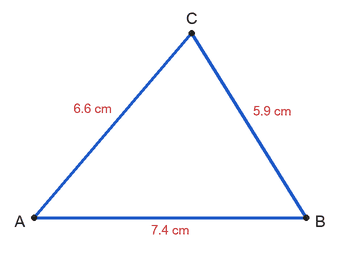
Which statement about its angles is correct ?
- 321 mark
Question 32
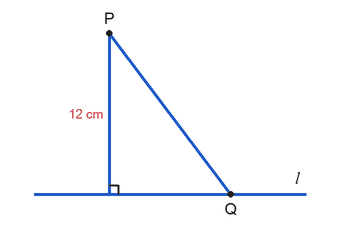
The perpendicular distance of a point from a straight line is 12 cm. If is any point on , which of the following cannot be the length of ?
- 331 mark
Question 33
Two sides of a triangle are 9 cm and 14 cm long. If the perimeter of the triangle is cm, then :
- 342 marks
Question 34
In , and .
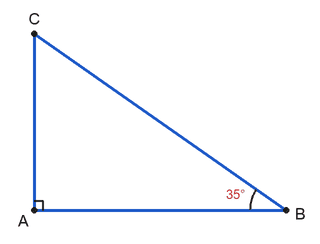
(i) Which is the longest side of the triangle? Give a reason.
(ii) Write the sides , and in descending order of length.
- 352 marks
Question 35
Two sides of a triangle measure 8 cm and 5 cm, and the third side is cm, where is a whole number. The angle opposite the 8 cm side is strictly greater than each of the other two angles.
(i) Find the range of values that can take, if the three sides are to form a triangle.
(ii) Use the given condition to list all possible values of .
- 363 marks
Question 36
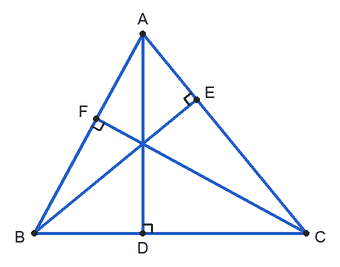
, and are the altitudes of drawn to the sides , and respectively.
Prove that :
(i) Compare with , with , and with .
(ii) Hence prove the result.
- 373 marks
Question 37
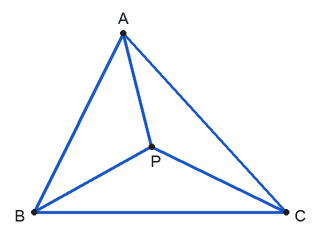
is a point inside .
Prove that :
(i) Write the inequality obtained from each of the triangles , and .
(ii) Add them and complete the proof.
(iii) If cm, cm and cm, what can you say about ?
- 384 marks
Question 38
In the figure, , , and is a point on such that .
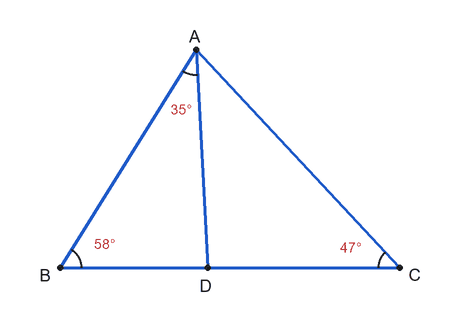
(i) Find and .
(ii) Arrange , and in ascending order of length.
(iii) Which is longer, or ? Give a reason.
- 394 marks
Question 39
The diagonals and of a quadrilateral meet at .
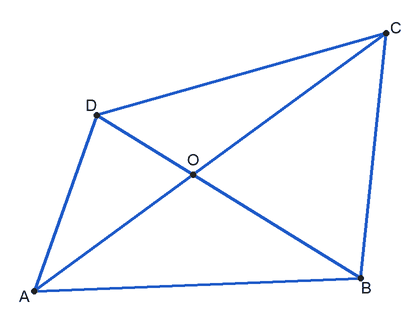
(i) Prove that .
(ii) Prove that .
(iii) Hence prove that .
- 404 marks
Question 40
In the figure, , , and is the perpendicular from to .
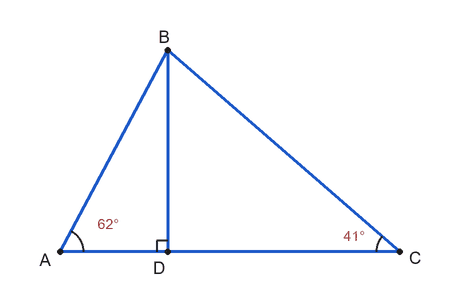
(i) Find and .
(ii) Arrange , and in ascending order of length.
(iii) Arrange , and in ascending order of length, and name the theorem that shows is the shortest.