
Opening your dashboard
Class 9 Maths Chapter 11 Inequalities: Competency-Based Questions (CBQ)
40 questions on Chapter 11, each worked through on its own page with the AI tutor. Class 9 Maths, ICSE 2026-27.
40 questions
1–5 marks · Mixed difficulty
- 11 mark
Question 1
Competency: Application
A triangular park has a gate at G, a fountain at F and a swing at S. Straight paths join them. A surveyor measures ∠G = 50° and ∠F = 72°.

Which path is the longest?
- 21 mark
Question 2
Competency: Application
Aman is making a triangular frame for a kite. He already has two sticks, 35 cm and 60 cm long. A shop sells sticks of the four lengths given below.
Which stick can he use as the third side of the frame?
- 31 mark
Question 3
Competency: Analysis
The figure shows a four-sided plot ABCD divided by a fence BD. The angles marked are ∠ABD = 60°, ∠ADB = 70°, ∠DBC = 55° and ∠BDC = 75°.
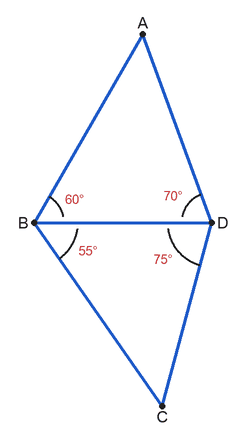
Which of the five line segments AB, AD, BC, CD and BD is the shortest?
- 41 mark
Question 4
Competency: Understanding
A swimmer at point S wants to reach a straight river bank by the shortest swim. Four ropes are stretched straight from S to points A, B, C and D on the bank. The rope SA makes an angle of 65° with the bank, SB makes 90°, SC makes 70° and SD makes 40°.
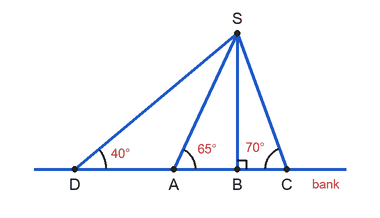
Along which rope should the swimmer go?
- 51 mark
Question 5
Competency: Analysis
A delivery rider goes 9 km along a straight road from his home H to an office O. He then goes 5 km along another straight road from O to a market M. The points H, O and M are not in one straight line.
Which of these cannot be the straight-line distance from H to M?
- 61 mark
Question 6
Competency: Evaluation
Assertion (A): A ladder that leans against a vertical wall, with its foot on level ground, is always longer than the height it reaches on the wall.
Reason (R): In any triangle, the side facing a larger angle is longer than the side facing a smaller angle.
- 72 marks
Question 7
Competency: Application
A gardener is fencing a triangular flower bed. Two of its sides are 7 m and 12 m long. The third side has not been measured yet.
Between which two values must the total length of the fence lie? Show your working.
- 82 marks
Question 8
Competency: Application
A triangular traffic island has signposts at its corners P, Q and R. An engineer measures ∠P = 64°. She also finds that the exterior angle at R, formed by producing QR, is 118°.
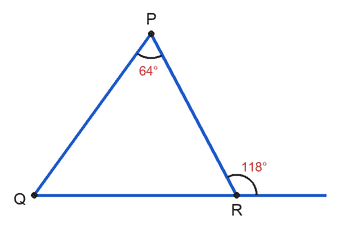
Which edge of the island is the longest and which is the shortest? Give reasons.
- 92 marks
Question 9
Competency: Analysis
A house H stands near a straight road. Three points A, B and C lie on the road in this order. A surveyor measures HA = 130 m, HB = 120 m and HC = 150 m. He also measures ∠HBC = 80°.
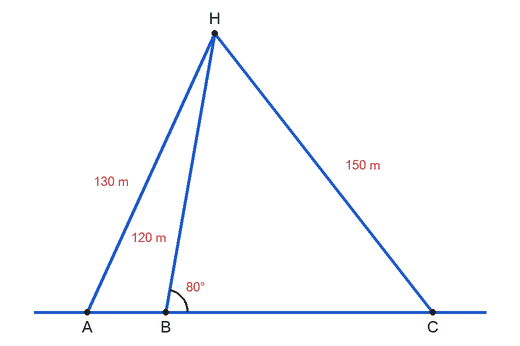
What can you say for certain about the shortest distance from the house to the road? Is it equal to 120 m? Give reasons.
- 102 marks
Question 10
Competency: Understanding
Three metro stations K, L and M are joined by straight tracks. The track KL is 2.4 km long, LM is 3.1 km long and MK is 2.7 km long.

At which station do the two tracks meet at the greatest angle? At which station do they meet at the smallest angle? Give a reason.
- 113 marks
Question 11
Competency: Analysis & Evaluation
A park is in the shape of a quadrilateral ABCD. Its sides AB, BC and CD are 50 m, 70 m and 40 m long. The fourth side AD runs along a pond and cannot be measured directly. A guard says, "AD is 170 m long."

(a) Join AC. Use ΔABC to find a length that AC must be less than.
(b) Use ΔACD to decide whether the guard can be right.
(c) If AD is a whole number of metres, what is its greatest possible value?
- 123 marks
Question 12
Competency: Creativity
A hardware shop has one fence panel of each of these lengths: 2 m, 3 m, 4 m, 6 m and 9 m. You have to design a triangular vegetable bed using exactly three of these panels as its sides.
(a) Choose three panels that can form a triangle. Show that your choice works.
(b) Give one choice of three panels that cannot form a triangle. Explain why.
(c) For your bed in part (a), state which corner has the greatest angle.
- 133 marks
Question 13
Competency: Application & Analysis
A ship sails along a straight course through the points P, Q and R, as shown. From P, the navigator sees a lighthouse L at an angle of 35° to the course. After sailing 6 km to Q, he sees it at an angle of 70° to the course, so ∠LPQ = 35° and ∠LQR = 70°.
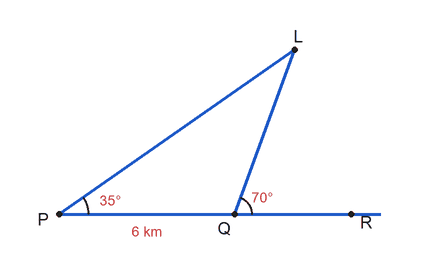
(a) Find ∠PLQ.
(b) How far is the ship from the lighthouse when it is at Q? Give a reason.
(c) Is the ship nearer to the lighthouse at P or at Q? Is LQ the least distance between the ship's course and the lighthouse? Give reasons.
- 144 marks
Question 14
Competency: Analysis & Evaluation
Case study — Checking a land record
A clerk enters the measurements of three triangular plots in a register. Each angle is rounded to the nearest degree.
Plot Sides Angles ABC AB = 30 m, BC = 45 m, CA = 38 m ∠A = 82°, ∠B = 57°, ∠C = 41° PQR PQ = 50 m, QR = 36 m, RP = 58 m ∠P = 83°, ∠Q = 38°, ∠R = 59° XYZ XY = 25 m, YZ = 32 m, ZX = 60 m ∠X = 28°, ∠Y = 132°, ∠Z = 20° (a) One plot cannot be a triangle at all. Which one? Give a reason.
(b) For plot ABC, check whether the order of the angles agrees with the order of the sides.
(c) In one plot the clerk has interchanged the values of two angles. Find the plot, and write the three angles correctly.
- 155 marks
Question 15
Competency: Analysis & Evaluation
Case study — A cycle track
A cycle track is in the shape of a triangle ABC with ∠A = 48° and ∠C = 57°. A water point W is on the side AC so that BW is perpendicular to AC.
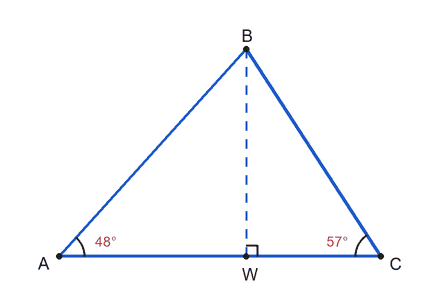
(a) Find ∠B. Arrange the three sides of the track in ascending order of length.
(b) The longest side of the track is 5 km. A board near the gate says, "One lap = 16 km". Show that the board is wrong, and find the two values between which the length of one lap must lie.
(c) A rider at B wants to reach the side AC. Explain why BW is shorter than both BA and BC. Then show that BW is longer than both AW and WC.
- 161 mark
Question 16
Competency: Understanding
A tailor cuts a triangular piece of cloth ABC. Without measuring the sides, he notes that ∠B > ∠C and ∠C > ∠A.
Which of the following gives the sides in decreasing order of length?
- 171 mark
Question 17
Competency: Analysis
A triangular signboard ABC has its three corners bent outwards for fixing. The exterior angles at A, B and C are 130°, 110° and 120° respectively.
Which side of the board is the shortest?
- 181 mark
Question 18
Competency: Analysis
A carpenter makes a triangular shelf bracket ABC. He extends the bottom edge BC beyond C to a point D and measures only one angle: the exterior angle ∠ACD = 100°.
Which of these statements must be true for every such bracket?
- 191 mark
Question 19
Competency: Analysis
A wire of length 30 cm is bent into a triangle with no wastage. One side of the triangle is 14 cm long.
Which of these pairs can be the lengths of the other two sides?
- 201 mark
Question 20
Competency: Evaluation
Assertion (A): In ΔABC, if BC is the longest side, then ∠A must be an obtuse angle.
Reason (R): In a triangle, the angle opposite the longest side is the greatest angle.
- 211 mark
Question 21
Competency: Evaluation
Assertion (A): In a triangle with sides 5 cm, 6 cm and 7 cm, the greatest angle is opposite the 7 cm side.
Reason (R): In every triangle, the angles are in the same ratio as the sides opposite to them.
- 221 mark
Question 22
Competency: Application
A four-sided plot ABCD has straight boundaries. Its two diagonals AC and BD cross each other inside the plot, with AC = 30 m and BD = 40 m. The four sides have not been measured. (Hypothetical data.)
Which of these could be the perimeter of the plot?
- 231 mark
Question 23
Competency: Analysis
In triangle ABC, the side BC is the shortest and the side AB is the longest. It is also known that ∠B = 50°.
Which of these could be the measure of ∠C?
- 241 mark
Question 24
Competency: Evaluation
A tailor cuts triangular cloth pieces of different shapes. For one piece, the longest side is cm and the perimeter is cm.
Which statement is true for every triangle?
- 251 mark
Question 25
Competency: Application
A bus goes from town A to town B, 6 km away. At B it turns through a right angle and goes 8 km to town C. The road AC joining A and C directly has not been measured.
Which of these could be the length of AC? (Hypothetical data.)
- 262 marks
Question 26
Competency: Understanding
A designer draws a triangular logo PQR in many sizes. In every size, the sides are in the ratio PQ : QR : RP = 3 : 5 : 7, so the sides are , and units for some positive number .
(i) Explain why these three lengths make a triangle for every value of .
(ii) Name the greatest angle and the smallest angle of the logo.
- 272 marks
Question 27
Competency: Application
Two straight fences BA and BC meet at the corner B of a farm, with BA = 20 m and BC = 15 m. A third straight fence AC closes a triangular plot ABC. The angle at B can be chosen. (Hypothetical data.)
The area of a triangle is .
(i) Taking AB as the base, explain why the height of the plot can never be more than 15 m.
(ii) Hence find the greatest possible area of the plot, and say how the fences must be placed to get it.
- 282 marks
Question 28
Competency: Application
A garden is in the shape of a parallelogram ABCD, and a straight path joins the corners A and C. A boy has only a protractor and no measuring tape. Standing at A, he measures ∠BAC = 50° and ∠CAD = 35°.
(i) Find ∠BCA, giving a reason.
(ii) Which side of the garden is longer, AB or BC? Give a reason.
- 292 marks
Question 29
Competency: Analysis
Two sides of an isosceles triangle are 4 cm and 11 cm long.
Find the length of the third side and the perimeter of the triangle. Give a reason for your choice.
- 302 marks
Question 30
Competency: Evaluation
Meera says: "If D is any point on the side BC of a triangle ABC, other than B and C, then AD is always shorter than AB."
Is she correct? Justify your answer.
- 312 marks
Question 31
Competency: Creativity
Pooja wants to make triangular rangoli frames whose three sides, in centimetres, are consecutive whole numbers, such as 7, 8 and 9.
(i) Design the smallest such frame. Show that it is a triangle and that a smaller set of consecutive numbers does not work.
(ii) Explain why every set of three consecutive whole numbers starting from 2 or more makes a triangle.
- 323 marks
Question 32
Competency: Analysis
A shopkeeper cuts a 20 cm piece of ribbon into three pieces, each a whole number of centimetres, to make a triangular badge.
(a) What is the greatest possible length of the longest piece?
(b) List all the different sets of three lengths that can make a badge.
(c) How many different badges are possible?
- 333 marks
Question 33
Competency: Analysis
In a triangular roof truss ABC, AB = 1.3 m and AC = 1.5 m. From the top corner A, a vertical post AL meets the beam BC at L with AL perpendicular to BC. A second rod AM joins A to the mid-point M of BC.
(a) Which is the shortest of AB, AC and AL? Give a reason.
(b) Which of ∠B and ∠C is greater? Give a reason.
(c) Explain why M and L cannot be the same point. Hence say which of AL and AM is longer.
- 343 marks
Question 34
Competency: Analysis
A hinge frame PQR has two rods PQ and PR, each 10 cm long. The angle ∠P between them can be changed, and an elastic cord QR joins the free ends Q and R to close the triangle.
(a) When ∠P = 40°, is QR longer or shorter than 10 cm?
(b) When ∠P = 80°, is QR longer or shorter than 10 cm?
(c) For what values of ∠P is QR the longest side of the triangle?
- 353 marks
Question 35
Competency: Analysis & Evaluation
Mohan walks from his home A to a shop B, 300 m away, and then from the shop to a school C, 400 m away. The angle ∠ABC between the two roads is 100°.
(a) Which of AB, BC and AC is the longest? Give a reason.
(b) Between which two values must AC lie?
(c) Mohan's friend says that walking straight along AC instead of going through B would save Mohan more than 300 m. Can the friend be right? Give a reason.
- 363 marks
Question 36
Competency: Application
Copy and fill in each blank with or , and give a reason.
(i) In ΔABC, ∠A = 55° and ∠B = 65°. Then BC ___ AC.
(ii) In ΔPQR, PQ = 7.5 cm and QR = 6.8 cm. Then ∠R ___ ∠P.
(iii) In ΔXYZ, ∠Z = 90°. Then XY ___ YZ.
- 375 marks
Question 37
Competency: Analysis & Evaluation
Case study — A distance chart
A bus company prepares a chart of straight-line distances, in kilometres, between four towns A, B, C and D. No three of the towns lie on one straight line. (Hypothetical data.)
Pair AB AC AD BC BD CD Distance (km) 12 7 25 9 11 15 (a) Show that the distances in triangles ABC and BCD are possible.
(b) Show that the chart cannot be correct, and say which distance is probably wrong.
(c) Assume the other five distances are correct. Use the triangles ABD and ACD to find the range within which AD must lie.
- 385 marks
Question 38
Competency: Analysis & Evaluation
Case study — A fire-brigade drill
Two ladders TA and TB reach the same point T of a vertical wall from level ground. The wall meets the ground at M, and A lies between M and B. The ladder TA makes an angle of 75° with the ground and the ladder TB makes an angle of 50° with the ground.

(a) Find ∠ATB.
(b) Arrange TM, TA and TB in increasing order of length. Give reasons.
(c) A third ladder TC reaches T from a point C of the ground that lies between A and B, with ∠TCM = 62°. Show that TA < TC < TB.
- 394 marks
Question 39
Competency: Application & Evaluation
Case study — Paths in a park
A triangular park ABC has three straight paths, each from a corner to the mid-point of the opposite side. The path AD meets BC at its mid-point D, BE meets CA at its mid-point E, and CF meets AB at its mid-point F. The paths measure AD = 45 m, BE = 60 m and CF = 75 m. (Hypothetical data.)
The chapter proves that for the median AD of ΔABC, , and the same holds for the other two medians.
(a) Show that the perimeter of the park is more than 180 m.
(b) Fencing costs ₹150 per metre. A contractor quotes ₹25,500 to fence the whole boundary at this rate. Can the quote be right? Give a reason.
(c) The side AB is measured as 50 m. Find a length that AC must be greater than.
- 404 marks
Question 40
Competency: Application & Analysis
Case study — A pump on the canal
Two villages A and B lie on opposite sides of a straight canal. Treat the canal as a straight line . A pump P is to be placed on , and straight pipes PA and PB will carry water to the villages. M and N are the feet of the perpendiculars from A and B to , with AM = 0.8 km and BN = 1.2 km. The straight distance AB is 2.5 km. (Hypothetical data.)
(a) Explain why, wherever P is placed on , the total pipe length PA + PB is at least AB. Where should P be placed to make the total exactly AB?
(b) An engineer suggests placing the pump at N, so that the pipe to B is as short as possible. The distance NA is 1.7 km. How much more pipe does this need than the best position?
(c) Explain why the pipe PA can never be shorter than 0.8 km, and why, for any two villages on opposite sides of at these distances from it, AB is at least 2 km.