
Opening your dashboard
Class 7 Maths Chapter 22: Constructions Solutions
49 textbook questions with step-by-step answers, free to read, for ICSE 2026-27.
Get talked through Ch 22, not just shown the answer
Reading a finished solution is not the same as being able to do it. The AI tutor takes one question at a time and works it with you, in your own words, until you can.
- Ask it out loud, in your own words
- It gives you the next step, not the answer
- Stuck on part (ii)? Start there
49 questions with solutions
1–3 marks · Mixed difficulty
- 13 marks
Question 1
Using ruler and compasses, construct the following angles :
(i) 30°
Solve with AIWritten solution
Solution:
Concept: Angles are built with compasses from 60°. If the compasses keep one opening, the vertex and two cut points on an arc form an equilateral triangle, so the angle at the vertex is 60°. Bisecting an angle (arcs of equal radius from two points equally far from the vertex) halves it, and two angles side by side add up. Here 30° is half of 60°, so we construct 60° and bisect it.
Given: The angle to be constructed; a ruler and a pair of compasses only.
Step 1 — Draw the arm.
Draw a ray OA with the ruler. O will be the vertex of the angle.
Step 2 — Draw the first arc.
With O as centre and any convenient radius, draw a large arc cutting OA at C.
Step 3 — Mark the 60° point.
With C as centre and the SAME radius, cut the arc at D. Now OC, OD and CD are all equal to the radius, so triangle OCD is equilateral and ∠DOC = 60°. We do not need to join OD.
Step 4 — Bisect the 60° angle.
With C and D as centres and the same radius, draw arcs meeting at G. Join OG and produce it to B. Since G is equally far from C and D, and OC = OD, the line OG divides the angle COD into two equal parts.
Step 5 — Work out the angle.
OB divides the 60° angle into two equal halves, so ∠AOB is half of 60°.
Step 6 — Look at the finished figure and check it.
The finished construction is shown below, with the given measurements marked on it.
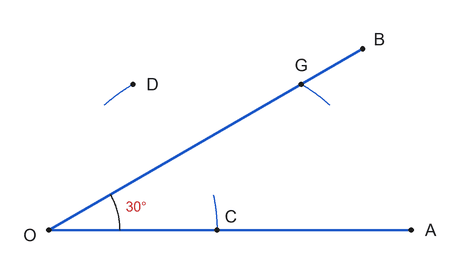
The 30° arc sits at O, between the arms OA and OB.
Watch out: Keep the compasses at the SAME radius while stepping off arcs along the first arc; changing it spoils the angle.
Therefore, ∠AOB = 30° is the required angle.
- 23 marks
Question 2
Using ruler and compasses, construct the following angles :
(ii) 15°
Solve with AIWritten solution
Solution:
Concept: Angles are built with compasses from 60°. If the compasses keep one opening, the vertex and two cut points on an arc form an equilateral triangle, so the angle at the vertex is 60°. Bisecting an angle (arcs of equal radius from two points equally far from the vertex) halves it, and two angles side by side add up. Here 15° is half of 30°, and 30° is half of 60°, so we bisect twice.
Given: The angle to be constructed; a ruler and a pair of compasses only.
Step 1 — Draw the arm.
Draw a ray OA. O will be the vertex of the angle.
Step 2 — Draw the first arc.
With O as centre and any convenient radius, draw a large arc cutting OA at C.
Step 3 — Mark the 60° point.
With C as centre and the SAME radius, cut the arc at D. Now OC, OD and CD are all equal to the radius, so triangle OCD is equilateral and ∠DOC = 60°. We do not need to join OD.
Step 4 — Bisect the 60° angle to get 30°.
With C and D as centres and the same radius, draw arcs meeting at G. Join OG. Since G is equally far from C and D, and OC = OD, the line OG divides the angle COD into two equal parts. So ∠GOA = 30°. Draw OG as a faint (dashed) line and let it cut the first arc at H.
Step 5 — Bisect the 30° angle.
With C and H as centres and the same radius, draw arcs meeting at K. Join OK and produce it to B. Since K is equally far from C and H, and OC = OH, the line OK divides the angle COH into two equal parts.
Step 6 — Work out the angle.
OB halves the 30° angle GOA, so ∠AOB is half of 30°.
Step 7 — Look at the finished figure and check it.
The finished construction is shown below, with the given measurements marked on it.
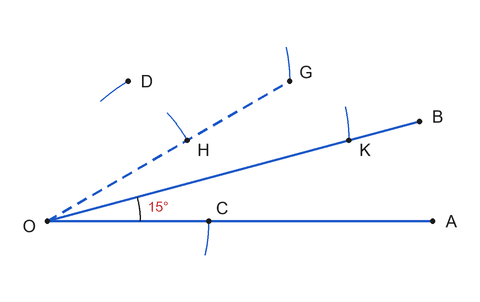
Watch out: When bisecting, use the SAME radius from both cut points; unequal arcs meet at a point that is not on the bisector.
Therefore, ∠AOB = 15° is the required angle.
- 33 marks
Question 3
Using ruler and compasses, construct the following angles :
(iii) 75°
Solve with AIWritten solution
Solution:
Concept: Angles are built with compasses from 60°. If the compasses keep one opening, the vertex and two cut points on an arc form an equilateral triangle, so the angle at the vertex is 60°. Bisecting an angle (arcs of equal radius from two points equally far from the vertex) halves it, and two angles side by side add up. Here 75° = 60° + 15°: it lies half-way between 60° and 90°, so we mark 60°, construct 90°, and bisect the angle between them.
Given: The angle to be constructed; a ruler and a pair of compasses only.
Step 1 — Draw the arm.
Draw a ray OA. O will be the vertex of the angle.
Step 2 — Draw the first arc.
With O as centre and any convenient radius, draw a large arc cutting OA at C.
Step 3 — Mark the 60° point.
With C as centre and the SAME radius, cut the arc at D. Now OC, OD and CD are all equal to the radius, so triangle OCD is equilateral and ∠DOC = 60°. We do not need to join OD.
Step 4 — Mark the 120° point.
With D as centre and the same radius, cut the arc again at E. This is a second step of 60°, so ∠EOA = 120°.
Step 5 — Construct 90°.
With D and E as centres and the same radius, draw arcs meeting at G. Join OG. Since G is equally far from D and E, and OD = OE, the line OG divides the angle DOE into two equal parts. It lies half-way between 60° and 120°, so ∠GOA = 90°. Draw OG as a dashed line and let it cut the first arc at H.
Step 6 — Bisect the angle between 60° and 90°.
With D and H as centres and the same radius, draw arcs meeting at K. Join OK and produce it to B. Since K is equally far from D and H, and OD = OH, the line OK divides the angle DOH into two equal parts.
Step 7 — Work out the angle.
The angle DOH is the 30° gap between 60° and 90°, and OB takes half of it on top of the 60°.
Step 8 — Look at the finished figure and check it.
The finished construction is shown below, with the given measurements marked on it.
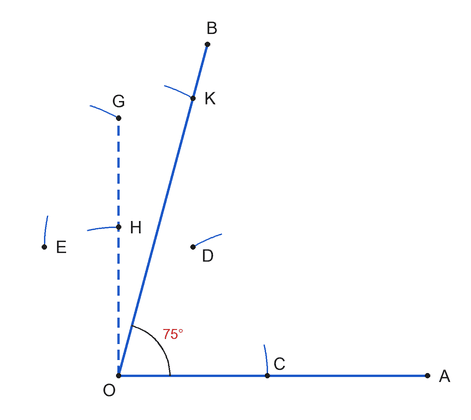
Watch out: Bisect the angle DOH (between 60° and 90°), not the angle GOA; that would give 45°.
Therefore, ∠AOB = 75° is the required angle.
- 43 marks
Question 4
Using ruler and compasses, construct the following angles :
(iv) 180°
Solve with AIWritten solution
Solution:
Concept: A straight angle measures 180°: its two arms point in exactly opposite directions and lie on one straight line.
Given: The angle to be constructed; a ruler and a pair of compasses only.
Step 1 — Draw the arm.
Draw a ray OA with the ruler. O will be the vertex of the angle.
Step 2 — Produce the ray backwards.
Place the ruler along OA and extend the line beyond O to a point B. Now B, O and A lie on one straight line, and the arms OA and OB point in opposite directions.
Step 3 — Look at the finished figure and check it.
The finished construction is shown below, with the given measurements marked on it.

The arc at O sweeps through half a turn, from OA round to OB.
Watch out: The vertex O must lie BETWEEN A and B on the line; if O is at one end, there is no straight angle at O.
Therefore, ∠AOB = 180° is the required angle.
- 53 marks
Question 5
Using ruler and compasses, construct the following angles :
(v) 165°
Solve with AIWritten solution
Solution:
Concept: Angles are built with compasses from 60°. If the compasses keep one opening, the vertex and two cut points on an arc form an equilateral triangle, so the angle at the vertex is 60°. Bisecting an angle (arcs of equal radius from two points equally far from the vertex) halves it, and two angles side by side add up. Here 165° = 180° − 15°. On the straight line through O we mark 120°, bisect the 60° left between 120° and 180° to get 150°, and then bisect the last 30° to get 165°.
Given: The angle to be constructed; a ruler and a pair of compasses only.
Step 1 — Draw the line.
Draw a ray OA, and produce AO beyond O as a dashed line. The straight angle at O is 180°.
Step 2 — Draw the first arc.
With O as centre and any convenient radius, draw a large arc cutting OA at C and the produced line at F. So ∠FOA = 180°.
Step 3 — Mark the 60° point.
With C as centre and the SAME radius, cut the arc at D. Now OC, OD and CD are all equal to the radius, so triangle OCD is equilateral and ∠DOC = 60°. We do not need to join OD.
Step 4 — Mark the 120° point.
With D as centre and the same radius, cut the arc again at E. This is a second step of 60°, so ∠EOA = 120°.
Step 5 — Construct 150°.
With E and F as centres and the same radius, draw arcs meeting at G. Join OG. Since G is equally far from E and F, and OE = OF, the line OG divides the angle EOF into two equal parts. ∠EOF is the 60° left between 120° and 180°, so OG makes 150° with OA (120° plus half of 60°). Draw OG as a dashed line and let it cut the first arc at H.
Step 6 — Bisect the angle between 150° and 180°.
With H and F as centres and the same radius, draw arcs meeting at K. Join OK and produce it to B. Since K is equally far from H and F, and OH = OF, the line OK divides the angle HOF into two equal parts.
Step 7 — Work out the angle.
The angle HOF is the 30° left between 150° and 180°, and OB takes half of it on top of the 150°.
Step 8 — Look at the finished figure and check it.
The finished construction is shown below, with the given measurements marked on it.
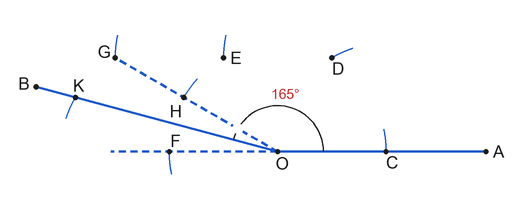
The 165° arc goes from OA, over the top, round to OB; the gap in it is where the dashed line OG passes.
Watch out: The angle is measured from OA, so OB must lie close to the produced line OF (only 15° from it), not close to OA.
Therefore, ∠AOB = 165° is the required angle.
- 63 marks
Question 6
Using ruler and compasses, construct the following angles :
(vi) 22·5°
Solve with AIWritten solution
Solution:
Concept: Angles are built with compasses from 60°. If the compasses keep one opening, the vertex and two cut points on an arc form an equilateral triangle, so the angle at the vertex is 60°. Bisecting an angle (arcs of equal radius from two points equally far from the vertex) halves it, and two angles side by side add up. Here 22.5° is half of 45°, and 45° is half of 90°: we construct 90° and bisect twice.
Given: The angle to be constructed; a ruler and a pair of compasses only.
Step 1 — Draw the arm.
Draw a ray OA. O will be the vertex of the angle.
Step 2 — Draw the first arc.
With O as centre and any convenient radius, draw a large arc cutting OA at C.
Step 3 — Mark the 60° and 120° points.
With C as centre and the SAME radius, cut the arc at D. Now OC, OD and CD are all equal to the radius, so triangle OCD is equilateral and ∠DOC = 60°. We do not need to join OD. With D as centre and the same radius, cut the arc again at E. This is a second step of 60°, so ∠EOA = 120°.
Step 4 — Construct 90°.
With D and E as centres and the same radius, draw arcs meeting at G. Join OG. Since G is equally far from D and E, and OD = OE, the line OG divides the angle DOE into two equal parts. So ∠GOA = 90°. Draw OG as a dashed line and let it cut the first arc at H.
Step 5 — Bisect 90° to get 45°.
With C and H as centres and the same radius, draw arcs meeting at K. Join OK. Since K is equally far from C and H, and OC = OH, the line OK divides the angle COH into two equal parts. So ∠KOA = 45°. Draw OK as a dashed line and let it cut the first arc at L.
Step 6 — Bisect 45° to get 22.5°.
With C and L as centres and the same radius, draw arcs meeting at N. Join ON and produce it to B. Since N is equally far from C and L, and OC = OL, the line ON divides the angle COL into two equal parts.
Step 7 — Work out the angle.
OB halves the 45° angle KOA.
Step 8 — Look at the finished figure and check it.
The finished construction is shown below, with the given measurements marked on it.
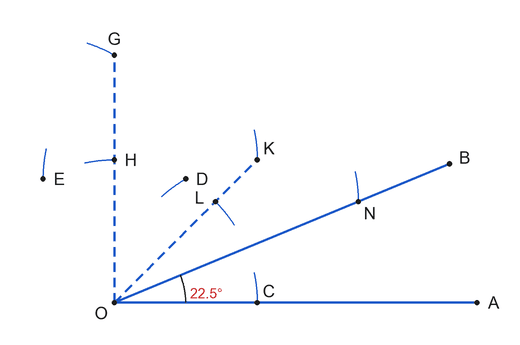
Watch out: When bisecting, use the SAME radius from both cut points; unequal arcs meet at a point that is not on the bisector.
Therefore, ∠AOB = 22.5° is the required angle.
- 73 marks
Question 7
Using ruler and compasses, construct the following angles :
(vii) 37·5°
Solve with AIWritten solution
Solution:
Concept: Angles are built with compasses from 60°. If the compasses keep one opening, the vertex and two cut points on an arc form an equilateral triangle, so the angle at the vertex is 60°. Bisecting an angle (arcs of equal radius from two points equally far from the vertex) halves it, and two angles side by side add up. Here 37.5° is half of 75°, and 75° lies half-way between 60° and 90°: we construct 75° and bisect it.
Given: The angle to be constructed; a ruler and a pair of compasses only.
Step 1 — Draw the arm.
Draw a ray OA. O will be the vertex of the angle.
Step 2 — Draw the first arc.
With O as centre and any convenient radius, draw a large arc cutting OA at C.
Step 3 — Mark the 60° and 120° points.
With C as centre and the SAME radius, cut the arc at D. Now OC, OD and CD are all equal to the radius, so triangle OCD is equilateral and ∠DOC = 60°. We do not need to join OD. With D as centre and the same radius, cut the arc again at E. This is a second step of 60°, so ∠EOA = 120°.
Step 4 — Construct 90°.
With D and E as centres and the same radius, draw arcs meeting at G. Join OG. Since G is equally far from D and E, and OD = OE, the line OG divides the angle DOE into two equal parts. So ∠GOA = 90°. Draw OG as a dashed line and let it cut the first arc at H.
Step 5 — Construct 75°.
With D and H as centres and the same radius, draw arcs meeting at K. Join OK. Since K is equally far from D and H, and OD = OH, the line OK divides the angle DOH into two equal parts. So ∠KOA = 75° (60° plus half of 30°). Draw OK as a dashed line and let it cut the first arc at L.
Step 6 — Bisect 75°.
With C and L as centres and the same radius, draw arcs meeting at N. Join ON and produce it to B. Since N is equally far from C and L, and OC = OL, the line ON divides the angle COL into two equal parts.
Step 7 — Work out the angle.
OB halves the 75° angle KOA.
Step 8 — Look at the finished figure and check it.
The finished construction is shown below, with the given measurements marked on it.
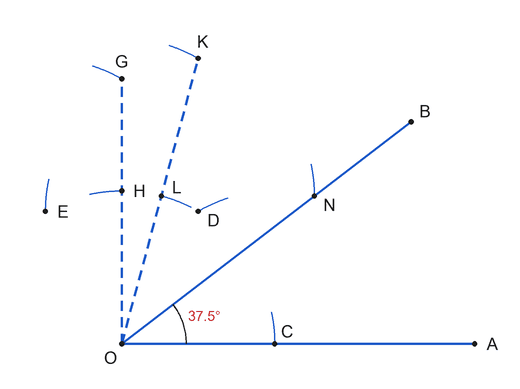
Watch out: The last bisection uses C and L (the 0° and 75° points), not D and L.
Therefore, ∠AOB = 37.5° is the required angle.
- 83 marks
Question 8
Using ruler and compasses, construct the following angles :
(viii) 67·5°
Solve with AIWritten solution
Solution:
Concept: Angles are built with compasses from 60°. If the compasses keep one opening, the vertex and two cut points on an arc form an equilateral triangle, so the angle at the vertex is 60°. Bisecting an angle (arcs of equal radius from two points equally far from the vertex) halves it, and two angles side by side add up. Here 67.5° = 45° + 22.5°: it lies half-way between 45° and 90°, so we construct 90° and 45° and bisect the angle between them.
Given: The angle to be constructed; a ruler and a pair of compasses only.
Step 1 — Draw the arm.
Draw a ray OA. O will be the vertex of the angle.
Step 2 — Draw the first arc.
With O as centre and any convenient radius, draw a large arc cutting OA at C.
Step 3 — Mark the 60° and 120° points.
With C as centre and the SAME radius, cut the arc at D. Now OC, OD and CD are all equal to the radius, so triangle OCD is equilateral and ∠DOC = 60°. We do not need to join OD. With D as centre and the same radius, cut the arc again at E. This is a second step of 60°, so ∠EOA = 120°.
Step 4 — Construct 90°.
With D and E as centres and the same radius, draw arcs meeting at G. Join OG. Since G is equally far from D and E, and OD = OE, the line OG divides the angle DOE into two equal parts. So ∠GOA = 90°. Draw OG as a dashed line and let it cut the first arc at H.
Step 5 — Construct 45°.
With C and H as centres and the same radius, draw arcs meeting at K. Join OK. Since K is equally far from C and H, and OC = OH, the line OK divides the angle COH into two equal parts. So ∠KOA = 45°. Draw OK as a dashed line and let it cut the first arc at L.
Step 6 — Bisect the angle between 45° and 90°.
With L and H as centres and the same radius, draw arcs meeting at N. Join ON and produce it to B. Since N is equally far from L and H, and OL = OH, the line ON divides the angle LOH into two equal parts.
Step 7 — Work out the angle.
The angle LOH is the 45° between 45° and 90°, and OB takes half of it on top of the 45°.
Step 8 — Look at the finished figure and check it.
The finished construction is shown below, with the given measurements marked on it.

The 67.5° arc is broken only where the dashed line OK passes through it.
Watch out: Bisect the angle LOH (between 45° and 90°); bisecting the angle LOA instead gives 22.5°.
Therefore, ∠AOB = 67.5° is the required angle.
- 93 marks
Question 9
Draw ∠ ABC = 120°. Bisect the angle using ruler and compasses only. Measure each angle so obtained and check whether the angles obtained on bisecting ∠ ABC are equal or not.
Solve with AIWritten solution
Solution:
Concept: 120° is made by stepping two 60° arcs along one arc. To bisect an angle, draw an arc about its vertex cutting both arms, then draw arcs of equal radius from the two cut points. The meeting point is equally far from both cut points, so the line from the vertex through it divides the angle into two equal parts.
Given: ∠ABC = 120°; a ruler and a pair of compasses only.
Step 1 — Draw the arm.
Draw a ray BC. B will be the vertex.
Step 2 — Construct 120°.
With B as centre and any convenient radius, draw a large arc cutting BC at S. With S as centre and the same radius, cut the arc at T, and with T as centre cut it again at U. Each step turns through 60°, so ∠UBC = 120°. Join BU and produce it to A, so ∠ABC = 120°.
Step 3 — Bisect ∠ABC.
The first arc cuts BC at S and BA at U. With S and U as centres and the same radius (more than half of SU), draw arcs meeting at W inside the angle. Join BW and produce it to D. W is equally far from S and U, so BD divides ∠ABC into two equal parts.
Step 4 — Measure the two parts.
Place the protractor at B with its base line along BC and read ∠DBC; then put it along BD and read ∠ABD. Both readings are 60°.
Step 5 — Look at the finished figure and check it.
The finished construction is shown below, with the given measurements marked on it.

Notice that BD passes through T, the 60° point, as it should.
Watch out: Measure each part from its own arms: ∠ABD between BA and BD, and ∠DBC between BD and BC.
Therefore, ∠ABD = 60° and ∠DBC = 60°, so the two angles obtained on bisecting ∠ABC are equal (each is half of 120°).
- 103 marks
Question 10
Draw a line segment PQ = 6 cm. Mark a point A in PQ so that AP = 2 cm. At point A, construct angle QAR = 60°.
Solve with AIWritten solution
Solution:
Concept: A point at a given distance along a line is cut off with the compasses. If the compasses keep one opening, the vertex and two cut points on an arc form an equilateral triangle, so the angle at the vertex is 60°.
Given: PQ = 6 cm, AP = 2 cm and ∠QAR = 60°; a ruler and a pair of compasses only.
Step 1 — Draw PQ.
Draw a line segment PQ = 6 cm with the ruler.
Step 2 — Mark A.
Open the compasses to 2 cm on the ruler. With P as centre, cut PQ at A. Then AP = 2 cm and AQ = 4 cm (that is, 6 cm − 2 cm).
Step 3 — Construct 60° at A on the arm AQ.
With A as centre and any convenient radius, draw an arc cutting AQ at S. With S as centre and the same radius, cut the arc at T. Join AT and produce it to R. Triangle AST is equilateral, so ∠QAR = 60°.
Step 4 — Look at the finished figure and check it.
The finished construction is shown below, with the given measurements marked on it.

Watch out: The angle is ∠QAR, so it must open from the arm AQ (towards Q), not from AP.
Therefore, ∠QAR = 60° is the required angle, with AP = 2 cm marked on the 6 cm segment PQ.
- 113 marks
Question 11
Draw a line segment AB = 8 cm. Mark a point P in AB so that AP = 5 cm. At P, construct angle APQ = 30°.
Solve with AIWritten solution
Solution:
Concept: ∠APQ is measured from the arm PA, so the construction is made on PA. 30° is half of 60°: construct 60° and bisect it.
Given: AB = 8 cm, AP = 5 cm and ∠APQ = 30°; a ruler and a pair of compasses only.
Step 1 — Draw AB.
Draw a line segment AB = 8 cm.
Step 2 — Mark P.
With A as centre and radius 5 cm, cut AB at P. Then AP = 5 cm and PB = 3 cm (that is, 8 cm − 5 cm).
Step 3 — Construct 60° on the arm PA.
With P as centre and any convenient radius, draw an arc cutting PA at S. With S as centre and the same radius, cut the arc at T. Triangle PST is equilateral, so ∠TPA = 60°.
Step 4 — Bisect the 60° angle.
With S and T as centres and the same radius, draw arcs meeting at W. Join PW and produce it to Q. Since W is equally far from S and T, and PS = PT, the line PW divides the angle SPT into two equal parts.
Step 5 — Work out the angle.
PQ halves the 60° angle TPA.
Step 6 — Look at the finished figure and check it.
The finished construction is shown below, with the given measurements marked on it.
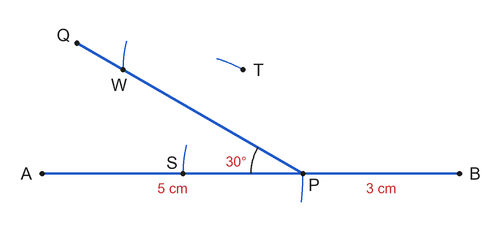
Watch out: ∠APQ opens from PA (towards A); drawing it from PB gives ∠BPQ = 30° instead.
Therefore, ∠APQ = 30° is the required angle, with AP = 5 cm marked on the 8 cm segment AB.
- 123 marks
Question 12
Construct an angle of 75° and then bisect it.
Solve with AIWritten solution
Solution:
Concept: Angles are built with compasses from 60°. If the compasses keep one opening, the vertex and two cut points on an arc form an equilateral triangle, so the angle at the vertex is 60°. Bisecting an angle (arcs of equal radius from two points equally far from the vertex) halves it, and two angles side by side add up. Here 75° = 60° + 15°: it lies half-way between 60° and 90°, so we mark 60°, construct 90°, and bisect the angle between them. Then the 75° angle is bisected in the usual way.
Given: The angle to be constructed; a ruler and a pair of compasses only.
Step 1 — Draw the arm.
Draw a ray OA. O will be the vertex of the angle.
Step 2 — Draw the first arc.
With O as centre and any convenient radius, draw a large arc cutting OA at C.
Step 3 — Mark the 60° and 120° points.
With C as centre and the SAME radius, cut the arc at D. Now OC, OD and CD are all equal to the radius, so triangle OCD is equilateral and ∠DOC = 60°. We do not need to join OD. With D as centre and the same radius, cut the arc again at E. This is a second step of 60°, so ∠EOA = 120°.
Step 4 — Construct 90°.
With D and E as centres and the same radius, draw arcs meeting at G. Join OG. Since G is equally far from D and E, and OD = OE, the line OG divides the angle DOE into two equal parts. So ∠GOA = 90°. Draw OG as a dashed line and let it cut the first arc at H.
Step 5 — Construct 75°.
With D and H as centres and the same radius, draw arcs meeting at K. Join OK and produce it to B. Since K is equally far from D and H, and OD = OH, the line OK divides the angle DOH into two equal parts. So ∠AOB = 75° (60° plus half of 30°).
Step 6 — Bisect ∠AOB.
The first arc cuts OA at C and OB at L. With C and L as centres and the same radius, draw arcs meeting at M. Join OM and produce it to N. Since M is equally far from C and L, and OC = OL, the line OM divides the angle COL into two equal parts.
Step 7 — Work out each part.
ON divides the 75° angle into two equal parts.
Step 8 — Look at the finished figure and check it.
The finished construction is shown below, with the given measurements marked on it.
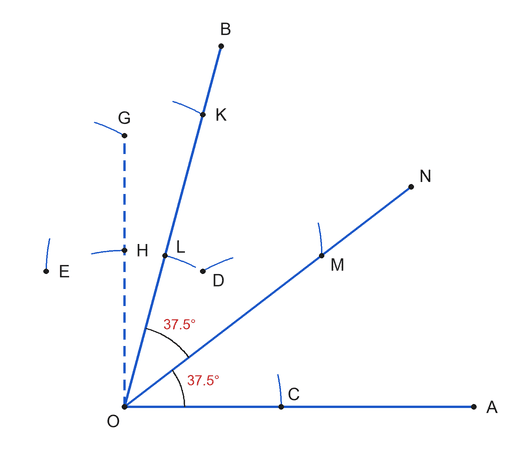
Both parts, ∠AON and ∠NOB, are marked 37.5° in the figure.
Watch out: When bisecting, use the SAME radius from both cut points; unequal arcs meet at a point that is not on the bisector.
Therefore, ON bisects the 75° angle AOB, so ∠AON and ∠NOB are each 37.5°.
- 133 marks
Question 13
Draw a line segment of length 6·4 cm. Draw its perpendicular bisector.
Solve with AIWritten solution
Solution:
Concept: Every point of the perpendicular bisector of AB is equally far from A and B. So two arcs of the same radius drawn from A and from B cross on it, and the line through the two crossing points is the perpendicular bisector.
Given: AB = 6.4 cm; a ruler and a pair of compasses only.
Step 1 — Draw AB.
Draw a line segment AB = 6.4 cm.
Step 2 — Draw equal arcs from A and B.
With A as centre and a radius more than half of AB (more than 3.2 cm), draw arcs above and below AB. With B as centre and the SAME radius, draw arcs cutting them at C and D.
Step 3 — Join CD.
Join CD, cutting AB at P. C and D are each equally far from A and B, so CD is the perpendicular bisector of AB.
Step 4 — Look at the finished figure and check it.
The finished construction is shown below, with the given measurements marked on it.
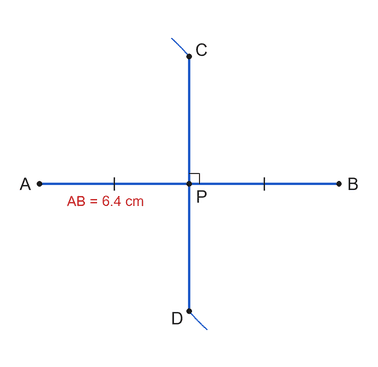
On measuring, AP and PB are each 3.2 cm, and ∠APC = 90°.
Watch out: The radius must be MORE than half of AB; with a smaller radius the arcs from A and B do not meet.
Therefore, CD is the perpendicular bisector of AB: AP and PB are each 3.2 cm, and ∠APC = 90°.
- 143 marks
Question 14
Draw a line segment AB = 5·8 cm. Mark a point P in AB such that PB = 3·6 cm. At P, draw perpendicular to AB.
Solve with AIWritten solution
Solution:
Concept: A perpendicular at a point P on a line is the perpendicular bisector of a short piece XY of the line with P as its mid-point: arcs of equal radius from X and Y meet on the line through P at right angles to AB.
Given: AB = 5.8 cm and PB = 3.6 cm; a ruler and a pair of compasses only.
Step 1 — Draw AB.
Draw a line segment AB = 5.8 cm.
Step 2 — Mark P.
With B as centre and radius 3.6 cm, cut AB at P.
Step 3 — Mark X and Y.
With P as centre and a small radius, draw arcs cutting AB at X and Y, one on each side of P. Then PX = PY.
Step 4 — Draw arcs from X and Y.
With X and Y as centres and a larger equal radius, draw arcs meeting at Q above AB.
Step 5 — Join PQ.
Join PQ. Q is equally far from X and Y, and P is the mid-point of XY, so PQ is perpendicular to AB.
Step 6 — Look at the finished figure and check it.
The finished construction is shown below, with the given measurements marked on it.
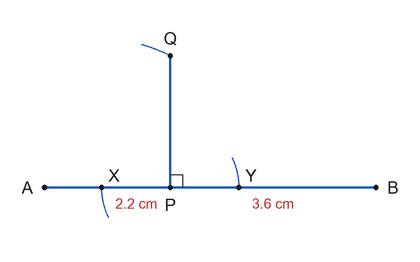
Watch out: The arcs from X and Y must have a radius larger than PX, or they will not meet.
Therefore, PQ is the required perpendicular to AB at P, so ∠QPB = 90°.
- 153 marks
Question 15
In each case, given below, draw a line through point P and parallel to AB :
(i)
 Solve with AI
Written solution
Solution:
Concept: When a line PQ cuts two lines, the angles on opposite sides of PQ and between the two lines are alternate angles. If a pair of alternate angles is equal, the two lines are parallel. So we copy the angle at Q to P, on the other side of PQ.
Given: The line AB and the point P shown in the figure; a ruler and a pair of compasses only.
Step 1 — Join P to a point of AB.
Mark any point Q on AB and join PQ (dashed in the figure).
Step 2 — Draw an arc at Q.
With Q as centre and a convenient radius, draw an arc cutting QP and QB. It marks the angle PQB.
Step 3 — Draw the same arc at P.
With P as centre and the SAME radius, draw an arc cutting PQ, on the side of PQ opposite to B.
Step 4 — Copy the opening.
Take in the compasses the distance between the two cut points of the arc at Q. With the point where the arc at P cuts PQ as centre, cut the arc at P at R.
Step 5 — Draw the line.
Join PR and produce it both ways to S and T. Equal radii and equal chords give equal angles, so ∠QPR = ∠PQB, and these are alternate angles.
Step 6 — Look at the finished figure and check it.
The finished construction is shown below, drawn for the line AB and the point P of the question.
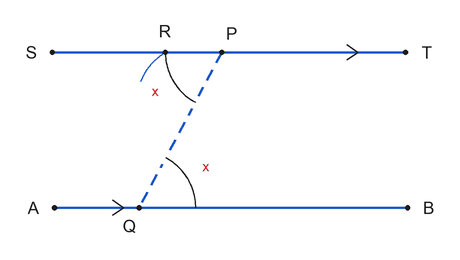
The two angles marked x are equal alternate angles, and the arrow marks show ST ∥ AB.
Watch out: Copy the angle on the OTHER side of PQ; an equal angle on the same side makes the lines meet.
Therefore, ST is the required line through P parallel to AB (∠QPR = ∠PQB, alternate angles).
- 163 marks
Question 16
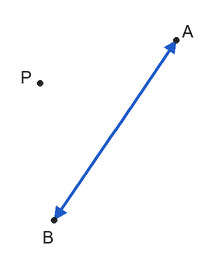
In each case, given below, draw a line through point P and parallel to AB :
(ii)
 Solve with AI
Written solution
Solution:
Concept: When a line PQ cuts two lines, the angles on opposite sides of PQ and between the two lines are alternate angles. If a pair of alternate angles is equal, the two lines are parallel. So we copy the angle at Q to P, on the other side of PQ.
Given: The line AB and the point P shown in the figure; a ruler and a pair of compasses only.
Step 1 — Join P to a point of AB.
Mark any point Q on AB and join PQ (dashed in the figure).
Step 2 — Draw an arc at Q.
With Q as centre and a convenient radius, draw an arc cutting QP and QA. It marks the angle PQA.
Step 3 — Draw the same arc at P.
With P as centre and the SAME radius, draw an arc cutting PQ, on the side of PQ opposite to A.
Step 4 — Copy the opening.
Take in the compasses the distance between the two cut points of the arc at Q. With the point where the arc at P cuts PQ as centre, cut the arc at P at R.
Step 5 — Draw the line.
Join PR and produce it both ways to S and T. Equal radii and equal chords give equal angles, so ∠QPR = ∠PQA, and these are alternate angles.
Step 6 — Look at the finished figure and check it.
The finished construction is shown below, drawn for the line AB and the point P of the question.
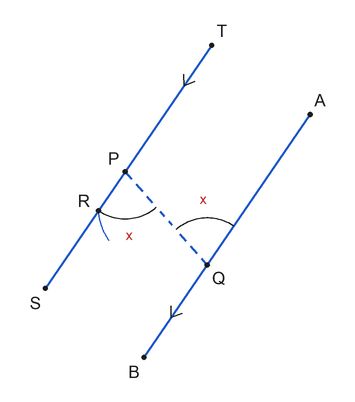
The two angles marked x are equal alternate angles, and the arrow marks show ST ∥ AB.
Watch out: Copy the angle on the OTHER side of PQ; an equal angle on the same side makes the lines meet.
Therefore, ST is the required line through P parallel to AB (∠QPR = ∠PQA, alternate angles).
- 173 marks
Question 17
In each case, given below, draw a line through point P and parallel to AB :
(iii)
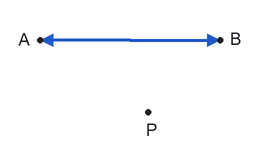 Solve with AI
Written solution
Solution:
Concept: When a line PQ cuts two lines, the angles on opposite sides of PQ and between the two lines are alternate angles. If a pair of alternate angles is equal, the two lines are parallel. So we copy the angle at Q to P, on the other side of PQ.
Given: The line AB and the point P shown in the figure; a ruler and a pair of compasses only.
Step 1 — Join P to a point of AB.
Mark any point Q on AB and join PQ (dashed in the figure).
Step 2 — Draw an arc at Q.
With Q as centre and a convenient radius, draw an arc cutting QP and QB. It marks the angle PQB.
Step 3 — Draw the same arc at P.
With P as centre and the SAME radius, draw an arc cutting PQ, on the side of PQ opposite to B.
Step 4 — Copy the opening.
Take in the compasses the distance between the two cut points of the arc at Q. With the point where the arc at P cuts PQ as centre, cut the arc at P at R.
Step 5 — Draw the line.
Join PR and produce it both ways to S and T. Equal radii and equal chords give equal angles, so ∠QPR = ∠PQB, and these are alternate angles.
Step 6 — Look at the finished figure and check it.
The finished construction is shown below, drawn for the line AB and the point P of the question.
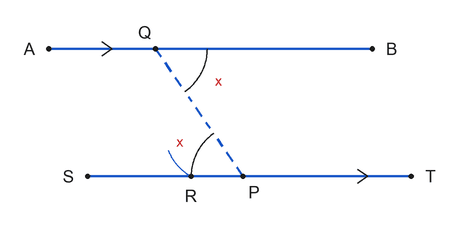
The two angles marked x are equal alternate angles, and the arrow marks show ST ∥ AB.
Watch out: Copy the angle on the OTHER side of PQ; an equal angle on the same side makes the lines meet.
Therefore, ST is the required line through P parallel to AB (∠QPR = ∠PQB, alternate angles).
- 183 marks
Question 18
Construct a Δ ABC such that :
(i) AB = 6 cm, BC = 4 cm and CA = 5·5 cm
Solve with AIWritten solution
Solution:
Concept: A triangle is fixed when its three sides are known. We draw one side as the base; the third vertex is where an arc from one end, with the second side as radius, meets an arc from the other end, with the third side as radius.
Given: AB = 6 cm, BC = 4 cm and CA = 5.5 cm; a ruler and a pair of compasses only.
Step 1 — Draw the base.
Draw AB = 6 cm with the ruler.
Step 2 — Draw the first arc.
With A as centre and radius 5.5 cm, draw an arc above AB.
Step 3 — Draw the second arc.
With B as centre and radius 4 cm, draw an arc cutting the first arc at C. C is 5.5 cm from A and 4 cm from B.
Step 4 — Join the sides.
Join CA and CB.
Step 5 — Look at the finished figure and check it.
The finished construction is shown below, with the given measurements marked on it.

Watch out: Draw both arcs on the same side of the base; arcs on opposite sides never meet.
Therefore, ΔABC is the required triangle.
- 193 marks
Question 19
Construct a Δ ABC such that :
(ii) CB = 6·5 cm, CA = 4·2 cm and BA = 5·1 cm
Solve with AIWritten solution
Solution:
Concept: A triangle is fixed when its three sides are known. We draw one side as the base; the third vertex is where an arc from one end, with the second side as radius, meets an arc from the other end, with the third side as radius.
Given: CB = 6.5 cm, CA = 4.2 cm and BA = 5.1 cm; a ruler and a pair of compasses only.
Step 1 — Draw the base.
Draw BC = 6.5 cm with the ruler.
Step 2 — Draw the first arc.
With B as centre and radius 5.1 cm, draw an arc above BC.
Step 3 — Draw the second arc.
With C as centre and radius 4.2 cm, draw an arc cutting the first arc at A. A is 5.1 cm from B and 4.2 cm from C.
Step 4 — Join the sides.
Join AB and AC.
Step 5 — Look at the finished figure and check it.
The finished construction is shown below, with the given measurements marked on it.

Watch out: Draw both arcs on the same side of the base; arcs on opposite sides never meet.
Therefore, ΔABC is the required triangle.
- 203 marks
Question 20
Construct a Δ ABC such that :
(iii) BC = 4 cm, AC = 5 cm and AB = 3·5 cm
Solve with AIWritten solution
Solution:
Concept: A triangle is fixed when its three sides are known. We draw one side as the base; the third vertex is where an arc from one end, with the second side as radius, meets an arc from the other end, with the third side as radius.
Given: BC = 4 cm, AC = 5 cm and AB = 3.5 cm; a ruler and a pair of compasses only.
Step 1 — Draw the base.
Draw BC = 4 cm with the ruler.
Step 2 — Draw the first arc.
With B as centre and radius 3.5 cm, draw an arc above BC.
Step 3 — Draw the second arc.
With C as centre and radius 5 cm, draw an arc cutting the first arc at A. A is 3.5 cm from B and 5 cm from C.
Step 4 — Join the sides.
Join AB and AC.
Step 5 — Look at the finished figure and check it.
The finished construction is shown below, with the given measurements marked on it.

Watch out: Draw both arcs on the same side of the base; arcs on opposite sides never meet.
Therefore, ΔABC is the required triangle.
- 213 marks
Question 21
Construct a Δ ABC such that :
(i) AB = 7 cm, BC = 5 cm and ∠ ABC = 60°
Solve with AIWritten solution
Solution:
Concept: When two sides and the angle between them are known, we draw one side, construct the angle at its end, and cut off the other side on the new arm with the compasses. Joining the two free ends completes the triangle.
Given: AB = 7 cm, BC = 5 cm and ∠ABC = 60°; a ruler and a pair of compasses only.
Step 1 — Draw the first side.
Draw BC = 5 cm.
Step 2 — Construct 60° at B.
With B as centre and any convenient radius, draw an arc cutting BC. With that cut point as centre and the same radius, cut the arc again, and draw a ray from B through this second point. B and the two cut points form an equilateral triangle, so the ray makes 60° with BC.
Step 3 — Cut off the second side.
With B as centre and radius 7 cm, cut the new ray at A. So BA = 7 cm.
Step 4 — Complete the triangle.
Join AC.
Step 5 — Look at the finished figure and check it.
The finished construction is shown below, with the given measurements marked on it.

Watch out: The given angle is the angle BETWEEN the two given sides, so construct it at their common vertex.
Therefore, ΔABC is the required triangle.
- 223 marks
Question 22
Construct a Δ ABC such that :
(ii) BC = 6 cm, AC = 5·7 cm and ∠ ACB = 75°
Solve with AIWritten solution
Solution:
Concept: When two sides and the angle between them are known, we draw one side, construct the angle at its end, and cut off the other side on the new arm with the compasses. Joining the two free ends completes the triangle. 75° is built with compasses from 60°.
Given: BC = 6 cm, AC = 5.7 cm and ∠ACB = 75°; a ruler and a pair of compasses only.
Step 1 — Draw the first side.
Draw CB = 6 cm.
Step 2 — Construct 75° at C.
At C, mark the 60° point and draw the 90° ray as described above (one arc about C, two equal steps along it, then a bisector). Bisect the angle between the 60° point and the 90° ray, using the 60° point and the point where the arc cuts the 90° ray. The bisector lies half-way between 60° and 90°, so it makes 60° + 15° = 75° with CB.
Step 3 — Cut off the second side.
With C as centre and radius 5.7 cm, cut the new ray at A. So CA = 5.7 cm.
Step 4 — Complete the triangle.
Join AB.
Step 5 — Look at the finished figure and check it.
The finished construction is shown below, with the given measurements marked on it.
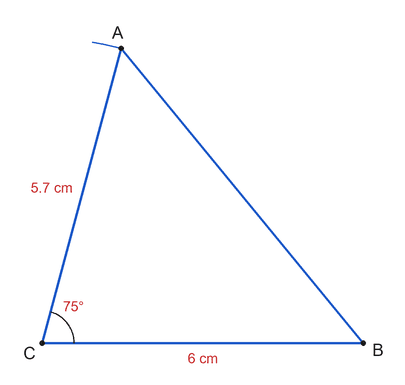
Watch out: The given angle is the angle BETWEEN the two given sides, so construct it at their common vertex.
Therefore, ΔABC is the required triangle.
- 233 marks
Question 23
Construct a Δ ABC such that :
(iii) AB = 6·5 cm, AC = 5·8 cm and ∠ A = 45°
Solve with AIWritten solution
Solution:
Concept: When two sides and the angle between them are known, we draw one side, construct the angle at its end, and cut off the other side on the new arm with the compasses. Joining the two free ends completes the triangle. 45° is built with compasses from 60°.
Given: AB = 6.5 cm, AC = 5.8 cm and ∠A = 45°; a ruler and a pair of compasses only.
Step 1 — Draw the first side.
Draw AB = 6.5 cm.
Step 2 — Construct 45° at A.
With A as centre draw an arc cutting AB; keeping the same radius, step off two equal arcs along it to mark the 60° and the 120° points. With these two points as centres and equal radii, draw arcs meeting outside the first arc, and draw a ray from A through the meeting point. It bisects the angle between 60° and 120°, so it makes 90° with AB. Now bisect this right angle, using the points where the first arc cuts AB and the 90° ray. The bisector makes 90° ÷ 2 = 45° with AB.
Step 3 — Cut off the second side.
With A as centre and radius 5.8 cm, cut the new ray at C. So AC = 5.8 cm.
Step 4 — Complete the triangle.
Join CB.
Step 5 — Look at the finished figure and check it.
The finished construction is shown below, with the given measurements marked on it.
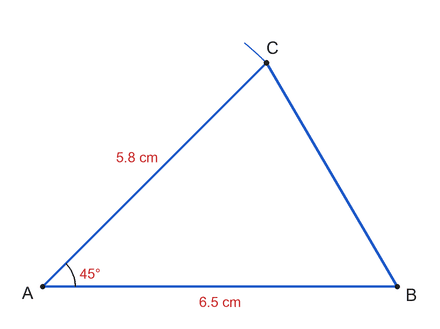
Watch out: The given angle is the angle BETWEEN the two given sides, so construct it at their common vertex.
Therefore, ΔABC is the required triangle.
- 243 marks
Question 24
Construct a Δ PQR such that :
(i) PQ = 6 cm, ∠ Q = 60° and ∠ P = 45°. Measure ∠ R.
Solve with AIWritten solution
Solution:
Concept: When two angles and the side between them are known, we draw the side and construct the two angles at its ends, on the same side of it. The two new arms meet at the third vertex. The angles of a triangle add up to 180°, so the third angle can be checked by calculation.
Given: PQ = 6 cm, ∠Q = 60° and ∠P = 45°; a ruler and a pair of compasses only.
Step 1 — Draw the given side.
Draw PQ = 6 cm.
Step 2 — Construct 45° at P.
With P as centre draw an arc cutting PQ; keeping the same radius, step off two equal arcs along it to mark the 60° and the 120° points. With these two points as centres and equal radii, draw arcs meeting outside the first arc, and draw a ray from P through the meeting point. It bisects the angle between 60° and 120°, so it makes 90° with PQ. Now bisect this right angle, using the points where the first arc cuts PQ and the 90° ray. The bisector makes 90° ÷ 2 = 45° with PQ.
Step 3 — Construct 60° at Q.
On the SAME side of PQ, with Q as centre and any convenient radius, draw an arc cutting QP. With that cut point as centre and the same radius, cut the arc again, and draw a ray from Q through this second point. Q and the two cut points form an equilateral triangle, so the ray makes 60° with QP.
Step 4 — Mark the third vertex.
The two new rays meet at R. ΔPQR is the required triangle.
Step 5 — Measure ∠R and check it.
With the protractor at R, the angle between RP and RQ reads 75°. The angles of the triangle add up to 180°, so we can check this.
Step 6 — Look at the finished figure and check it.
The finished construction is shown below, with the given measurements marked on it.
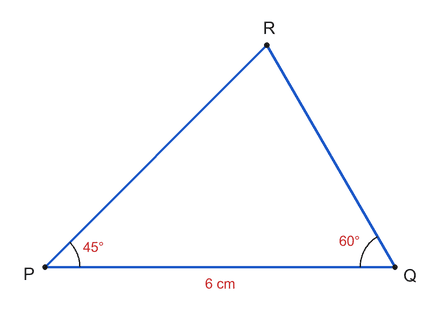
Watch out: Construct the angles on the SAME side of the base, or the arms never meet.
Therefore, on measuring, ∠R = 75°.
- 253 marks
Question 25
Construct a Δ PQR such that :
(ii) QR = 4·4 cm, ∠ R = 30° and ∠ Q = 75°. Measure PQ and PR.
Solve with AIWritten solution
Solution:
Concept: When two angles and the side between them are known, we draw the side and construct the two angles at its ends, on the same side of it. The two new arms meet at the third vertex. The angles of a triangle add up to 180°, so the third angle can be checked by calculation.
Given: QR = 4.4 cm, ∠R = 30° and ∠Q = 75°; a ruler and a pair of compasses only.
Step 1 — Draw the given side.
Draw RQ = 4.4 cm.
Step 2 — Construct 30° at R.
With R as centre and any convenient radius, draw an arc cutting RQ. With that cut point as centre and the same radius, cut the arc again, and draw a ray from R through this second point. R and the two cut points form an equilateral triangle, so the ray makes 60° with RQ. Now bisect this 60° angle: with the two cut points as centres and equal radii, draw arcs meeting inside the angle, and draw a ray from R through the meeting point. It makes 60° ÷ 2 = 30° with RQ.
Step 3 — Construct 75° at Q.
On the SAME side of RQ, at Q, mark the 60° point and draw the 90° ray as described above (one arc about Q, two equal steps along it, then a bisector). Bisect the angle between the 60° point and the 90° ray, using the 60° point and the point where the arc cuts the 90° ray. The bisector lies half-way between 60° and 90°, so it makes 60° + 15° = 75° with QR.
Step 4 — Mark the third vertex.
The two new rays meet at P. ΔPQR is the required triangle.
Step 5 — Find ∠P to check the lengths.
We work out the third angle first; it tells us which sides should be equal.
Step 6 — Measure PQ and PR.
With the ruler, PQ measures about 2.3 cm and PR measures 4.4 cm. ∠P and ∠Q are both 75°, so the sides opposite them are equal: PR (opposite ∠Q) is as long as QR (opposite ∠P), 4.4 cm, which agrees with the measurement. PQ is opposite the smallest angle, 30°, so it is the shortest side.
Step 7 — Look at the finished figure and check it.
The finished construction is shown below, with the given measurements marked on it.

Watch out: Construct the angles on the SAME side of the base, or the arms never meet.
Therefore, on measuring, PQ ≈ 2.3 cm and PR = 4.4 cm.
- 263 marks
Question 26
Construct a Δ PQR such that :
(iii) PR = 5·8 cm, ∠ P = 60° and ∠ R = 45°. Measure ∠ Q and verify it by calculations.
Solve with AIWritten solution
Solution:
Concept: When two angles and the side between them are known, we draw the side and construct the two angles at its ends, on the same side of it. The two new arms meet at the third vertex. The angles of a triangle add up to 180°, so the third angle can be checked by calculation.
Given: PR = 5.8 cm, ∠P = 60° and ∠R = 45°; a ruler and a pair of compasses only.
Step 1 — Draw the given side.
Draw PR = 5.8 cm.
Step 2 — Construct 60° at P.
With P as centre and any convenient radius, draw an arc cutting PR. With that cut point as centre and the same radius, cut the arc again, and draw a ray from P through this second point. P and the two cut points form an equilateral triangle, so the ray makes 60° with PR.
Step 3 — Construct 45° at R.
On the SAME side of PR, with R as centre draw an arc cutting RP; keeping the same radius, step off two equal arcs along it to mark the 60° and the 120° points. With these two points as centres and equal radii, draw arcs meeting outside the first arc, and draw a ray from R through the meeting point. It bisects the angle between 60° and 120°, so it makes 90° with RP. Now bisect this right angle, using the points where the first arc cuts RP and the 90° ray. The bisector makes 90° ÷ 2 = 45° with RP.
Step 4 — Mark the third vertex.
The two new rays meet at Q. ΔPQR is the required triangle.
Step 5 — Measure ∠Q and verify it by calculation.
With the protractor at Q, the angle between QP and QR reads 75°. The angles of a triangle add up to 180°, so the calculation must give the same value.
Step 6 — Look at the finished figure and check it.
The finished construction is shown below, with the given measurements marked on it.
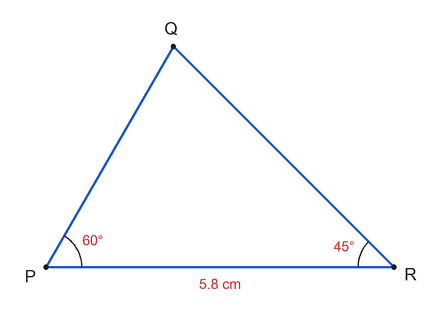
Watch out: Construct the angles on the SAME side of the base, or the arms never meet.
Therefore, on measuring, ∠Q = 75°, and the calculation 180° − (60° + 45°) = 75° verifies it.
- 273 marks
Question 27
Construct an isosceles Δ ABC such that :
(i) base BC = 4 cm and base angle = 30°
Solve with AIWritten solution
Solution:
Concept: In an isosceles triangle the angles opposite the equal sides (the base angles) are equal. So we construct the given base angle at BOTH ends of the base; the two arms meet at the vertex. The angles of a triangle add up to 180°.
Given: Base BC = 4 cm and base angles = 30°; a ruler and a pair of compasses only.
Step 1 — Draw the base.
Draw the base BC = 4 cm.
Step 2 — Construct 30° at B.
With B as centre and any convenient radius, draw an arc cutting BC. With that cut point as centre and the same radius, cut the arc again, and draw a ray from B through this second point. B and the two cut points form an equilateral triangle, so the ray makes 60° with BC. Now bisect this 60° angle: with the two cut points as centres and equal radii, draw arcs meeting inside the angle, and draw a ray from B through the meeting point. It makes 60° ÷ 2 = 30° with BC.
Step 3 — Construct 30° at C.
On the SAME side of BC, construct 30° at C in the same way, measured from CB.
Step 4 — Mark the vertex.
The two rays meet at A. The base angles are equal, so AB = AC.
Step 5 — Look at the finished figure and check it.
The finished construction is shown below, with the given measurements marked on it.
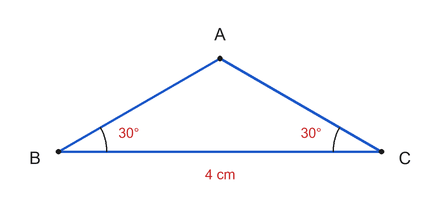
Watch out: Construct the angles on the SAME side of the base, or the arms never meet.
Therefore, ΔABC is the required isosceles triangle (AB = AC).
- 283 marks
Question 28
Construct an isosceles Δ ABC such that :
(ii) base AB = 6·2 cm and base angle = 45°
Solve with AIWritten solution
Solution:
Concept: In an isosceles triangle the angles opposite the equal sides (the base angles) are equal. So we construct the given base angle at BOTH ends of the base; the two arms meet at the vertex. The angles of a triangle add up to 180°.
Given: Base AB = 6.2 cm and base angles = 45°; a ruler and a pair of compasses only.
Step 1 — Draw the base.
Draw the base AB = 6.2 cm.
Step 2 — Construct 45° at A.
With A as centre draw an arc cutting AB; keeping the same radius, step off two equal arcs along it to mark the 60° and the 120° points. With these two points as centres and equal radii, draw arcs meeting outside the first arc, and draw a ray from A through the meeting point. It bisects the angle between 60° and 120°, so it makes 90° with AB. Now bisect this right angle, using the points where the first arc cuts AB and the 90° ray. The bisector makes 90° ÷ 2 = 45° with AB.
Step 3 — Construct 45° at B.
On the SAME side of AB, construct 45° at B in the same way, measured from BA.
Step 4 — Mark the vertex.
The two rays meet at C. The base angles are equal, so CA = CB.
Step 5 — Look at the finished figure and check it.
The finished construction is shown below, with the given measurements marked on it.
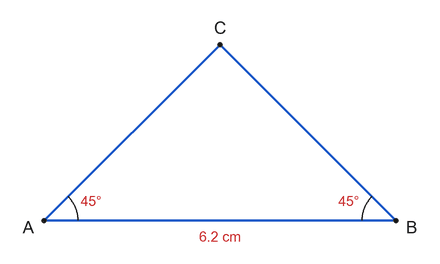
Watch out: Construct the angles on the SAME side of the base, or the arms never meet.
Therefore, ΔABC is the required isosceles triangle (CA = CB).
- 293 marks
Question 29
Construct an isosceles Δ ABC such that :
(iii) base AC = 5 cm and base angle = 75°. Measure the other two sides of the triangle.
Solve with AIWritten solution
Solution:
Concept: In an isosceles triangle the angles opposite the equal sides (the base angles) are equal. So we construct the given base angle at BOTH ends of the base; the two arms meet at the vertex. The angles of a triangle add up to 180°.
Given: Base AC = 5 cm and base angles = 75°; a ruler and a pair of compasses only.
Step 1 — Draw the base.
Draw the base AC = 5 cm.
Step 2 — Construct 75° at A.
At A, mark the 60° point and draw the 90° ray as described above (one arc about A, two equal steps along it, then a bisector). Bisect the angle between the 60° point and the 90° ray, using the 60° point and the point where the arc cuts the 90° ray. The bisector lies half-way between 60° and 90°, so it makes 60° + 15° = 75° with AC.
Step 3 — Construct 75° at C.
On the SAME side of AC, construct 75° at C in the same way, measured from CA.
Step 4 — Mark the vertex.
The two rays meet at B. The base angles are equal, so BA = BC.
Step 5 — Measure the other two sides.
With the ruler, AB and BC each measure about 9.7 cm. They are equal because the base angles are equal, and they are long because 75° base angles make a tall, narrow triangle (the vertex angle is only 180° − 150° = 30°).
Step 6 — Look at the finished figure and check it.
The finished construction is shown below, with the given measurements marked on it.
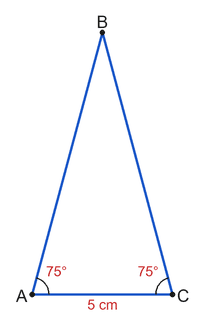
Watch out: Construct the angles on the SAME side of the base, or the arms never meet.
Note: A printed answer of 9.6 cm is the same length cut short; to one decimal place the length is 9.7 cm (more exactly 9.66 cm). A measured length can differ by 0.1 cm.
Therefore, on measuring, AB = BC ≈ 9.7 cm.
- 303 marks
Question 30
Construct an isosceles Δ ABC such that :
(i) AB = AC = 6·5 cm and ∠ A = 60°
Solve with AIWritten solution
Solution:
Concept: When two sides and the angle between them are known, we draw one side, construct the angle at its end, and cut off the other side on the new arm with the compasses. Joining the two free ends completes the triangle. In an isosceles triangle the base angles (opposite the equal sides) are equal, and the angles of a triangle add up to 180°.
Given: AB = 6.5 cm, AC = 6.5 cm and ∠A = 60°; a ruler and a pair of compasses only.
Step 1 — Draw one equal side.
Draw AB = 6.5 cm.
Step 2 — Construct 60° at A.
With A as centre and any convenient radius, draw an arc cutting AB. With that cut point as centre and the same radius, cut the arc again, and draw a ray from A through this second point. A and the two cut points form an equilateral triangle, so the ray makes 60° with AB.
Step 3 — Cut off the other equal side.
With A as centre and radius 6.5 cm, cut the new ray at C. Now AB and AC are both 6.5 cm.
Step 4 — Complete the triangle.
Join BC.
Step 5 — Look at the base angles.
The base angles are equal, and together they make the rest of 180°.
All three angles are 60°, so the triangle is equilateral and BC = 6.5 cm as well.
Step 6 — Look at the finished figure and check it.
The finished construction is shown below, with the given measurements marked on it.

Watch out: The given angle is the VERTEX angle between the equal sides; do not construct it at the base.
Therefore, ΔABC is the required triangle; it is in fact equilateral, with BC = 6.5 cm.
- 313 marks
Question 31
Construct an isosceles Δ ABC such that :
(ii) One of the equal sides = 6 cm and vertex angle = 45°. Measure the base angles.
Solve with AIWritten solution
Solution:
Concept: When two sides and the angle between them are known, we draw one side, construct the angle at its end, and cut off the other side on the new arm with the compasses. Joining the two free ends completes the triangle. In an isosceles triangle the base angles (opposite the equal sides) are equal, and the angles of a triangle add up to 180°.
Given: One of the equal sides = 6 cm and the vertex angle = 45°; a ruler and a pair of compasses only.
Step 1 — Draw one equal side.
Draw AB = 6 cm.
Step 2 — Construct 45° at A.
With A as centre draw an arc cutting AB; keeping the same radius, step off two equal arcs along it to mark the 60° and the 120° points. With these two points as centres and equal radii, draw arcs meeting outside the first arc, and draw a ray from A through the meeting point. It bisects the angle between 60° and 120°, so it makes 90° with AB. Now bisect this right angle, using the points where the first arc cuts AB and the 90° ray. The bisector makes 90° ÷ 2 = 45° with AB.
Step 3 — Cut off the other equal side.
With A as centre and radius 6 cm, cut the new ray at C. Now AB and AC are both 6 cm.
Step 4 — Complete the triangle.
Join BC.
Step 5 — Measure and check the base angles.
With the protractor, ∠B and ∠C each read 67.5°. The base angles are equal and share the 135° left over from 180°.
Step 6 — Look at the finished figure and check it.
The finished construction is shown below, with the given measurements marked on it.
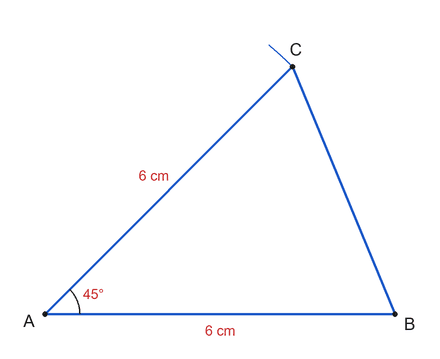
Watch out: The given angle is the VERTEX angle between the equal sides; do not construct it at the base.
Therefore, on measuring, each base angle = 67.5° (67° 30′).
- 323 marks
Question 32
Construct an isosceles Δ ABC such that :
(iii) BC = AB = 5·8 cm and ∠ B = 30°. Measure ∠ A and ∠ C.
Solve with AIWritten solution
Solution:
Concept: When two sides and the angle between them are known, we draw one side, construct the angle at its end, and cut off the other side on the new arm with the compasses. Joining the two free ends completes the triangle. In an isosceles triangle the base angles (opposite the equal sides) are equal, and the angles of a triangle add up to 180°.
Given: BC = 5.8 cm, AB = 5.8 cm and ∠B = 30°; a ruler and a pair of compasses only.
Step 1 — Draw one equal side.
Draw BC = 5.8 cm.
Step 2 — Construct 30° at B.
With B as centre and any convenient radius, draw an arc cutting BC. With that cut point as centre and the same radius, cut the arc again, and draw a ray from B through this second point. B and the two cut points form an equilateral triangle, so the ray makes 60° with BC. Now bisect this 60° angle: with the two cut points as centres and equal radii, draw arcs meeting inside the angle, and draw a ray from B through the meeting point. It makes 60° ÷ 2 = 30° with BC.
Step 3 — Cut off the other equal side.
With B as centre and radius 5.8 cm, cut the new ray at A. Now BC and BA are both 5.8 cm.
Step 4 — Complete the triangle.
Join CA.
Step 5 — Measure and check ∠A and ∠C.
With the protractor, ∠A and ∠C each read 75°. BA = BC, so the angles opposite these sides, ∠C and ∠A, are equal and share the 150° left over from 180°.
Step 6 — Look at the finished figure and check it.
The finished construction is shown below, with the given measurements marked on it.
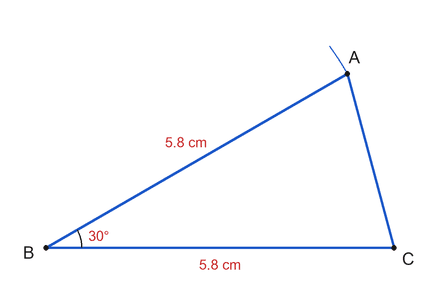
Watch out: The given angle is the VERTEX angle between the equal sides; do not construct it at the base.
Therefore, on measuring, ∠A = 75° and ∠C = 75°.
- 333 marks
Question 33
Construct an equilateral Δ ABC such that :
(i) AB = 5 cm. Draw the perpendicular bisectors of BC and AC. Let P be the point of intersection of these two bisectors. Measure PA, PB and PC.
Solve with AIWritten solution
Solution:
Concept: All three sides of an equilateral triangle are equal, so the third vertex is where arcs of radius equal to the side, drawn from both ends of the base, meet. A point on the perpendicular bisector of a side is equally far from the two ends of that side.
Given: AB = 5 cm; a ruler and a pair of compasses only.
Step 1 — Draw the base.
Draw AB = 5 cm.
Step 2 — Mark C.
With A and B as centres and radius 5 cm, draw arcs meeting at C. Join AC and BC. Every side is 5 cm, so ΔABC is equilateral.
Step 3 — Draw the perpendicular bisector of BC.
With B and C as centres and equal radii (more than half of BC), draw arcs on both sides of BC and join their crossing points. This line meets BC at its mid-point M at right angles; in an equilateral triangle it also passes through A.
Step 4 — Draw the perpendicular bisector of AC.
In the same way, draw the perpendicular bisector of AC, meeting AC at its mid-point N; it passes through B. Let the two bisectors meet at P.
Step 5 — Measure PA, PB and PC.
Join PC and measure the three lengths: each is about 2.9 cm. P is on the perpendicular bisector of BC, so PB = PC; it is on the perpendicular bisector of AC, so PA = PC.
Step 6 — Look at the finished figure and check it.
The finished construction is shown below, with the given measurements marked on it.
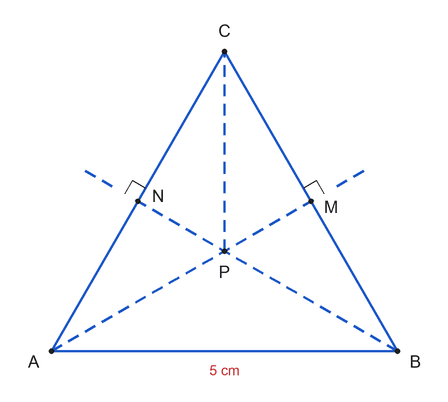
Watch out: The perpendicular bisector cuts the side at its MID-point; check that BM = MC before going on.
Therefore, ΔABC is the required equilateral triangle; P is equally far from all three vertices: PA, PB and PC are each about 2.9 cm.
- 343 marks
Question 34
Construct an equilateral Δ ABC such that :
(ii) Each side is 6 cm.
Solve with AIWritten solution
Solution:
Concept: All three sides of an equilateral triangle are equal, so the third vertex is where arcs of radius equal to the side, drawn from both ends of the base, meet. A point on the perpendicular bisector of a side is equally far from the two ends of that side.
Given: Each side = 6 cm; a ruler and a pair of compasses only.
Step 1 — Draw the base.
Draw AB = 6 cm.
Step 2 — Mark C.
With A and B as centres and radius 6 cm, draw arcs meeting at C. Join AC and BC. Every side is 6 cm, so ΔABC is equilateral.
Step 3 — Draw the perpendicular bisector of BC.
With B and C as centres and equal radii (more than half of BC), draw arcs on both sides of BC and join their crossing points. This line meets BC at its mid-point M at right angles; in an equilateral triangle it also passes through A.
Step 4 — Draw the perpendicular bisector of AC.
In the same way, draw the perpendicular bisector of AC, meeting AC at its mid-point N; it passes through B. Let the two bisectors meet at P.
Step 5 — Measure PA, PB and PC.
Join PC and measure the three lengths: each is about 3.5 cm. P is on the perpendicular bisector of BC, so PB = PC; it is on the perpendicular bisector of AC, so PA = PC.
Step 6 — Look at the finished figure and check it.
The finished construction is shown below, with the given measurements marked on it.
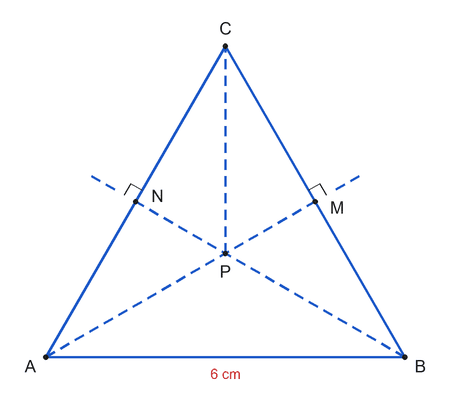
Watch out: The perpendicular bisector cuts the side at its MID-point; check that BM = MC before going on.
Note: Constructing the triangle answers part (ii). As in part (i), the perpendicular bisectors of BC and AC are also drawn, and they meet at P.
Therefore, ΔABC is the required equilateral triangle; P is equally far from all three vertices: PA, PB and PC are each about 3.5 cm.
- 353 marks
Question 35
(i) Construct a Δ ABC such that AB = 6 cm, BC = 4·5 cm and AC = 5·5 cm. Construct a circumcircle of this triangle.
Solve with AIWritten solution
Solution:
Concept: The circumcircle of a triangle passes through all three vertices. Its centre, the circumcentre O, is equally far from the three vertices, so it lies on the perpendicular bisector of every side (each point of a side's perpendicular bisector is equally far from the two ends of that side). Two perpendicular bisectors are enough to find O.
Given: AB = 6 cm, BC = 4.5 cm and AC = 5.5 cm; a ruler and a pair of compasses only.
Step 1 — Construct the triangle.
Draw AB = 6 cm. With A as centre and radius 5.5 cm, and with B as centre and radius 4.5 cm, draw arcs meeting at C. Join AC and BC.
Step 2 — Draw the perpendicular bisector of AB.
With A and B as centres and equal radii (more than half of AB), draw arcs on both sides of AB and join their crossing points. This line meets AB at its mid-point M at right angles.
Step 3 — Draw the perpendicular bisector of BC.
With B and C as centres and equal radii (more than half of BC), draw arcs on both sides of BC and join their crossing points. This line meets BC at its mid-point N at right angles.
Step 4 — Mark the circumcentre.
Let the two perpendicular bisectors meet at O. O is equally far from A and B, and from B and C, so OA, OB and OC are all equal.
Step 5 — Draw the circle.
With O as centre and radius OA, draw a circle. It passes through A, B and C; on measuring, its radius OA is about 3.1 cm.
Step 6 — Look at the finished figure and check it.
The finished construction is shown below, with the given measurements marked on it.
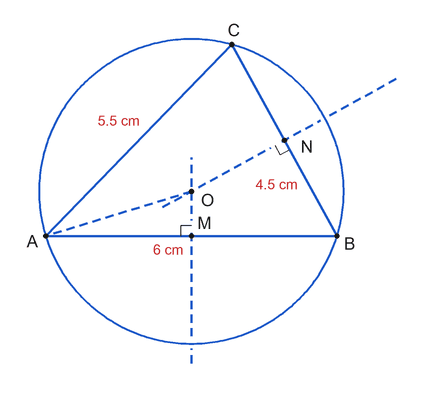
Watch out: The circle's centre is where the perpendicular bisectors of the SIDES meet, not where the angle bisectors meet.
Therefore, the circle through A, B and C is the required circumcircle (radius OA ≈ 3.1 cm).
- 363 marks
Question 36
(ii) Construct an isosceles Δ PQR such that PQ = PR = 6·5 cm and ∠PQR = 75°. Using ruler and compasses only construct a circumcircle to this triangle.
Solve with AIWritten solution
Solution:
Concept: The circumcircle of a triangle passes through all three vertices. Its centre, the circumcentre O, is equally far from the three vertices, so it lies on the perpendicular bisector of every side (each point of a side's perpendicular bisector is equally far from the two ends of that side). Two perpendicular bisectors are enough to find O. In ΔPQR, PQ = PR, so the base angles ∠Q and ∠R are equal (both 75°).
Given: PQ = 6.5 cm, PR = 6.5 cm and ∠PQR = 75°; a ruler and a pair of compasses only.
Step 1 — Construct 75° at Q.
Draw a ray QX. At Q, mark the 60° point and draw the 90° ray as described above (one arc about Q, two equal steps along it, then a bisector). Bisect the angle between the 60° point and the 90° ray, using the 60° point and the point where the arc cuts the 90° ray. The bisector lies half-way between 60° and 90°, so it makes 60° + 15° = 75° with QX.
Step 2 — Mark P.
With Q as centre and radius 6.5 cm, cut the 75° ray at P. So PQ = 6.5 cm.
Step 3 — Mark R.
With P as centre and radius 6.5 cm, cut QX again at R, and join PR. Now PR and PQ are both 6.5 cm, so the base angles PRQ and PQR are equal, each 75°, as required.
Step 4 — Draw the perpendicular bisector of QR.
With Q and R as centres and equal radii (more than half of QR), draw arcs on both sides of QR and join their crossing points. This line meets QR at its mid-point M at right angles.
Step 5 — Draw the perpendicular bisector of PR.
With P and R as centres and equal radii (more than half of PR), draw arcs on both sides of PR and join their crossing points. This line meets PR at its mid-point N at right angles.
Step 6 — Mark the circumcentre.
Let the two perpendicular bisectors meet at O. Then OP, OQ and OR are all equal.
Step 7 — Draw the circle.
With O as centre and radius OR, draw a circle through P, Q and R. On measuring, its radius is about 3.4 cm.
Step 8 — Look at the finished figure and check it.
The finished construction is shown below, with the given measurements marked on it.
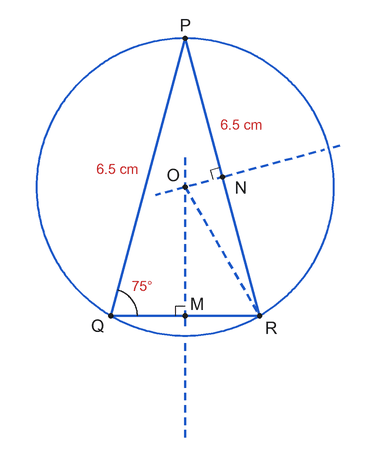
The perpendicular bisector of QR passes through the vertex P, because PQ = PR.
Watch out: The circle with centre P in Step 3 meets the line QX at Q as well; R is the OTHER meeting point.
Therefore, the circle through P, Q and R is the required circumcircle (radius ≈ 3.4 cm).
- 373 marks
Question 37
(iii) Construct an equilateral triangle ABC such that its one side = 5·5 cm. Construct a circumcircle to this triangle.
Solve with AIWritten solution
Solution:
Concept: The circumcircle of a triangle passes through all three vertices. Its centre, the circumcentre O, is equally far from the three vertices, so it lies on the perpendicular bisector of every side (each point of a side's perpendicular bisector is equally far from the two ends of that side). Two perpendicular bisectors are enough to find O.
Given: ΔABC equilateral with each side 5.5 cm; a ruler and a pair of compasses only.
Step 1 — Construct the triangle.
Draw AB = 5.5 cm. With A and B as centres and radius 5.5 cm, draw arcs meeting at C. Join AC and BC.
Step 2 — Draw the perpendicular bisector of AB.
With A and B as centres and equal radii (more than half of AB), draw arcs on both sides of AB and join their crossing points. This line meets AB at its mid-point M at right angles.
Step 3 — Draw the perpendicular bisector of BC.
With B and C as centres and equal radii (more than half of BC), draw arcs on both sides of BC and join their crossing points. This line meets BC at its mid-point N at right angles.
Step 4 — Mark the circumcentre.
Let the two perpendicular bisectors meet at O. Then OA, OB and OC are all equal.
Step 5 — Draw the circle.
With O as centre and radius OA, draw a circle through A, B and C. On measuring, its radius is about 3.2 cm.
Step 6 — Look at the finished figure and check it.
The finished construction is shown below, with the given measurements marked on it.
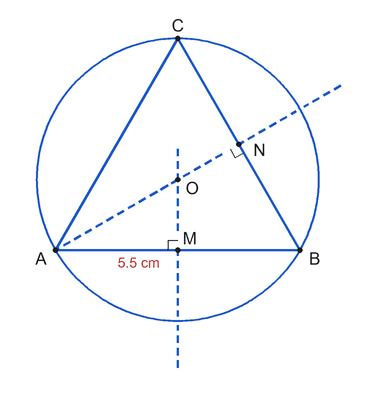
In an equilateral triangle each perpendicular bisector passes through the opposite vertex.
Watch out: The circle's centre is where the perpendicular bisectors of the SIDES meet; keep the radius OA, not the side.
Therefore, the circle through A, B and C is the required circumcircle (radius ≈ 3.2 cm).
- 383 marks
Question 38
(i) Construct a Δ ABC such that AB = 6 cm, BC = 5·6 cm and CA = 6·5 cm. Inscribe a circle to this triangle.
Solve with AIWritten solution
Solution:
Concept: The incircle of a triangle touches all three sides. Its centre, the incentre I, is equally far from the three sides, so it lies on the bisector of every angle (each point of an angle's bisector is equally far from the two arms). Two angle bisectors are enough to find I; the radius is the perpendicular distance from I to a side.
Given: AB = 6 cm, BC = 5.6 cm and CA = 6.5 cm; a ruler and a pair of compasses only.
Step 1 — Construct the triangle.
Draw AB = 6 cm. With A as centre and radius 6.5 cm, and with B as centre and radius 5.6 cm, draw arcs meeting at C. Join AC and BC.
Step 2 — Bisect ∠A and ∠B.
Bisect ∠A and ∠B (arcs about the vertex cutting both arms, then equal arcs from the two cut points). Let the two bisectors meet at I, the incentre.
Step 3 — Drop a perpendicular from I to AB.
With I as centre, draw an arc cutting AB at two points; with these points as centres and equal radii, draw arcs meeting below AB. The line from I through this point meets AB at right angles at S.
Step 4 — Draw the circle.
With I as centre and radius IS, draw a circle. It touches all three sides; on measuring, its radius IS is about 1.7 cm.
Step 5 — Look at the finished figure and check it.
The finished construction is shown below, with the given measurements marked on it.
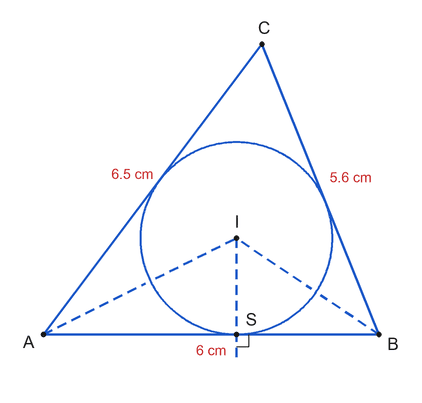
Watch out: The radius is the PERPENDICULAR distance IS, not the distance from I to a vertex.
Therefore, the circle with centre I and radius IS ≈ 1.7 cm is the required incircle; it touches all three sides.
- 393 marks
Question 39
(ii) Construct an isosceles Δ MNP such that base MN = 5·8 cm, base angle MNP = 30°. Construct an incircle to this triangle.
Solve with AIWritten solution
Solution:
Concept: The incircle of a triangle touches all three sides. Its centre, the incentre I, is equally far from the three sides, so it lies on the bisector of every angle (each point of an angle's bisector is equally far from the two arms). Two angle bisectors are enough to find I; the radius is the perpendicular distance from I to a side.
Given: Base MN = 5.8 cm and base angle MNP = 30° (the triangle is isosceles); a ruler and a pair of compasses only.
Step 1 — Draw the base.
Draw MN = 5.8 cm.
Step 2 — Construct the base angles.
At M, with M as centre and any convenient radius, draw an arc cutting MN. With that cut point as centre and the same radius, cut the arc again, and draw a ray from M through this second point. M and the two cut points form an equilateral triangle, so the ray makes 60° with MN. Now bisect this 60° angle: with the two cut points as centres and equal radii, draw arcs meeting inside the angle, and draw a ray from M through the meeting point. It makes 60° ÷ 2 = 30° with MN. On the same side of MN, construct 30° at N in the same way, measured from NM. The two rays meet at P, and MP = NP because the base angles are equal.
Step 3 — Bisect ∠M and ∠N.
Bisect ∠M and ∠N (arcs about the vertex cutting both arms, then equal arcs from the two cut points). Let the two bisectors meet at I, the incentre.
Step 4 — Drop a perpendicular from I to MN.
With I as centre, draw an arc cutting MN at two points; with these points as centres and equal radii, draw arcs meeting below MN. The line from I through this point meets MN at right angles at S.
Step 5 — Draw the circle.
With I as centre and radius IS, draw a circle. It touches all three sides; on measuring, its radius IS is about 0.8 cm.
Step 6 — Look at the finished figure and check it.
The finished construction is shown below, with the given measurements marked on it.

Watch out: The base angles are BOTH 30°: construct 30° at M and at N; the radius is the perpendicular distance IS.
Therefore, the circle with centre I and radius IS ≈ 0.8 cm is the required incircle; it touches all three sides.
- 403 marks
Question 40
(iii) Construct an equilateral Δ DEF whose one side is 5·5 cm. Construct an incircle to this triangle.
Solve with AIWritten solution
Solution:
Concept: The incircle of a triangle touches all three sides. Its centre, the incentre I, is equally far from the three sides, so it lies on the bisector of every angle (each point of an angle's bisector is equally far from the two arms). Two angle bisectors are enough to find I; the radius is the perpendicular distance from I to a side.
Given: ΔDEF equilateral with each side 5.5 cm; a ruler and a pair of compasses only.
Step 1 — Construct the triangle.
Draw DE = 5.5 cm. With D and E as centres and radius 5.5 cm, draw arcs meeting at F. Join DF and EF.
Step 2 — Bisect ∠D and ∠E.
Bisect ∠D and ∠E (arcs about the vertex cutting both arms, then equal arcs from the two cut points). Let the two bisectors meet at I, the incentre.
Step 3 — Drop a perpendicular from I to DE.
With I as centre, draw an arc cutting DE at two points; with these points as centres and equal radii, draw arcs meeting below DE. The line from I through this point meets DE at right angles at S.
Step 4 — Draw the circle.
With I as centre and radius IS, draw a circle. It touches all three sides; on measuring, its radius IS is about 1.6 cm.
Step 5 — Look at the finished figure and check it.
The finished construction is shown below, with the given measurements marked on it.
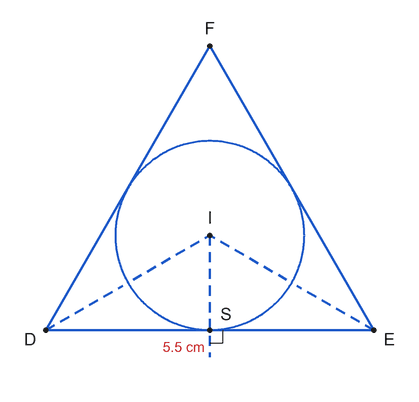
Watch out: The radius is the PERPENDICULAR distance IS, not the distance from I to a vertex.
Therefore, the circle with centre I and radius IS ≈ 1.6 cm is the required incircle; it touches all three sides.
- 413 marks
Question 41
(iv) Construct a Δ PQR such that PQ = 6 cm, ∠QPR = 45° and angle PQR = 60°. Locate its incentre and then draw its incircle.
Solve with AIWritten solution
Solution:
Concept: The incircle of a triangle touches all three sides. Its centre, the incentre I, is equally far from the three sides, so it lies on the bisector of every angle (each point of an angle's bisector is equally far from the two arms). Two angle bisectors are enough to find I; the radius is the perpendicular distance from I to a side.
Given: PQ = 6 cm, ∠QPR = 45° and ∠PQR = 60°; a ruler and a pair of compasses only.
Step 1 — Draw the base.
Draw PQ = 6 cm.
Step 2 — Construct 45° at P.
With P as centre draw an arc cutting PQ; keeping the same radius, step off two equal arcs along it to mark the 60° and the 120° points. With these two points as centres and equal radii, draw arcs meeting outside the first arc, and draw a ray from P through the meeting point. It bisects the angle between 60° and 120°, so it makes 90° with PQ. Now bisect this right angle, using the points where the first arc cuts PQ and the 90° ray. The bisector makes 90° ÷ 2 = 45° with PQ.
Step 3 — Construct 60° at Q.
On the same side of PQ, with Q as centre and any convenient radius, draw an arc cutting QP. With that cut point as centre and the same radius, cut the arc again, and draw a ray from Q through this second point. Q and the two cut points form an equilateral triangle, so the ray makes 60° with QP. The two rays meet at R.
Step 4 — Bisect ∠P and ∠Q.
Bisect ∠P and ∠Q (arcs about the vertex cutting both arms, then equal arcs from the two cut points). Let the two bisectors meet at I, the incentre.
Step 5 — Drop a perpendicular from I to PQ.
With I as centre, draw an arc cutting PQ at two points; with these points as centres and equal radii, draw arcs meeting below PQ. The line from I through this point meets PQ at right angles at S.
Step 6 — Draw the circle.
With I as centre and radius IS, draw a circle. It touches all three sides; on measuring, its radius IS is about 1.4 cm.
Step 7 — Look at the finished figure and check it.
The finished construction is shown below, with the given measurements marked on it.
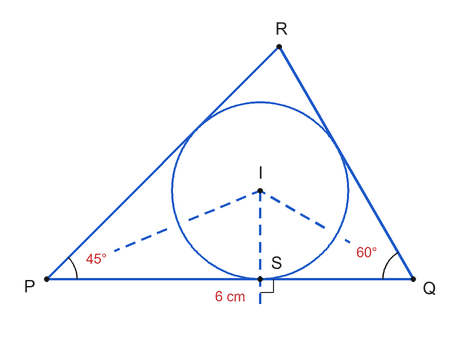
I is the incentre: it lies on the bisectors of ∠P, ∠Q (and ∠R).
Watch out: The radius is the PERPENDICULAR distance IS, not the distance from I to a vertex.
Therefore, the circle with centre I and radius IS ≈ 1.4 cm is the required incircle; it touches all three sides.
- 421 mark
Question 42
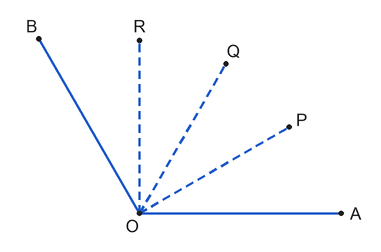
Angle AOB = 120°, is divided into four equal parts. The measure of angle ROA is :
 Solve with AI
Answer
(A) 30°
(B) 60°
(C) 45°
- Correct
(D) 90°
Answer: (D) 90°
Concept: When an angle is divided into equal parts, each part is the whole angle divided by the number of parts, and an angle made of several parts is that many parts added together.
Step 1 — Find one part.
The angle AOB of 120° is cut into four equal parts by OP, OQ and OR.
Step 2 — Count the parts from OA to OR.
Going from OA towards OB, the rays come in the order OP, OQ, OR. So ∠ROA is made of three of the equal parts.
Watch out: Count the parts between OA and OR (three), not the number of rays drawn.
Why the other options are wrong:
- (A) 30°: 30° is one part only; it is ∠POA.
- (B) 60°: 60° is two parts; it is ∠QOA.
- (C) 45°: 45° is not a whole number of 30° parts, so no ray of the figure makes 45° with OA.
Therefore, ∠ROA = 90°, option (D).
- 431 mark
Question 43
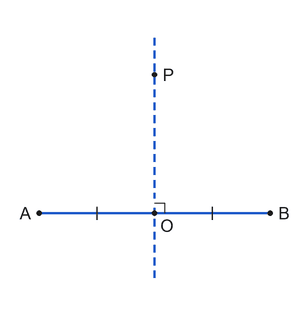
Point P lies on perpendicular bisector of line segment AB. Then :
 Solve with AI
Answer
(A) PA > PB
(B) PA < PB
- Correct
(C) PA = PB
(D) none of these
Answer: (C) PA = PB
Concept: Every point on the perpendicular bisector of a segment is equally far from the two ends of the segment.
Step 1 — Use the property of the perpendicular bisector.
Let the perpendicular bisector meet AB at O. Then AO = OB, ∠POA and ∠POB are both 90°, and PO is common, so ΔPOA ≅ ΔPOB (S.A.S.). Corresponding sides are equal, so PA = PB.
Watch out: This holds for EVERY point of the perpendicular bisector, however far P is from AB.
Why the other options are wrong:
- (A) PA > PB: PA > PB would put P nearer to B than to A, so P would not be on the perpendicular bisector.
- (B) PA < PB: PA < PB would put P nearer to A than to B, so P would not be on the perpendicular bisector.
- (D) none of these: it cannot be 'none of these', because option (C), PA = PB, is true.
Therefore, PA = PB, option (C).
- 441 mark
Question 44
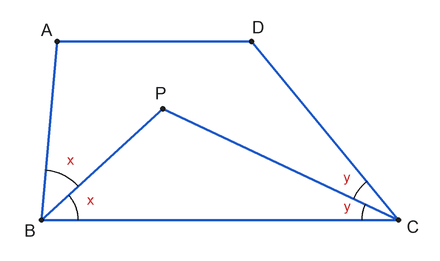
Point P is the point of intersection of the bisectors of angles ABC and DCB, then :
 Solve with AI
Answer
(A) PB = PC
(B) P is equidistant from AB = BC
(C) P is equidistant from BC and CD
- Correct
(D) P is equidistant from AB, BC and CD
Answer: (D) P is equidistant from AB, BC and CD
Concept: Each point on the bisector of an angle is equally far (perpendicular distance) from the two arms of the angle.
Step 1 — Use the bisector of ∠ABC.
P lies on the bisector of ∠ABC, so P is equally far from its arms AB and BC.
Step 2 — Use the bisector of ∠DCB.
P also lies on the bisector of ∠DCB, so P is equally far from its arms BC and CD.
Step 3 — Put the two results together.
Both distances include the distance from P to BC, so all three distances are equal: P is equally far from AB, BC and CD.
Watch out: Being equidistant from a LINE means having equal perpendicular distances to it, not equal lengths PB and PC.
Why the other options are wrong:
- (A): PB = PC would need the angles PBC and PCB to be equal, that is ∠ABC = ∠DCB, which is not given (in the figure the two angles are different).
- (B): as printed it reads 'AB = BC'; meaning 'AB and BC', it is true, but it is only half of the result, because P is also equally far from CD.
- (C) P is equidistant from BC and CD: this is true, but it is also only half of the result; it leaves out AB.
Therefore, P is equidistant from AB, BC and CD, option (D).
- 451 mark
Question 45
In ΔABC, the perpendicular bisectors of sides AB and BC meet at point P, then :
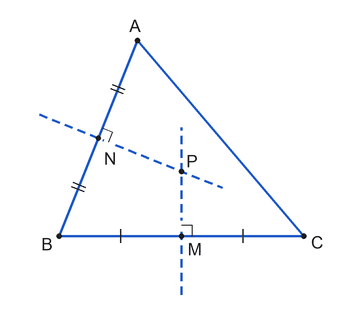 Solve with AI
Answer
(A) PB = PC
(B) PA = PC
- Correct
(C) PA = PB = PC
(D) none of these
Answer: (C) PA, PB and PC are all equal
Concept: Every point on the perpendicular bisector of a segment is equally far from its two ends.
Step 1 — Use the perpendicular bisector of AB.
P lies on it, so P is equally far from A and B: PA = PB.
Step 2 — Use the perpendicular bisector of BC.
P lies on it too, so PB = PC.
Step 3 — Combine the two results.
PA = PB and PB = PC, so all three lengths PA, PB and PC are equal. P is the circumcentre of ΔABC.
Watch out: Each bisector gives only one equality; the full result needs both of them together.
Why the other options are wrong:
- (A): PB = PC is true, but it is only part of the result.
- (B): PA = PC is true (both equal PB), but it is only part of the result.
- (D) none of these: it cannot be 'none of these', because option (C) is true.
Therefore, PA, PB and PC are all equal, option (C).
- 461 mark
Question 46
The number of parallel lines, that can be drawn parallel to a given line from a point outside it, is :
Solve with AIAnswer
(A) 0
- Correct
(B) 1
(C) 2
(D) infinite
Answer: (B) 1
Concept: Through a point outside a given line, exactly one line can be drawn parallel to the given line.
Step 1 — Recall the parallel through an outside point.
Through a point P outside a line AB, the construction of Exercise 22(A) Q8 gives one line parallel to AB. Any other line through P makes a different angle with PQ, so it is not parallel and meets AB somewhere.
Watch out: Lines through P in other directions may look parallel near P, but they all meet AB if produced far enough.
Why the other options are wrong:
- (A) 0: 0 is wrong: the alternate-angle construction always gives one parallel line.
- (C) 2: 2 is wrong: two different lines through P cannot both be parallel to AB, as they would then be parallel to each other although they meet at P.
- (D) infinite: infinite is wrong: there are infinitely many lines through P, but only one of them is parallel to AB.
Therefore, exactly 1 parallel line can be drawn, option (B).
- 471 mark
Question 47
An angle that cannot be constructed using ruler and compass only is :
Solve with AIAnswer
(A) 22·5°
(B) 67·5°
- Correct
(C) 52°
(D) 105°
Answer: (C) 52°
Concept: Ruler-and-compass angles are built from 60° by bisecting, adding and subtracting, starting from the equilateral triangle.
Step 1 — List the angles we can make.
With ruler and compasses we start from 60° (and 120°, 180°), make 90° from them, and then bisect, add or subtract. So every angle we can make is a whole number of small pieces of 15°, or of 15° halved again and again (7.5°, 3.75°, …).
Step 2 — Test each option.
22.5° = 15° + 7.5° (half of 45°); 67.5° = 45° + 22.5°; 105° = 90° + 15°. All three can be constructed.
Step 3 — Test 52°.
52 has no factor 3 or 5, so 52° is never a whole number of 15° pieces, nor of any halved piece (52 × 2, 52 × 4, … are never multiples of 15). So 52° cannot be constructed.
Watch out: An angle being a whole number of degrees does not make it constructible.
Note: In fact a whole-number angle can be constructed with ruler and compasses only when it is a multiple of 3°; 52 is not a multiple of 3.
Why the other options are wrong:
- (A) 22·5°: 22.5° can be constructed: bisect 90° to get 45°, and bisect again.
- (B) 67·5°: 67.5° can be constructed: bisect the angle between 45° and 90°.
- (D) 105°: 105° can be constructed: bisect the angle between 90° and 120°.
Therefore, 52° cannot be constructed with ruler and compasses only, option (C).
- 481 mark
Question 48
The length of line segment PQ = 10 cm. The number of triangles PAQ that can be drawn with AP = 3 cm and AQ = 6 cm is :
Solve with AIAnswer
(A) 1
(B) 2
- Correct
(C) 0
(D) infinite
Answer: (C) 0
Concept: In every triangle, the sum of any two sides is greater than the third side.
Step 1 — Test the three sides.
A triangle can be drawn only if the two shorter sides together are LONGER than the third side. Here the two shorter sides are AP and AQ.
The sum, 9 cm, is less than PQ = 10 cm.
Step 2 — Look at the arcs.
The arc of radius 3 cm about P and the arc of radius 6 cm about Q stay 1 cm apart along PQ, so they never meet. There is no point A.
Watch out: Check the two SHORTER sides against the longest one; 3 + 6 is not more than 10.
Why the other options are wrong:
- (A) 1: 1 triangle would need the arcs to meet at a point, but 3 + 6 < 10.
- (B) 2: 2 triangles (one on each side of PQ) would need the arcs to cross, but they never meet.
- (D) infinite: infinitely many is impossible; even when the arcs do meet, they give at most two points.
Therefore, no triangle can be drawn, option (C) 0.
- 491 mark
Question 49
The length of line segment PQ = 10 cm. The number of triangles APQ (point A is above PQ) that can be drawn with AP = AQ = 10 cm.
Solve with AIAnswer
- Correct
(A) 1
(B) 2
(C) 0
(D) infinite
Answer: (A) 1
Concept: Two circles meet in at most two points; the third vertex of a triangle with two known sides is where the two arcs meet.
Step 1 — Draw the arcs.
A must be 10 cm from P and 10 cm from Q, so it lies on the arc of radius 10 cm about P and on the arc of radius 10 cm about Q.
Step 2 — Count the meeting points.
10 + 10 > 10, so the two arcs meet at exactly two points, one above PQ and one below it. Only the point above PQ is allowed, so there is exactly one position for A.
The triangle APQ is equilateral, with every side 10 cm.
Watch out: Read the condition 'A is above PQ'; it rules out the second meeting point.
Why the other options are wrong:
- (B) 2: 2 counts the meeting point below PQ as well, but A must be above PQ.
- (C) 0: 0 is wrong: the arcs do meet, because 10 + 10 > 10.
- (D) infinite: infinite is wrong: the position of A is fixed by the two arcs.
Therefore, exactly 1 triangle can be drawn, option (A).
What Class 7 Maths Ch 22 covers
The sections of the chapter, in the order the book takes them. Every question above comes from one of these.
- 01Construction of Angles
- 02Some Special Constructions
- 03Construction of Triangles
- 04Construction of an Isosceles Triangle
- 05Construction of an Equilateral Triangle
- 06Construction of a Right Angled Triangle
More ways to study this chapter
The same chapter asked three other ways. Practise it, revise it, and see what the board has set on Ch 22 before.
Class 7 Maths Ch 22 questions students ask
How many questions are there in Class 7 Maths Ch 22?
49 questions. Every one is solved step by step on this page.
Are these Class 7 Maths solutions free?
Yes. Every question and its full working is free to read, with no account needed.
Can I download the Class 7 Maths Ch 22 solutions as a PDF?
There is no PDF to download. Every solution is on this page instead, which means it is searchable, always the current syllabus, and readable on a phone. Use your browser's print option if you want it on paper.