
Question 123 marksMedium
Construct an angle of 75° and then bisect it.
Confirming your payment
Sign up now and get 250 free tokens.
Constructions · Question 12 of 49
Construct an angle of 75° and then bisect it.
Solution:
Concept: Angles are built with compasses from 60°. If the compasses keep one opening, the vertex and two cut points on an arc form an equilateral triangle, so the angle at the vertex is 60°. Bisecting an angle (arcs of equal radius from two points equally far from the vertex) halves it, and two angles side by side add up. Here 75° = 60° + 15°: it lies half-way between 60° and 90°, so we mark 60°, construct 90°, and bisect the angle between them. Then the 75° angle is bisected in the usual way.
Given: The angle to be constructed; a ruler and a pair of compasses only.
Step 1 — Draw the arm.
Draw a ray OA. O will be the vertex of the angle.
Step 2 — Draw the first arc.
With O as centre and any convenient radius, draw a large arc cutting OA at C.
Step 3 — Mark the 60° and 120° points.
With C as centre and the SAME radius, cut the arc at D. Now OC, OD and CD are all equal to the radius, so triangle OCD is equilateral and ∠DOC = 60°. We do not need to join OD. With D as centre and the same radius, cut the arc again at E. This is a second step of 60°, so ∠EOA = 120°.
Step 4 — Construct 90°.
With D and E as centres and the same radius, draw arcs meeting at G. Join OG. Since G is equally far from D and E, and OD = OE, the line OG divides the angle DOE into two equal parts. So ∠GOA = 90°. Draw OG as a dashed line and let it cut the first arc at H.
Step 5 — Construct 75°.
With D and H as centres and the same radius, draw arcs meeting at K. Join OK and produce it to B. Since K is equally far from D and H, and OD = OH, the line OK divides the angle DOH into two equal parts. So ∠AOB = 75° (60° plus half of 30°).
Step 6 — Bisect ∠AOB.
The first arc cuts OA at C and OB at L. With C and L as centres and the same radius, draw arcs meeting at M. Join OM and produce it to N. Since M is equally far from C and L, and OC = OL, the line OM divides the angle COL into two equal parts.
Step 7 — Work out each part.
ON divides the 75° angle into two equal parts.
Step 8 — Look at the finished figure and check it.
The finished construction is shown below, with the given measurements marked on it.
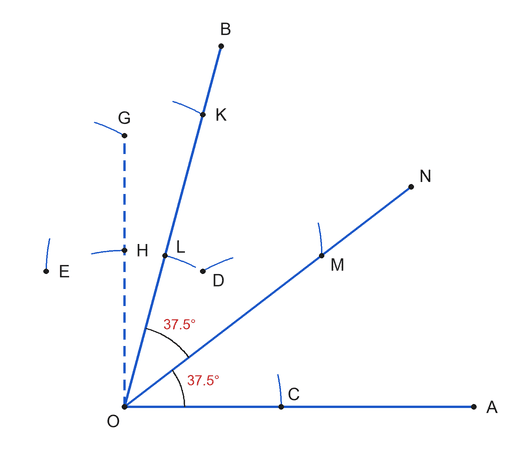
Both parts, ∠AON and ∠NOB, are marked 37.5° in the figure.
Watch out: When bisecting, use the SAME radius from both cut points; unequal arcs meet at a point that is not on the bisector.
Therefore, ON bisects the 75° angle AOB, so ∠AON and ∠NOB are each 37.5°.