
Question 133 marksEasy
Draw a line segment of length 6·4 cm. Draw its perpendicular bisector.
Confirming your payment
Sign up now and get 250 free tokens.
Constructions · Question 13 of 49
Draw a line segment of length 6·4 cm. Draw its perpendicular bisector.
Solution:
Concept: Every point of the perpendicular bisector of AB is equally far from A and B. So two arcs of the same radius drawn from A and from B cross on it, and the line through the two crossing points is the perpendicular bisector.
Given: AB = 6.4 cm; a ruler and a pair of compasses only.
Step 1 — Draw AB.
Draw a line segment AB = 6.4 cm.
Step 2 — Draw equal arcs from A and B.
With A as centre and a radius more than half of AB (more than 3.2 cm), draw arcs above and below AB. With B as centre and the SAME radius, draw arcs cutting them at C and D.
Step 3 — Join CD.
Join CD, cutting AB at P. C and D are each equally far from A and B, so CD is the perpendicular bisector of AB.
Step 4 — Look at the finished figure and check it.
The finished construction is shown below, with the given measurements marked on it.
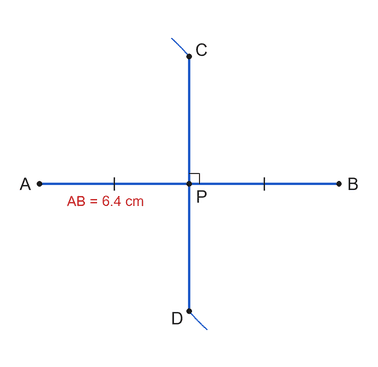
On measuring, AP and PB are each 3.2 cm, and ∠APC = 90°.
Watch out: The radius must be MORE than half of AB; with a smaller radius the arcs from A and B do not meet.
Therefore, CD is the perpendicular bisector of AB: AP and PB are each 3.2 cm, and ∠APC = 90°.