
Question 143 marksEasy
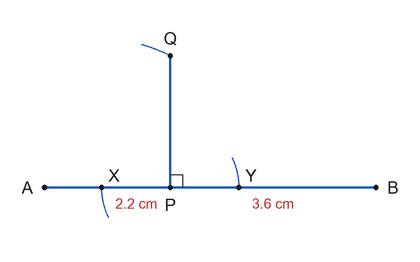
Draw a line segment AB = 5·8 cm. Mark a point P in AB such that PB = 3·6 cm. At P, draw perpendicular to AB.
Confirming your payment
Sign up now and get 250 free tokens.
Constructions · Question 14 of 49
Draw a line segment AB = 5·8 cm. Mark a point P in AB such that PB = 3·6 cm. At P, draw perpendicular to AB.
Solution:
Concept: A perpendicular at a point P on a line is the perpendicular bisector of a short piece XY of the line with P as its mid-point: arcs of equal radius from X and Y meet on the line through P at right angles to AB.
Given: AB = 5.8 cm and PB = 3.6 cm; a ruler and a pair of compasses only.
Step 1 — Draw AB.
Draw a line segment AB = 5.8 cm.
Step 2 — Mark P.
With B as centre and radius 3.6 cm, cut AB at P.
Step 3 — Mark X and Y.
With P as centre and a small radius, draw arcs cutting AB at X and Y, one on each side of P. Then PX = PY.
Step 4 — Draw arcs from X and Y.
With X and Y as centres and a larger equal radius, draw arcs meeting at Q above AB.
Step 5 — Join PQ.
Join PQ. Q is equally far from X and Y, and P is the mid-point of XY, so PQ is perpendicular to AB.
Step 6 — Look at the finished figure and check it.
The finished construction is shown below, with the given measurements marked on it.
Watch out: The arcs from X and Y must have a radius larger than PX, or they will not meet.
Therefore, PQ is the required perpendicular to AB at P, so ∠QPB = 90°.